
Berlin Marathon: An Epic Virtual Tour
 |
| Bradford G. |
The incredible, astonishing, not-to-be-missed sites along the Berlin Marathon Route.
Keep an eye out for these memorable sites and you won’t even notice the 26.2 miles breezing by! But first, here's a brief history lesson:
Fast Facts
- Population - City: 3.7 million (40% of NYC), largest city in Europe.
- Metro: 4.5 million (25% of NYC)
- Size - 340 sq miles (10% larger than NYC!):
- Boroughs – 12!
- Brandenberg – One of 16 Federal German States, it surrounds but does not include Berlin. Berlin is also a Federal State.


Background
Berlin is a young city by European standards. Berlin was long the capital of Prussia, which was an unlikely candidate to become the dominant state in Germany. Sandwiched between Poland and the (mostly) German Holy Roman Empire, Prussia was a marginal state that came to the world’s attention long after more powerful and established German lands like Austria and Bavaria.
Prussia enjoyed a string of highly effective Electors and Princes, especially in the 18th Century. As the State gradually expanded, its leaders were eventually allowed the privilege of using the title of King. They rose through a combination of effective administration and brilliant military campaigns. Wilhelm I united Germany through a series of wars against German and non-German nations, ending with the immensely successful Franco-Prussian War of 1871.


When Germany united under Wilhelm, he took the title Kaiser or Emperor. These Royal leaders dominated Prussia and, later, Germany’s government long after the royal families of Britain, France and other European royals became ceremonial leaders or were eliminated altogether.
After decades on the fault line of East and West, Berlin is one of the culturally compelling cites in the West. And, yet, it’s hard to run through the city without recalling its darkest moments: the World War I famine, the strife of the Weimar Republic, National Socialism, defeat by the USSR and, of course, the Holocaust. It can be said of Berlin and Germany that the people have worked hard to reclaim their place of leadership amongst the peoples of the world and that Berlin, today, is one of the most exciting cities to live, visit and run.
Three recurring motifs in the Marathon are the bridges over the Spree, crossings over the former Berlin Wall and the TV Tower. While the bridges are much smaller than those in New York, most are pretty nonetheless. As for the Wall, the two cities diverged dramatically during the Cold War. The West thrived while the East suffered from the inefficiencies of communism, exploitation by the Soviets and the horrific police state. West Germany has worked full out to heal the wounds, but East and West still have distinct personalities.

Lastly, The Fernsehturm TV Tower was the fourth highest manmade structure in the world when completed by the East German government in 1969. Its soaring height had great meaning in the propaganda war between East and West Berlin. Today, it is a proud symbol for all of Berlin and a centerpoint that can be viewed from points throughout the Marathon.

Good luck on Sunday!

START: Grosser Tiergarten

– The Grand Animal Garden is the largest park in Berlin. At 200 hectares it is 60% the size of Central Park. The park was built in the 1830s, 20 years before Central Park. The Parks and Palaces of Berlin (& Potsdam) are, collectively, one of Berlin’s three UNESCO World Heritage Sites. (NYC has six!) The famous Berlin Zoo is in the southwest corner of the Tiergarten.
Strasse des 17. Juni

– Named to commemorate the1953 East Berlin uprising that spread across East Germany. Originally a protest against lengthened works days, it grew into a people’s revolt against the German Democratic Republic government. After several days it was quashed by Soviet troops.
KM 0.0 Soviet War Memorial

Overlooking the corrals before the start, the Memorial honors the 80,000 Soviet soldiers killed and 280,000 wounded in the April/May 1945 Battle of Berlin. It is rather shocking to see a Soviet memorial in the heart of Germany because the Soviets were vengeful in their assault on Germany’s. But, even most Germans recognize that Nazi Germany was an evil that needed to be expunged. Although the site was in the “British” Zone of Occupation, it was guarded for decades by a Soviet honor guard.
KM .75 Siegessaule

– The 203’ Victory Column was built in 1864 to celebrate Prussia’s victory over Denmark. The Statue of Victoria was added in 1871 to celebrate Prussia’s monumental victories over Austria and France.
KM 2.0 Ernst-Reuter Platz

– Named for Berlin’s post-war mayor, framed by three major universities.
KM3.7 FIRST BRIDGE CROSSING
KM 4.5 Otto Platz & Kleiner Tiergarten

– Small parks astride Turmstrasse U-Bahn Station.
KM 7.0 Spreebogenpark

(left) – First building on right is the modern Bundeskanzleramt (Chancellery), the second building is Paul-Lobe Haus, Berlin’s modern parliamentary offices. In between one can catch a glimpse of the Reichstag.
KM 7.0 Reichstag

– Completed in 1894, the construction of a grand parliamentary building showcased the liberal tolerance of the powerful Kaiser Wilhelm I and the political and administrative genius of his Chancellor, Otto von Bismark. Ironically, its more famous moments were its worst, the Reichstag Fire of 1933 – it remained burnt out through the Nazi era – and the planting of the Soviet Flag above its pediment, marking the unthinkable victory of the USSR over Germany in WWII after 27 million Soviet and 14 million German deaths. The Norman Foster Dome, a sign of transparency and inclusion, capped a complete restoration in 1999.
KM 8.0 Freidrichstadt-Palast

- Originally completed in 1865 for popular shows, circus acts and vaudeville, the theater hall failed commercially several times. It was rebuilt in 1919 and, again, in 1984. It is currently the largest “show palace” in Europe with 1,900 seats.
KM 10.0 Rosa Luxemburg Platz

– “Red Rosa,” the ideological genius and Che Guevara of the German Revolution of 1919. A timeless hero to leftists everywhere, especially the German Democratic Republic, she was captured and killed by “Freikorps” paramilitaries after the failed Spartacist Uprising of January 1919.
KM 12.0 Straus-berger Platz
– Starting point for the East German Uprising of 1953.
KM 13.3 (On right before left turn) – Kit Kat Club

The name says it all. By most accounts, it lives up to its sordid reputation.
KM 13.4 Heinrich-Heine Strasse

– At last, one of Germany’s great literary figures. Heine was famed for his lyric poetry that was set to music by composers such as Schumann and Schubert in the mid-nineteenth century. He ran afoul of German censors and spent his last 25 years writing in Paris.
KM 17.7 Sudstern – Kaiser-Friedrich-Platz

was renamed Pioneer Guard Platz in 1938. In 1947, it was renamed Seven Star Platz for the seven avenues that enter the plaza. The 1897 Church at the South Star is a landmark in the middle of the road can be seen a kilometer ahead.
KM 19.5 Rathaus Kreuzberg

(right) & Riehmers Hofgarten

(left) – The 1951 Rathaus was built as for West Berlin Borough administrative offices. The Bauhaus-influenced building remains remarkably modern. The Hofgarten is a fin-de-siècle apartment building that set new standards for middle-class housing in the late nineteenth century.
KM 22.8 Martin-Luther Strasse

– For the record, Martin Luther King was named for the revolutionary German Protestant cleric, not the other way around. Luther changed the world of Christianity when he posted his Ninety-Five Thesis on the Wittenberg Cathedral door in 1517.
KM 23.0 Rathaus Schoneberg
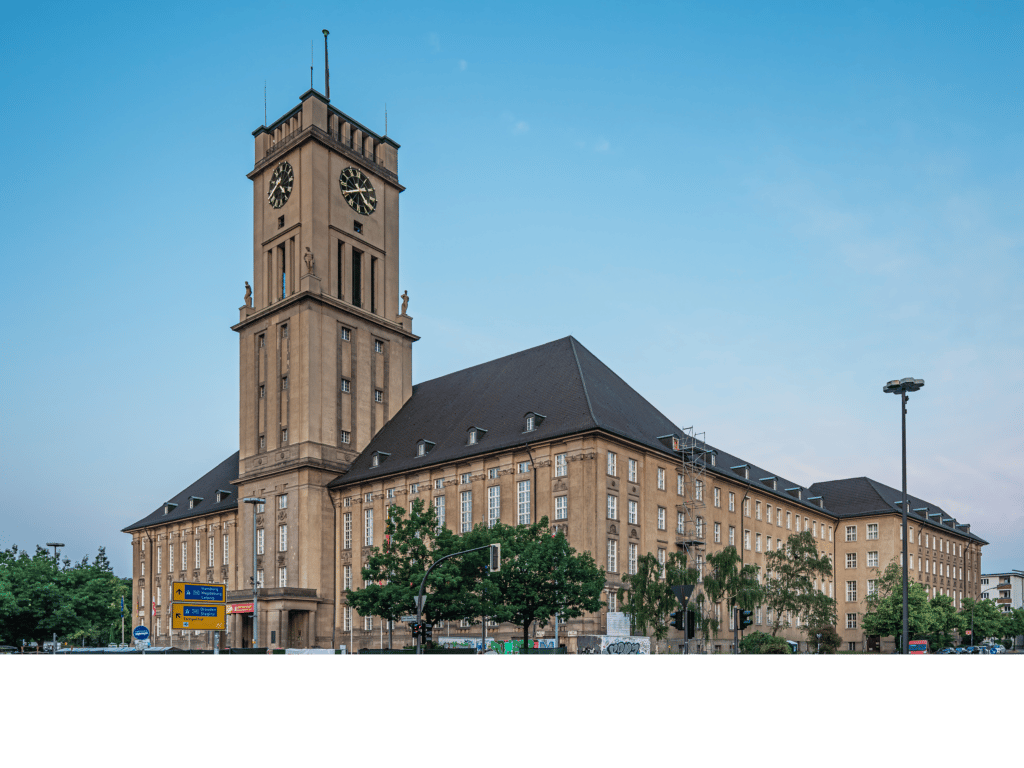
– Completed in 1914, just in time for WWI, the Rathaus has had many functions, but served mainly as a town hall for the Borough of Tempelhof-Schoneberg. The plaza in front has been the scene of many momentous gatherings including one of the most memorable speeches of the Cold War, John F. Kennedy’s Ich bin ein Berliner speech of 1963. The plaza was renamed for Kennedy after his assassination only a few months following his trip to Berlin.
KM 23.2 The radical concrete building on the left is the Catholic Parish of St. Norbert.

KM 24.0 Innsbrucker Platz
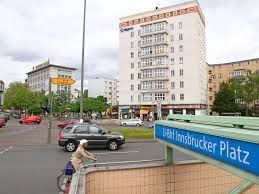
- Located between the old villages of Schöneberg and Steglitz, originally a path between Berlin and Potsdam. It was expanded in 1792 and become the first paved road in Prussia.
The Berlin Ringbahn, which passes through Innsbrucker Platz, was completed in 1877.
KM 31.4 Russisch Orthodoxe Kathedrale / Cathedral of the Resurrection of Christ

– First completed in 1938 with the cooperation and some financing from the Nazi government. A year later Germany and the Soviet Union concluded the astonishing Molotov–Ribbentrop Pact. Less than two years later Germany shocked the world by invading the USSR.
KM 31.6 Rathaus Wilmersdorf

- Wilmersdorf Town Hall was built between 1941 to 1943, making in one of the last non-military buildings constructed in National Socialist Berlin. It was expanded over the years, but now sits vacant as the Borough seeks to lease the space for a profit.
KM 34.7 Kaiser-Wilhelm-Gedächtniskirche

– The Kaiser-Wilhelm Memorial Church was dedicated in 1895, but not completed until 1905. It was severely damaged in a 1944 air raid, but was still in a repairable condition. Church authorities ultimately decided to tear down part of the remaining church to emphasize the futility of war. The original church was effectively replaced by the modern church and tower, which were completed in 1965.
KM 37.8 Kulturforum

– The Cultural Forum is the Lincoln Center of Berlin, with a library and museums thrown in. Built in the 1950s and 1960s when West Berlin was cut off from many of the city’s great cultural centers during the Cold War.
KM 38.1 Potsdamer Platz

KM 40.3 (On right) Deutscher Dom

KM 40.4 (On right) Konzerthaus am Gendarmenmark

KM 40.5 (On right) Franzosscher Dom

KM 41.2 Unter den Linden

– Germany’s Champs Elysees, it was originally a 16th century bridle path for Elector John George of Brandenburg to reach his hunting grounds in today’s Tiergarten. His successor planted the famous lime trees that line the boulevard to make a grand entrance from his palace to the city gates. Many trees were cut down to build the S-Bahn, the rest were cut down for firewood in WWII. The current trees date to the 1950s.
KM 41.9 Brandenburg Gate

– It ain’t over! There’s 200+ meters left to go, but everyone feels victorious racing through this magnificent triumphal arch. This neo-classical masterpiece was completed in 1971 to celebrate Prussia’s role in crushing a popular reform uprising in The Netherlands! The Gate originally marked the start of the road to the capital of Brandenburg, one of 18 gates that surrounded Berlin in the 1700s. Ironically, the first army to march through the current gate was Napoleon’s Grand Armée.
The Gate stood in isolated desolation in the heart of the “no man’s” land between East and West Berlin, a symbol of the deep chasm separating two worlds, east and west, during the Cold War. Today it stands as a beacon of European unity and world-wide reconciliation.
Honorable Mention: Sites NOT included in the Berlin Marathon but that are worth seeing!
Museum Island, Altes Museum, Neues Museum, Alte Nationalgalerie, Bode-Museum, Pergamonmuseum, Berliner Dom (Cathedral), The Berlin Palace (King’s Royal Palace), Memorial to the Murdered Jews of Europe, Berlin Wall Memorial, Berlin Television Tower-the tallest structure in Germany.
-Bradford Goz


