Showing posts with label A* Blogger Richard G. Show all posts

Monday, November 19, 2018

Oktoberfest Run

 The Oktoberfest Run and Festivities
by Papa Bear


Papa Bear
The Germans have a way to mark the coming of the colder weather in mid September, and that is to stay inside and drink beer! It's called "Oktoberfest" and it sounds good to me. 

The best place by far we have found to celebrate Oktoberfest is in that Beer Brewing Borough of Brooklyn, and the best place by far in Brooklyn is Radegast Hall & Biergarten (Check it out) in Williamsburg. And the best way by far to get there is to run. So what are we waiting for? 

In Bavaria, where it all started, they would start in mid September and keep going till the first week of October, so that's what they do at Radegast Hall. 

The Group in Central Park 
Ready to Go
On the first full day of autumn, a group of seven runners from the NY Flyers (Ed, Heidi, Rob, Andrea, Brad, Lora, and Papa Bear) gathered in Central Park and ran some eight miles to said Radegast Hall via the Ed Koch Queensboro Bridge, the Long Island City riverfront parks, the Pulaski Bridge, through Greenpoint and lastly through Williamsburg. And when we finally got to Radegast Hall we met with a few others who had planned to meet us there, and we were all hungry and thirsty. 

Now for a few details: When we met up in Central Park, we divided our party into a faster group and slower group (which I was in) and each group would be more-or-less on their own. Initially Brad and Lora were the faster group and the rest of us, the slower. We also agreed to approach the Ed Koch Queensboro Bridge along First Avenue rather than along York Avenue to avoid the pretty steep hill on York just before the bridge. Here's our route: MapMyRun: Central Park to Radegast Hall (Note the MapMyRun software would not let me show the route within the newly opened section of Hunter's Point South Park), and off we went. 

Manhattan View from the 
LIC River front Park
When  we got to the bridge we spread out quite a bit so we (the slower group) regrouped at the Queens side. There we met Kristel who lives in Greenpoint. Off we went again with Kristel and Andrea moving ahead to become a medium speed group of 2, leaving Ed, Heidi, Rob and myself as slowpokes. That's why all the photos taken in Long Island City were of Ed, Heidi and Rob with myself as photographer.

We moved along though the stunning riverfront parks in Long Island City, first Gantry State Park and then the recently opened southern section, Hunters Point South Park. If you ever find yourself running in this section of Queens, you must take the river route (unless you happen to be running the NYC Marathon). 
At the Newly Opened South Point Park
At the south end of Hunters Point South Park, we got onto 54th and then 53rd Ave to run to the Pulaski Bridge, which we crossed and got onto Franklin Street. Now we were in Brooklyn and here the photos ended until we got to our destination. 

The four of us stayed mostly together on our trek through Greenpoint, but a bit before we got to Williamsburg, Heidi and I stayed behind since I was nursing a sore foot. We soon lost sight of Ed and Rob, but through some mystery, when we got to Radegast Hall, not only had Ed and Rob not yet arrived, but neither had the speedy Brad. 

Around the Table at Radegast Hall
At Radegast Hall: When Heidi and I arrived we met Rebecca, Stephanie (with her two toddlers Keira and Quinn) and Luiza who had planned to meet us at the Biergarten, plus Lora, Kristel and Andrea (joined by her husband Chad) from the faster groups. Finally Ed and Brad (who, it turned out, had done some extra miles) showed up and Ed told us that Rob had to skip the festivities, so now we were all accounted for and nicely filled a table (see photo, above). 

I had planned for us to arrive by 11:30, which, for the most part we did. This was a perfect time for families and folks who didn't plan to drink all afternoon. But the down side was we missed the really wild and wonderful time when the oom-pah brass band is playing and the beer is flowing and it's standing room only. 

There's a nice album of photos of the run and the festivities and I strongly advise you to check it out on the NY Flyers web site: Oktoberfest Run and Festivities Album. 

Ed and I were the last to leave at about 1:30 and to top off a fun day, I took the NYC Ferry home which leaves Williamsburg from North 5th Street.
One of the Gantries as Seen 
from the Ferry
The Ferry is fun and it's cheap and it affords you with yet another close up view of Manhattan's East River shoreline. 

So we'll see you next year when the L train will not be running and we'll all take the Ferry home. 

Gotta run! 


This post was adapted from the report on 
Papa Bear's web page


Read more...

Thursday, November 30, 2017

Runs to Beautiful Places: Fort Tryon Park and The Cloisters

Fort Tryon Park and The Cloisters

by Papa Bear

The Cloisters in Fort Tryon Park in Early Spring

A Run to a Beautiful Place —
  and Four Ways to Get There


 "The Journey is the Destination" ... NO!
For this run "The Destination is the Journey"


Some times I just want to go somewhere. A favorite brunch spot, a beautiful park, or maybe the beach. And being a runner, I say to myself, "Hmm .. I wonder if I could run there?" Often times we think "I'm training for a marathon; my schedule says I gotta do 14 miles this weekend." That's called focusing on the mileage. That's not me. I would more likely say "How can I run to that place, get 14 miles (more-or-less) of running in, find a nice place to eat afterwards, and have easy subway access to get home?" 

That's what these "Runs to Beautiful Places" posts are all about. It's the destination that comes first, not getting there. Forget about your "life's journey" (and don't even think about your "life's destination"!) This is about getting somewhere you want to be.

Fort Tryon Park is definitely one of those places. I've written many reports on these pages about going through this place to get somewhere else, but this time I'd like to talk about just getting there, spending time enjoying the beauty of the place and its setting, and perhaps taking in a visit to The Cloisters, one of the most unique and marvelous museums in the world.

So how do we get there? Let me count the ways ... well, in my many reports of long runs I counted four different ways to get there with varying distances — I know you haven't forgotten that factor — of between about 7+ and 9 miles. This is perfect for early marathon training. If you want to do more miles, tack on some at the beginning or throw in a park loop or two (see below). And if you're torn between one route and another, no problem, go part way on one route and the rest on another. For consistency they all start at Carl Schurz Park, but of course that's up to you. Start where ever you live and join your preferred route somewhere along the way.

A note on the photos: most of the photos were taken on visits we made in March of 2012 and in June of 2013. So you will notice some shots show spring foliage with fruit trees in bloom, and some show the dense foliage and the flowers of summer. There is also a December 2016 album which shows that Winter is no obstacle to beauty.

The Map


I like maps I almost always put them in my reports, often using the USATF running route maps, or sometimes using my own custom maps. I've generated maps for hiking, for mountain climbing, for locating survey markers and lately for runs.

This one is a bit different in that it shows four different routes on the same map. They are color coded: red, blue, green and purple. They are described from west to east. Let's call them "the west side route", "the parks route", "the streets route" and "the South Bronx route".

Note: as if there were not enough confusion on the map, the part from Carl Schurz to Central Park is common to three routes ("west side", "the streets" and "the parks"), and the part that goes up to the north end of Central Park is common to two routes ("the streets" and "the parks"). The route colors sort of mush together on these sections, sorry.

Look at the map for a minute and you'll "get" it. They all start in Carl Schurz Park and the first 3 head over to Central Park before splitting apart and heading their own way. The 4th route heads up the river and over to the Bronx for a bit before returning back to Manhattan. I've marked most of the parks and other interesting points of interest. Although we are focusing on the destination here, we should, of course, observe and enjoy the places we are running through.

Four Routes to Fort Tryon Park


The Routes


Mileage: the mileage listed is approximate. Use your Garmin or iPhone if you need to know it to .1 miles. For the first three routes, if you want extra mileage, I suggest adding one of more reservoir loops (on the bridle path) which is 1.7 miles per loop, or one or more inner loops of the park roads at 4 miles each.

Details: the report links included for each run have detailed directions. These can be quite valuable since the directions here are cursory (remember, this is about the destination, not the journey).
 
  • The Little Red Lighthouse

    The west side route (red line, about 8½ miles): Pretty easy to follow. Go across the park to the west side on the bridle path at the south end of the reservoir and continue west on 86th Street to Riverside Park. Follow the path along the river all the way up to the GWB. Then take the path up to the highway, cross the pedestrian bridge, and cross on 181st Street to Pinehurst Avenue (which starts with stairs). Then it's straight up on Pinehurst to Fort Tryon Park. Details (many, many details) can be found in The West Side Run
     
  • Highbridge Park

    The parks route (blue line, about 9 miles): This route goes up through a series of parks north of Manhattan which I call the "Escarpment" Parks" (5 of them, not counting our destination). In each park you follow along either the top or bottom of a steep cliff (in two you go from the top TO the bottom). Originally I devised this route for the legendary Carl Schurz to Wave Hill Run, but a simpler version can be found Run to the Tip of Manhattan. It's easy, but hard to explain in a few words. I suggest reading one or both of these reports.
     
  • Harriet Tubman /
    St. Nicholas Ave.


    The streets route (green line, about 8 miles): the easiest one of all. Just take St. Nicholas Ave. from the park all the way up to 168th Street. Then follow Broadway up to the GWB bus station, go over to Fort Washington Ave., and follow that up to Fort Tryon Park. Want more detail? Follow directions given Run to the Tip of Manhattan.
     
  • The South Bronx
    The South Bronx route (purple, line, about 9 miles): A route you have probably never considered. Don't worry, the South Bronx is fine. From Carl Schurz Park, follow the river up to 123rd Street, cross the pedestrian bridge and go over to First Avenue. Cross the Willetts Avenue Bridge and zig-zag up to 144th Street. Go west on 144th Street across the tracks and on to the Grand Councourse. Follow this up to 161st Street with a side trip through Franz Sigel Park. Go west on 161st and cross the Macombs Dam Bridge to Manhattan. Take the highway ramp down from 155th Street to the Harlem River and go north to Dyckman Street. Go west on Dyckman, cross Broadway, and follow Riverside Drive to the north entrance to Fort Tryon Park. You will have to run up a steep hill to get to the main part of the park, sorry. It's easier than it sounds, just zoom the map in and you'll get it. See the report To Wave Hill via the South Bronx for lots of details. Note: the link takes you to a report of a run to Wave Hill which is in the Bronx. Since we are talking about Fort Tryon Park here, which is in Manhattan, you need to stop there and skip the last segment of that report. Save the Bronx run for another day.

The Destination: Fort Tryon Park and the Cloisters


Now for the best part! Fort Tryon Park is one of the gems of Manhattan or for that matter, of the
Fort Tryon Park Heather Gardens
whole of New York City. The Park comprises 66.6 acres and sits atop some of the highest public land in Manhattan, providing views of the Hudson River and the New Jersey Palisades.

In 1917, John D. Rockefeller purchased the land and hired Frederick Law Olmsted Jr. to design a manicured landscape to preserve the valuable views as a city park for all to enjoy. The modern Fort Tryon Park opened in 1935, after years of transformation and is the only northern Manhattan park with a design similar to that of Riverside or Central Park. The Cloisters, a branch of the New York Metropolitan Museum of Art, opened within the park in 1938, and houses the museum’s medieval collection. Although the majority of the park remains true to its Olmstedian design, the slopes leading up to the park are largely naturally occurring second growth forest communities.

Go into the park and head along the walkway (not the road). This is the garden section and in the spring it's covered with heather and sedge and surrounded by fruit trees in bloom. When we got there one day last spring, we arrived just as they were doing the "trimming of the sedge", a once-a-year ritual attended by local school children. Who knew you had to trim sedge?

Next, head for the flag pole, which is on a promontory surrounded by a stone rampart with stairs up to the top. This point, one of the highest in Manhattan, has the most fantastic views in all of New York City. Unobstructed 360° views of the GWB, The Palisades, up towards Westchester, and east over much of the Bronx. If you visit this park, you must climb the steps to this point.

Keep heading north on the various pathways and you'll next see the Cloisters, a branch of the Metropolitan Museum. It's a treasure trove of medieval art and architecture. Coming off the flag pole pinnacle, there is an open lawn surrounded by mature trees. You can certainly see the hand of Olmstead in this area.

Spring and Summer Visit to Fort Tryon Park
Click for Photo Album

 You Can Run There in the Winter Too

We've also been there in the Winter. Last December (2016) Susan S. and I ran up there on a very
Beautiful Browns and Golds
cold day. We followed the "Streets Route" from the Engineers' Gate in Central Park as outlined above with a few small variations (see the report here: A Cold Run to the Cloisters). I took no photos at all along the route — it was too cold — but I took a few inside the park and quite a few inside the cloisters. Notice the lack of foliage on the deciduous trees. But the brown and gold of the leaf litter and flower stalks have a special winter beauty of their own. The next photo album gives a really good sense of the grounds and what you'll see in this unique museum of medieval art. 

 
A Winter Visit to Fort Tryon Park
Click for Photo Album
Here's a few links on Fort Tryon Park: Parks Department and Wikipedia.

The Cloisters


The Cloisters  in Spring
The Cloisters in Winter
The Cloisters really deserves a separate dedicated visit, since you could spend all day there. But we have occasionally made a visit in a tired, post-run state, and it's worth it. It's part of the Metropolitan Museum of Art and even though it has a suggested entrance fee, it's technically under a pay-what-you-want policy, so you can pay a dollar if you're cheap. I'm a member so I'm good.
 
What's it all about? It's basically built with fragments of ruined medieval churches with authentic art and appointments. The rooms give you an idea of the original settings for the art. The most memorable thing to me is the series of large tapestries made around 1500 AD which tell the mysterious and symbolic story of "The Hunt of The Unicorn".

Visiting The Cloisters will certainly put you in a world far removed from 21st century New York City. And there is a beautiful interior garden which is a perfect place for silent contemplation. I hesitate to say where to go and what to look at. Both photo albums give a good sense of what you'll see, better than I could discribe. What's that saying? "One picture is worth a thousand words." Especially true in this case.

Here's a good link giving some details: The Cloisters.

Brunch?


There are couple of favorites of mine both to the north (Indian Road Café), and to the south (Coogans), but they are both a mile or more distant. I would suggest you give the New Leaf Restaurant your consideration. It's a little pricey, but to me it's a special treat commensurate with the beauty of the park. It's in the park, just south of the flag pole, down the slope to the east of the gardens. And maybe bring a change of clothes or a clean shirt in your pack. There is a bathroom in the basement of the restaurant, accessible from the road.
 

Show me the way to go home


Across the street from the park entrance you can get an M4 or M98 bus, or take the elevator down to the A-Train. What's not to like about this place?

This post is adapted from the report of the same name on Papa Bear's Beyond Central Park web site.


Read more...

Friday, April 28, 2017

A Trip to Washington DC for the Cherry Blossom 10 Miler (April 1st to 3rd, 2017)


by Papa Bear


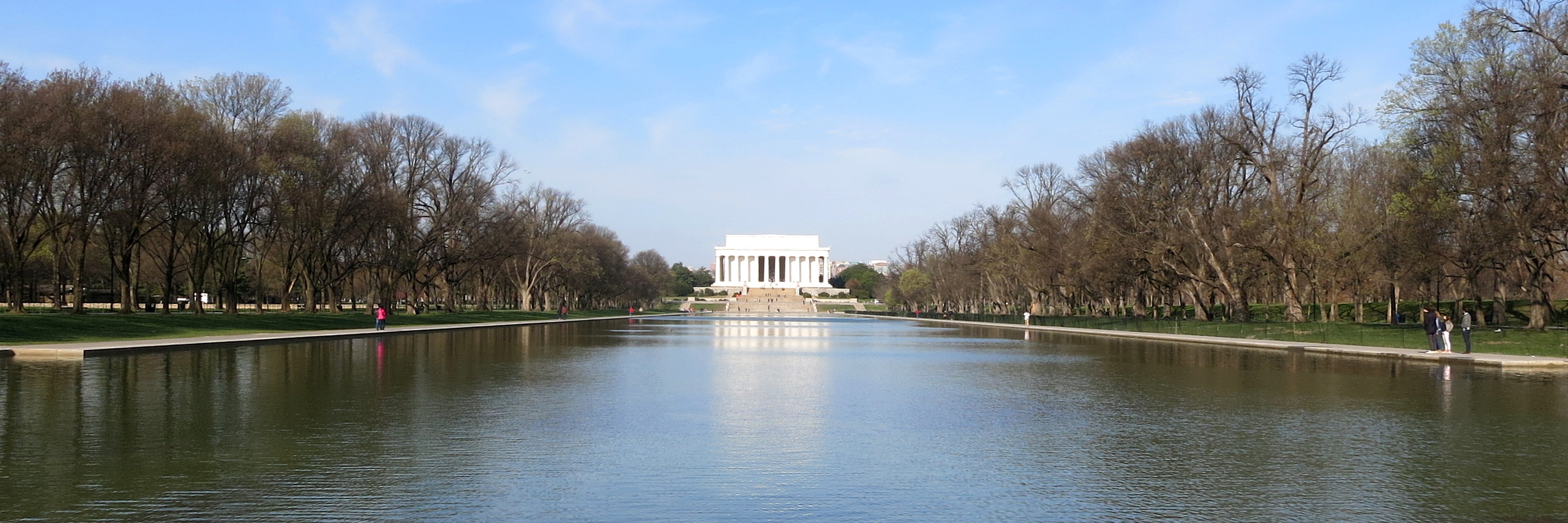
The Lincoln Memorial across the Reflecting Pool

Back to 1990

My 
first Cherry Blossom 10 Miler was in 1990 when there were a couple of thousand runners and a very informal organization. I don't remember if the starter said "go" or there was a horn, but it was typical of the good old days. This year there were over 17,000 participants and like a lot of races nowadays it was highly sponsored, well marketed and well organized. There were a number of corrals (something unheard of in 1990), and I think the announcer said that my corral had it's own sponsor — "The Orange Corral, sponsored by so-and-so, will be starting in two minutes". But you know what? I loved the race in 1990, and I still love it today although my pace has slowed about 3 minutes a mile. Ouch!

For the last several years my friend and running partner Susan and I had registered as a "group" so in the lottery we would both get in or both lose out. You have to apply for the lottery in December, so you do it on "spec", hoping you'll be ready and able to run the race. I was a bit under-trained when April came around, but Susan had sustained a knee injury about 3 weeks before. But she soldiered on and figured she'd just do the best she could.

Besides, we don't go only for the race — there's lots of sights and scenes in Washington, including good (but affordable) restaurants, museums, historic sights and even the ballet at the Kennedy Center (yes we went: The Little Mermaid, sad but beautifully done). And we always try to do it on the cheap: bolt Bus ($35 round Trip) and staying in the HI Washington D.C. Hostel ($43 per night).

Saturday

We took the 7:30 Bolt Bus and got to Washington around noon. We then took the "DC Circulator" bus to the Hostel ($1), dropped off our stuff and tried (but failed) to get dinner reservations at Capitol City Brewing, a favorite of ours (we tried again on Sunday night and got in with no waiting — everyone had left town!). So we walked to pick up our race packets at the National Building Museum (a beautiful structure inside and out) which was the race head quarters.

From there we walked down to the Mall and checked out the United States Botanic Garden, new to me and quite lovely — but not a match for our own NY Botanical Garden in the Bronx.

We then trudged back up the hill to one our favorite restaurants: Busboys and Poets, a must for you if you should visit Washington. To quote from their website: "The name Busboys and Poets refers to American poet Langston Hughes, who worked as a busboy at the Wardman Park Hotel in the 1920s, prior to gaining recognition as a poet." It is more than an eating place, it is a performance space and venue for many progressive happenings and is devoted the ideal of an egalitarian and inclusive community.

So, we had a long bus ride from New York, did quite a bit of walking, picked up our race packets, visited the Botanic Garden and enjoyed an excellent meal at a unique restaurant — AND — we had a 10 Mile Race to run early the next morning. The best thing to do would be to get back to the Hostel and to retire early to bed, yes?

No! Susan had bought tickets to a ballet (The Little Mermaid) at the Kennedy Center, way out on the west side of town and it started at 8:00 that night and we didn't know how to get there. So we got back to the Hostel, changed into our going-to-the-Kennedy-Center clothes and waited for a bus. It didn't come for 10 - 15 minutes, so we gave up and took a cab. Hey it's like a vacation, it's OK to take a cab!
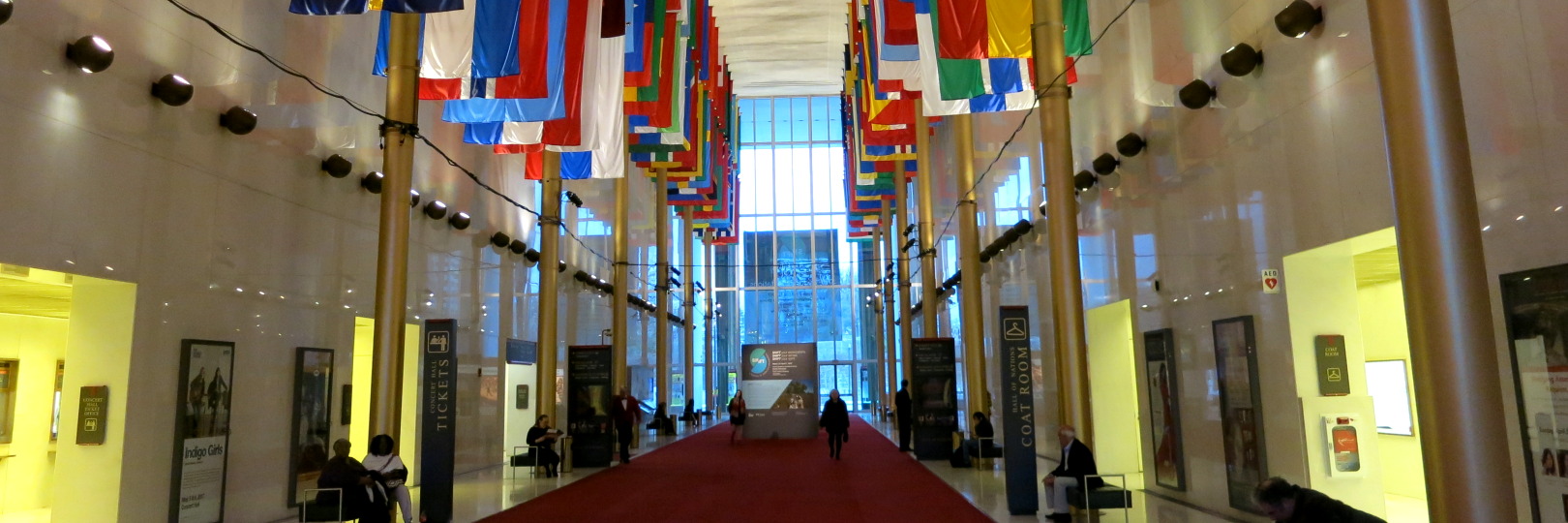
The Kennedy Center

We greatly enjoyed the whole experience, even though it's a dark tale. It was brilliantly danced by the troupe and although I thought I would fall asleep and was tempted to go home (and to bed) at the intermission, we stayed till the end and enjoyed the beautiful ending. We "ran today's race" from New York to the Kennedy Center and finished very satisfied (and took another cab home). Would we could do it again Sunday in the 10 miler!

Sunday Morning
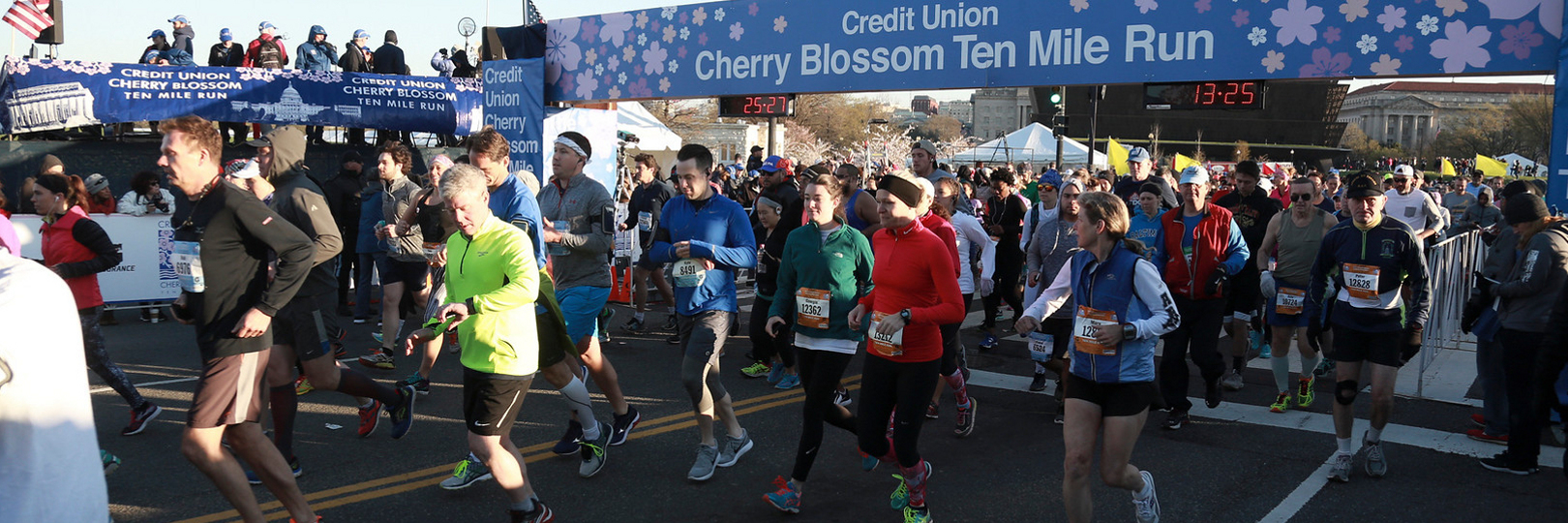
 
The Start of the Orange Corral

 Cherry Blossom
10 Miler
Mile Split
1 10:41
2 10:21
3 10:21
4 10:21
5 10:25
6 10:22
7 10:17
8 10:20
9 10:08
10 9:59
Finish 1:43:15
Pace 10:20

I met Susan about 6:45 in the kitchen/dining room. Breakfast was not officially served till 7:00 but we could at least get some coffee which is available at all hours. John, the manager of the kitchen, was setting up. We had chatted with him on Saturday and he knew us from previous years and had actually fetched some food for us (an apple and a muffin).

The elites didn't start till 7:30, so we back-of-the packers had plenty of time. My corral didn't start till about 7:45 and Susan planned to get at the very back of the pack, so her cut off to get down to the race start was 8:00 or something like that. I said good bye and started out about 7:20 and made it down in plenty of time to squeeze into the Orange corral. This group was expected to run somewhere in the 10 to 11 minutes per mile range so I was in the right place. (I looked up my 1990 race results and I had run that race at a 7:25 pace. Wow! What a difference 27 years can make!) I knew I was under-trained but I wanted to do as well as I could anyway. I recalled the Cherry Tree race in Prospect Park in mid February where I really died in the last 3 miles, and hoped that that would not happen here. Besides this was a flat course as opposed to Prospect Park which is very far from flat.
I got a good start (the wave starts work well) and ran cautiously the first mile and then picked it up a bit. It turns out my first mile was my slowest, no doubt due to the crowds, but my last mile was the fastest. Check the splits in the table on the right.

Two things surprised me in a very positive way: I never felt like I was running out of steam as the miles went by, and my right forefoot never felt numb. This latter was very welcome since I have lived with this problem for over 5 years and had learned just to put up with it.

The course was lovely, but the few cherry blossoms we encountered looked past their prime. The weather also cooperated with temperatures in the 40°s at the start and in the 50°s at the finish. And there were no howling winds like last year. And although we tried to forget politics for the weekend in this "seat of the government", we all got a chuckle from one hand lettered sign: "You run better than the government".

I had some strength left the last mile or two, and pushed as much as I could and they were the fastest two miles for the race. The finish line photo on the right certainly shows this.

Cherry Blossom 10 Miler
Split Pace
1st Third 34:51 10:27
2nd Third 34:33 10:22
3rd Third 33:53 10:10
Finish 1:43:15 10:20
Cherry Tree 10 Miler
Split Pace
1st Third 32:59 9:53
2nd Third 34:15 10:20
3rd Third 36:13 10:53
Finish 1:43:28 10:21
Well, how did I do compared to the Prospect Park race? The two tables (on the left, this race, on the right, that race) tell the story very well. Although the finishing times were close, the splits show a dramatically different story: in the Prospect Park race I had strongly positive splits (getting slower: 9:53, 10:20, 10:53) and this race I had negative splits (getting faster: 10:27, 10:22, 10:20). I was very happy with that and it encouraged me to train a bit more, especially by doing longer weekly runs to get some increased endurance and further improve my times.
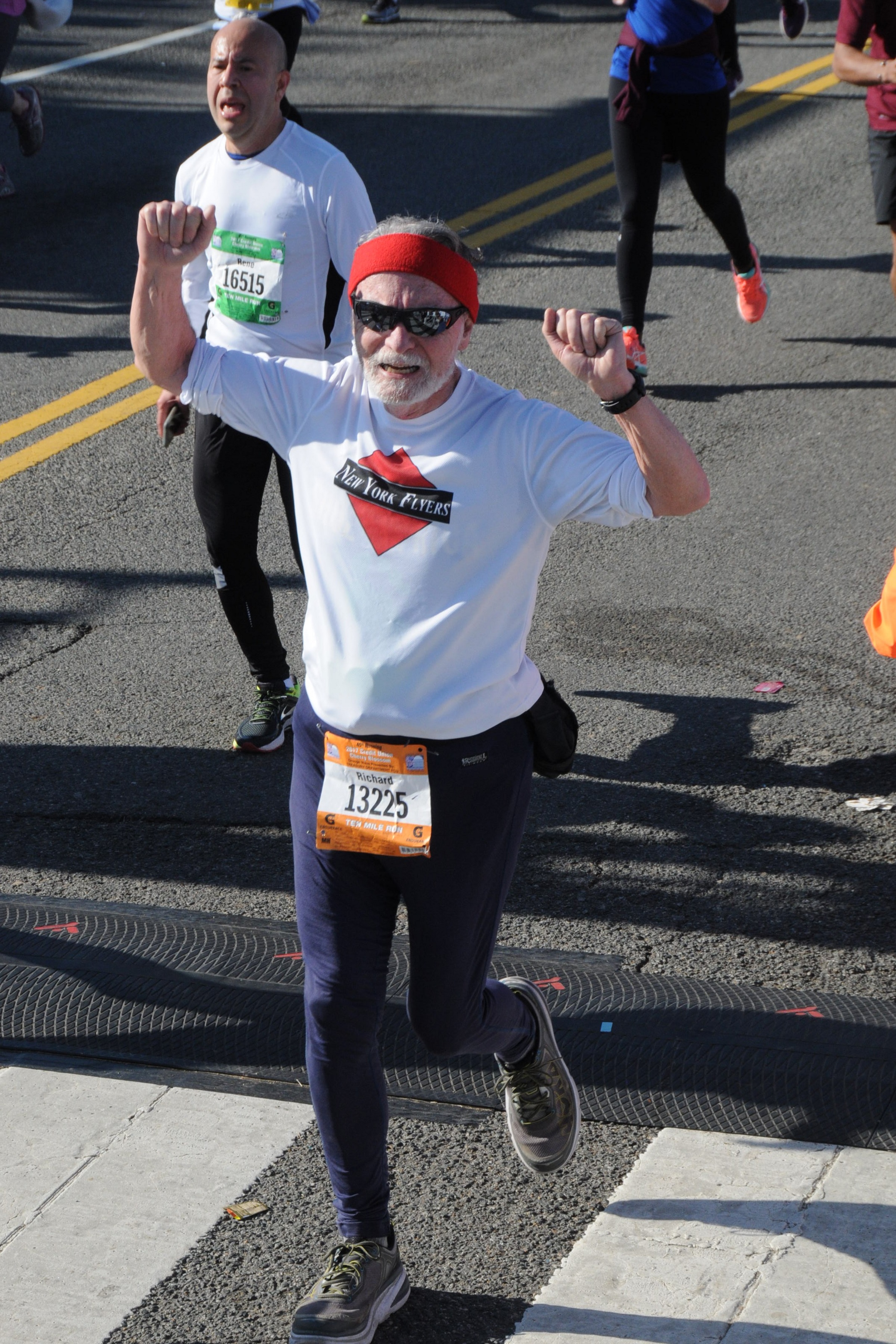
Papa Bear at the Finish
I climbed the hill back to the Hostel and after cleaning up and recovering a bit, I met up with Susan and we had a bite to eat and planned for our afternoon: we would visit the new African American Museum.

Sunday Afternoon


The new African American Museum in Washington opened in late September 2016. The attendance was so overwhelming that they had to introduce "timed entry passes" which you could get on-line for future dates. At the time when we registered for the Cherry Blossom and received our lottery acceptances (December 12th), they were "sold out" for every day till March and their web site said they would not be opening it up for April, May and June till "to be announced".

Susan and I agreed we should really try for these passes and decided the afternoon of race day would be the best. So we checked the web site every day and finally in late December they announced the passes would be available on-line starting on January 4th. So we both logged in at 9:00 on January 4th and agreed who ever got through first would text the other. We figured since this was the first weekend of the new batch of timed entries and the weekend of the Cherry Blossom Festival to boot, that the demand would be high. Well, I won our own little lottery and I got two passes for us for 2:45 on April 2nd, race day.

Now, back to race day, we were a little "itchy" when afternoon came around so we went down to check out the National Gallery (just a bit east of the African American Museum) first. There were interesting archival photos and period furniture but we managed to lose each other and cell reception was poor. Well, all's well that ends well, and we did find each other and walked along the mall in the warm sunny April afternoon and got to our destination about 15 minutes early. A line was already forming up for the next "wave start", so I asked a security guard if we should get in the line (thinking it might be the 2:30 wave) but she just let us skip the line and go right in. And there we were.
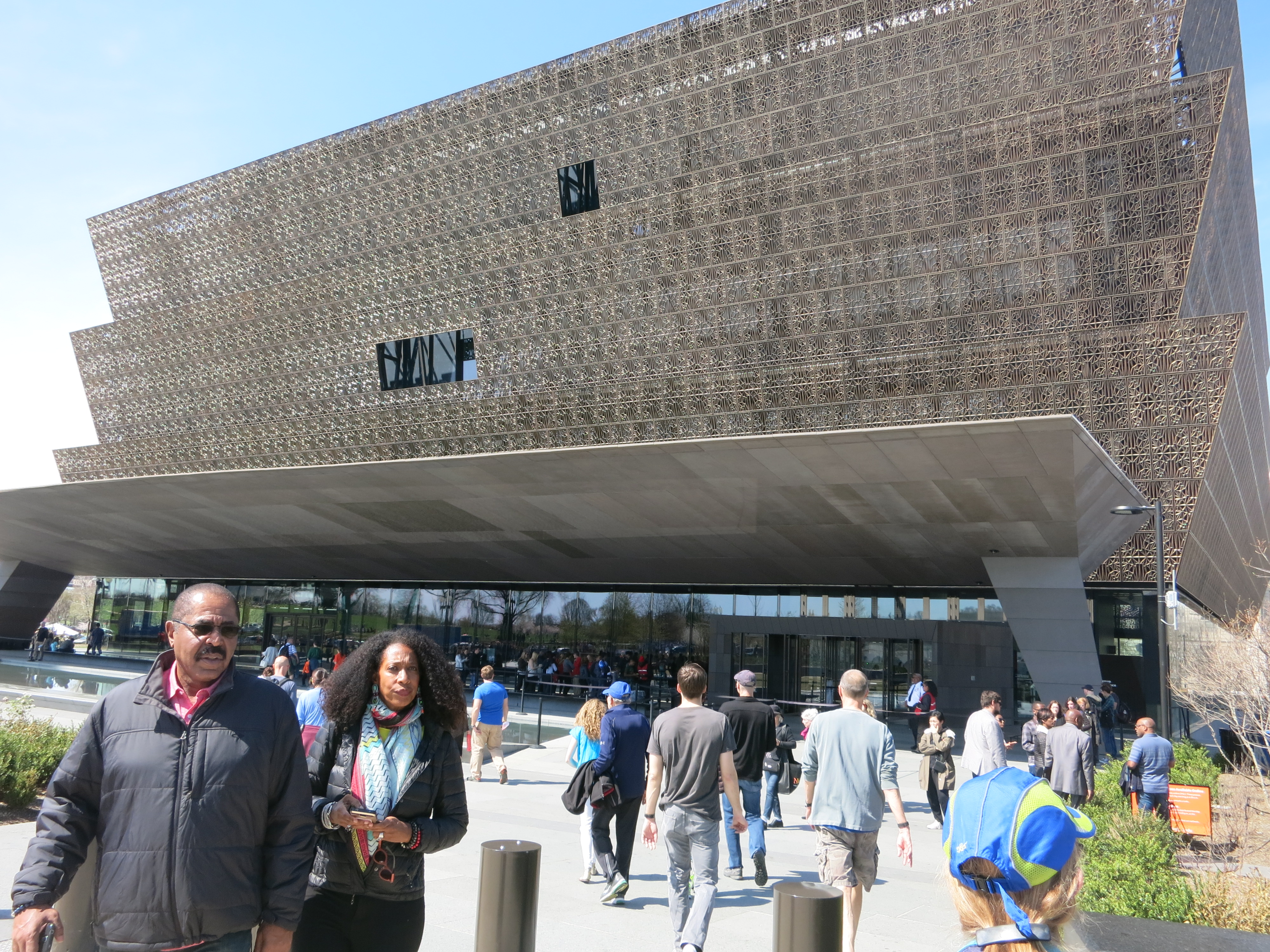
The African American Museum

The building which is shown above, although it appears to be rather large, is actually much larger. When we went in and looked at the guide pamphlet, we saw that there were three floors below ground level showing the history of the Black experience in North America from the beginning of the slave trade in the 16th century up to the present. And the three floors above showed African American art and artifice. So we figured we'd take the elevator down and check out the history first, and then explore the upper floors.

Well, it didn't work out that way. First off there were large crowds everywhere and we took our time and looked carefully at everything. We knew we may not make it back here for some time. As for the narrative shown in the history floors, which included historical articles, quotations from early leaders, both African and American, they showed every detail of that terrible period.

The narrative took us step by painful step from the start of the slave trade in the mid 16th century, where European traders found there was more profit in shipping a human cargo of slaves to North and South America than engaging in the trading of goods, though the colonization of the New World and the establishment of the U.S. — which at the time was highly dependent on slave labor in both the southern and northern states — through numerous slave uprising, which were brutally suppressed, through the abolitionists movement in the 18th and 19th centuries which fostered the "Underground Railroad", through the Civil War, the "Jim Crow" period, the "Great Migration", the Civil Rights Act and and up though the present day.

I'm sorry but I can't verbalize all I saw — it was just too powerful and moving. We were shaken. When we got back to the ground floor it was almost 5:00 and we had to leave. We vowed we would come back to visit what we had missed. If you go, try to pick a time when there would be less crowds and allow plenty of time. You may need two visits since you'll need time to digest what you've seen, which I'm sill doing.

Monday


We had tickets for the 12:00 noon Bolt bus back to New York City. So over breakfast, we figured we needed to leave the Hostel by 11:00 or at the latest 11:15 to make the bus. That would give us a couple of hours to check out the west end of the mall, in particular the Vietnam War Memorial, the Lincoln Memorial and some adjacent areas. Monday was by far the nicest day, weather-wise, so we both went up, packed our stuff up and met in the lobby for a nice Sunday morning walk.
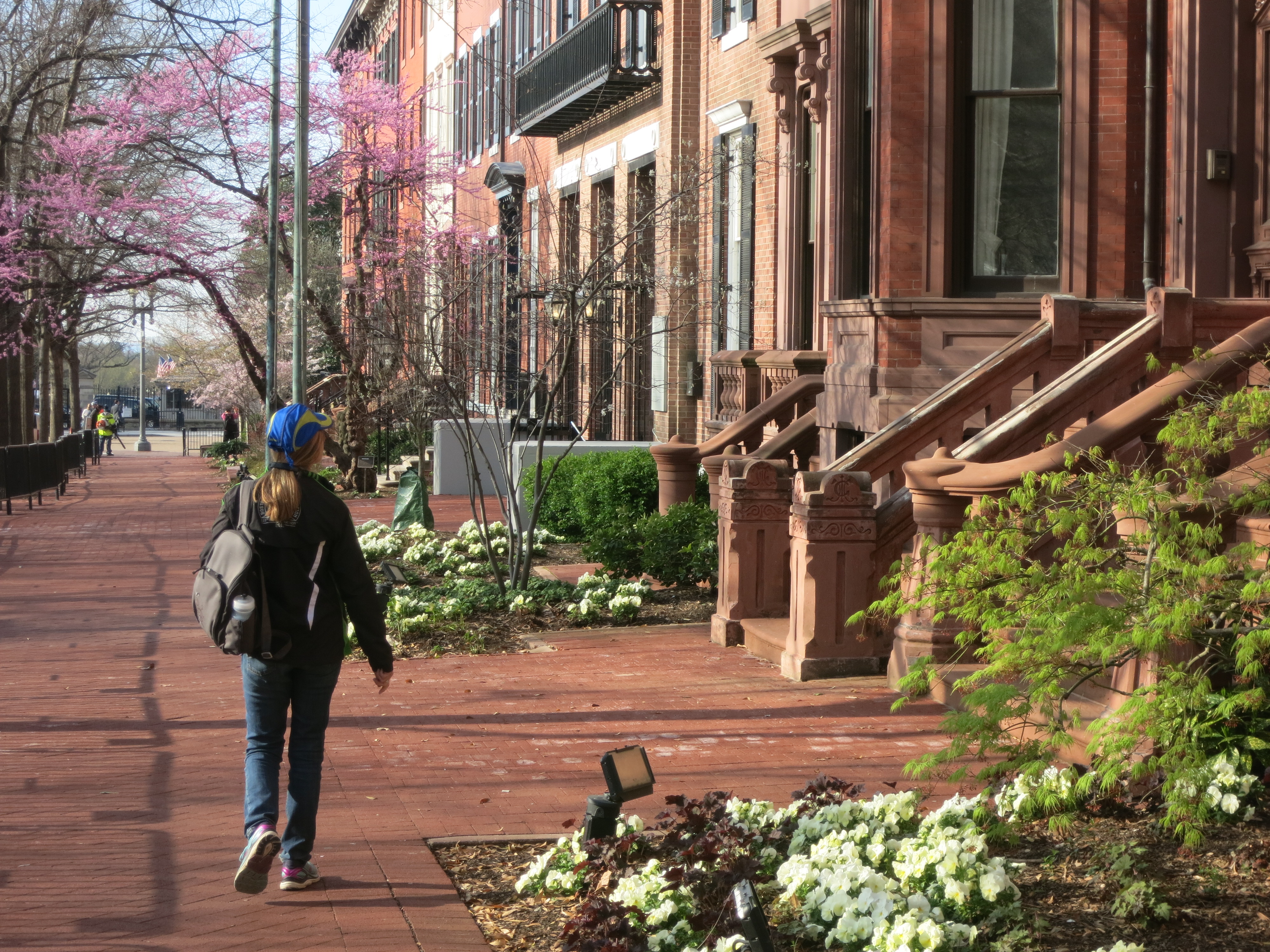
Beautiful Row Houses at Lafayette Square

We walked down and along the beautiful row houses along the west side of Lafayette Square (which were saved from development by none other that First Lady Jacqueline Kennedy in 1962 among others — see this), past the White House and down 17th Street to the Mall just west of the Washington Monument. It was totally cleaned up and you would never know there were 17,000+ runners here just one day before.

We had both seen this area numerous time but it's always an inspiration to visit. The Lincoln Memorial seen over the reflecting pool is just a marvel. I love that picture above with the clouds streaking up at an angle from the Memorial with the building and clouds reflected in the pool. We split up on the way back but this relatively long walk for a small number of objectives was well worth it.

We both managed to get everything down from our rooms, checked out and took a few minutes to relax. Then we left the Hostel and got the "Circulator" bus on time at 11:20. Unfortunately it didn't stay on time and we were held up by a construction project about half way to the station. So we got out of the bus with our luggage and walked the rest of the way to Union Station and got there with about 10 minutes to spare. And since we both had "Group A" tickets, we were first on the bus. About 4 and a half hours later we were in New York, and I was home about 45 minutes after that. It was a wonderful weekend!

This post is adapted from Papa Bear's blog  
Beyond Central Park 


Read more...

Wednesday, January 4, 2017

Looking Back at 2016

Looking Back at 2016
by Papa Bear 


Awards: a Carrot Cake in the VCTC UEC / a Pyramid of NYCRuns 5K awards / a Carrot Muffin in a VCTC XC 5K

If you look at the awards I won during 2016 (triptych above), you might think I did nothing but run races and win awards. That would be a mistake, since I was actually quite busy with other pursuits. And even though I was happy to win awards, truth be told, there is little competition in the 70+ age group to which I belong. At some races I was the only one. And as you might guess, this sport gets tougher and tougher as the years go by and I am happy to just be out there just giving it my best efforts. The races keep me honest and my goal is to not slow down. And by most measure I was getting about the same times at the end of the year as at the start.

Dorothy and Scarecrow
But even when I ran races and won some age group awards, the two pictures here (Dorothy and the Scarecrow left, and me and my daughter in those hoodies, right, below) mean more to me than all those awards. You can see we were Just Plain Having Fun.

Me  and Suzy in Hoodies
Yes, racing is hard work, but it's fun when you meet up with friends and family and just enjoy yourself.

And by the way, both of these photos depict prizes: best costume award for Heidi and me, and a couple of chance lottery prizes for Suzy, my daughter, and myself.

When I'm just running—not racing—I go easy. And many of those "easy" runs are with friends to destinations, sometimes to brunch and sometimes to a park or other lovely place. Among others, this year have I run to the NY Botanical Garden, The historic 1848 High Bridge, the Cloisters, the Morris Jumel Mansion and more.

Bottom line: Yes, I won a number of age group awards, I more-or-less kept my fitness level intact, but most importantly, I had fun with my running in 2016. You can't do much better than that!

But Speaking of "Destination Runs", here's a story of a run I did with my friend Susan a little over a week before the New Year:


December 19th: A Cold Run to the Cloisters


On December 19th, the day before the Winter solstice, Susan and I met at about 10:30 AM to run from Central Park up to the Cloisters, a distance of about 7 miles. 7 miles not enough for you?  No problem, loop to your heart's content in Central Park before you head north.

It was sunny but the temperatures were in the mid to upper 20°s. Cold, in other words. We fooled with our layers and finally got warm enough for running, but we just couldn't stop, or we'd really feel it. A note on the pictures: I didn't take any photos till we got to Fort Tryon Park and the Cloisters — it was too cold to take out my camera during the run. So the text doesn't catch up with the photos till around the 4th paragraph.

Full Route Map
We took the straight route, mostly along the long diagonal of St. Nicholas Avenue. No, we were not trying to hit any of the parks today. We did veer up to Convent Avenue at 141st Street to check out the lovely town houses in Hamilton Heights but got back to St. Nicholas about 152rd where it catches up to Convent. Then when we got to 154th a few minutes later, Susan said "What's that park over there?" I said "Let's check it out" and we soon found ourselves on Amsterdam Avenue, opposite Trinity Cemetery, which was the "Park" we had found.

These zig-zags didn't materially affect our route since we kept heading north and we eventually had to get to the west anyway. By 162nd Street St. Nicholas caught up to us again, so we left Amsterdam and resumed the diagonal route north and westward on St. Nicholas. Finally at 169th we reached Broadway where it exchanges its heading with St. Nicholas so we headed along Broadway which now took up the diagonal. If this sounds confusing, look at the full route map (click on the map caption) and you'll "get it".

Fort Tryon Park
We knew we had to move one more block west to get on Fort Washington Avenue, but it didn't much matter when we made the switch so we chose 174th because it looked like a nice street. Now we had about one more mile on Fort Washington Ave. plus Fort Tryon Park, a lovely northern Manhattan oasis, to get to the Cloisters. And here it was when I got out my camera taking shots in the park and inside the Cloisters.

"What's the Cloisters?" you ask? Well, if you have to ask, it
View of the Cloisters From the Park
means you have never been there, and you should drop everything and go there, like NOW! You'll find an old building made up of pieces of much older structures — mostly parts of churches and assorted artifacts — from medieval Europe, which I believe were mostly stolen, oops, I mean collected by John D. Rockefeller. The park land and the
Unicorn Tapestry
Cloisters were later donated to the city. It's actually a branch of the Metropolitan Museum of art and is one of the hidden gems of Manhattan and well worth the run (or bus ride if you like) to get there. 

I'll let the pictures tell the tale, so here is a link to a slideshow of the photos starting at the entrance to Fort Tryon Park, going up to the Cloisters and then exploring some of the areas within: Fort Tryon Park and the Cloisters.   << Don't skip this slideshow: there's some gorgeous pictures.


After spending about an hour at the Cloisters, we braved the cold again and walked as quickly as we could down the park road to Dyckman Street, thence to Broadway, and finding no suitable alternative, made our way to our favorite eating place in this neck of the woods, Indian Road Café, the "Last Café on the Only Road" in Manhattan.
Better Than Truffles
Luckily they were open for business even though it was after 3:00 PM on a Tuesday and there were very few other customers. But the food was as good as ever — we both ordered Mac & Cheese with lobster and truffles. Yum! But where were the truffles? Of course, we both ordered cold ones as well — those were better than the missing truffles, for sure!

That's all for now folks, but take my advice: run for fun in 2017, and run to nice places!

Papa Bear 


This post is adapted from Papa Bear's recent posts on his blog:
Running and Stuff for 2016

Read more...

Friday, October 28, 2016

Advice from Papa Bear

Papa Bear (aka Richard G.) wrote these tidbits of wisdom (and occasional humor) for the New York Flyers monthly Newsletter during the year 2000. Over the years they have maintained their relevance to today's running scene. As the saying goes, "The more things change, the more they stay the same."  Pay special attention to the last 3 months' advice below; this is where we are in the calendar today.  You may find these particular bits of advice relevant to the marathon very helpful.

They were originally published month by month.  Yes, the Newsletter was published every month and mailed (snail-mailed, not emailed) to the membership back then.  Now that, give today's myriad of communications channels, has certainly changed.

January: Cold Weather Running

Papa Bear says: use the 20 degree rule in cold weather - dress as if the temperature is 20 degrees warmer than the thermometer shows.  So if it's 30 out, dress for 50 degree temperatures. If there's wind, use the wind-chill factor instead of the temperature and then add 20 (and remember to wear a windbreaker).


February: A Four Mile Race

This month's points race is the Snowflake 4 Miler on Feb. 26th. Note: this was in 2000.  Next February the corresponding race is the February 27th 2017 Al Gordon 4 Miler. Here's the link: NYRR Al Gordon 4 Miler

Papa Bear says: to run this race you must know the miles. To know the miles you must know their names.
And the name of the first mile is EXHILARATION.
And the name of the second mile is DISTRACTION.
And the name of the third mile is DOUBT.
And the name of the fourth mile is PAIN.
When you know these names you will know the miles. When you know the miles you can run the race.


March: Wet running shoes

Papa Bear says: When you get home from a wet workout, stuff crumpled up newspaper into your running shoes. If they are really really wet, change the newspaper before going to bed. Works like a charm and doesn't destroy your shoes like a hot radiator.

Special hint: take the shoes off before stuffing the newspaper in.


April: Rounding

Papa Bear says: When training, we round our training mileage UP. So naturally 5.7 miles becomes 6 miles in your running log. When racing, we round our finishing times DOWN. So when asked our time after a 3:10:57 marathon we say 3:10, or to be really brazen to non-runner friends we might say "three hours and change". Note how useful the expression "and change" is, use it often.


May: Rest

Papa Bear says: as you get on in years, consider taking an extra day (or 2) off each week. The extra rest may actually improve your performance. Rearrange your mileage into longer runs with more days off in between. Papa Bear has trained just 4 days a week since 1995, during which time he has run 6 marathons and qualified for Boston twice. Rest works! Try it.  

Note: now in 2016, Papa Bear still follows this schedule and you can add 3 more Bostons to that total.


June: Bathrooms

Papa Bear says: if the race starts in 15 minutes and the port-o-san line is 20 minutes long, what to do? GO SOUTH about a half-mile, past Cleopatra's Needle to the traffic light at the top of Cat Hill; turn right on the maintenance road at the light. Bathrooms are in the maintenance building about 100 feet in from the road.
Or GO NORTH about a half mile along the reservoir track, past the stone pump house; go over the arched foot bridge and follow the walkway down to the tennis house. I have always found these facilities clean and safe. Besides you get a nice extra pre-race warm-up.


July: Hot Weather Hydration

Papa Bear says: now that the weather is hot and humid and we must increase those long runs, here's a trick to stay cool and well hydrated. Take a half-full quart container of Gatorade (or your favorite sports drink) and put it on its side in your freezer the night before your long run. In the morning it will be frozen. Fill the empty space with cold water and put it in a plastic bag. Hide it in the park where you will pass by every loop. Each time around take a drink - more and more of the liquid will be melted. It should stay cold for at least 3 loops.


August: Long Run Pacing - your U.T.

Papa Bear says: It's long run season and long runs cause soreness or injury for two reasons: 1) you run too fast, and 2) you get dehydrated. In both cases you break down your muscles and delay recovery. Papa bear says to avoid these problems, run your long runs under your U.T. (Urination Threshold). If you aren't making a pit stop every 5 miles or so, you're running too fast or you're drinking too little, or both. Slow down and drink up!


September: The Bridle Path

Papa Bear says: as you increase your mileage training for the marathon, your legs take a beating, especially you ankles, knees and hips. Give them a break - get off the pavement and run on the Central Park Bridle Path whenever you can. You can run about 2/3 of the way around the Park on this path and your legs will thank you. As an added benefit you will likely see Giorgio in his multi-colored running clothes!


October: Marathon Hydration

Papa Bear says: One of the most important ingredients for a successful marathon, and one that is easy to get right is hydration. 1) The last 3 days before the race, keep absolutely full of water: every time you "go", follow it up with another drink. 2) Race day: drink until about 30 minutes before the race, then STOP. Empty your bladder one last time as close as possible to the gun. 3) After the gun, take a small bottle of water with you and sip from it frequently for the first couple of miles, then throw it away. Skip the crowds at the first water stop, but drink at all the other water stops. If you are running at your proper pace, you shouldn't need any pit stops during the race.


 November: A Great Marathon

Papa Bear says: Those of you who have just had the experience of doing a great marathon, and hopefully you all eventually will, where all your training and other factors have paid off, will know this advice already:
A perfect day and a well executed training plan do not allow you to run easier - they allow you to run harder!


 December: Recovery

Papa Bear says: Now that you have finished your big race it's time to recover. Spend your time in the pool, hiking, skiing, partying and socializing. No hard running workouts or races for several months. Your body needs a break. You'll do better in the spring if you take one.


Read more...

  © Blogger templates The Professional Template by Ourblogtemplates.com 2008

Back to TOP