Showing posts with label Training Advice. Show all posts

Sunday, July 3, 2022

Run/Walk: A Competitive Edge for Speed and Endurance

Wendy M

Like many native and local New Yorkers, I grew up watching the NYC Marathon and being inspired by the athletes as they crossed the finish line. When I moved to Manhattan, I had an apartment with the best view of all, First Avenue! 


Every November, I went down and watched and cheered for hours, being inspired by all the “regular runners” not usually shown on TV and wondering what it might be like to be a NYC Marathoner one day. The fact that I couldn’t run even one block didn’t stop me from thinking about it!


In 2019, looking to make some changes, I decided to try running with the goal of completing a 5K. I quickly caught the running bug and moved on to a 10K and began to contemplate a half marathon and whether I could actually run a full marathon, but longer distances seemed impossible to even consider.


Impossible, however, only until I saw a group of Flyers using the run/walk method and became curious. I looked into it and spoke with many who used run/walk, tried it out, and discovered how much it could help me. To my surprise, after using the method I started to become a stronger and faster runner who could take on longer distances. Could I take on the NYC Marathon? Only one way to find out. I threw my name into the Flyers lottery for club bibs and won. Oh man! Now I am running the marathon! My first marathon and it would be NYC!

As it turns out, life (and Covid) had other plans for me as it did for many of us, and the marathon was canceled – but I continued to work on my running and my run/walk strategy. I ran my first half marathon, and then in the fall of 2021, I got to run my first marathon on a hot and humid October day in Chicago. Throughout the race I found so many others run/walking right along with me, and thanks to this method I never worried about being able to finish.

Completed First Marathon! 
Chicago 2021 :)


So What is a Run/Walk strategy?

You may have heard about it, you may have heard it called the Galloway method (more on that later), and you may have seen people practicing it on runs through the park and races throughout the city. It’s an interval pacing strategy used by many runners that consists of alternating running segments followed by short walk breaks, repeated throughout the course of a run.


But why? Some do it to boost endurance over a long run or reduce the risk of an injury, while others find it less taxing on the body so they recover faster. Some run/walk athletes even find it improves their long run pace and it’s now incorporated into training plans by coaches Bobby McGee and Jim Vance for their Olympic athletes.  


So where did this all start?


No one actually knows when and where this method originated, but it became very popular in the 70’s when former Olympian
Jeff Galloway was seeking a less intimidating way for non-runners to get into the sport. He started both running and walk/run clinics from his running store in Atlanta and eventually wrote several books. Today there are articles, books, blogs and lots of other information on the topic. Many charities affiliated with large full and half marathons now even offer run/walk pace groups for their runners and you can find run/walk training groups in a lot of cities. 


So I want to get started. What should I do?


For something that seems so obvious (I mean just run then walk, right?), there's a lot of work and strategy behind it:


  • First you will need to determine your run and walk segments. There is no set segment for any one person. If you follow a Galloway method, he has a “Magic Mile” formula that can help you determine your ratios based on pace, but most people choose their own paces and ratios based on what feels most comfortable personally. No matter what method you use, it takes patience, practice and evaluation. You may find that you need to change it up regularly based on injury, weather or the length of the race/training run. The most common ratios athletes use are runs of anywhere from 45 seconds to 4 minutes followed by a 30-second to 1-minute walk. Longer and shorter walking segments are also used.


  • Second is to work on transitioning from the walk to the run and back to the walk again. Moving back and forth between them abruptly is taxing, slows you down and can cause injury. A solution is to learn how to “glide” or “stride” into the run/walk change. Using 3-5 seconds to slow down or increase your pace will help your transition. 

  • Third is to consider your racing strategy. While there are no hard-and-fast rules about using a run/walk method in a race, there are a few courtesies to help avoid collisions in a crowd: 


  • Try to stay to your right, raise your right hand when you prepare to walk and if necessary call out that you're walking as others may not be paying attention. In a crowded race before everyone has spread out this can be especially important for your safety as well as others’. 

  • You’ll want to consider your pace when deciding where in the corral to start. Slower runners or those with shorter intervals may want to consider starting in the back of a corral, but some runners are quite fast with this strategy and are better off in the front. It all comes down to your comfort level and knowing your pace and your ratios. 


What about those hills?


Oh the hills you say? Well, this again comes down to your personal preference. You can either continue a run/walk ratio for the uphill and the downhill or you can walk the uphills and always run the downhills. There are different personal thoughts and preferences for both. 
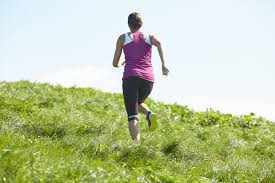


For the first it can be helpful to always follow your ratios no matter the hills which can help train your brain and your legs to keep moving every time you hear the timer. This is especially helpful at the end of a longer race such as a half-marathon, marathon or longer. 


With the second strategy you may find that you have an easier time conserving energy and gaining more speed by walking up short hills and running down them and ignoring your timer. This is especially helpful if your goal may be running a long trail race or an ultra where it is very common to do just this. 


So how do I know when to run and when to walk?


There are lots of different tools to time your intervals. The most popular one is a Gym Boss. You may see this clipped to the shirts of many runners. It is a simple, small device that beeps audibly and/or vibrates at whatever intervals you set. It costs about $17 - $20 and can be good for group workouts. 


Pros: 

  • You can set multiple custom timers on it 

  • It’s inexpensive

  • It can be set to vibrate so it’s good to use in a loud race 

  • It requires one battery that lasts a long time 

Cons: 

  • It can be a bit bulky and it’s another extra thing to carry


Your Garmin Watch as well as many other fitness devices can also be set to vibrate at certain intervals, alerting you when it’s time to transition. 


Pros: 

  • Having it vibrate is easy in a loud situation like a big race such as a marathon

  • There’s nothing extra to carry

Cons: 

  • Depending on your watch, in a long run or marathon you could drain your battery quickly


There are also many apps available for your smartphone, including the Intervasl Pro, Running Distance Timer, Running Distance Tracker Pro, Interval Timer Plus, Simple Interval Timer, Run Interval Timer and Map My Run.


Pros: 

  • You can set multiple custom timers

  • You can get voice prompts through your earphones and bluetooth

  • Many will give you 5-second heads up so you can “transition” between run/walk easier 

Cons: 

  • They range from free to $8

  • They may drain your phone battery quickly so on a long run or race you may need a back up 

  • You need to carry your phone


Sounds great! How can I practice and learn more?


Come on out to Thursday night Flyers group runs and join us! I lead a small but dedicated run/walk group that completes a 3-4 mile distance. 


 Run-Walkers On A Walk Break During Thursday Night Fun -- TNF!
                                           

I love showing other runners who are scared about trying running or anxious about longer distances what they can do with this method. If you are curious, come out and give it a try with us! 


Debi U Hamming it Up with the Flyers
Thursday Evening Run/Walk Group


We meet at the Maine Monument at Columbus Circle at 6:30 PM each Thursday. I hope to see you there!


As for that NYC Marathon….I’ll see you on the start line this fall. 


- Wendy M.


Read more...

Tuesday, December 11, 2018

Maybe When I am Older -- Profile of a Prolific Flyer

Heather Tolford
Blogmaster Dave: Flyer Heather Tolford has been breaking Flyers Hall of Fame racing records throughout 2018, including her own newly set records. I recently caught up with Heather (though not during a race!) to learn about her running and related experiences. She also talked about her training and racing strategies.  Here's what I learned!

Blogmaster Dave: Heather, I'd love to hear about your years as a star high school and collegiate runner. Tell us about your early years?

SFVTC Girls with Coach Laszlo Tabori
Heather's reply:  My original running mentors were world class marathoners and one really fast miler. From 1974 to the end of 1976, Jacqueline Hansen, Miki Gorman, Sue Kinsey and Leal Ann Rhinehart were training partners every Tuesday and Thursday evening at Valley College in southern California’s San Fernando Valley (SFV) where we endured 2-3 hour workouts under the guidance of the legendary Hungarian, Laszlo Tabori -- the 3rd man to break four minutes in the mile. Laszlo had convinced my father to let me train with his group during my first year of competing when I was a senior in high school. There was no girls' program at my school and I had crashed the JV boys cross country team in the wake of Title IX. I received the first women’s running scholarship to the University of Oregon and by the spring of 1978 I had set school records for the Duck women in the 3K (9:46), 5K (17:03), and 10K (35:51) .
  
In June of 1978, Fred Lebow brought me to New York to run The Crazy Legs Mini Marathon (10K) and for a special presentation to my former coach, Laszlo Tabori, for his contributions to women’s running. I fell in love with the city. After that, I jumped right into a summer of road racing, including a 1:15 and change at the Bohemia Mining Days Half Marathon in Cottage Grove, Oregon. Oregon Coach Tom Heinonen thought I might have some luck with the marathon so I signed up for the 1978 OTC Marathon in Eugene set for early in the fall. I made my marathon debut, finishing 3rd for women in 2:46. Unfortunately, that escapade ended my collegiate running career, as illness and injury took their toll in the wake of that effort.
OTC -- 1978
Blogmaster Dave: Heather, you eventually came back to running.  Tell us about that?

Heather's Reply: Fast forward 10 years and I have a 3 year old, and a challenging spouse who had moved us to a tiny town on the Oregon coast the week I turned 30. I panicked and started to run. I dominated the coastal races and started traveling two hours across the mountains to Portland. I took second at the Portland Marathon, 3rd at Honolulu and ran a string of marathons under 2:45, competing briefly for Saucony, and then Nike’s Oregon International Team. My 2:40.15 marathon PR at Los Angeles in 1991, the closest I got to my goal of breaking 2:40, got me an Olympic qualifying A standard for the 1992 trials in Houston, but I was starting feel worn down in my longer races, and was battling Achilles issues, so after a painful 3-hour Boston Marathon in 1993, I started coaching high school track and had my second daughter in 1995.

Blogmaster Dave: What have you been up to more recently, Heather?  And when did the NY Flyers enter your life? 

Heather's Reply: I continued to teach, coach track, cross country, and gymnastics while raising my two daughters on the rugged northern Oregon coast. When I reunited with my high school sweetheart and moved to New York from Oregon in 2011, I was looking forward to a new life and running and racing in Central Park.
Coach Heather -- With Her District Champs, 2006
I had been running consistently in Oregon before the move and had a lottery entry into the New York Half, but ended up scratching due to a slip on the ice and a torn MCL. A few months later, I started up again, with a full time job teaching gymnastics and some easy runs in Central Park.

I returned to the Mini 10K again in 2014 and New York Flyer, Francine Alfandry introduced herself at the finish line. She encouraged me to join the Flyers and race more frequently. I wasn’t training seriously, but I had ditched my metro card in favor of running to work and back across the island each day. I saved time and money (which I promptly spent on running shoes), and combined with my very physical job, throwing children around the gym, I got into decent shape.

I had picked up a second job working for a coaching service, Coach Up, and added more mileage working with high school kids, and runners of all abilities when I was not at the gym. The bulk of my training was still easy running, with the occasional short, faster paced “late to work” run.

I have been reluctant to do the intense speed interval work that I did when I was younger. I had developed Achilles problems in the 90’s, and when I “retired” in 1993, I had to stop running entirely for nearly a year. I started training as a gymnastics coach for the Tillamook YMCA to supplement track and cross country coaching at the high school there and to my surprise, the lifting, stretching and jumping helped my Achilles issues and I was able to run comfortably again. My gymnastics day job ended up being really good strength and PT work!

I would occasionally jump into a race for fun and fitness, but had no master’s ambitions until I started placing in races competing for the Flyer’s. Approaching 60, I started thinking about trying to have a good 2018 season and added a longish (8-10 mile) run to my weekly commuting on Mondays. I typically run it at 9:50 -10:30 pace per mile, going by feel. This easy run has resulted in a slew of “senior” PR’s this year.

I have had minor injuries over the past few years, trips, falls, getting hit by a bicycle, and bumps and strains from the hazardous job of catching little children as they flip into you, but I have managed to run through most of them. As I write this, I am working on recovery from a bone-bruised knee from a fall navigating a slushy curb during the recent November snow storm. A few days off and exercises to maintain mobility takes care of most issues but I am cautious about committing to an aggressive race schedule during the winter months due to potential hazardous conditions and occasional klutziness on my part.
NYRR Mini 10K -- 2018
Blogmaster Dave: Heather, how would you describe your training regimen? 

Heather's Reply: As of November 25, I have run 2040 miles this year, mostly in the form of 2.5 - 3 mile runs, twice a day commuting to work, 6 days a week. I try to throw in a longer run of 8-10 miles on my way home from work on Mondays when I work half a day. Sometimes on Saturdays and on weekday evenings in the summer, if I have multiple running clients booked, I get extra mileage running them around the park for up to 3 hours. I have not been doing any interval work to speak of myself, but occasionally run at a faster "tempo" pace when I am running late to work. Because running is my main mode of transportation, I only take a day off if I am injured or really sick.

I am in the gym 40 hours per week and spend much of that time stretching with my classes, demonstrating gymnastics drills, moving heavy equipment and lifting kids infant sized to 9 years old. 

When I am coaching runners, I have my athletes use a modified Jack Daniels type plan, but interject specific interval workouts from my experiences with Tabori and the at the University of Oregon. I emphasize the importance of listening to your body and taking easy days really easy. I try to practice what I preach, but skip the fast stuff. I did enough of that when I was young!

Blogmaster Dave: Heather, do you have racing strategies to share with other NY Flyers?

Heather's Reply: Consistency to the point of being a bit OCD helps with my pre race routine. I Iike to eat the same meal the night before a race, a pasta carbonara with turkey bacon (I don't eat red meat) and a glass of red wine. I never imbibed before a race prior to my 1991 marathon PR, so it is a good luck ritual for me.

I wake up at least 2 hours before I have to be at the starting area,have one cup of coffee and a banana or a little yogurt with honey and chew a piece of Run Gum 30 minutes before the race starts (I was a brand ambassador for the company this year). 

I tend to start a race a bit fast to get out of the crowd and then settle into my pace. I am not the greatest uphill runner, but can relax and let it rip on the downhills to make up time. I try to push my races as hard as I can go and often look pretty wobbly at the end. I race at a much faster paster than any of my daily "workouts."

I ended up with a 9+1 this year for guaranteed entry into the 2019 NYC Marathon, but have no marathon plans right now and want to try to improve my mile to 10k times and perhaps try another half marathon next year. Maybe when I am older….

-Heather Tolford 
Coaching Website: https://www.coachup.com/coaches/heathert

Read more...

Thursday, July 12, 2018

SUN PROTECTION FOR RUNNERS

Jane Y.

It’s almost SUMMER!  You know what that means.  It’s time to think about gearing up for fall marathon training.  Chicago.  NYC.  Berlin.  Marine Corps.  So, lace up your sneakers and hit the pavement.  However, please don’t forget your sunscreen.  One in five Americans will develop skin cancer in their lifetime—don’t let it be you!

Who should wear Sunscreen?
EVERYONE! Anyone can get skin cancer, regardless of age, race or gender. 

When should I wear Sunscreen?
EVERY DAY.  Believe it or not, the sun emits harmful UV rays year-round.  Even on cloudy days, up to 80% of the sun’s UV rays can penetrate your skin. 

How to Choose a Sunscreen:
  • Broad Spectrum: Meaning that it should protect the skin from ultraviolet A (UVA) and ultraviolet B (UVB) rays, both of which contribute towards skin cancer
  • SPF 30 or Higher:  The sun protection factor is a measure of a sunscreen’s ability to prevent UVB rays from damaging the skin. 
  • Water Resistant: How long the sunscreen will stay on wet skin (40 or 80 minutes). Even water resistant sunscreens have to be re-applied as heavy perspiration can reduce their efficacy.  

What Type of Sunscreen is Best?
Available sunscreen options include lotions, creams, gels, ointments, wax sticks and sprays. 

Creams: Best for dry skin and the face
Gels: Good for hairy areas, such as the scalp or male chest
Sticks: Good to use around the eyes
Sprays: Although easier to apply, make sure you spray an adequate amount and rub it in to ensure equal coverage

How much do I need to Use?
One ounce of sunscreen (a full shot glass) is considered the amount needed to cover the exposed areas of the body.  Don’t be that stingy bartender.  Pour yourself a nice tall glass!

WHEN should I Apply it?
Ideally, you should apply sunscreen before you go outdoors.  It takes approximately 15 minutes for your skin to absorb the sunscreen and take effect.  If you wait until you are out in the sun to apply, you could risk getting a sunburn.  Re-apply sunscreen every 2 hours, especially after sweating or swimming. 

WHERE should I Apply it?
On all bare skin—including the face, neck, arms and legs.  Don’t forget your ears and the top of your head, especially if you don’t have much hair there.  To protect your lips, apply a lip balm with a SPF of at least 15. 

What else can I do to PROTECT myself?
  • Seek shade, remembering that the sun’s rays are strongest between 10 am and 2 pm.  If you have a long run, schedule it for early morning or late afternoon. 
  • Wear protective clothing such a long-sleeved shirt, pants, a wide brimmed hat and sunglasses if possible.  
  • Check your skin! If you notice anything changing, itchy or bleeding on your skin, see a dermatologist.  Skin cancer is almost always curable when detected early,

What are some good sunscreens for runners?
Lotions and creams are great until you start running and your eyes start to sting and burn (trust me, I know from plenty of experience). I prefer sticks because they are good for sensitive areas and are ultra portable—small enough to fit in your running belt or pocket. 

  • ELTA MD UV Clear Broad Spectrum SPF 46 (A perennial favorite of all dermatologists and especially mine, because you CAN rub it in your eyes and run!)
  • ISDIN Eryfotona Actinica Broad Spectrum SPF 50+
  • SkinMedica Total Defense and Repair SPF 50+
  • Colorescience Sunforgettable Total Protection Brush on Shield SPF 50
  • Shiseido UV Protective Stick SPF 37
  • Eau Thermale Avene Hydrating Sunscreen Balm SPF 50+
  • La Roche Posay Anthelios XL Senstive Areas Stick SPF 50+
  • Aquaphor Lip Protectant + Sunscreen 
Blogmaster's Note:
Flyer Jane Yoo is a practicing dermatologist with her office location near Columbus Circle.  She attended M.I.T. and Harvard University, with her medical degree at the Medical College of Virginia.  Her clinical and research interests revolve around the prevention, detection, treatment and management of skin cancer.  For more information, you can visit her website at: http://www.janeyoomd.com/

Read more...

Friday, October 28, 2016

Advice from Papa Bear

Papa Bear (aka Richard G.) wrote these tidbits of wisdom (and occasional humor) for the New York Flyers monthly Newsletter during the year 2000. Over the years they have maintained their relevance to today's running scene. As the saying goes, "The more things change, the more they stay the same."  Pay special attention to the last 3 months' advice below; this is where we are in the calendar today.  You may find these particular bits of advice relevant to the marathon very helpful.

They were originally published month by month.  Yes, the Newsletter was published every month and mailed (snail-mailed, not emailed) to the membership back then.  Now that, give today's myriad of communications channels, has certainly changed.

January: Cold Weather Running

Papa Bear says: use the 20 degree rule in cold weather - dress as if the temperature is 20 degrees warmer than the thermometer shows.  So if it's 30 out, dress for 50 degree temperatures. If there's wind, use the wind-chill factor instead of the temperature and then add 20 (and remember to wear a windbreaker).


February: A Four Mile Race

This month's points race is the Snowflake 4 Miler on Feb. 26th. Note: this was in 2000.  Next February the corresponding race is the February 27th 2017 Al Gordon 4 Miler. Here's the link: NYRR Al Gordon 4 Miler

Papa Bear says: to run this race you must know the miles. To know the miles you must know their names.
And the name of the first mile is EXHILARATION.
And the name of the second mile is DISTRACTION.
And the name of the third mile is DOUBT.
And the name of the fourth mile is PAIN.
When you know these names you will know the miles. When you know the miles you can run the race.


March: Wet running shoes

Papa Bear says: When you get home from a wet workout, stuff crumpled up newspaper into your running shoes. If they are really really wet, change the newspaper before going to bed. Works like a charm and doesn't destroy your shoes like a hot radiator.

Special hint: take the shoes off before stuffing the newspaper in.


April: Rounding

Papa Bear says: When training, we round our training mileage UP. So naturally 5.7 miles becomes 6 miles in your running log. When racing, we round our finishing times DOWN. So when asked our time after a 3:10:57 marathon we say 3:10, or to be really brazen to non-runner friends we might say "three hours and change". Note how useful the expression "and change" is, use it often.


May: Rest

Papa Bear says: as you get on in years, consider taking an extra day (or 2) off each week. The extra rest may actually improve your performance. Rearrange your mileage into longer runs with more days off in between. Papa Bear has trained just 4 days a week since 1995, during which time he has run 6 marathons and qualified for Boston twice. Rest works! Try it.  

Note: now in 2016, Papa Bear still follows this schedule and you can add 3 more Bostons to that total.


June: Bathrooms

Papa Bear says: if the race starts in 15 minutes and the port-o-san line is 20 minutes long, what to do? GO SOUTH about a half-mile, past Cleopatra's Needle to the traffic light at the top of Cat Hill; turn right on the maintenance road at the light. Bathrooms are in the maintenance building about 100 feet in from the road.
Or GO NORTH about a half mile along the reservoir track, past the stone pump house; go over the arched foot bridge and follow the walkway down to the tennis house. I have always found these facilities clean and safe. Besides you get a nice extra pre-race warm-up.


July: Hot Weather Hydration

Papa Bear says: now that the weather is hot and humid and we must increase those long runs, here's a trick to stay cool and well hydrated. Take a half-full quart container of Gatorade (or your favorite sports drink) and put it on its side in your freezer the night before your long run. In the morning it will be frozen. Fill the empty space with cold water and put it in a plastic bag. Hide it in the park where you will pass by every loop. Each time around take a drink - more and more of the liquid will be melted. It should stay cold for at least 3 loops.


August: Long Run Pacing - your U.T.

Papa Bear says: It's long run season and long runs cause soreness or injury for two reasons: 1) you run too fast, and 2) you get dehydrated. In both cases you break down your muscles and delay recovery. Papa bear says to avoid these problems, run your long runs under your U.T. (Urination Threshold). If you aren't making a pit stop every 5 miles or so, you're running too fast or you're drinking too little, or both. Slow down and drink up!


September: The Bridle Path

Papa Bear says: as you increase your mileage training for the marathon, your legs take a beating, especially you ankles, knees and hips. Give them a break - get off the pavement and run on the Central Park Bridle Path whenever you can. You can run about 2/3 of the way around the Park on this path and your legs will thank you. As an added benefit you will likely see Giorgio in his multi-colored running clothes!


October: Marathon Hydration

Papa Bear says: One of the most important ingredients for a successful marathon, and one that is easy to get right is hydration. 1) The last 3 days before the race, keep absolutely full of water: every time you "go", follow it up with another drink. 2) Race day: drink until about 30 minutes before the race, then STOP. Empty your bladder one last time as close as possible to the gun. 3) After the gun, take a small bottle of water with you and sip from it frequently for the first couple of miles, then throw it away. Skip the crowds at the first water stop, but drink at all the other water stops. If you are running at your proper pace, you shouldn't need any pit stops during the race.


 November: A Great Marathon

Papa Bear says: Those of you who have just had the experience of doing a great marathon, and hopefully you all eventually will, where all your training and other factors have paid off, will know this advice already:
A perfect day and a well executed training plan do not allow you to run easier - they allow you to run harder!


 December: Recovery

Papa Bear says: Now that you have finished your big race it's time to recover. Spend your time in the pool, hiking, skiing, partying and socializing. No hard running workouts or races for several months. Your body needs a break. You'll do better in the spring if you take one.


Read more...

Thursday, March 10, 2016

Getting Back Into Shape


Getting Back Into Shape
by Papa Bear


The  summer of 2015 was rather disappointing from the point of view of my running. I did the same two sets of 5Ks in alternate weeks, one set in Van Cortlandt Park on alternate Thursday evenings and the other set in Riverside Park on alternate Wednesdays. But the times were consistently slower than the previous couple of years and I just didn't have the drive. Now you might say "Hey, you're just getting older dude!" Yes, I'm well aware of getting slower with age, especially upon entering the 70+ age group,  but it was more than that. The big factor was that 2015 was the first year since 2011 when I did not run a marathon. And I was coasting, as it were, on 3 days a week of training. My mileage base was just not enough. It was time to ratchet things up a notch: add another day, do some cross training and increase my mileage. 

So in November just after the NYC marathon, I wrote down a weekly schedule: 


Weekly Training Schedule
Day Training
Monday Medium Run 6 miles
Tuesday Gym Workout
WednesdayTempo Run 2 + 1 + 2 miles
Thursday Easy Run 4 - 5 miles
Friday Pool Workout
Saturday Long Run 7 - 10 miles
Sunday – day of rest –
This gave me 4 days of running and two days of cross training and the mileage ranges from about 20 to 25 miles per week. This is hardly heroic, and is well below the level of marathon training, but it would give me more consistency and with the combination of the tempo run and the long run, would help with both speed and endurance. What's a tempo run? It starts and ends as an easy run, but in the middle you run fast, like at a 10K pace. So "2 + 1 +2" means 2 miles easy, 1 mile fast and 2 miles easy. 

So how am I doing? Well, adding the 4th day of running was probably the most important, even if the mileage was low. And I didn't change my Wednesday run to a tempo run till sometime in December. And of course, once in a while I'd skip some planned workout due to weather or a schedule conflict. The Thursday run was originally done in Central Park with Melissa, but that became tougher as the weather got colder and the days grew shorter, so by January, those 5:00 PM evening runs became mid day runs. By and large the schedule was quite doable, and (as I had hoped) it gradually became easier. 

And lest I forget, I religiously did an exercise routine EVERY morning after breakfast. This consisted of a thorough workout with "The Stick" on my legs, dynamic stretches of the main muscle groups (hamstrings, quads, adductors, hip flexors and both kinds of calf muscles), foot drills and a stair climb to my apartment (elevator down, climb up stairs 8 floors). This took about 30 minutes and I didn't skip it come hell or high water (which did come a few times ). 

But in addition to getting my training in good order, I picked a target race in which I hoped to do better than last year. That race was the Cherry Tree 10 miler held in early February in Prospect Park, Brooklyn, and I had just under three months to get ready. Last year I did a 1:40:33 (10:03 pace) and that, I would beat! 

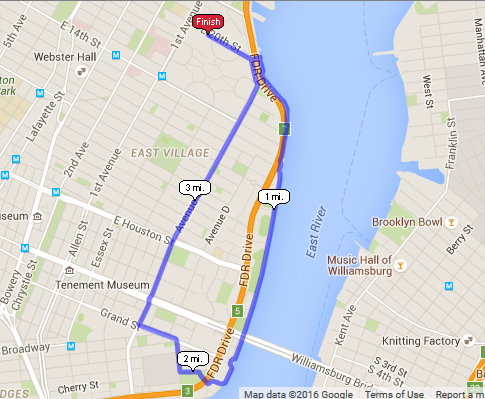
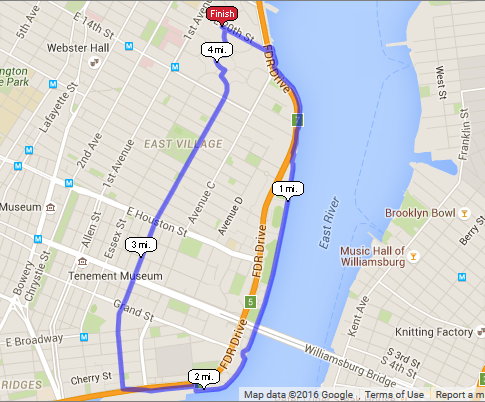
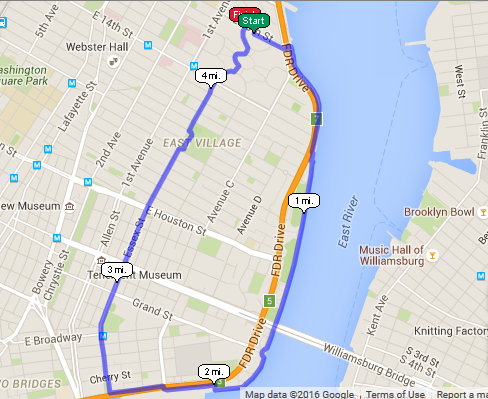
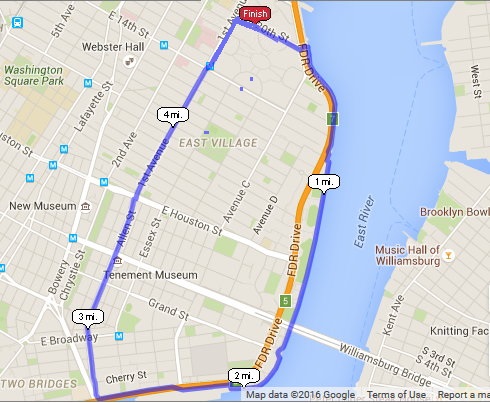
As most of my runs (3 out of 4) were down along the East River and back, things got a bit boring. So I worked out several alternate routes back, basically veering west from the river and returning through various parts of the East Village. Here's a few maps — if you live near me (Stuyvesant Town) you might try these and add some variety. And you'll discover Tompkins Square Park, a largely ignored gem of a park in just great shape! The maps show routes going along side of it, but in actuality I went through the park whenever I had the chance. 
Down along the River and Back via Avenue C

Down along the River and Back via Avenue B

Down along the River and Back via Avenue A
Down along the River and Back via First Avenue


Feb 6th: The Riverside Park 5K – a "Warm Up Race"

Saturday, February 6th was the date of the NYCRUNS Cocoa Classic Riverside Park 5K, my first race in months and a "warm up" for the PPTC Cherry tree 10 Miler the following weekend. If the date "February 6th" sounds familiar, it should. It was the day I got up at friggin 5:30 AM, went down to the East River and got those great pictures of Venus, Mercury and the crescent moon in the cold, pre-dawn February 6th sky (Check this out). I highly recommend you read that post. The success of that venture, set me up for a "double" if this race also turned out well. Read on ... 

After returning from my astronomic adventure, and quickly looking through the NY Times over coffee, I actually took a nap AND IT WAS ONLY 7:30 IN THE MORNING. But that gave me a little extra energy as down I went for the L train about 8:30, then connected to the #1 train at 14th Street and got off at 103rd Street. After a short walk I got to the race HQ in Riverside Park a little past 9:00. I got my number and visited the facilities and then said to my self "So now what the hell do I do for the next hour?" It was cold, but it was 9:00 AM cold, not 6:00 AM cold. I scouted out the race route and it turned out to be different from the summer Riverside Park 5K route I've done numerous times, but I was not sure what the differences were. Then I bumped into Flyers Jodie and Peter. They said John was also here and was scouting out some icy spots along the route. 
Me, Jodie, Peter and John

I still wasn't sure if we would even run over those spots. The NYCRUN's guy said it was the "long route", but I didn't know what that meant. In the end, it wasn't a big deal: the first mile or so was the same as the summer route (up the big hill and along the top of the park), then it veered down towards the Hudson around 100th Street and went down to about 92nd Street where it turned around and snaked back to rejoin the old route, but skipped the last big hill. And yes, there were two or three icy spots which added maybe a good part of a minute to my time. 

We all got a good start and I took it really easy up the big hill and then settled into a strong pace. The first icy spot was about a quarter mile past the hill and I had to walk around it. Then when we got to the part along the Hudson, there was another bad spot just after the turn-around and maybe one more spot later. The finish was easier — no repeat of the big hill — and I finished well. I was just a smidgeon over 29 minutes, but that was actually faster than any of my Riverside Park 5Ks I did last summer. Considering the icy spots and the difficulty of running in cold weather, it was by far the best Riverside 5K I'd done in several years. I got an age group award — and so did the other Flyers (hint: next time you should come out for one of these smaller races). 

Final result: 29:05 9:23/mile 1st in the 70+ age group. And what is more I had a "double" for the day! Was I ready for my target race the following Sunday? Bring it on! 

Feb 14th: The 2016 Cherry Tree 10 Miler – My "Target Race"

The PPTC Cherry Tree 10 Miler, a race put on every February by the Prospect Park Track Club, has always had the nickname "The Race for the Hard Core". Well, this year with temperatures between 0° and 4°, it truly was for the hard core. I had been feeling high all week since my good 5K race the weekend before, but this weekend the temperatures were forecast to be record-setting lows. Saturday was the coldest February 13th on record, and Sunday had a Central Park temperature of -1° at 6:00 AM, also a record. By race time the temperature had risen to 0° (what a relief! ) and we had bright sunshine. Several of our friends had decided to skip this one, but Susan and I decided we would soldier on and meet in the subway for the trip to Prospect Park. 
 
The race start had been moved this year to be near the new skating rink, about a half mile further along the park road, and this was just inside the park from the Prospect Park Q train stop. At one point the MTA had scheduled a string of stations on this line for repairs to be replaced by a shuttle bus from Barclays Center. Luckily this was cancelled and the trains made their ususl stops; a shuttle bus would have been a disaster in this weather. So we decided to meet inside the Union Square subway station on the Q line platform for the 9:02 train, but although we were both there, we managed to miss each other and missed our train. We finally found each other and got the next Q, which got us to the park about 9:40. Normally this would have been cutting it close, but in this frigid weather it was fine. 


Susan and I Before the Start
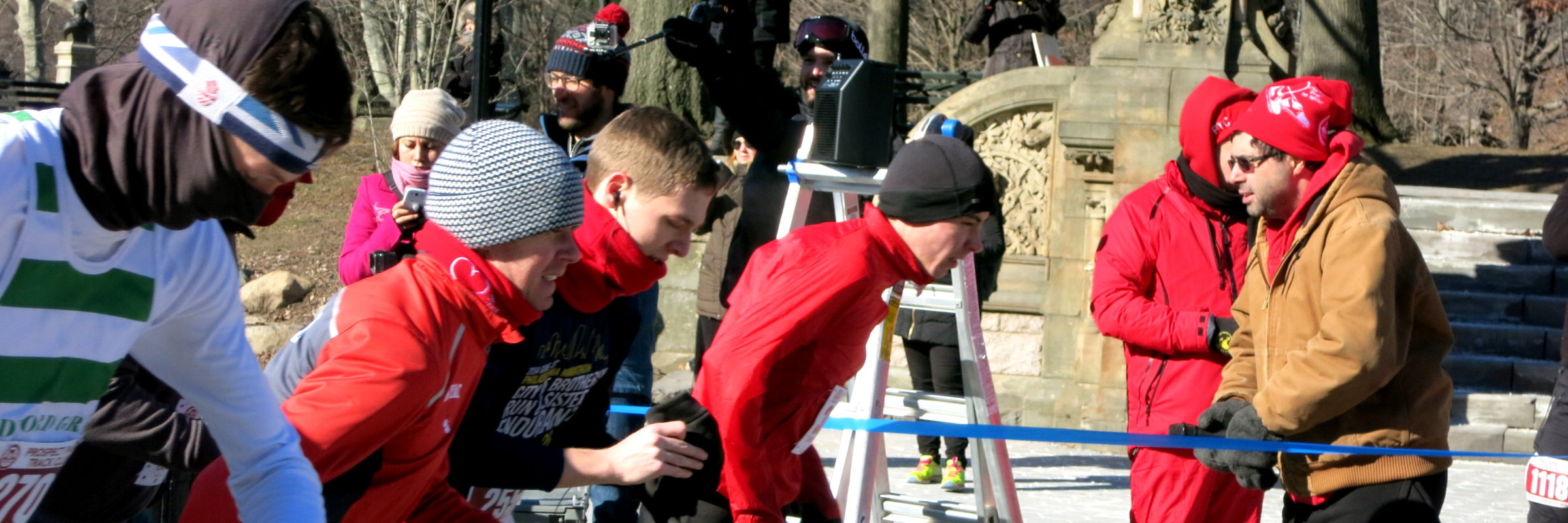
We found our way to the skating rink cafe, literally packed with runners, changed into our running stuff (I had 5 layers) and waited till the very last minute before moving outside to the start. We all quickly got in the corral, but I decided to take some pictures of the start. I took 4 or 5, one of which is below,  but this resulted in freezing my hands since I couldn't manage the camera with my gloves on. My hands, even with fancy Nike gloves on, took me about 2 miles to warm up. 

After the "gun" (actually an air horn), I stashed my camera in a pouch, walked back behind the starting line and got into the moving stream of runners. I probably crossed the starting line about 30 seconds after the "gun" (the final results gave my start delay as 35 seconds). So with 5 layers, a face mask, sunglasses and frozen fingers, I was off! 

And They're Off!

The start: The course was three loops of the park road and the start and finish were at the same point, so somehow they measured the loop to be exactly 3⅓ miles. It was USATF certified, so I'll take their word for this lucky coincidence. Unlike previous years, the start was just at the beginning of the mile long hill to the high point of the park at Grand Army Plaza. I always found this to be a tough stretch, particularly since it comes three times, but this year it seemed relatively easy. Perhaps the enforced slowing down that the temperatures and all my layers had on my pace was the reason. Whatever the reason, I didn't dread coming back to this hill twice more as I had in the past. 

1st loop: As I got moving, I made a conscious effort to really ease into my pace. It was easy, easy, easy for the first half mile or so to let my muscles warm up. The last thing I needed was some kind of muscle strain due to cold-induced tightness. 

I love the point in the race route where you are almost to the top of the long hill and you can see the runners across the park turning down the other side of the hill. I kept my pace strong but sustainable — but I wasn't clocking the miles. In fact there were no mile markers out at all and I had a feeling that in this weather, no one really cared. The topography on the east side of the park from Grand Army Plaza to Bartel-Prichard Square is a gradual down hill with a few dips along the way. Then we turn left and follow the loop down a slightly steeper hill, past the old finish line and finally reach the lake. I knew the skating rink was on the lake shore about half way around the lake, but still on each loop, it seemed further and further to make that last half mile. When I finished my first loop, the clock said about 33:30, so subtracting my guess of 30 seconds start delay, I was under my goal pace (to break 1:40:00 or 10 minutes per mile). I stopped for water and Gatorade and got moving again. 

2nd loop: I did not dread the long hill this time and this probably helped my confidence. And surprised as I was, my hands were now too warm and my gloves were getting wet from perspiration, so I actually took off my gloves, tucked them into my wind breaker pocket, and just kept my hands inside the ends of my sleeves, where I could regulate my hand temperature by moving the tips of my fingers slightly out, or slightly inside the sleeve. I'm sure most of you have done something similar over the years. 

This time around I paid more attention to the sights along the loop: the Lichfield Villa, the Picnic House, the view across the Long Meadow, the Band Shell, the Lake with the Parade Grounds across Parkside Avenue and the Peristyle (where did they get that name?). Then came that never ending half mile to the skating rink and the loop was done. This time the clock showed about 1:06:30 (66:30) so I knew I had done another loop in 33 minutes — very good pacing — but now the hard part was to sustain it for one more loop. 

3rd loop: The first thing I did after passing through the finish line after the 2nd loop was to take off my wind breaker and tie it around my waist, as well as getting another drink (the only water station was here at the start/finish line). This took maybe 15-20 seconds off my time but probably helped keep my body temperature in balance for the 3rd loop. Without the wind breaker I lost some heat through evaporation, but as long as I kept plugging along I was not cold. There were, however, a few spots near the top of the park where the wind was fairly chilly. My pace was harder to keep and now those same landmarks became not interesting sights, but rather markers of my progress. Of course, it seemed to take longer than before to get from one to the next, but my pace was still pretty strong.

Finished: 1:39:41
Gun Time: 1:40:16
Pace: 9:58
The finish: I knew that because the start delay, my time on the clock might be a little over 1:40:00, but if it was not more than about 30 seconds over (my start delay) I would break the 10 minutes per mile target. As I crossed the finish line it was about 1:40:15, so I knew I had made it — it was a great feeling of accomplishment. The official time is shown on the left. 

But one unwelcome reappearance of and old nemesis of mine showed up in the last mile. This is numbness and eventually pain in my right forefoot that sets in after a certain number of miles in my runs — the exact point may vary from 5 to 10 miles into a run. This time it started to bother me by about mile 9, and by the finish it was actually hurting my foot, but not to the extent of slowing me down. Let's just say this was one more reason to be very glad to cross the finish line. And as is usually the case, the numbness / pain subsided a few minutes after I stopped running. 

I spent a few minutes at the finish line and I soon heard a voice call "Papa Bear". It was Heidi who had just finished a few minutes after me, and about a minute after Heidi, there was Susan. All of us felt it was a great day and a great race and much (but not all) of the hype about the low temperatures ("Polar Vortex!", "-30° wind chills!") was unwarranted. In fact both Heidi and Susan said they have had worse times out skiing. 

I could not stay long out there in the cold so I said I would meet them in the skating rink cafe where we had changed. I stopped at the van on the way and asked the timing guy about our age group places. I found I was first in the 70+ group and Susan was 2nd in the 60-64 group. Good news all around. 

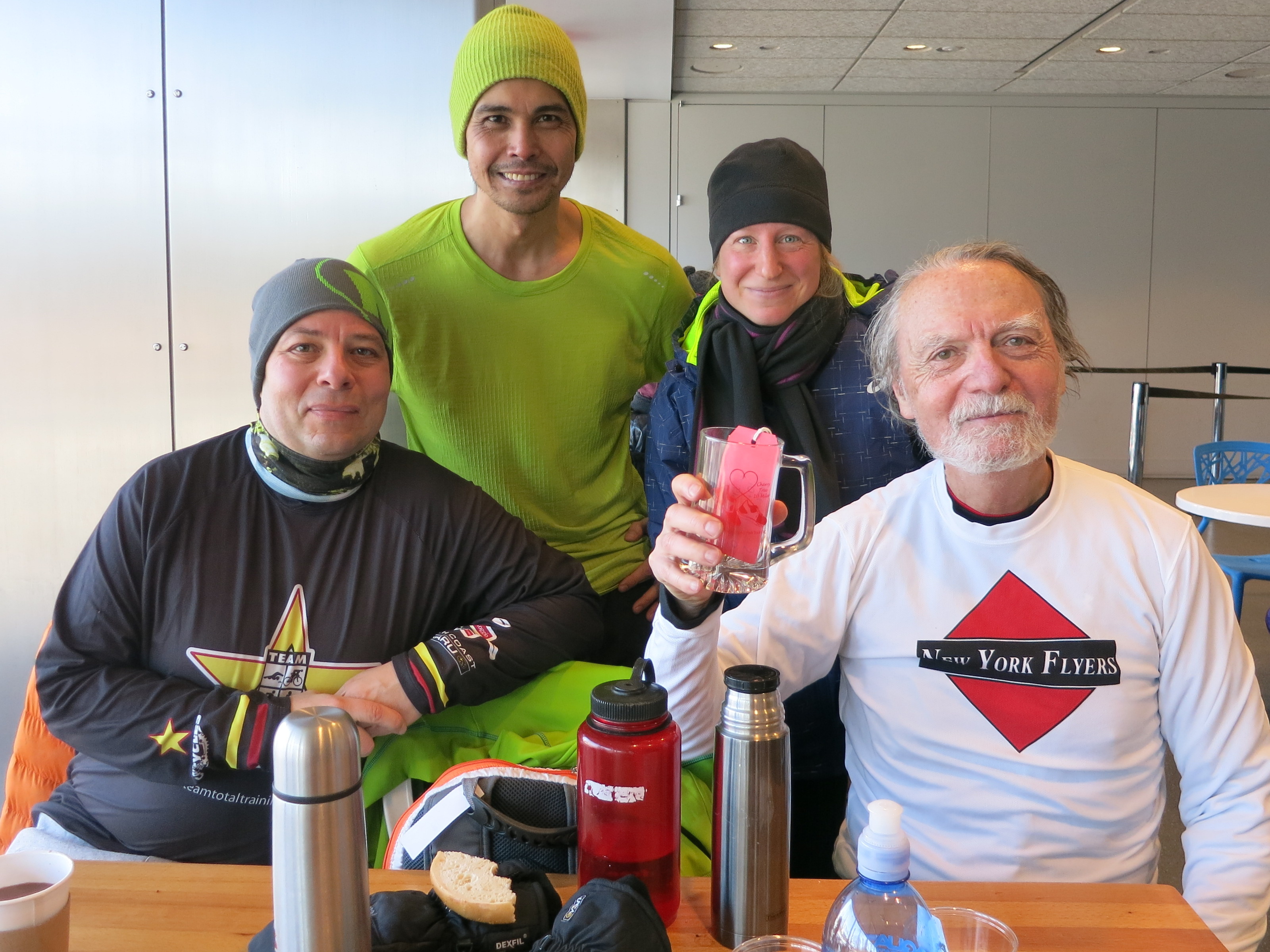
I got back inside, picked up my age group award and bumped into a few folks I knew, such as this group enjoying the warmth: 

Kenny, Ray, Charlotte and Me with my Age Group Award

But it turns out I was waiting in the wrong spot to meet Heidi and Susan. I had inadvertently gone not to where we had changed before the race, but to another part of the cafe one door away. So I had managed to not meet Susan at a rendezvous both before and after the race! 

But reunited again, we shivered our way to the Q train and about a half hour later said our good byes at the Union Square station. BUT before parting company, we chose a bench where some folks were sitting next to the stairs down to the Q train, and agreed THAT is where we'll meet next time. Now, if we can just manage to remember that when the next time comes along.  

That night I got my final results from the NYCRUNS (which managed the race for the PPTC) web site: 

Rank Split Pace
1st Lap 343 32:59 9:54
2nd Lap 334 33:03 9:55
3rd Lap 330 33:38 10:06
Finish 330 1:39:419:58
The splits certainly were pretty even but with a falling off for the 3rd loop. But on each loop I passed a number of other runners. Given the temperatures and other delays, I had certainly met my goal for this race, and then some. 

So what's my next target race? The Cherry Blossom 10 Miler in Washington DC on April 3rd. And the target pace? To do better than this one, but of course.

This post is adapted from Papa Bear's Blog:
Running & Stuff for 2016


Read more...

  © Blogger templates The Professional Template by Ourblogtemplates.com 2008

Back to TOP