Showing posts with label A* Blogger Howard C. Show all posts

Friday, May 8, 2015

26th Annual Bataan Memorial Death March

Howard C
The Bataan Memorial Death March is more of an event than a race. It honors the fallen soldiers and survivors of the infamous Bataan Death March, which occurred in the Philippines during World War II. The Philippines was a U.S. protectorate at the time. After months of battle and surviving on dwindling supplies, the U.S. and Filipino forces there surrendered to Japan in April 1942. Tens of thousands of soldiers were forced to march about 65 miles from the southern Bataan peninsula to prisoner of war camps further north. Over the course of several days, they marched under grueling hot jungle conditions with minimal to no food or water. Thousands died during the forced march.

A large contingent of the U.S. armed forces defending the Philippines at the time happened to be from New Mexico. In 1989, the Army ROTC at New Mexico State University began sponsoring a march to memorialize the event. In 1992, the New Mexico National Guard joined as a sponsor and the march moved to the White Sands Missile Range, an active military base. The event has been occurring there annually since then. This year was the 26th Annual Bataan Memorial Death March. While it is still a military-dominated event, it has gained a positive reputation in civilian marathon running circles as well. For someone like me, who has a goal of running a marathon in each of the 50 states, it was penciled in as my first choice for New Mexico. So when I got an email last fall from my running friend Nancy about trying to put a group together for doing this race in March 2015, I jumped on it. In the end, five of us decided to do this trip, all from the New York City area. Each of us registered in the “civilian” (vs. military), “light” (vs. “heavy”) and “individual” (vs. team) category.  We were “civilian” because you have to possess a military ID in order to enter in the military category. “Military” have to wear their full service uniform including boots for the march. “Heavy” means that you have to carry a 35 lbs. pack for the whole march, excluding water. Teams consist of five people, who must all finish within 20 seconds of each other. Teams are not allowed to abandon any members. Besides the marathon distance, there is an “honorary” distance, which is 14.2 miles.

Photo from http://www.bataanmarch.com/

The five of us arrived in El Paso International Airport, which is the nearest large airport, on Saturday (March 21, 2015), the day before the race. We drove for about an hour from the airport to a villa we rented out in Las Cruces, NM, which is the second largest city in New Mexico, and the nearest “big” city to the race course. After dropping off our luggage, we drove for another 30 minutes or so to the race expo at the White Sands Missile Range. This was also where the start line of the race was going to be, so the trip to the expo was helpful in learning the route we take on race day. We picked up our bibs, t-shirts, participant certificates and dog tag (finisher’s) medals without any problems. It was already pretty late in the day and the expo was clearly winding down. There had been survivors of the actual Bataan Death March in 1942 present at the expo earlier in the day, but they were long gone.

After taking care of business at the expo, we took a little time to explore the base. Outside of the expo area, there were numerous tents and campers set up on the grass, where some participants were staying overnight. There were military barracks nearby that were available for rent as well. We visited “Missile Park,” which is an outdoor museum for historic missiles tested at the base. Some of the missiles were the size of airplanes. White Sands Missile Range is actually a very historic site. This is where the super secret Manhattan Project (primarily based in nearby Los Alamos, NM) detonated Trinity, the world’s first atomic bomb. Besides the Missile Park, however, there didn’t seem to be a whole lot else available for civilians to see. This is an active military base (where, among other things, real missiles are still being tested regularly), so you can’t exactly just wander around unless you are unafraid of becoming missile fodder. As you can imagine, this base is in the middle of absolutely nowhere.


After visiting the base, we had a carbo-loading pasta dinner in Las Cruces and then went back to the villa for an early end to the evening. After long flights and a few hours in a desert climate, everyone was very tired and very dehydrated. I set my alarms and crashed quickly and hard.

In the early morning of race day (Sunday, March 22, 2015), the temperature was in the upper 30’s to low 40’s F. But it actually felt colder. One thing about deserts is that they can get quite cold overnight. I’ll never forget a hike I once did in a desert a while back where I saw patches of frosty snow on the sand in the morning, only for the temperatures to rise into the 90s later in the day, under a scorching hot sun. New Mexico, in addition, is mostly at elevation and thus has a much more temperate climate than you might expect. Although the temperatures were expected to go into the mid to upper 70’s later on race day, everyone was basically dressed for the winter that morning.
            
There was a mandatory opening ceremony that started at 6:35 AM. The March is clearly a very significant event in New Mexico. The two U.S. senators for New Mexico were there, as was the Philippines Ambassador to the U.S. There was a Black Hawk helicopter flyover. There were three actual Bataan Death March survivors who were present for the ceremony. Each firmly gave a “here!” when their names were called during a roll call. After that, the names of the Bataan Death March survivors who had passed away since last year’s Memorial March were called out, only to be answered with silence. There were a lot of names whose calls went unanswered. A lot. I could hear soft crying in the crowd starting to build around me. There was not a dry eye in the house.


After the ceremony finished, the various corrals started moving to the start line, led first by the Wounded Warriors. Cannons went off as the various waves started the race. As I approached the start line, I saw the three actual Bataan Death March survivors sitting to the side of the road. They were greeting everyone and shaking hands with the marchers. I waited my turn and shook hands with each of these three survivors. It was very humbling.

The race was scheduled to start at 7:05 AM, on a rolling basis. I did not cross the start line until about 7:45 AM. The course was closing at 8 PM, so there was plenty of time. We were starting off in civilization, on asphalt roads near base headquarters, so it felt basically like the start of most small city road marathons, except for the many uniformed military personnel.

After a short while, we hit a coarse sand trail, but it was mostly flat and quite runnable. A few miles further in, the course opened up and you could see far into the desert. I stopped and took some pictures. I ran together with Nancy for a bit before she had to fall back. Our three other friends were much further ahead as they are much more talented runners.


At about mile 7 or so, the main hill of the course started. It lasted for about 10 km (6.2 miles) and had an average grade of 4% (400 m rise over 10 km run). I was still pretty fresh so it wasn’t horrible, but it was nonetheless one of the most prolonged, steady hills I had ever encountered in a race. It was essentially the equivalent of running up an incline similar to Central Park’s Harlem Hill or Cat Hill, for a distance of the entire big loop of Central Park. For reference, per the New York Cycle Club, Cat Hill is 0.25 miles long and has a 3.7% grade. Harlem Hill is 0.32 miles long and has a 4.4% grade. Plus, there is altitude to deal with. The beginning of the Bataan Memorial Death March hill is at ~4000 ft elevation and the highest point is at ~5400 feet. This altitude is not too bad if you are just walking, but you can definitely feel the difference if you try to run. I slowly jogged this uphill section, with plenty of walk breaks, especially for the steeper (8% or so grade) sections.

Elevation and distance in meters. The numbers along the course are the aid stations.  Photo from http://www.bataanmarch.com/
The top of the hill was about the halfway point of the course. I reached there at about 2 hours and 19 minutes. At this point, I knew the original 4 hours and 30 minutes finish goal I had casually guesstimated was no longer possible. With a lot of downhills to go, however, 4 hours and 45 minutes seemed realistic. Meanwhile, there were matters of more immediate interest. At the top of the hill, there was an aid station. The wind must have hit us perfectly, because a fellow runner and I could smell something good cooking. The other runner kept going, but I was drawn to the smell like a tractor beam. I found the source of the smell, and it was a grill where they were cooking burgers and hot dogs! I could not turn it down. I was actually their first customer and ordered a cheeseburger and potato chips. At $4 with all the toppings you wanted, how could I say no? I resumed the race, running downhill for the next two miles, refueling myself with small bites of the burger and chips. The runners around me were incredulous as they saw me running by them, burger and chips in hand. “Protein” and “sodium” I explained. In total there was about a 10 km downhill section, which I mostly ran at a decent (for me) clip (approximately 8:00 – 8:30 min/mi pace).

There were some incredible views of the expanse of the desert around us. At about the 18 mile mark, the route merged with an earlier part of the course, which had marchers who were going the other way. They were roughly at their 10 mile mark, in the middle of their long uphill climb. These folks were mostly military team marchers, dressed in full uniform and carrying heavy 35 lbs. packs. It was an impressive sight. I did my best to salute, wave or otherwise cheer them on. They were friendly and cheered back.


A team of soldiers.  Photo courtesy of Nancy O.
Between mile 20 and 21, we hit a fairly longish stretch of deep sand. This section was tough, especially at this stage of the race. My legs protested loudly. I had no choice but to mentally adjust my goal finish time further down. I decided that if I could break 5 hours, I would be very happy. (For reference, I think if I had run a standard sea-level road marathon, all else being equal, I would have run it in roughly 4 hours and 15 minutes or so that day.) Fortunately, the course footing eventually improved to a firmer sand, then back to asphalt for the final stretch to the finish line. I was elated and relieved when I finally crossed the line. Although I’ve run a fair number of marathons (The Bataan Memorial Death March was my 44th marathon or ultramarathon), I never take finishing a race for granted. I’ve DNF’ed 3 times at marathons or ultras before. I was feeling tired, but great, and most importantly, I finished the run without any injuries. My primary race goal for the spring of 2015 is finishing the Comrades Marathon up run within the twelve hour time limit, and this race was superb training for that.

My official Bataan Memorial Death March time was 4:57:59 (11:22 overall pace), which was good enough for 78th place out of 885 in the civilian male light individual category. Normally, I finish in the middle of the pack, or in the second half of the finishers, especially in travel races. The median finishing time in my category was roughly 7 hours and 50 minutes. Thus, most of the participants at this event were clearly walking. Nancy finished about an hour later after I did. The other three of our travel companions on the trip are super fast runners. Keila finished in 3:30:12 (which is just unfathomable to me, on that course). She won the women’s civilian light category! Benny finished in 3:40:47, which was good for 7th in the civilian male light individual category. Brian H (a former New York Flyer) finished right behind him in 3:40:56, 8th place in the category. Benny and Brian were also #1 and #2 for their age group respectively as well.


We celebrated afterwards at a local restaurant/institution called La Posta De Mesilla, consuming the usual crazy amounts of food a runner eats after a tough marathon. Later that afternoon, we did the tourist thing and saw most of the recommended sites in Las Cruces, NM, which mostly revolve around local legend Billy The Kid. That took less than an hour.

The Bataan Memorial Death March is a race I would definitely recommend. For anyone considering doing this race, I would recommend doing it as soon as possible, because there likely won’t be too many actual Bataan Death March survivors around soon given their ages. I would definitely consider repeating this race in the future, probably in the “heavy” division with a pack. Overall, it was an unforgettable and exceptional event, and it deserves a place on every runner’s bucket list.

-Howard C

Read more...

Friday, June 6, 2014

Journey to the North Pole Marathon


Howard C
"I understand that the North Pole, and Arctic Ice Pack, is over 2,000 km across and will be desolate of many western standard rescue facilities. I understand that I will be lodging on an active ice floe that is 6 to 12 feet thick on top of the Arctic Ocean, and that sudden cracks (leads), pressure ridges, and ocean currents can expose the ocean at any time; that temperatures in April can be below –40 degrees Celsius, with wind chills to – 100 degrees Celsius; that bad weather and aircraft malfunction could strand the expedition for many days; that prolonged exposure to the polar environment can cause loss of fingers, toes, and body parts due to frostbite, or loss of life due to many causes including hypothermia, dehydration or even drowning or polar bear attacks…” (From the liability waiver for the North Pole Marathon - npmarathon.com)

This year was the 12th annual North Pole Marathon. There were 48 race participants. On April 7, 2014, we met for a prerace briefing in the Norwegian town of Longyearbyen, which is about 830 miles from the North Pole. It is pretty much the northernmost outpost of civilization in the world. Here, in the comfort of a conference room at a Radisson Blu hotel, we learned about the incredible logistics that are involved in setting up the North Pole camp and marathon course.

Each year in late March/early April, a private, Russian camp (Camp Barneo) is set up on the Arctic ice near the North Pole. This time of year is specifically selected because it is during the sunlit and “warmer” season, but the sea ice is still thick and stable enough to safely land a passenger plane. Camp has to be set up from scratch every year because it is not possible to build a permanent camp on floating and moving chunks of ice in the Arctic Ocean. First, a helicopter flies from northern Russia to scout a suitable area to set up camp and build an airstrip. 

The helicopter only has enough fuel for a one way trip, so the crew lands and waits for a cargo plane to parachute down more crew and supplies, including a bulldozer/snow plow for preparing the airstrip. Technical (test) landings on the airstrip are then made with the passenger plane that will eventually ferry in the tourists. Once the test landings are successful, the camp is open for business. North Pole Marathon runners apparently make up the largest contingent of visitors. There are other tourists, however, who come in for trips such as ski treks, dog sledding treks and helicopter trips to the geographic North Pole. Over the years, we learned, there have been some interesting visitors to camp. For example, British broadcaster Sir David Attenborough is frequently there. Prince Harry was recently there with his security detail. And a few years ago, an American adult film entertainer apparently decided to have her wedding at the North Pole.
Dog Sledding on the Arctic Tundra near Longyearbyen
We were next warned abundantly about the dangers of exposure to the extremely cold conditions. Exposed skin freezes in a very short time in the polar regions. There was a story about a participant on the 2013 North Pole Marathon trip who had decided to strip down for a souvenir picture in camp just prior to the race. He stood on the Arctic ice for maybe a minute or so for his picture, but quickly developed severe pain and blistering on the bottom of his bare feet. He was unable to participate at all in the 2013 North Pole Marathon and, in fact, spent most of the next several weeks in a wheelchair before he ultimately made his recovery. Someone joked that he was lucky he hadn’t slipped and fallen forward onto the ice, and we had a good (somewhat nervous) laugh.

April 8, 2014

The next afternoon, after a few delays, we flew out of Longyearbyen airport for Camp Barneo. The flight took about 2.5 hours. Contrary to expectations, the landing on the Arctic ice airstrip was about as soft and smooth as any in a normal airport. When we got off the plane, the difference in the cold compared to Longyearbyen (not exactly a warm place either) was pronounced. The temperature at camp was about -30 degrees C (-22 degrees F), not including wind chill. For reference, a typical food freezer is kept at -18 degrees C (0 degrees F). Going into a food freezer at that point would have felt toasty…

We had another briefing in the communal dining tent about camp rules. There were warnings about polar bears, which were a serious danger. Camouflaged by the icy terrain, they can quietly sneak up on you. You cannot outrun them. And they were definitely around. A few days prior to our arrival, a polar bear with cubs had approached the camp and had to be scared off with flares. The word “Arctic,” we learned, is derived from the Greek word Arktos, which is “bear.” (On the other hand, Antarctica, which has no bears, literally means “no bears.”)

Inside the Tent Before the Start of the Race
 (photo courtesy of D. Andrade)

After this briefing, we were split into groups to take helicopter rides from camp to the actual geographic North Pole. At the time, Camp Barneo was floating at about 89.2 degrees north, which was about 85 km from the actual geographic North Pole. We flew over an astonishing “landscape” of pure white, mostly flat, frozen sea ice, stretching to the horizon in all directions. Here and there I could see a rift in the ice that looked like a stream, but was, in actuality, exposed Arctic Ocean, thousands of feet deep. As we were about to land at the North Pole, I was completely astonished to see tents already there, with people waving at our helicopter. This had to be the most extreme camping I had ever witnessed with my own eyes. We learned that these folks were people who were skiing “the last degree,” i.e., from 89 degrees N to the North Pole (90 degrees N). After arriving in Camp Barneo, they had been flown by helicopter to the 89th parallel. Over the course of about three days, guided by GPS, they cross country skied the last degree. They carried all their supplies, including food and tents, on sleds that they dragged. They had been camping out at the North Pole waiting for our helicopter to take them back to camp. Apparently, for some cross country skiers, skiing the last degree is a bucket list type of trip.
Camp Barneo
(photo courtesy of Camp Barneo)
After we got off the helicopter, we still had to chase the precise geographic North Pole on foot for another few minutes by GPS. There is no permanent marking for the North Pole because the North Pole exists over floating and moving pieces of Arctic sea ice. When the GPS finally registered 90'00'00.0" N, we planted a red striped pole. Everyone took the requisite photo shots. Some decided to “run around the world” by making a circle around the North Pole. One of the guys who did so stated that you had to run about 100 meters away from the Pole in order for the GPS to click through each of the time zones.

April 9, 2014

When we returned to camp, it was sometime in the early morning hours, Norwegian time, of the “next day.” The race director, accompanied by a polar bear guard, was still out marking the course. It would have been prudent to rest and sleep, but it was not easy to do so. At this time of year, there is 24 hour daylight at the North Pole. The sun just makes a circle around the horizon and does not set. We were going by Norwegian time, but this was arbitrary. My personal body clock was still mostly on Eastern Standard Time. I walked around camp and chatted with staff and other marathon participants. I knew a number of them from my 2012 Antarctic Ice Marathon trip (also organized by the same group, Polar Running Adventures). Everyone was still totally buzzed from the fact that we were at the North Pole. I visited the souvenir shop (a folding table set up in the back of the communal tent) and bought a few t-shirts that said “North Pole” on them. Euros and U.S. dollars were the preferred currencies, but other currencies were accepted as well (at a steep premium). There was a bar (the world’s northernmost bar), selling beer and spirits, including the old Russian standby, Stolichnaya.
World's Northernmost Bar
Sitting around with the staff, I heard some pretty crazy stories about prior North Pole Marathons. One year, two Australians who were soccer enthusiasts had finished the North Pole Marathon and had become a bit intoxicated. When they got to the geographic North Pole after the race, they stripped down to their underwear and boots and kicked around a soccer ball, still in an inebriated state. The next day, as they were saying their good byes, now sobered up, they approached the race director to thank him for the awesome trip and really life changing experience, etc. But they expressed a small regret that they had not been able to make it to the actual North Pole. The race director was puzzled. Someone showed them pictures of the pair in their underwear and boots kicking around a soccer ball at the North Pole. The Aussies were incredulous. They said something to the effect of “Crikies, mate! That's us! …but, where did we get a soccer ball from, we didn’t bring one!!” A mystery, apparently, that has never been solved.

After a few hours of shut eye, it was finally time for the race. The excitement was palpable. The course was 12 laps of a loop of about 3.5 kilometers (2.19 miles) around Camp Barneo. (So, no, the North Pole Marathon did not occur at the actual geographic North Pole, but at the camp, about 85 km away.) There was a medical check after each lap by the medical staff. You could also go into your tent after each lap to warm up, drink/eat, and swap into dry/warm clothes as needed. One of the paradoxical dangers of this run was actually overheating. The problem with overheating is that it can lead to excessive sweating, which in turn can completely freeze your clothes.

To start, I wore multiple layers on my head, neck and face, including ski goggles. I had four thin to medium torso layers (plus a Flyers race singlet) and two layers for the legs. I wore two layers of gloves: thin liner gloves and large weatherproof winter mitten shells. I wore three layers of socks: short compression race socks, thin liner socks, and wool winter hiking socks. For shoes, I wore a pair of standard trail runners (Skechers GoTrails) that were a half size larger than my normal size. I had tested this outfit on multiple occasions during the cold winter we had experienced in the Northeast, as well as in Longyearbyen.
At The Start
(photo courtesy of Mike King, North Pole Marathon)
My overall race strategy was simple. Go slowly, enjoy the scenery, and spend lots of time between laps in the tent to do everything I needed to do in order to survive the next lap intact. Time was not an issue, as there was no real time limit. I absolutely did not want to DNF this race and face the difficult decision of returning or not.

Racing!
(photo courtesy of Mike King)
Once the race started, a few runners could be seen taking off, while the bulk of the runners took it really easy. The footing was soft, but very energy sapping. I would judge it to be roughly equivalent, energy-wise, to running in deep sand or mud. Having trained mostly on treadmills during the cold and icy winter in the Northeast, my leg muscles strained on the uneven course. It was not exactly easy to move in the direction you wanted to either. During the course of the race, I did see a few people fall. I had a couple of near falls myself. Taking a very cautious pace on the first lap, I was in the back of the pack. Michael Wardian, the famous marathoner and ultrarunner (and favorite to win the race), lapped us stragglers on our first lap.  

The main problem for me, however, was visibility. Condensation made it difficult to impossible to wear my ski googles or even my glasses. Strategies to manage condensation that had worked well back home and in Longyearbyen at -15 to -20 degrees C (+5 to -4 degrees F) did not work at -30 degrees C (-22 degrees F) in the North Pole.  After two laps, I gave up wearing glasses altogether. With my -7.0 diopter visual acuity (= nearly as blind as a bat), I had to bend over at the waist for the rest of the race (ten more laps), in order to see the ground well enough not to fall. My back ached all day.


Mid-Race
(photo courtesy of Mike King)
Because I could no longer wear my goggles, there was a small part of my upper face around the eyes that was uncovered. Figuring out how to keep this little area warm took a couple of laps to perfect. Ultimately, I realized that I could shape my balaclava in a way that when I exhaled, the warm air would bounce off the balaclava and blow onto the exposed area to keep it warm. (The balaclava would actually freeze completely solid within minutes of starting each lap.) Unfortunately, the extra water vapor from my breath expedited the formation of ice crystals on my eyelashes. Thus, every few minutes or so, it was necessary to unglove a hand and melt/wipe the crystals off the eyelashes or they would literally freeze the eyelids shut. After a couple of laps, however, I figured out a system that worked and it was manageable.
Keeping Going
(photo courtesy of Mike King)
Between each lap, I spent about 10 minutes in the tent to warm up, eat, drink and swap out my wet/cold/frozen items. The tent was about 55 degrees F, which felt like a sauna. My initial four layer torso outfit lasted six laps before it was so frozen that it would not thaw out between laps. I swapped my base and mid layers, and decided to don my semi-bulky insulated jacket. Some other runners, I could see, were swapping to heavy, insulated polar coats. Some were even abandoning trail sneakers and putting on their polar boots, apparently giving up on running. They were going to walk the rest of the course.

Finally, after 12 laps, the race was over. After 9 hours and 19 minutes plus of slipping, sliding, jogging, walking, and changing clothes, I was elated and relieved to have finished. I joined the others in celebration and watched the rest of the participants come in.
Triumphant
(photo courtesy of Mike King)
Michael Wardian had won the race handily, with a time of 4:07+. He described it as the hardest marathon he had ever done (he has a 2:17 marathon PR). Second place overall was a German woman, Anne-Marie, at 4:52+. Third place was Luke, a British runner, at 5:03+, a guy who was my tent mate at the North Pole. Luke told me that he had been running fairly well until about the 10th lap, with only Michael Wardian ahead of him. Around that time, however, he was getting pretty tired and started to slow down just a bit. He could feel the runner behind him, on the other hand, getting stronger and stronger.  At lap 11, she (Anne-Marie) went right by him, leaving him in the dust. 

Luke is a strong runner (with a 2:40 marathon PR), but he had no answer at that point in the race. Anne-Marie was the only person I spoke with, who didn’t think that the race was particularly difficult. After she told me about her training and racing background, however, I could understand why. She lives in the Swiss Alps and runs in similar (or even worse) conditions regularly. She showed me some pictures of her training and racing in waist deep snow, plowing through it like a bulldozer.

Amongst the rest of us mere mortals, several runners had dropped from the full marathon to a half marathon. There was an option to quit after 6 laps (a half marathon) and get credit for a half marathon finish. However, if you decided to continue, but could not complete all 12 laps, you would not be listed as a half marathon (or marathon) finisher at all. This was apparently to discourage anyone of continuing beyond 6 laps if they were really unsure of themselves.

Only one person had to drop out completely. He was a very seasoned and accomplished ultrarunner who I had met at the Antarctic Ice Marathon in 2012. After 7 laps, he had become severely hypothermic, with his core temperature dropping to about 31 degrees C (88 degrees F). He had been shaking uncontrollably in the medical tent for a good half hour, despite close medical attention and treatment. He eventually warmed up and wanted to continue, but the doctors would not let him. He was obviously disappointed. He told me that part of the reason why he had become so hypothermic was that he had decided to keep wearing his prescription eyeglasses for the race. This required him to uncover his mouth (and lower face) so that the condensation from his exhaled breath would be diverted away from his glasses. I realized after his story that I had made the right decision to give up on trying to wear my eyeglasses.

One other runner had became quite hypothermic as well. After his fifth lap, he had to warm up in his cot in the tent for maybe a half hour or so before continuing. He finished one more lap and stopped, getting credit for a half-marathon finish. Several runners got frostnip. One of the guys who put on a heavy polar coat and polar boots for the last few laps became overheated and uncovered much of his head in order to cool off, but got some frostnip on his ears.
At The Geographic North Pole
(photo courtesy of Mike King)
For the most part, however, everyone else finished without any problems. As far as I know, no one got any frostbite from standing in their birthday suits for a souvenir picture. No one lost any body parts to a hungry polar bear. Everyone was exhausted, but ecstatic, and proudly wore their finisher’s medals. After a solid night of sleep at Camp Barneo, we all returned to Longyearbyen the next day. Longyearbyen, with its above-zero temperatures (about 4 to 5 degrees F), felt like a balmy subtropical paradise. We had an awards ceremony and some decent meals accompanied by some nice brews. Over the next couple of days, we each said our good byes. By the time I returned to New York on a late, warm, sunny afternoon on April 12, it felt like another world. It was weird not having to worry about base layers, insulating mid layers and shells. It was weird not having to cover every last square inch of skin while outside. It felt strange to feel sunlight that felt warm on the skin. It was amazing how over a period of just one week, the wintry, icy and frozen worlds of Longyearbyen and the Arctic Ocean/North Pole had become my new normal.

-Howard C

Read more...

Saturday, February 2, 2013

Antarctica Ice Marathon and Ultra: Back-to-Back

Howard C
My original goal (way back when) was running just one marathon and crossing "marathon" off the bucket list.  Then moving onto other things.  Instead, I became hooked.  Somewhere along the way, goals formed of running marathons/ultras in each of the 50 states and each of the seven continents.  After finishing a few marathons/ultras in the US, I decided that it was time to start running some races outside of North America, too.  I figured that I'd start off with a bang and do Antarctica.  Before I could change my mind, I sent off a deposit to secure a spot in the Antarctic Ice Marathon that was slated for November 20, 2012.  Looking back, I'm very glad that I did.

The Ice Marathon offers both a marathon distance and a 100 k ultra.  They are scheduled on different days, in case you want to do both.  I figured that there wasn't going to be much else to do down there, so I'd try running both races.  The marathon was scheduled first, so at the very least I could just finish that and play it by ear afterwards.  There was a scheduled day of rest between the two races.  This would help recovery.  In addition, I figured I'd try to get a picture of myself sunbathing in just shorts and sunglasses in Antarctica -- at midnight (with there being 24 hours of sunlight and all).  Sounded like a plan.

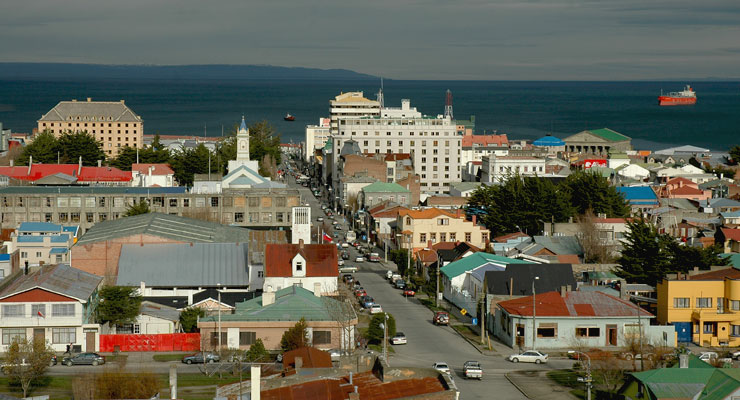
As instructed, I landed in Punta Arenas, Chile and went to the designated hotel to meet up with the race director, staff and the other participants.  Punta Arenas, it turns out, is quite a busy little city with lots of international visitors, as it serves as a gateway city for hikers, climbers and other visitors/tourists to Patagonia and Antarctica.
Punta Arenas, Chile
From the outset, there were two clear themes.  One, logistics were no joke, but extremely well-organized.  Our clothing and gear were checked over at the hotel by the logistics staff.  Anything missing or insufficient for polar conditions had be procured prior to boarding the plane for Antarctica.  Fortunately, Punta Arenas has lots of shops that accommodate this purpose.

The other theme was that we were totally at the mercy of the weather.  We had been instructed not to schedule anything important for at least a week after our scheduled return, as there could be significant delays.  While waiting for the weather to clear, some of us went running (of course!).  Just outside the hotel was a long strip along the Straits of Magellan, which provided an awesome backdrop for some great running.  A very windy run, but very invigorating.  After a couple of false starts, we finally were given clearance to take off.

For the trip over to Antarctica, we took a plane called an "Ilyushin IL-76," which is a Russian plane originally designed for use in Siberia.  After a noisy, cold, and somewhat nerve-racking trip, we landed on a frozen blue ice runway in the middle of Antarctica.  When the plane finally came to a stop, a great cheer erupted.


Camp was located on Union Glacier, a junction between various glaciers flowing down the surrounding mountains.  We were south of the Antarctic Circle, about 600 miles from the South Pole.  The Union Glacier camp is a semi-permanent camp that is in operation for several months each Antarctic summer.  It accommodates various visitors, including climbers heading to Mt. Vinson (one of the Seven Summits), photographers visiting Emperor penguin colonies, and hikers/skiers headed to the South Pole.  Camp accommodations were about as close to first class as you could expect for literally the middle of nowhere.

Things were definitely different than your usual camp though, besides the fact that it was just really, really cold (it got down to 14 degrees F inside my tent at night!).  First, there was a very strict "leave no trace" policy in effect.  For example, if someone spilled some coffee on the snow, someone would come dig out the spill and surrounding snow, then put it in a container for transport back to Punta Arenas.  Chile apparently has a small but very busy industry accepting and processing all the waste that is regularly flown in from Antarctica.

Bodily hygiene was a bit of a challenge.  Using baby wipes and hand sanitizer in frigid conditions is not much fun, especially in those, ahem, sensitive areas.

We were also sternly warned not to go outside of marked boundaries surrounding the camp, as those areas had not been scanned for crevasses.  The glacial ice underneath is constantly moving at a slow pace due to gravity, but it is pushed and pulled at varying rates, causing rifts and cracks.  Special sonographic equipment has be used regularly to make sure there are no crevasses underneath.  Camp and the race trails were safe.  As for the other areas, they were strict no go zones.

The marathon itself was delayed for a day due to windy weather conditions out on the back side of the course.  While frustrating, this gave us time to test out clothing and gear.  Out on a test run, it struck me how cold the wind could get when it picked up even a little, despite my "windproof" shell.  In addition, I realized how cold my feet could get when I wasn't actively running.  While we wore heavily insulated polar boots around camp, running was done in regular trail sneakers.  Even with two layers of socks (including thick winter hiking socks), my feet went numb in the sneakers while standing around.  On the other hand, the footing was surprisingly non-slippery.  The consistency is hard to describe, but was like a slightly crunchy, soft gravel.  Overall, it was clear that this was going to be a much different run than I was used to.

Finally, the weather cleared up enough to run.  Everyone was just so excited to run after so much preparation, travel and waiting.  Running conditions turned out to be perfect.  The trail was well-groomed from the night before.  The air was cold, but clean and refreshing.  There were mild winds that occasionally picked up a little, but nothing that couldn't be handled.  Most of all, the scenery was unimaginably spectacular.  Many of us just ran in constant awe of our surroundings.


One of the most striking things about Antarctica, actually, is just how much more pristine the air is down there compared to the rest of the world.  There is absolutely no haze in the air.  You can see everything in perfect focus all the way to the horizon.  This does, however, completely skew your sense of distance.  In the rest of the world, we are used to a certain amount of haze that makes things that are far away appear fuzzy.  With no haze, things that are far away in Antarctica, seem so much closer than they actually are.  The staff pointed to various mountains that one might guess could be about an hour's hike away, when in actuality they were more than 10 miles away and a full day's hike.  It was startling.


The course was two half-marathon loops.  There were a few aid stations along the way that served all sorts of snacks and hot water.  I never would have thought that I'd want to drink plain hot water during the middle of a marathon, even in polar conditions, but contrary to expectations, it really hit the spot and was really energizing.

The coldest that it got during the marathon was 14 degrees F, but that did not account for wind chill.  When I took my gloves off for a few minutes at an aid station once, I really paid for it.  It took several minutes of running afterwards to get the circulation restored in my fingers and for the pain in the fingers (quite severe actually) to go away.  Thoughts of my fingers falling off due to frostbite crossed my mind....

I took a nice easy pace, finishing in a comfortable 5:53+ (13:29 pace), trying to save something for the upcoming ultra.  In all, there were 48 Antarctic Ice Marathon finishers, with no DNFs.  The range was from 3:41+ to 7:55+, with the majority running between 5 to 6 hours.  Everyone was all smiles for hours afterwards.

November 22nd -- the day after the marathon -- was the 100 k.  Originally, there was supposed to be a day off in between, but it was lost when the marathon got delayed.  There were nine entrants for the 100 k, with four of us having run the marathon the day before.  It was 10 laps of a 10 k loop.  Unlike the marathon, this was a much less supported run.  It was mandatory to carry emergency supplies like a bivy and whistle.  Given that it took so long to finish the marathon, and with the in-between rest day gone, I decided to run just 60k out of the 100k race.  This would be a total of a little over 100 k over two days, which was more than enough for me.


Conditions during the 100 k were a little cloudier and colder.  I measured a low of 9 degrees F while I was out there.  I took my time, taking in the scenery and taking long breaks at aid stations to sit down, chat and eat lots of food.  I must have been burning a lot of energy because I practically took in a normal meal's worth of calories with each 10 k loop.  At the end of my 60k, I was still running pretty strongly, but I was glad to stop.  I knew that if I went another 10 or 20 k, it would become too tempting to just go ahead and try to finish the whole 100 k.  I did not want to risk injury or tempt fate.  Including all the breaks, I ran my 60 k in 10:41+, a 17:14 pace.

In all, there were seven finishers of the 100 k and two DNFs.  The winner came in at 12:06+ (11:43 pace, very impressive for the conditions out there).  The last finisher, a wounded military veteran from the UK, came in at 18:57+ (18:21 pace).  A few of the marathoners were still up reveling at the time (~3 AM) and walked the final 10k lap with him.


Overall, it was a great trip even if I didn't achieve two out of my three original goals.  DNF'ing the 100k was no big deal.  I was probably more upset about not getting a picture of myself in shorts, sunbathing under Antarctica's midnight sun, which would have been quite a unique little picture.  I did drink a little more beer and wine while in Antarctica than I ever would have guessed, but apparently it was not quite enough to get me out there in my skivvies.

Best of all, there was an incredible sense of camaraderie among the participants.  I made many new like-minded friends.  I also found out about some crazy other races out there to add to the so-called bucket list.  Like a crazy 250k multistage ultra through the Amazon jungle, a race through the jungles of Vietnam, and a marathon at the North Pole.... hmmmm.....

Happy running out there!

-Howard C

Read more...

  © Blogger templates The Professional Template by Ourblogtemplates.com 2008

Back to TOP