Thursday, December 27, 2012

Metabolism: Bust the Myths (Part 1)

Reyna F
I often get asked “what is my metabolism?” or “how do I boost my metabolism?”  Depending upon the person, they can get the short, simplified answer or the long explanation.  You are the lucky ones who are getting the long, scientific answer.  It is so long that I split this into two parts. Part 1, which you are reading, defines metabolism and how you can determine your metabolism. Part 2 will explain what will and what will not improve metabolism.  So continue reading to learn more.

What is Metabolism?              

Metabolism is the sum total of all chemical reactions involved in maintaining the living state of the cells, and thus the organism. Metabolism is divided into two categories: catabolism or the break down of molecules to obtain energy; and anabolism or the synthesis of all compounds needed by the cells (examples are DNA, RNA, and protein synthesis).


Difference Between BMR and RMR

BMR and RMR are estimates of how many calories you would burn if you were to do nothing but rest for 24 hours. It is the minimal rate of energy consumption necessary to support all cellular functions and accounts for 50-75% of total energy expenditure in humans. They represent the minimum amount of energy required to keep your body functioning, including your heart beating, lungs breathing, and body temperature normal.

·        BMR stands for Basal Metabolic Rate, and is synonymous with Basal Energy Expenditure or BEE. BMR measurements are typically taken in a darkened room upon waking after 8 hours of sleep; 12 hours of fasting to ensure that the digestive system is inactive; and with the subject resting in a reclining position. BMR is measured by indirect calorimetry after the subject has fasted ~12 h (usually overnight), then rested motionless in a supine position 20-30 min in a thermally neutral environment. The subject is instructed to remain still for the next 30-40 min while the indirect calorimetry measurements are taken. The procedure is not only time-consuming but requires extensive subject cooperation as well as accurate and precise flow and concentration measurements, using sophisticated flow and gas analyzers.


  • RMR stands for Resting Metabolic Rate, and is synonymous with Resting Energy Expenditure or REE. RMR measurements are typically taken under less restricted conditions than BMR, and do not require that the subject spend the night sleeping in the test facility prior to testing. An example of a device used to determine RMR is “BodyGem.”  


Several factors impact metabolism:
  • Body size and composition. The bodies of people who are larger or have more muscle burn up more calories, even at rest.
  • Gender. Men generally have less body fat and more muscle than women of the same age and weight, thereby burning more calories.
  • Age. As one get older, the amount of muscle tends to decrease and fat accounts for a greater percentage of weight, slowing down metabolism.
  • Heredity. Some people are born with faster metabolisms, while others naturally have slower metabolisms.
  • Hormones such as thyroid and insulin.
  • Medication
  • Stress
  • Sleep
  • Thermogenesis or the Thermic Effect of Food (TEF).  Digesting, absorbing, transporting and storing of food consumed. This accounts for about 10 percent of the calories used each day. For the most part, the body's energy requirement to process food stays relatively steady and isn't easily changed.
  • Calorie expenditure. Lifestyle, exercise, movement.
Calculating BMR/RMR
There are several calculations and apps for determining metabolism.  As you see below, there are quite a few.  Which is the best? Most programs and apps use the Harris-Benedict equation.  But Mufflin is a bit more accurate for average adults.  Two formulas that consider lean body mass (LBM) include the Katch-McArdle equation (BMR) and the Cunningham equation (RMR). These formulas should be used for athletic adults where muscle mass is significantly higher than average.

BMR and RMR Equations

The Harris-Benedict equation for BMR:
  • For men: (13.75 x w) + (5 x h) - (6.76 x a) + 66
  • For women: (9.56 x w) + (1.85 x h) - (4.68 x a) + 655

The Mufflin equation for RMR:
  • For men: (10 x w) + (6.25 x h) - (5 x a) + 5
  • For women: (10 x w) + (6.25 x h) - (5 x a) - 161

Where:
w = weight in kg
h = height in cm
a = age

Katch-McArdle (BMR):  370 + (21.6 x LBM)
  • To calculate LBM, multiple total body weight by body-fat percentage. If one has 10% body fat and weighs 80 kg, his LBM would be 72 kg (i.e., body weight of 80 kg – 10% body fat of 8 kg = 72 kg of LBM). Therefore, using the Katch-McArdle equation: 370 + (21.6 x 72) = 1,925
Note that this result is significantly higher than the non-LBM formulas (Harris-Benedict and Mifflin).

Cunningham (RMR) - 500 + (22 x LBM)
  • This formula is similar to Katch-McArdle, but provides a slightly higher estimate.
500 + (22 x 72) = 2,084

Using the Calculations
As BMR and RMR only represent resting energy expenditure, an adjustment must be made to reflect activity level. This is done by multiplying BMR or RMR by an activity factor. Note that the following activity factors also take into account the thermic effect of food:

Activity Factor
Category
Definition
1.2
Sedentary
Little or no exercise and desk job
1.375
Lightly Active
Light exercise or sports 1-3 days a week
1.55
Moderately Active
Moderate exercise or sports 3-5 days a week
1.725
Very Active
Hard exercise or sports 6-7 days a week
1.9
Extremely Active
Hard daily exercise or sports and physical job


Use of these activity factors produces a very rough estimate, and there are many different opinions on what these activity factors should be.

Now that you estimated your metabolism, what can be done to change it?  Stay tuned for Part 2 of Metabolism: Bust the Myth.

-Reyna F 

Blogmaster's Note:  For more information, contact Reyna Franco (Reyna@reynafranco.com). She is a registered dietitian, certified personal trainer, certified specialist in sports dietetics and NY Flyers member.  Her office is located on the upper west side and she counsels individuals and groups on sports and medical nutrition.  Her website which is in the process of being upgraded is www.reynafranco.com.

Read more...

Friday, December 21, 2012

The Bronx is Up, Manhattan is Down —


2 miles too far, 10 degrees too hot, and about an hour too long!


Note: I ran this run in April, about a month before my marathon (see this), and as you can see I had really had enough of long runs!  The account has been adapted from an account on my web site, which you are welcome to read: The Bronx is Up, Manhattan is Down

April 21st — My Last 20 Miler  (Holy Cow, it was 22.1 miles!)

H

ooray! This was my last 20 miler. Of course there is that little matter of a 26 miler coming up, but those are always a lot of fun .  But there were a couple of unanticipated things: it got hot — no, not summer hot, but late spring hot — and I figured my mileage wrong and ended up running over 22 miles. I didn't actually figure it wrong, but I did some extra side trips which added up, and took a different route back from Van Cortlandt Park to avoid the long unshaded route along the Harlem River I had originally planned. But it's done, I feel fine (I'm writing this on Sunday) and what do they say, "No pain, no gain," whatever.

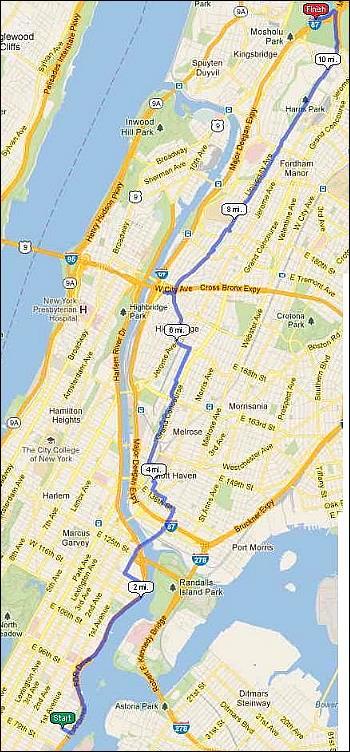
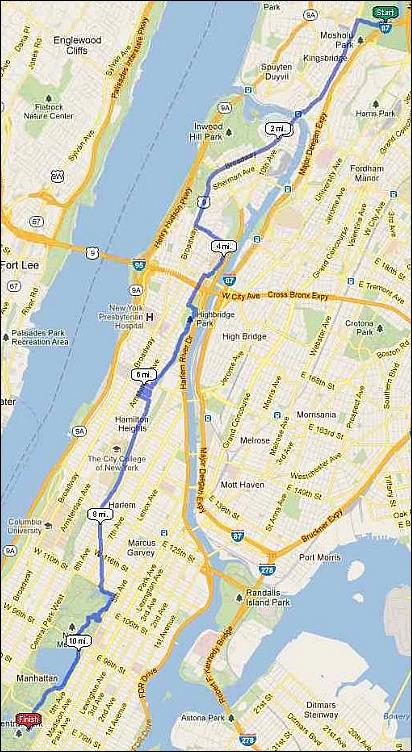
Flyers Susan S and Melissa C both joined me but decided to take a different route back and they ended up with around 16 miles. We all felt the effects of the warmer weather but I would say everyone was satisfied that it was a good run. Just below are a couple of maps, one for the northbound and one for the south bound section. They  were generated by the USA Track and Field route tracking software. If you click on the links under each map you will get the live Google Map from the USA Track and Field web site. This will also give an elevation profile of the route.

If you are interested in these routes, email me using the link at the bottom of the page and I'll give you all the details you want. If you decide to do this run, I strongly suggest you click on the links for the USATF interactive maps and zoom in, since some of the fine details of the route are not given in this report (such as "zig-zagging over to the Grand Concourse").

There are two small albums on the net, one for the northbound route and one for the southbound. Just click on the link under the photos for those sections. When the album comes up, click on the “Slideshow” link on the upper left of the page.

First Half: Going North, Mostly in the Bronx 


The route was a combination of various other routes we had done with a few new pieces thrown in. Going up, we started up the East River, crossed over the Willis Avenue Bridge and did our South Bronx Route. This involves zig-zagging over to the Grand Concourse and running up through Franz Sigel Park and Joyce Kilmer Park . At this point we broke some new ground and made our way up to the Bronx section of the Old Croton Aqueduct (aka the OCA), via the Edward Grant Highway and University Avenue. Then we retraced the route we had taken 2 weeks ago along the OCA (see the April 7th MiniBlog post) up to and into Van Cortlandt Park to the Golf Club House. The part of this on the streets was a bit gritty, but hey, this is the South Bronx.


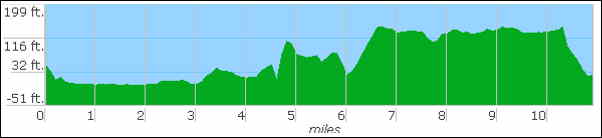
Elevation Profile, Northbound

The elevation profile is interesting in that you can spot the relatively flat and elevated portion when we were running along the Aqueduct (roughly miles 6.5 to 10.5. That dip just before mile 8 is where the Aqueduct is interrupted at Burnside Avenue. See this and this for that story. It's also interesting to see how you go down when you enter Van Cortlandt Park (the last half mile or so), That makes sense since if you've run on the OCA in that park, you know it's up on the side of a hill. The fact that the Aqueduct is at a higher elevation than just about anything else in the South Bronx shows how expertly the surveyors laid out the route in the 1830s. Remember, the water was entirely gravity fed in that era.


Along the OCA in the Bronx

One thing that was very noticeable to us was that the trees were much more in leaf than they were just two weeks before. Take a look at the above photo  and compare it with some of the scenes looking along the Aqueduct in the April 7th MiniBlog post (especially the one showing the the playgound at Tremont Avenue and the next one showing the locked gate, which show the same section of the Aqueduct, although from a different view), you'll see the difference.

Taking a Break in Van Cortlandt Park

We took a break at the Golf Club House in VC Park and after some discussion, the women decided to do around 3 miles on the cross country trails and then head back along the #4 line. Then they would hop on the train when they got the mileage they were looking for. For my part, I would head out to Broadway, fill up on Gatorade from a local deli, and then figure how to get the least exposure to the sun on my way back to Central Park.

Second Half: Going South, Mostly in Manhattan


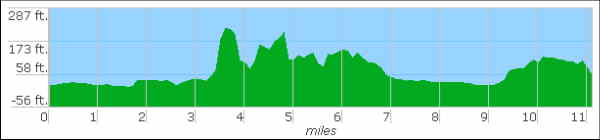
I had taken my shirt off when we got to Van Cortlandt Park and when I got back to Broadway I put it on briefly when I went into a deli to get some Gatorade. I ended up carrying the bottle about 2 miles. Meanwhile my shirt was hot a sticky so I took it off again. I was amused by the 3 or 4 comments I got, exclusively from young males. One memorable one was "Put your shirt back on, you're scaring the women". Hmmm .. Some how I doubt that. I crossed into Manhattan and stayed on the shady side of Broadway (the east side) till 190th Street. There I took a little known shortcut: there is a subway entrance for the 190th Street stop on the #1 train, even though that train runs under St. Nicholoas Avenue at this point. Well, there is a long horizontal tunnel that heads east under the steep escarpment, and at the end, an elevator that brings you up the 120 odd feet. It's shown as a dotted line on the Google map. A great saver for a hot tired runner. It also explains the unusually steep climb on the elevation profile (below) around mile 3.5.


Elevation Profile, Southbound

Once I was on the top of the hill at St. Nicholas Avenue, I ran the two blocks to High Bridge Park and ran down on the park road and the OCA the length of the park. The very steep down hill, just before mile 5 on the profile, is the stairway down from the tower to the Aqueduct. Each part of this route was chosen to minimize exposure to the sun. This route through High Bridge Park is almost the same (in reverse) to that taken many times, the latest on my "Manhattan Parks 20 Miler" which you can read about via the link.


Looking across St. Nicholas Park to City College
Cick for Southbound Album

Once past this diversion, you can see the long lazy down slope along St. Nicholas Avenue from about mile 7 right into Central Park on the profile. I was sure glad there were no hills at this point in my run.

2 miles too far, 10 degrees too hot, and about an hour too long! 

Well, Central Park was a welcome sight and I went down around the Meer and through the Conservatory Garden and finally ended up at the Boat House — 2 miles too far, 10 degrees too hot, and about an hour too long.

I met Melissa for brunch, got home and crashed. But you know what? No more 20s! Yes, life is good.
- Papa Bear (Richard G.)

This account and a number of others featuring long training runs in the greater New York area primarily lying outsider of central Park can be found on Papa Bear's web site: Beyond Central Park 

Read more...

Saturday, December 15, 2012

NY FLYERS 2012 TOYS FOR TOTS RUN

Scott S
The Flyers annual Toys for Tots Run is one of many longstanding Flyer traditions. For years Sandy A arranged the toy drive to benefit children with serious illnesses staying in the Pediatric Center at Mt. Sinai Hospital on Manhattan’s Upper East Side. Participants would typically gather at the Engineers’ Gate, put their donated toys in Jerry F’s car, run down Central Park’s East Drive, exit the Park, stroll past the holiday windows on Fifth Avenue, and sing holiday songs underneath the Rockefeller Center Christmas tree with Laurent N conducting. Then the singers would run north through Central Park to Mt. Sinai, go room to room singing for the appreciative children (and their parents) and distribute toys as they sang.  The event concluded with a celebratory holiday brunch.

This Year's Singer's Show Off Their Dance Moves, Too!
Several years ago, for the sake of the health of both the patients and the singers, Mt. Sinai forbade the Flyer choir’s singing in the children’s rooms. Instead, the Flyers were ushered into the hospital’s new internal television studio, where the singers would perform live for approximately half an hour. Children were able to call in with their requests, which inevitably were dominated by songs the Flyers had just sung, songs the Flyers didn’t know, or everyone’s favorite musical tribute to holiday sadism “Grandma Got Run Over by a Reindeer.” Thankfully, the mellifluous bagpipe stylings of Flyer Patrick D kept the singers’ holiday spirits bright.

Unfortunately, the toy drive was canceled in 2011 when the Flyers and the Mt. Sinai staff could not agree on a suitable time for a visit (“could you come in at 6:30pm on the third Sunday in December?”) However, this venerable Flyers’ holiday tradition returned this year thanks to Sandy A’s tireless efforts. She arranged a toy drive to benefit kids affected by the recent Hurricane Sandy and coordinated with the Central Park Zoo to accept the donated toys (no, we didn’t sing for the animals). As an added benefit, those who gave toys were given a ticket good for future admission to the Bronx Zoo (note: Sandy also volunteers as a guide at the zoo, so be on the lookout for a Flyer day at the zoo in 2013!).

Jodie F, Laurent N, Laurie H (with her dog Paco), Steve K, Debbie P, Robert B, Scott S, Amy S, Jennifer B, David W
The Flyer singers met near the Central Park Zoo entrance at the appointed time – this year’s participants included Sandy A, Jennifer B, Robert B, Maribeth C, Jodie F, Laurie H and her dog Paco, Laurent N, Steve K, Debbie P, Amy S, Scott S, and David W. After introducing ourselves to each other and posing for some group photos, the singers dropped off their toys at the Central Park Zoo, then headed out of the Park and down Fifth Avenue to see the 2012 holiday windows.

Laurent was waiting for us underneath the Rock Center tree when we arrived, but as has been the case the last several times the event has been held, our group was prevented from singing directly underneath the tree by the Center’s crack security force. Apparently, there’s now a formal sign-up process in place for groups wishing to perform underneath the tree, and groups that attempt to circumvent this process are threatened with eviction, incarceration, and forcible removal of vocal cords with a sharp instrument (my apologies to any junior Flyers who may be reading this). After posing for several group photos underneath the tree, we found an unguarded area across the street and belted out several up-tempo holiday favorites before the wind and steady rain conspired to dampen our spirits.

Click the Arrrow:
Then Sing Along with The Von Flyer Family Singers

The group had planned to return to Central Park and enjoy a four-mile run together, but due to the weather the group decided to forego the run and proceed directly to the brunch portion of our program. After securing a table for twelve at a café in the Rock Center concourse, the group decided to leave after discovering that the cafe didn’t see fit to include brunch items on its menu.

Brunchtime for Hungry Singers
A new venue was chosen, brunch was ordered, and a good time was had by all. Thanks again to the hearty souls who chose to participate this year, and special thanks, as always, to Sandy for organizing the event and Laurent for leading us in song!

-Scott S

Read more...

Sunday, December 9, 2012

Rachel G: New Flyer

Rachel G
Hey! My name is Rachel.  I live in what I like to call the grey area of Manhattan, not exactly Midtown East and not Gramercy, however a stone throw from some great Korean and Indian food. During the winter months, I try to escape the cold and venture to candy land aka Miami Beach. For me, the cold is good for one thing only – running. Yes, I am one of those crazy runners you see running the streets of New York in 30 degree temps, dressed like its summer out while passersby think I'm clinically insane.

Similar to recent new Flyer, Catie B (click HERE to read about Catie), I also was a dancer and had zero interest in running for most of life. I still consider myself a dancer, but for now that means just being in the moment with music.  I find myself dancing at very inopportune times while listening to my iPod, waiting for the light to change during my runs, and at the end of a 20 miler when I hear Payphone by Maroon 5 playing.

Beginning of an Obsession

I have always been a health and fitness enthusiast. This began at an early age. You know what they say; you do exactly as your parents or the complete opposite. Their sedentary lifestyle coupled with bad eating habits, led them to be overweight and riddled with health issues.
I knew this was not at all what I wanted for myself. So I think this made me obsessed with my physicality and health. There are definitely worse things to be obsessed with, right?

Game Changer

Prior to 2008, I never ran a step.  In fact, I would see runners and think they looked miserable. Why on earth would I want to voluntarily inflict pain on myself. That same year the economy crumbled and I was at a personal and financial crossroad.  I needed to deflect from all of the uncertainty in my life and figure out where to channel feelings of anger,
frustration and hopelessness.  

Fortunately for me, I stumbled upon TFK online and the idea of running to help others was born for me. Mind you at this point I hated running and did not know many people who ran. Most of my friends would ask "how far is that marathon?" Lol. 

I think I was drawn to having to plan my weeks and weekends and the progression you can clearly see week by week. While most everything else in my life was uncertain my running plan was a constant. 


NYC Marathon 2008
I accredit running for changing my life. Some might say that is extreme, but the way it makes me feel and the energy it allows me to put forth to the universe is incomparable.


Philly Marathon
2012
Running has allowed me to see that anything is possible. From running my first marathon hoping to break 4:00 hours and actually ran 3:50:56, to my 6th marathon hoping to run sub 3:05 and ran 3:10:27. I have learned one should strive for progress, not perfection. Most long distance runners would agree that running is mostly mental. This has allowed me to extrapolate this concept further and say that all of life is mental and with the right attitude and the guidance of a few great people along the way, each of us can achieve greatness.


Chasing Times and the Flyers

This summer I set out to train and break 3:05 at the NYC Marathon. I wanted to do some or all of my long runs with runners that had a similar goal. I did just that and felt I was on my way to achieving my goals. It was early summer and running felt like a chore; it had lost its meaning for me. I needed something to recharge me.

By accident, I found the Flyers and their need for pacers for the NYC Marathon Long Training Run in July. I thought to myself maybe if I could help someone perhaps run farther and faster than ever before, that might recharge my love of running.


Rachel G and Catie B
8:30 Pace Group Leaders
Not only did this recharge me, but it was a game changer for me. I found more joy in helping the 8:30 pace group get to the finish line than achieving my own running goals. During this pace run, I met some of the strongest and interesting women. 

They thanked me numerous times, not realizing how much I should be the one thanking them for helping me realize it is not about chasing times, but the journey along the way.


8:30 Pace Group Runners:
Smiling Faces At the Finish


Although finding the NY Flyers was what most would say was an accident, I believe this was divine intervention. I look forward to spreading my love of running, positive energy, and desire for helping others achieve greatness, with the help of other Flyers.

-Rachel G

Read more...

Saturday, December 8, 2012

Shoe4Africa 5K Race

Toby T
It seems like every single week there is a charity running race in New York City.... Well that was five years ago.  Now there are three or four races every weekend.  Ask the Flyers' Tim D who did a triple-decker last Sunday –– his last stop was at the T-Mobile Shoe4Africa 5K.


This race was originally a fundraiser for Africa, to raise money for ground breaking on a children's but then a big storm hit New York. Suddenly the hospital plans got put on hold. All attention needed to be shifted to the hurricane relief.  


T-Mobile, a company that has never been involved in race sponsorship, came in to cover the race costs with the company's CEO offering any T-Mobile employee their money back if they beat him to the line!  While PepsiCo offered to feed all the hungry runners after they finished the race.  A large contingent of Flyers participated in the race, and enjoyed the raffle that followed, while Achilles athletes and guides came out in force, as well.
Flyer Steve K and Flyer/Achilles Guide Shira Z
And the money rolled in – more than $75,000 – which will be used to buy gifts for the many children who have lost everything in three highlighted schools: one each in Staten Island, Red Hook and the Rockaways. 

-Toby T.

Read more...

Thursday, December 6, 2012

The Flyers Executive Board Needs You!


Richard B
Blogmaster's Note:  This post was originally published on December 3, 2011.  -Dave K

What Does it Take?

Ever wonder what it takes to make the largest running team in New York (a.k.a. The NY Flyers) function?  It takes wonderfully helpful volunteers just like you.  We’ve all enjoyed the Flyer parties, training programs, group runs and more.  Behind every one of these events are motivated Flyer volunteers spending a few hours making the event happen.  And behind each Flyer volunteer is the Flyer Executive Board supporting them in their efforts.  As someone who has been volunteering for the Flyers for my 14 years and served on the Flyer Executive Board as Member at Large, I can tell you that I find the consistent achievement and personal fulfillment intoxicating.  It is also one of the best forms of social networking with fellow members.
Flyers Volunteering at the Palisades Long Training Run

Shira Z and Adam H at Flyers Central Park Clean-Up Event
So, How Do I Become a Volunteer?
Think about the kind of work you enjoy. Are you more interested in social events? Are you an expert in technology, legal or finance? Are you a creative writer? There is always a place where you can contribute. Just approach the Flyer Executive Board and see where help is needed. And maybe you are interested in management. In that case, serving on the Flyer Executive Board can be quite fulfilling.
Flyers Leading the NYRR Marathon Long Training Run
What About Serving the Flyer Executive Board?
Serving on the Executive Board is a great way to give back to the club. Click here for a list of Executive Board members, and other Flyer volunteer positions.  The Executive Board allows members to take a leadership role with the Flyers and to help shape its direction and standing in the running community. There is no better place to make a huge impact on the success of the Flyers than on the Exec Board. If you have some organizational skills and some time to spend helping the club, then you are qualified. Don’t worry about too many details of the club’s 22 year history that you may not know. There is an Advisory Board and many long-time volunteers who are there to help with any details on how the club has worked in the past.
Flyers on an Organized TGIF Boat Cruise
How Can I Get on the Flyer Exec Board?
The only way to get onto the Flyer Exec Board is to be elected. Early in the month of December, an election committee is formed to organize members who want to serve on the board. If you’re reading this blog entry now in early December, then now is the time. Click here for the election page and nominate yourself or someone else for office. The Flyer election committee members will give you all the details you need. Flyers can nominate other Flyers or they nominate themselves for one of the 5 officer positions:
  • President
  • Vice President
  • Treasurer
  • Secretary
  • Member at Large.
You should talk to the existing officers or past officers to better understand the roles. Once you are a candidate for a position, there is an election process that lasts a few weeks. Members of the club are given the opportunity to vote on the candidates, and the candidate with the most votes is chosen to serve on the Executive Board.

So, What Next?

Every year, we attract so many new members of the Flyers who love the camaraderie and social aspects of running. They know that the Flyers are the epitome of socializing and having fun in the running community. I love seeing all these new faces every year at events. I hope many of you will step up and take a leadership role in the Flyers.

Richard B.

Read more...

Monday, December 3, 2012

JFK 50-Mile Ultra Marathon

Stephanie T
Blogmaster's Note:  This Flyers Blog entry was written by Stephanie T, enhanced by her husband Ray's photography, and includes additional perspectives provided by her partners in crime, Felicity L and Julie W, as so noted below.


Stephanie:  I am a planner. This is a fact I begrudgingly admit.  During my morning subway commute to work, I plan out my schedule for the day to the minute so that I maximize the use of my time.  I schedule my vacation plans with my husband to the hour. I also, as most distance runners do, follow a training schedule and establish a goal pace for my marathons.

I knew long before my training had started for the JFK 50 Mile that I would find it difficult to plan out the logistics for this race. When I received the exciting news on May 10th that my race entry had been accepted, I had just started to run up to 8 miles at a time –– the most mileage in more than six months –– due to a knee injury. I recognized that I had over-trained last fall, and was now slow and out of running shape.  However, I was confident that I would be able to train the “right” way this year, and for my first ultramarathon at that!
The JFK 50 Mile Race Confirmation Mailed to Participants
The JFK 50 Mile is a race of historic significance, making it all the more special.  It was first held in the spring of 1963 and was one of numerous 50 mile events held around the country as part of President John F. Kennedy's push to promote physical fitness.  The initial inspiration behind the event came from President Kennedy challenging his military officers to meet the requirements that Teddy Roosevelt had set for his own military officers at the dawn of the 20th Century.  It is the only original JFK 50 Mile Challenge event to be held every year since the challenge was launched.  Many many military personnel continue to participate each year.  This year marked the 50th running of this illustrious event.

MONTHS BEFORE RACE DAY

Stephanie: The first planning-related obstacle I tackled was finding a training schedule for an event of this distance.  We’ve all come across numerous 5K, 10K, half marathon and marathon training plans in magazines, in books and on the internet, but a 50-mile one was hard to find.  After sifting through online forums for advice, I was directed to read Bryon Powell’s Relentless ForwardProgress: A Guide to Ultramarathons, from which I created a schedule, in conjunction with the New York Flyers’ Marathon Training Program—the book became the foundation for my training.

I followed my 4.5-month schedule closely as long as I felt good and strong, and I learned from last year to give myself days off when I felt too tired or sick. I completed three 14, 16, 20 and 24-mile long runs, two 18-mile back-to-back runs and one 50K long run, and I mixed in a lot of long bike rides and yoga classes, mostly during the first half of training.  I immediately grew accustomed to running with a hydration pack, in which I stored my water, food and extra clothing, and realized I preferred using it over a fuel belt (I tried carrying a bottle, and hated it so much I hid it behind some bushes after the first of four Central Park loops one day!).

I practiced and enjoyed eating solid food on my long runs, mostly PB 'n' J quarter sandwiches and halves of Honey Stinger waffles, a practice that I learned is the norm in ultras.  I started using salt tablets during long runs, and discovered that water plus salt worked much better than Gatorade for me, and diminished feelings of nausea I used to experience during runs.

Felicity: To be honest, I didn’t really follow a training plan. Basically, I did the Flyers Tuesday night speed work outs, Thursday night runs, and a long weekend run. I’ve found that I get injured easily when I run more than three times a week, and this schedule works really well for me. My long runs (not in order) were 33, 31, 30, 27, 25, 23, and a bunch of 20’s. I also travel a lot for work, and often to places where running is impossible, so my training schedule was pretty unorthodox.  I did a lot of my long runs in the Palisades trails (as well as trails in Arizona and Kenya) which I think definitely helped my trail running skills and prepared me well for the Appalachian trail section. I don’t like eating solid food on long runs and have trouble eating enough, but I found that the Hammer Sustained Energy powder mixed with OJ kept me going for hours!

Hartford Marathon + 4.9 Miles = My First 50K Run!
Julie:  This would be the third ultra I would run this year (having run a 12-hour in June and a 24-hour in July), so I already had a good base. I followed the same training plan as Stephanie, jumping right back in after taking two weeks off from the 24 hour race. This was the same program I had used for the 24 hour race (except I followed the 100 mile plan for that one). Stephanie and I actually met one another at the Hartford Marathon, which we were using as a 50K training run. Yay, marathons as training runs! 

I also tried to listen to my body rather than doggedly following the training plan, and there were times I cut back a bit, particularly if I had run a race or hard run the week before. I did very little (read: no) cross-training, other than occasional brief workouts with my kettle bell and walking between 3 and 6 miles to and from work and 5 miles on Sundays with a friend. 

Unlike most ultra runners, I prefer a waist pack, which holds two 24 ounce bottles and plenty of pockets for gels, electrolyte capsules, etc. I don’t like carrying things on my shoulders, and find I don’t notice the pack at all. Most of my training was done on roads (which came back to haunt me a bit on the Appalachian Trail), with shorter long runs on the hills of Central Park, and longer ones around the perimeter of Manhattan for the most part. 

After having experienced stomach upset trying to take in lots of gels and solid food in my 24-hour race, I decided to make a drastic change in my eating habits and adopt the primal diet. I also found the book The Paleo Diet for Athletes by Dr. Loren Cordain particularly helpful. The idea is that over time, you train your body to use stored fat as its primary fuel source, rather than sugars. This enables the endurance athlete to not only run longer without “hitting the wall”, but also to drastically limit the amount of calories required during endurance events, thus decreasing the chances of stomach upset, etc. 

For my long runs, I mainly fueled with a superstarch drink mix called Generation UCAN, but still took in the occasional gel if needed. I also only drank water and supplemented electrolytes with Saltstick capsules. 

WEEKS BEFORE RACE DAY

Stephanie: The next planning-related obstacle was one that truly took me by surprise— I would not be able to plan a race pace nor could I predict my finish time!  When I looked to my ultra friends for advice on how to pace myself, my friend (and Team In Training coach) Mike B. responded: “The thing with ultras is that the courses are all so different, compared to run of the mill road races that one 50K or 50-miler cannot be compared to another, and they certainly (if it's a trail ultra with some decent elevation gain) can't be compared to a marathon.”  I had at least started with a pace group for my last seven out of 11 marathons, so to think that I wouldn’t be able to determine a race pace was mind-boggling to me at the time (but makes complete sense now post-race!).

Felicity: Totally agree. Really hard to predict! I knew the trail section would be slow but not having run it before, it was hard to estimate. I crunched some numbers and came up with an estimate of 10 - 10.5 hours, which turned out to be correct. As my first ultra though I really was just focused on finishing rather than on time.


Julie:  Ah, the blessed variety of the ultra! When asked what my predicted finish time was, I always said I just wanted to finish under the 12 hour cutoff. This was the first ultra I had run that had strict time cutoffs at various points along the way, and while this stressed me out a bit at the start, I found it was also a great motivating force to run harder! I found that imagining the race as three races, as Stephanie outlines below, helped me to better prepare mentally for what was to come.

DAY BEFORE RACE DAY

Stephanie: The day before the JFK 50 Mile had finally arrived, and I was overwhelmed with excitement and nerves! I felt like I had a golf ball stuck in my throat, and my heart beat faster every time I thought about the race!! My nerves were diminished as Flyer Julie W, Flyer Felicity L, Felicity’s boyfriend Zack B, my husband Ray T. and I shared running and other stories (such as Julie often works with dead rats, and Felicity tapered in South Sudan!) during our pasta dinner at a local Italian restaurant.  Ultra-veteran Julie also shared a great piece of advice with us, one that I recalled throughout the race—she advised us to break the race up into segments that felt doable. She suggested three races:

(1) The first 15 miles on the Appalachian Trail;
(2) A marathon on the C 'n O Canal tow path; and
(3) The final 8 miles.

In my mind, I no longer thought of the race as a 50-miler, but rather three smaller races, a last-minute change in perspective that would prove to be of huge help..
JFK 50 Mile Map & Elevation Chart

Julie:  This day was filled with unexpected stress for me, as I experienced car trouble on the way and almost didn’t make it to the hotel. Fortunately, there was a car rental place within walking distance of where I was staying, and although they only had a giant white “soccer mom” minivan left, I gladly took it. I make it a habit to stay in a hotel with a kitchen the night before a big race so I can prepare my own food, but took a chance and had dinner out with Stephanie and Felicity. I was very glad I did this, as it helped calm my nerves, and it felt good to offer advice to the “newbies”…they didn’t really need it though.  Plus, the chicken smothered in cream sauce and butter that I ate was SO good. And by the way, I don’t work that much with dead rats…mostly mutant mice. They are FAR more interesting!


RACE DAY!

Stephanie: On race day, Ray and I walked together from a high school where the mandatory pre-race meeting was held to downtown Boonsboro, MD along with over a thousand runners and their families and friends to the race start.  We quickly found Julie, Felicity and Zack, and, without any warning (or national anthem or speech), we heard a gunshot to signify that the race had begun!
Stephanie, Julie W and Felicity L
Felicity: I really loved this part of the race! The trail was super-pretty and more run-able than I expected. Here and there the trail was a bit crowded, but as my main goal was to just keep moving at a reasonable pace and not fall on my face, it wasn’t a major problem. I actually finished the first 15 miles about half an hour faster than I thought I would, and didn’t feel too worn out – though moving on to the relatively easy terrain of the towpath was a relief for my ankles!

Stephanie: My quads felt sore and my feet and ankles beat up at the start of the towpath . A man named Don approached me who inspired me with his story.  Don was an ultrarunner who had a heart attack and open heart surgery only a year ago. Only months after surgery, Don continued to run 50 and 100-mile races, though at a much slower pace now. He simply loved to run.  I lost Don during a Port-A-Potty break at Mile 22, and only then realized how monotonous it was running on the towpath.  The scenery never changed—water to the left, trees to my right, and brown leaves beneath my feet. 

Mile 15 – The End of the Appalachian Trail
By the time I saw Ray and Zack at the Mile 27 aid station, I was struggling—physically and mentally.  I only now realized the toll that the trail had taken on my body, and the thought of having to run nearly another marathon was more than I could bear. Ray let me know that they would meet me again at Mile 39, and I contemplated ways to call him to tell him I wanted to stop.

I never called Ray.  I continued to contemplate the idea until Mile 36, when the physical pains subsided, and a switch went off with the realization that I only had a “short” long run to go—I could finish this.  I picked up the pace and smiled widely as I approached them again! I savored nearly every item that was offered at the aid station—a blueberry bagel quarter with cream cheese, an orange slice, chicken noodle soup, red velvet cake, a half of a banana and Coke—as my handler Ray restocked my hydration pack with water, and helped me slip it back on.
Mile 39 - Ray Refills My Water Bladder
(As I Refuel On Red Velvet Cake, A Blueberry Bagel Quarter
AND A Piece of Banana)
Felicity: The toughest part of the race for me was miles 27 to 39… knowing that I’d gone a long way but still had some hours to go. And it didn’t help that I was expecting the Mile 39 aid station at Mile 36 (optimistic/can’t read properly). I’d been able to keep up a strong pace so far though, so I knew that as long as I kept moving I could beat the 12-hour cut-off no matter what. I found the towpath really beautiful as well — not too monotonous!


Felicity Approaching Mile 39 -- Finally!
I think I hit the nutrition really well –  until Mile 40 I only drank my Hammer drink concoction, water, and two granola bars – and felt great; I was able to take in enough calories and felt pretty strong throughout the entire race. The caffeinated shot blocks I added in at Miles 40-50 helped too J    But I didn’t want to start experimenting with all the aid station food, so I only paused long enough for water. And in fact this saved me a lot of time in the end – a lot of faster runners would pass me on the towpath and then I’d catch them at every aid station. One of the pieces of advice I’d read about this race is that since there are SO MANY aid stations (like every 2-4 miles) you need to be strategic about getting in and out because it’s easy to get distracted and lose a lot of time.

Stephanie: I continued to run out the towpath, slipping on the “vest of shame,” worn by runners that didn’t arrive at mile 41.8 by 3pm, onto the last 8 miles on asphalt, and toward the mile 46 aid station, toward Ray, but barely stopped when I reached it, knowing I was almost there!  I trotted up and down the rolling hills, enjoying the sights of cows and the smells of farm land.  The skies were black when I ran toward the finish line. A man’s voice behind me screamed, “I’m going to get you. Pick it up!” I responded, “Let’s do this!” as I sprinted and leapt to the finish!

Finished!
The JFK 50 Mile was the most challenging race I’ve ever run on so many levels.  The unplanned elements of training and the trails proved to be one of the most exciting aspects.  Ask me in another month if I’d run another again!

Felicity: What an amazing race! My bf Zack, Stephanie's husband Ray, and Flyer Derek C. were a great cheering / photography / handling crew. And it was really fun to have a couple of awesome Flyer ladies to have dinner with the night before and start off the race together. The race itself was incredibly well organized, great volunteers, beautiful course – would definitely recommend the JFK50. 


Julie:  One of the things I love most about running ultras is the “small town” feel they have, even in one as big as the JFK 50. The start in the middle of town was so cool. One potential mistake I made was to jog the entire 2 miles up the road before the entrance to the Appalachian Trail. I hadn’t studied the map well enough to know about this part, and it kind of went against my idea to walk all the hills. Who knows if it cost me any time later in the race, but something to consider if I ever run it again. The most physically trying part of the race for me was the trail, as it also beat up my quads and ankles pretty badly. I also fell three times (fortunately on soft leaves) and turned my ankle once. I’ve never been so glad to get off a mountain! 

I found the tow path “marathon” to be a mental challenge, due to its flat tediousness. I was actually looking forward to the hills of the last 8 miles, so I could have an excuse to walk again! I passed the time talking to various folks and “being in the moment” as much as possible, not thinking about what was still to come. I even started to name some of the folks whom I kept seeing, like the “most colorful man” wearing fluorescent green/yellow attire. He turned out to be named Les and was a New Yorker as well, as I found out after the race. The last 8 miles through scenic farmland was really a “run/walk” in the park, as by that time I knew it was all over but the crying (which I did with 1.5 miles to go…getting choked up and tearfully thanking the aid station volunteers). I even managed to “sprint” to the finish (at least it felt that way…although I probably was going like 4 mph at that point!).
"Thanks" Brightroom for  Lettting me "Borrow"
This Teensy Little Pic -- Yes, That's Me, Julie W,
Waving and Smiling on the Trail :)
Due to concerns about stomach issues, my nutrition for race day was far simpler than Stephanie’s:  I ate a banana, a packet of almond butter, and two hard boiled eggs two hours before the race and followed this up with two packets of UCan 30 minutes prior to the start. During the race, I took in a total of 3 packets of UCan, 5 gels, and two packets of almond butter. My energy felt great, and my stomach gave me no issues. I also felt mentally strong the whole time…no ups and downs. 

Immediately after finishing, I had a recovery drink called Mike’s Mix and managed to choke down a slice of pizza before being accosted by Stephanie carrying pizza, a burrito, a Twinkie (where did they find those?), and a HoHo. Proof of her ironclad stomach can be seen in our finisher photo…notice the pizza crust still clutched in her left hand. 

I also felt this race was the most challenging I have run to date, at least physically. The variety of terrain, while nice mentally, takes its toll. And while I easily beat the time cutoffs, that little voice in my head never stopped reminding me that they were there (or maybe I was just hearing things due to lack of calorie intake!). Additionally, this was the most prestigious ultra I have ever run and I felt honored to have been a part of it, particularly in its 50th year! 

On the bus back to the start to pick up my “soccer van,” I sat next to an elderly man who had run the race 21 times…what an inspiration! And I also chatted with some folks who are planning to run the Western States 100, which has been on my bucket list for a while. You don’t have to wait a month to ask me if I will run another ultra…I already have 4, possibly 5 planned for next year, including my first 100 miler! I’m also so happy that I got to share this experience with Stephanie and Felicity…they made me very proud!

Blogmaster's Other Note:  Steph, Felicity and Julie were too modest to include their incredible race result times in their write-ups, but if you're curious and want to be impressed on how fast they chugged up and down and around and along this 50-mile rugged route, you should click HERE.

-Stephanie T, with Felicity L and Julie W

Read more...

  © Blogger templates The Professional Template by Ourblogtemplates.com 2008

Back to TOP