Showing posts with label A* Blogger Scott C. Show all posts

Monday, February 17, 2014

Flyer of the Year: Scott Cohen

Scott C
Receiving the FOTY award is truly an honor and I will be forever grateful to the club for recognizing me. I'd also like to acknowledge the other fine candidates who were nominated -- Bob Cowin, Nick Jesdanun and Justine Kirby -- as they were all very deserving of the award as well and I know we are all appreciative of all of their efforts and service through the years. 

In a very real sense the Flyers have taught me so much about my own life and who I'd like to be. As I enter my 20th year as a NYF, I can't believe how fast the past twenty years have gone. As I write this I think back to my humble beginnings with our club like that first time in October 1994, on the cusp of running my first NYC marathon.

My then neighbor and teammate, FlyerTom D, told me about the buses his club charters to take the members from Lexington and 86th street all the way to the start in Ft.  Wadsworth in Staten Island. Back then I recall it was two maybe three buses at the most until it grew and grew through the years as the clubs ranks swelled. As I continued to find my stride and race anything and everything I could, I also began to develop and nurture my love for the Flyers and the great people who were and continue to be part of its charm.  

2003
With Amy S, John W and Tim D
I began to want to become more involved as friendships and the club itself grew. I wanted to emulate certain people who always pushed past their own boundaries on the roads and within our ranks, always looking to improve themselves and the club they cherished.  

In proudly accepting my FOTY award at the gala I had expressed gratitude to a lot of individuals that include Laurie Harris who inspired us with her energy, her determination to live, to love and to run and that's how I will always choose to remember her. The opportunity to create the Laurie Harris Hope and Dreams 5K Race to support Laurie also produced an opportunity for so many of us to be together on a sunny warm Saturday morning and feel the love and energy we created!

With Laurie Harris
March Madness Biathlon 2004
I had mentioned at this year's Flyers Annual Awards Gala that possibly on one beautiful warm day to come, while you're out on your run -- whether it's to clear your head, to zone out or whatever reasons we need or don't need to push our bodies and minds -- that off in the distance maybe you'll see her distinctive running gait. Maybe the focus will become sharper and you might see that shock of blond bouncy curly hair and finally maybe you'll see and receive her warm smile and loving embrace. 

I feel very fortunate to belong to a club that not only has helped and encouraged me to always reach for more within myself and my athletic potential, but perhaps more significantly has allowed me to find my voice and use it, to conceive and apply ideas and in the process apply leadership, make mistakes but also make many new friends and do my best to continue to make the NYF the most dynamic club in NYC. 


In closing I'd like to offer that a club like ours will only continue to be as good and vibrant as the people who want to be involved and committed and I want to use this passage of thanks and gratitude to encourage and ask anybody who enjoys being a Flyer to use their voice, to offer their ideas and opinions and to continue to make the Flyers even better. 

Ask not what your running club can do for you but....

Go Flyers!!!

-Scott C

Read more...

Friday, June 14, 2013

Laurie Harris Hope and Dreams 5K

Scott C
Chemo, coffee and courage throughout

I started to think about writing this when I recently had coffee with Laurie Harris and Paco “the wonder dog” at our usual meeting place, the Starbucks on Second Ave and 81st street. It was on a Monday and the morning started out grey and drab, but by mid-afternoon the sun was shining.

Laurie with Paco
I knew it was Laurie’s birthday and I was pleasantly surprised when she called me to say she was nearby and wondered if I had time for coffee. We’ve been trying to meet somewhat regularly these past several months either through our race committee, which consists of me, Laurie, Betsy P, and Heather M. or on our own at Starbucks to discuss the race, my upcoming wedding plans, how she and her husband Neal L are doing and to watch Paco a young boisterous Portuguese water dog nap diligently next to Laurie.

As I mentioned, it was a Monday, it was her birthday and it was also the day she goes and receives chemotherapy. But if you know Laurie or have seen her these past several months, getting pumped full of chemo on your birthday at Memorial Sloan Kettering Cancer Center (MSKCC) and then meeting a bud for coffee is just a piece of cake.

I’ve always believed that running has either given me certain qualities, or has enhanced in me those qualities, that can help me go the extra mile when life itself presents its challenges or when one can lose perspective on what is truly important on our journeys through this life.  Laurie inspires these qualities in me, as well.

Let’s dance in style, let's dance for a while, heaven can wait we’re only watching the skies

I’ve also come to see that belonging to a club like the Flyers can inspire, aspire and forge long-standing friendships.

AST_6995.jpg

Surrounded by like minded folk who lace on running shoes to free their minds of stress for a little while, find their creativity, set and exceed goals, rip up their bodies, and to sweat. To do what they may once have thought was highly unlikely if not impossible until they laced up those shoes and joined a club like the NYF and discovered that the only limits are those we place on ourselves.

Can you imagine when this race is won turning our faces into the sun

Next year, our club will celebrate 25 years of camaraderie, PR’s, parties, memories and people that have helped shape our club, given it a soul, a character and a special place within the NYC running community.

I’ve often though that the best quality of being in the Flyers was the voice many have found, the personality many have developed, and the numerous ways many have gone on to use both and to continue to make us a better organization.


For years now the concept of the Flyers creating our own race has been discussed and conceptualized, but for various reasons had just never gotten off the ground beyond talk.  But at the start of this year, one of our own, our Laurie, became the catalyst for us to finally stop talking about doing a race and to create one on her behalf.  The courage she shows as she fights every minute of every day to keep running, keep living and to continue to embrace those qualities as a runner have gotten her far in life and serves as an inspiration for us all.

It’s so hard to get old without a cause I don’t want to perish like a fading horse

Laurie_Harris_2.jpg
Racing Mini 10K, August 2001
Laurie Harris is a long time member of our club, very well known throughout the running community and cannot be missed when seen running in Central Park with both her distinctive running gait and long blond curly hair. While the hair has been replaced with an auburn colored wig of late due to frequent doses of chemotherapy, Laurie can still be seen often running and racing in CP nearly two years since her diagnosis of pancreatic cancer on August 29, 2011.
Her running resume boasts an impressive 540 races and 14 NYC marathons, the first marathon being in 1992, which many will remember as the year NYRR visionary and leader Fred Lebow ran with the great marathon champion Grete Waitz at his side mile after mile after mile during his own battle with cancer.

To offer a brief timeline, at the start of 2013 after agreeing to terms with Steve Lastoe of NYC RUNS, the Flyers Executive and Advisory Boards signed off on the creation of what would become the inaugural Laurie Harris Hope and Dreams 5K to benefit pancreatic cancer research at MSKCC.

We were offered a range of dates between August-October and a choice of venue between Fireman’s Field on Roosevelt Island and Riverside Park in Manhattan.  We looked at running calendars and decided that a Saturday morning on Roosevelt Island on August 10th could work as there were no local road races that weekend and the flat course Roosevelt Island provides great views, free of any traffic, and otherwise provided us the best venue to race in and to invite those who might want to walk the course.


During February and March we realized our work was only beginning as we reviewed a race budget and sought out much needed help through race sponsorship. Getting sponsors would be our greatest challenge as we were often rejected, but we kept at it believing that people, companies and others would come through––and like Laurie’s faith and courage we would not be denied!

With June upon us, and the race now only two months away, we still have a lot more to do but we have received invaluable help from individuals and companies who have agreed to sponsor us, including Skechers, the NYRR, the Running Company, the Mars Co and the National Pancreatic Foundation.


I also am deeply touched and want to thank two of our own teammates who approached me and asked how much do we need to get this race off without a hitch.  Flyers Sungwon Huang with Joe Jones, and Howard Brown, we are all deeply grateful for your very generous financial donation to help insure that indeed this race will go off without a hitch!

The race is scheduled for Saturday, August 10th, at 9:30 AM.  You may register right now by clicking HERE.

With two months remaining an appeal, please!

If you feel you can help in any way, including if you think you can provide an introduction to someone or a company or corporation that might want to play a role in our developing the race then, please, we need your help now!  Click here to contact me if you wish to help out.
BCI_0681.jpg
Racing Club Team Championships 2012
Thanks for reading this and we will continue to keep you updated these last two months!  Please note:
  • We hope to see you at the summer party our sponsor Skechers has agreed to host in their showroom on Thursday night July 25th 717 Fifth Avenue Suite 494!  
  • The party will go from 6:30-8:30 PM and refreshments will be served.  We will be offering anybody who would like to register for the race immediate on site registration by bringing either a CC a check or cash in the amount of $25.  
  • An RSVP will be required as building security requests it and a photo ID will be required for admittance to the building and the party.  
  • Details will be posted on Flyers FB, including a sign-up sheet on the Flyers website.
  • For folks who'd like to donate to the Memorial Sloan Kettering Cancer Center on behalf of Laurie, a separate Giving Page has been set up and you may click HERE to donate. 
  • You also can "like" and follow the Laurie Harris Hope and Dreams 5K on Facebook––Laurie's daughter, Tracey Rediker, created the Facebook page for the race and you may click HERE to view it.
Laurie Strikes a Pose with Daughter Tracey
Finally, some of you will recognize the following lyrics, but if not I'll make mention that throughout writing this piece for the blog, Alphaville’s “Forever Young” kept playing in my head.  And so I want to leave you with this last verse and with a thank you on behalf of Laurie and our race committee for all of your support!


So many adventures couldn’t happen today
So many songs we forgot to play
So many dreams are swinging out of the blue
We let them come true

Go Flyers!!! 

-Scott C.

Read more...

Thursday, April 4, 2013

Vive la Revolution


Scott C
Many of us in the running and multi sport community have long utilized indoor cycling, which for this piece we will refer to as spinning.

We spin for a variety of reasons ranging from the obvious––that it’s a fun intense activity–– to the perhaps not so obvious as it can:
  • Torch 500-700 calories an hour
  • Compete with a speed work session in terms of maximum heart rate, sweat factor and a great group dynamic, and
  • As a non-impact, or more accurately a non-weight bearing activity, be done by many on a daily basis year round.

I want to go deeper here, I want to try and bring the uninitiated into the world of spinning both from a class participant's perspective and from the perspective of a teacher, a class leader whose bike sits on a platform and who can address, motivate or sometimes even alienate a room full of 20-40 eager cyclists ready to rip up their bodies, drench their clothes, and exit that spin room feeling totally spent.  

As a running and multi-sport coach, I integrate specificity into each athletes scheduling model.  Specificity often takes on various components such as implementing a pattern of intervals segments that differ based on distance goals. The training approach will include a progression in tempo and hill repeats using pacing ranges that allow an athlete to explore a greater depth or be more “in touch” with their leg turnover and pacing range.  Focus also is placed on developing and enhancing their conditioning to enable each athlete to achieve a better overall understanding of their mechanics.

As a “middle aged” athlete who some may have accused of being reckless with my body in the past as an arrogant Type A overachiever, I have had to learn that as my body ages I need to work smarter. I now need to be open minded and patient.  I need to work in greater specifics on how I utilize my volume and where I want to maximize my energy in selected work outs. And, I need to try and look at the bigger picture.

I’ve discussed the above context with my athletes, and considered it for myself, as it can and does relate to the activity known as spinning.

Spinning History

To offer a brief history, spinning was created by a man known as Johnny G more than two decades ago, and the first indoor “spin” class premiered in Venice, California in 1992. Johnny created the weighted “flywheel” you see on all spin bikes as well as the ability to allow a cyclist to add or to minimize their resistance levels. Both the flywheel and the ability to progress, adapt to resistance levels using cadence or RPM variations, which I will offer more explanation on, give each rider the feel of being on bicycle and simulating that sensation within a class dynamic.

Add a strong motivating instructor and some great loud music and you just might be hooked on this awesome work out!

How Can Spinning Help a Runner?

Spinning can help runners gain greater range of motion, enhanced functional strength, improved heart rate, and the ability to add at least one cross-training activity to increase not just training volume and variations but also our athletic “shelf lives.”  In addition, spinning can help develop perhaps the most integral and important aspect that any runner needs to take that next step in achieving more PR’s…..confidence!

From a class participant's perspective and from an individual who teaches a 45-60 minute spin class, spinning should offer diversity, and that diversity needs to begin with and include a 7-10 minute warm up period where your objective is to relax your shoulders, put some flexion through your elbows and begin developing a fairly high cadence by working with a resistance level that should simulate riding a bicycle outside on a flat smooth road. Moving past the warm-up and looking to increase our work load we will put ourselves through segmental training that will involve high RPM intervals, tempo riding and hills, hills, hills! 

Cadence and RPM

The terms cadence and RPM (revolutions per minute) are interchangeable to both an indoor spinning participant and to an outdoor cyclist. Both relate to the number of times our legs are turning the crank on either a spin bike or a road, mountain, hybrid or triathlon bike.

To the recreational cyclist cadence might be 70 RPM on a flat road. To a more aggressive cyclist or “freaks of spin” it might mean 90-110 RPM, again on a flat road within a very manageable resistance spin range or rear gear range on an outdoor bicycle. Conversely when utilizing hills, either outdoors or on a spin bike, our cadence range will decrease in reflecting the difficulty or rate of perceived exertion.  When spinning indoors, we use resistance to simulate a challenging gradient, or outside riders can find challenging gradients on paths such as Central Park's winding Northern Hill.

While there are certain spin bikes that can measure our cadence anyone can do this by counting within a 15 second range the number of times your left or right knee or foot turns over, multiplying it by four to calculate the RPM whether on a flat road (high cadence) or on a fairly challenging hill (lower cadence).

The relevance and subsequent benefit to both the cyclist and the runner behind our change up in cadence directly relates to developing and utilizing our range of motion and leg turn over thus increasing our leg strength, utilizing changes in heart rate for interval, tempo and hill segments.    

Structure and Stimuli

The relevance and benefit to not just an older athlete but any athlete steeped in one dimensional training is that it allows your body to develop, progress and adapt to different stimuli and overload while gaining not just physically but psychologically as well in getting enjoyment from a new found activity and quenching the urge to explore your own limits from within.  The physical “push me hard” and the psychological “I feel drained” are two components that spinners seek and leave them wanting to keep coming back for more.


However, the two components have limited success unless the spin instructor leading his or her charges can provide the spinners with a structure, a menu based on working past the warm up and getting everyone to be on the same page and to take them into the next stage.  The structure might include, for example, working through higher RPMs, using limited time-based interval drills, or maybe a blend of both endurance and functional strength using an extended hill set that features both vertical and seated climbing over a length of time––all based on changing gradients and resistance levels or categories.

A Spinner's Perspective

No matter what type of structure an instructor might bring, for many spinners often what's as or more important to the spinner might be how that instructor “bonds” with the class, how personal he or she is, how well he or she takes command of the room, what type of music is played.  Sometimes it’s just a matter of  an instructors style, your personal taste or more precisely what works for me just may not work for you.

I genuinely love spinning and the rewards I get from it and because of this I’ve been an instructor for 10 years now, I’ve taught at Crunch Fitness, Reebok/Sports Club LA, the 92nd Street Y, and some other smaller private clubs.  During this time I’ve learned a lot about people, about venues I’ve worked at and while some might seem peculiar some have also been valuable (but I think that might be left to perhaps a follow up piece I can call…..Confessions of a Spin Instructor!).

Some Qualities of a Good Spin Instructor

I will say though that one of the more important things any instructor needs to do is ask and  identify anyone in the class who is either new to spinning or isn’t seated correctly on their spin bike. I make sure to do both as I think it’s important that someone new to spinning understand the intensity behind it and use those first few classes to ride properly and more conservatively and within an easy resistance range vs. too aggressively so that they aren’t turned off by the experience.  This helps a new spinner to give spinning the chance it deserves, and if they aren't fit on their bikes correctly they do not allow their knees to have a fair range of motion, and they may also risk injury.

A good instructor will explain both proper form and why and how he or she wants you to work through a ten minute blended interval segment. A good instructor will encourage, never disparage and never put someone on the spot or isolate them for doing something wrong. A good instructor will be firm but fun. A good instructor will never go to anybody’s bike and turn up their resistance but will rather explain that their cadence is too fast and resistance is required to make the most out of their time.

Finally a good instructor will understand that everyone is different and while one person might be there to leave a puddle of salty water under their bike, someone else may be there for a different reason that the instructor may or may not agree with or relate with, but should respect, too.

Spinning is hot and I know some people who ride and take as many as 10 classes per week shuttling between Equinox, Flywheel or Soul Cycle where some instructors are rock stars, have intense followings and are sometimes more important to the spinner than their therapist, hairdresser, or maybe even their boyfriend or girlfriend!

Spinning certainly has been a welcome cross training activity for me as it’s allowed me to develop my leg turnover, increase my strength, work hard during a triathlon off-season to prep for a new season, and to burn calories dressed in a triathlon kit sweating profusely indoors while it’s freezing outdoors.  And it's great to get paid to be the instructor to make my spinners work hard while I get my work out in as well.

Scott C Leading His Spinning Class
If you’ve been curious then try it!  And if you're interested in trying out a spinning class at the 92nd Street Y, please don't hesitate to contact me and I’ll arrange to give you a guest pass so you can try one of the classes I either teach regularly or for when I sub for others when they need the help.

Spinning Play List

This is the play list and structure for one of my recent classes

The warm up

Beautiful Day/ U2
Speed of Sound/ Coldplay

First blended hill interval segments

Sweet Nothing/ Florence Welch
Ooh La La/ Goldfrapp
White Flag/ Dido (Rich Radio Remix)

Hill Work combined vertical/seated climbing based on categories

Sprawl Arcade/ Fire
Anything Can Happen/ Ellie Goulding
Brain Damage/Eclipse/ Pink Floyd
A Loop in Time/ Wally Brill
        .      
Final interval work

On the run/ Pink Floyd
Anthem/ Moby

Cool down
Novio/Moby

-Scott C 

Blogmaster's Note: I happen to love spinning and have taken lots of classes at lots of places.  Recently I took Scott's spinning class at the 92nd Street Y and it was great!  I especially liked doing "hill #4" when he had us visualize riding six repeats of the northern hills of Central Park (hill #4 was conquered while Scott had us working hard to the beat of Pink Floyd's Comfortably Numb) -Dave K.

Read more...

Tuesday, January 8, 2013

THERE ARE SUPERSTITIONS....

Scott C
Runners, Roadies, Rituals and Superstitions

There are superstitions (so sings Stevie Wonder here)....  And then there are rituals.  And, then there is OCD!

Perhaps one of the most recent, popular and downright funny rituals is the setting up of the ubiquitous “staging area” that me and so many others take the time to build -- right down to the compression socks, the sunglasses, and the GUs we’ll use -- and then we’ll photograph the area and send out the pics to our several hundred Facebook friends.

Where do we draw the line? Where do we separate rituals from superstitions or make a clear distinction? What should pass for behavior inherent to an athlete vs. behavior bordering on OCD?


For several months prior to the 2012 Boston Marathon, hidden away in our closet at home, there was a gorgeous burnt-orange 2012 Boston Marathon jacket, women’s size small, with the Boston Athletic Association unicorn logo proudly embroidered in black stitching and declaring the 116th running of the Boston Marathon.


It’s truly a beautiful jacket that most would be chomping at the bit to wear when out running in Central Park or just casually walking around town, but its owner -- a certain Flyer Ms. Elle G -- had steadfastly refused to wear it until early in the afternoon of April 17th after she had crossed the finish line of her first Boston Marathon with hopefully a new PR (and possibly not until after taking a cold shower upon running in the near record heat endured by those who ran the race!).

Sound familiar? Anybody else out there who might also adhere to what might be the number one ritual (or is it a superstition?) among the running camp that you never ever wear your race t-shirt, jacket or any form of racing apparel until after you have actually run and finished said race?

I know I’ve always fallen in line with this ritual, superstition or belief that somehow wearing the race shirt before the race will have an adverse negative influence on how I run, how I think, how I perform on the stage I have wanted to be on through my hours of sweat, self doubt, shaken confidence, tearing up my body and mind in preparation for “the day.”

Or can it be more an issue of one’s OCD vs. superstition since we see plenty of runners wearing their race t-shirt during the actual race?  What are they thinking? Are they normal like me? Or clearly they must be a running “newbie” so untrained and unadvised in the “normal” ways of the distance runner who has taken on so many risks, sacrificed so many birthdays, weddings, bar mitzvahs and other assorted social opportunities in pursuit of one more PR!

Any body see themselves in the mirror yet?

Certainly there are other “items of distinction" held onto such as your lucky socks, or perhaps your running shorts from 1981, your lucky running shoes with holes on the bottom almost bigger than a newborn's fist or a running cap from your first “destination" marathon. Or, maybe it's your first marathon medal that you need to kiss before you’ll kiss your husband, wife, boyfriend, girlfriend or kids on your next 26.2 mile endeavor?  Or does the need to touch something, maybe once or twice or even three times reflect a superstition aimed to guarantee the optimal racing experience.  I’ve yet to hear anybody say they have a lucky or favorite “porta potty” they must visit but, hey, you never know, right?

Hard Luck Stories

For me, I have two hard luck stories to share here regarding “items of distinction" …..

The first was several years ago on a very windy Verrazano bridge at the start of the NYC Marathon. I was feeling good, ready to zip through Brooklyn like I stole something, ready to welcome all who clearly came out just for me as I bolted off the 59th Street Bridge onto First Avenue, ready to tear down any wall anyone or anything had the nerve to put in front of me when……the gusty winds at the start on the bridge blew my lucky racing visor clear off my head and into the direction of the forty thousand or more runners behind me!

What could I do? Stop and pick it up?

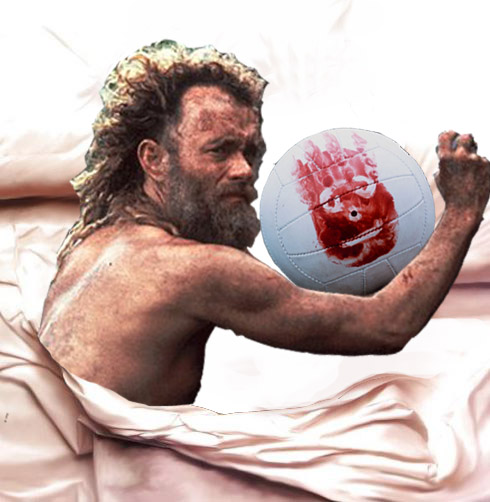
For a fleeting moment I felt like Tom Hanks in the movie Cast Away when Wilson (the volley ball) floats away and Tom can’t reach it so he sobs and sobs and sobs. I will forever miss that visor; we had some amazing runs and shared some great times together.

Tom Hanks in Cast Away with his Beloved Wilson
My other hard luck story involves my favorite baby blue t-shirt I got after finishing Ironman Austria in 2004, which in itself was a personal victory for me because I had to cancel on the event I was going to do with three other Flyers just a few weeks before the race due to an injury before finally redeeming myself.  On the bright side, I never lost it and am grateful that I still have what might be my favorite race t-shirt ever because of its color, its design, and its personal meaning for me.  But it’s long been riddled with holes throughout simply from wearing it too much, lifting weights in it too much, sweating in it too much, and running in it too much.  I believe that a lesson learned is to savor those things you love that offer some personal meaning or remembrance in your life.

It's Not Just a Runner Thing

So much for those crazy runners but what about “roadies” (i.e., cyclists) and their own habits, beliefs and superstitions?

The most common ones as you might guess are to talk about never “flatting” and of course then going out on a ride and actually getting a flat.


Others involve such important priorities as when is the right time to shave the legs before a big race, mounting a bike from the left vs. the right, never washing a race jersey while you're winning races or riding exceptionally well, never hurling a “loogie” from your left nostril over your right shoulder, and never ever getting a bib numbered “13”

This article would not be complete without including one more species of athlete….the “triathlete” or as the roadie cyclist might say a cyclist's “dysfunctional cousin.”

What strange customs abound in the triathlete’s world of aero bikes, helmets and wheel sets? Do we take the prize in “weirdness” because we have to perform not one but three different disciplines all in the same race?

Not a ritual but a mantra I have used in every Ironman I have raced is to repeat to myself  “It’s Showtime” as I’m nervously peeing in my wetsuit while waiting for the mass swim start of the race to begin. I find it helps me to focus a bit more.

Or are triathlete’s so Type A or so tightly wrapped in Lycra and compression wear that we are beyond any weirdness, ritual or superstitions?

Well…….NO not really as here are some samplings from some assorted racing forums I have read:

  • Don’t let anyone touch you on the morning of an Ironman except other triathletes
  • Always have race kit washed and hung up to drip dry the night before the event (guilty here)
  • Always say "thank you" to the volunteers (a case can be made that saying thanks is event-universal)
  • Pump tires in pre-morning darkness while squinting at pressure gauge so as not to…well you know
  • Make sure to touch the finish line three times the day before the race
  • Always mount the bike with the right leg
  • And, like our road cyclist friends…..when do I shave my legs?

The closing here is that there isn’t a closing and that superstitions or rituals abound whether you are a marathon runner who will only use a particular anti-chafing ointment or a baseball player who spits in his hands. They may possibly define us and can even add a measure of  “order” or a discipline that has become as common as the discipline or practice of running has become in our lives. Maybe the superstitions help us on some level.  Maybe the only differences are how weird yours might be viewed to the world vs. my own, but if it helps us cope with pre-race anxiety or serves our objectives in ways that work only for us, then let weirdness rule and may the athlete within always reign.


Keep calm and run like hell my friends J

-Scott C

Read more...

Friday, February 24, 2012

How I Spent My NYC Winter....

CROSS TRAINING FOR RUNNERS AND TRIATHLETES

It’s a dark freezing morning in NYC but I’m creating large puddles, sweating as I’m wearing my triathlon kit while The Who’s Baba O’Riley blares over the speakers at the Reebok Sports Club on Columbus Avenue. Myself and 30 other people used most of this 70’s rock classic as a progressive standing climb, using 3 categories of resistance with a cadence ranging from a high of 110 at tempo and the goal to go below 55 on the vertical climbing.  But now we’re in the last minute of this tune where the songs tempo changes and is pleading for the cyclist to sit back down, change their body and hand position to come off their climb and spend the last 60 seconds pushing through a dynamic hard 60-second racing interval that might make you toss your breakfast.

Welcome to my spin class! Welcome to your hell :)

I’ve been teaching spin classes throughout the city for nearly 10 years now and I still bring a tremendous passion to the class because I love being on the bike instructing and I love listening to great tunes while riding!

This blog post will explore various cross training (XT) options a runner and/or a triathlete can use to create, sustain, and add a greater fitness component to complement their running or the disciplines that the triathlon requires.  During a NYC winter when the trees of Central Park are bare, there might be ice sheets hanging from the rocks overlooking the Northern Hills, and getting out of your warm comfortable bed and out to the park can take on a more challenging component when you’d rather be a bear and stay in your warm cave surrounded by pizzas and ice cream and your favorite blanket :)


Spinning is a great non weight-bearing activity that can burn 400-600 calories over a 45 minute ride. A spin bike has a fly wheel that weighs over 40 pounds and your resistance is manipulated by the turn of a knob (usually colored red) atop the frame at the base of the bike. Turn the knob to the left and your resistance becomes easier.  Turn it to the right and you create greater resistance and a slower leg turnover or a lower cadence produced by your pedal strokes.

A good instructor should not only bring good music but should also offer and clearly communicate a class structure throughout.  The format may include hill based interval sets, seated/standing climbs, sprints and more based on experience and how well they can motivate the other freaks of spin :)

Although I teach throughout the year, I particularly like teaching in the winter because I love the workout, the conditioning aspect it offers my legs and cardiovascular system and I’m inside wearing my triathlon gear using my cycling shoes bathed in sweat vs. being out in the elements dressed in layers determined to keep my heart rate elevated to help me stay warm.

Key Tip:  Spinning is fun, anyone can do it but one key tip for a novice is to let your body/mindset adapt to greater resistance levels gradually over several classes to allow for a proper ramp up period.

If being outside in the winter elements floats your boat then let’s look at another great XT option which is Cross Country Skiing

Fellow Flyer and running/triathlon coach Mikael Hanson of Enhance Sports is a long time XC skiing fanatic who swears by the activity not only for the enjoyment but for its benefits that include using muscles in the shoulders, back, chest, abdomen, buttocks, and legs. Cross-country skiers can burn as many as 600 to 900 calories per hour. The kick and glide technique, combined with the poling motion to propel you along, can provide a more complete workout than running or cycling, both of which also emphasize lower body muscles.


Key tip:  If you are a beginner, you should gradually build up the amount of time you spend at it.  Otherwise you run the risk of overuse strains (such as tendonitis) of the shoulder, knee, and arm. To prepare for a season of cross-country skiing, it's best to combine activities that primarily strengthen the upper body (rowing, swimming) with those working the muscles in the lower body (cycling, running or brisk walking) to promote overall muscle tone.

Let’s go back inside a nice warm locale for some……..Yoga!!!

Yoga has been practiced for more than 5,000 years, and currently, close to 11 million Americans enjoy its health benefits. The following is from Web MD’s webpage regarding yoga:

Most Westernized yoga classes focus on learning physical poses, which are called asanas. They also usually include some form of breathing technique and possibly a meditation technique as well. Some yoga classes are designed purely for relaxation. But there are styles of yoga that teach you how to move your body in new ways. Choosing one of these styles offers the greatest health benefits by enabling you to develop your flexibility, strength, and balance.

  • You’re never too old to improve flexibility
The series of yoga poses called asanas work by stretching your muscles. This releases the lactic acid that builds up with muscle use and causes stiffness, tension, pain, and fatigue. In addition, yoga increases the range of motion in joints. It may also increase lubrication in the joints. The outcome is a sense of ease and fluidity throughout your body.

Yoga stretches not only your muscles but all of the soft tissues of your body. That includes ligaments, tendons, and the fascia sheath that surrounds your muscles. And no matter your level of yoga, you most likely will see benefits in a very short period of time. In one study, participants had up to 35% improvement in flexibility after only eight weeks of yoga. The greatest gains were in shoulder and trunk flexibility.

  • Yoga and Strength
Some styles of yoga, such as ashtanga and power yoga, are more vigorous than others. Practicing one of these styles will help you improve muscle tone.

But even less vigorous styles of yoga, such as Iyengar or hatha, which focuses on less movement and more precise alignment in poses, can provide strength and endurance benefits.

Many of the poses, such as downward dog, upward dog, and the plank pose, build upper-body strength. This becomes crucial as people age. The standing poses, especially if you hold them for several long breaths, build strength in your hamstrings, quadriceps, and abdominal muscles. Poses that strengthen the lower back include upward dog and the chair pose. When practiced correctly, nearly all poses build core strength in the deep abdominal muscles.

  • Yoga Can Help Posture
With increased flexibility and strength comes better posture. Most standing and sitting poses develop core strength. That's because you're counting on your deep abdominals to support and maintain each pose. With a stronger core, you're more likely to sit and stand "tall." Another benefit of yoga is the increased body awareness. This heightened awareness tells you more quickly when you're slouching or slumping so you can adjust your posture.

  • Yoga Benefits Breathing
Because of the deep, mindful breathing that yoga involves, lung capacity often improves. This in turn can improve sports performance and endurance. But yoga typically isn't focused on aerobic fitness the way running or cycling are. Taking an intense power yoga class that gets you breathing hard in a heated room, however, can provide an aerobic benefit.

Most forms of yoga emphasize deepening and lengthening your breath. This stimulates the relaxation response -- the opposite of the fight-or-flight adrenaline boost of the stress response.

For more on yoga on the Flyers blog, click here.

Swimming with the sharks…


Or at least sharing lane space with others who swim throughout the year swimming is one of the best workouts any of us can do for a host of reasons that include cardio elevation, recovery from running and cycling, the opportunity to increase your strength and fitness levels through getting into the pool on a regular basis or even open water swimming on those occasions we are traveling and have the opportunity to get an open water swim in.

Strength/Functional Training

One of the best cross-training activities we all can develop and engage in is strength/fuctional training.  Over the years I’ve written a few articles on the merits of strength/functional training but whether you hear it from me (including on the Flyers blog -- just click here) or fellow Flyer and Fitness Trainer Brett Cohen of Integrated Training Systems (click here for Brett Cohen on the Flyers blog) making winter, or, as many treat it, “off season” strength work a top priority pays huge dividends for any athlete looking to set new goals and establish new PR’s come spring/summer and autumn racing.

But how do you go about it? What type of structure should a single or multi sport athlete choose to either strengthen trouble areas that some might have a history of chronic injury with or what can be used as a sport specific routine?

I’ve listed a few movements that many regard as being the most valuable exercises runners and triathlete’s alike can and should engage in.

Congratulations if the reader is regularly working with any of these whether to have an interest or commitment in the virtues of regular strength work and keep repetitive injuries running can invite at bay or for those who have suffered injury but who now recognize the importance and necessity of regular strength work.

One of the biggest culprits causing injuries to runners is not strengthening their gluteus.  When we’re not out running many of us have jobs that require us to sit for hours on end which can lead to gluteus muscle atrophy. Without strengthening our gluteus we leave ourselves open to injuries like lower back pain, tight (IT bands), tight hip flexors as well as possible accompanying compensation injuries.
  • Squats
One of the top strength exercises for any runner and triathlete to work with are Squats!

Squats will work and strengthen your gluteus, your quadriceps, calves and your hamstrings.

How to Do It: Stand with feet hip-width apart, toes facing straight ahead or angled slightly outward. Slowly bend the knees and lower hips towards the floor, keeping your torso straight and abs pulled in tight. Keep your knees behind your toes; make sure everything's pointing in the same direction. Do not go lower than 90 degrees.

Work with 2-3 sets of squats using a repetition range of 6-12.

Performance Tips:  Many people begin a squat in the wrong position which immediately places them at a disadvantage.  Sit back as far as you can before you bend your knees. We have all heard the term “sit back” when squatting but it is especially important to start to sit back at the beginning of the squat.   This will ensure that you start the lift correctly. The first motion of a good squat is pushing the hips/glutes to the rear, not bending the knees first. This will require that you have strong hips, strong hamstrings and a very strong low back. Remember that if you begin wrong, you will end wrong.

For a squats demonstration, click here.

  • Bridges
The pelvic bridge is an easy-to-do exercise, it is highly useful in maintaining strength in the low back, and it's useful in a low back pain prevention programs. Pelvic bridging is also a great exercise that strengthens the quadriceps muscles the hamstrings, the abdominals and the gluteal muscles.

How to Do It: Lie on a flat surface such as a carpeted floor or fitness mat. Bend your knees and place your feet flat on the floor with your feet six to eight inches apart. Your palms should be flat on the floor alongside your body. Relax your upper body and back while you draw in your abdominals and squeeze your pelvic floor muscles. Exhale as you press your hands and forearms into the floor and slowly push your pelvis up towards the ceiling. Hold in an up position for a slow count of three. Inhale as you slowly lower your body back to the start position. Keep your abdominals tight to avoid sagging in the low back or glutes. Perform two to three sets of 12-15 repetitions, allowing 30-60 seconds rest between sets

A more advanced type of bridge is the one-legged bridge. This can be challenging as it requires one-leg strength and stability through the back and hips. Start in the basic bridging position with one leg extended straight out on the floor. Tighten the abdominals and raise your buttocks off the floor with one leg, bringing the extended leg up so that your thighs are parallel to the ground.

Whenever performing a bridge always make sure that you push through your heels, elevating your pelvis so that you form a straight line from knee to shoulders. Avoid pushing your pelvis up so high that you place weight on your upper back and neck.

One type of bridge I really enjoy involves using a 55-65 cm stability ball where my legs are on top of it up to my calves. The variation I like best is 2-3 sets of tilts where the feet are pointed toward each other.  For another variation, place both heels together and splay your toes wide apart.  The most traditional version is to place the feet straight up as you work through the tilt. Your spine should always be in a neutral position and active breathing is important here, inhaling as you contract your gluteus to raise your hips and exhaling as you slowly release the contraction and lower your hips and gluteus.

For a bridge demonstration, click here.

  • Planks
So much has been written about planks and the benefit they offer by way of "core stability". Planks do work as an excellent core movement (in addition to helping you perform a better push up) and you can add variations to planks that will offer greater stimuli and the opportunity for adaptation by performing a plank on a stability ball, by lifting a leg 2-3 inches off the surface (without compromising form) or by including a light weight (2-8pounds) and incorporating shoulder raises into a side plank.


The plank is used in Pilates and Yoga and works the abs, back, arms and legs. The plank also targets your internal abdominal muscles.


How to Do It: To do prone isolated planks, lie face down on mat with elbows resting on floor next to chest. Push your body off the floor in a pushup position with body resting on elbows or hands. Contract the abs and keep the body in a straight line from head to toes. Hold for 30-60 seconds and repeat over 2-4 sets.

For a demonstration, click here.
  • The Push Up
So much have been written about planks and the benefit they offer by way of "core stability." Planks work as an excellent core movement (in addition to helping you perform a better push up) and you can add variations to planks that will offer greater stimuli and the opportunity for adaptation by performing a plank on a stability ball, by lifting a leg 2-3 inches off the surface (without compromising form) or by including a light weight (2-8pounds) and incorporating shoulder raises into a side plank


How to Do It: Position yourself face down on the floor, balancing on your toes/knees and hands. Your hands should be wider than shoulders, body in a straight line from head to toe. Don't sag in the middle and stick your butt up in the air instead focus on keeping a plank position from head to toe. Slowly bend your arms and lower your body to the floor, stopping when your elbows are at 90 degrees. Exhale and push back up. Variations can include incline, decline, or wall pushups.

Performance Tip:  For someone who is just beginning to perform a push up, start out on your knees with your knees slightly apart and work on your technique before graduating to a plank position using on your toes.

For a demonstration, click here.

  • Lat Pull Downs
The lat pull down works on the major muscles of your back (the latissmus dorsi), which helps you burn calories and, of course, strengthen your back.  As a triathlete, I need to develop both shoulder strength and strong lats to support my swimming technique and increase my aquatic endurance or the ability to handle a 2.4 mile Ironman mass swim, so lat pull downs are an integral part of both my own program and that of my athletes. (Another great bonus of developing lat definition is that it can make your waist appear smaller).


How to Do It: Sit on the lat pull down machine and hold the bar with palms out and wider than shoulders. Pull your abs in and lean back slightly. Bend your elbows and pull the bar down towards your chin, contracting the outer muscles of your back. Do this exercise 2-3 times a week using enough weight to complete 10-12 repetitions.

Performance Tips: The biggest error I usually see among those attempting the lat pull down is that they don't keep their back straight but rather angle their backs away from the pull down station presumably to compensate for trying to pull weight down that might be heavier than they are ready for.  Another tip is hand and grip placement on the bar itself. Varying your hand grip (both overhand and underhand) from narrow to wide will allow you to work your lats, upper back muscles and biceps differently, allowing for great variation in your program.

For a demonstration, click here.

If you don't have access to a gym, but do have a bench and free weights then try a one armed row instead.

For a demonstration, click here.

Conclusion

There are obviously far more choices we can make when it comes to developing a cross training program but the intent here was to offer a few ideas that some readers may have been curious about but have yet to try and are fun, will compliment our running without the weight bearing pounding we put ourselves through with running.

I hope you will give at least one of these a chance and if you already are working with at least one of the above then congratulations and good luck in all your endeavors!

-Scott C

Read more...

Tuesday, July 5, 2011

Driving You Forward

Scott C

Brett C


Running is one of the greatest types of exercise available to most of us. It has one of the lowest equipment needs of any sport. You really only need a pair of running shoes, a t-shirt and a pair of shorts.


Right?

What is running anyway?

You could simply define running as the act of putting one foot in front of the other.... But as runners do you know how this happens biomechanically? What muscles get you from step to step, from point A to point B?

From the Starting Line to the Finish Line

What drives you forward are your hips. The hips are quite complex and it would take much more detail than this blog entry allows to go over all the muscles and mechanisms that contribute to proper hip function. So, this article will be limited to the function of the gluteus (hip extensors) and hip flexors.

We are, by-in-large, a sedentary population. Now matter how many miles you run in a week, the majority of people reading this sit between 40-60 hours a week. When you spend much of your day in front of a computer, behind the wheel of a car, or in front of the television set bad things can happen that can be detrimental to a runner’s performance. One such problem is the loss of hip mobility. Hip mobility can be restricted by both soft tissue and muscle length and strength discrepancies. The key to hip mobility is to get the right muscles moving in the hip joint and decrease the movement of the lumbar spine as a substitute for hip movement.

If The Hips Don't Move, The Spine Will

Being in a seated position tends to lengthen the gluteus and surrounding hip stabilizers and shortens the muscles on the front side, the hip flexors. The hip flexors create a paradox in that they need to be flexible enough to allow for full range of motion of the hip extensors and also be strong enough to create full hip flexion. In other words, the ability to lift your knee up to hip height so as to create space for the leg to move forward in the swing phase of our running gait. Additionally, if a runner has an inability to flex the hip this will usually result in flexion of the lumbar spine (the low back). Done repetitively, this can lead to Low Back Pain!

The problem arises when chronic quad/hip flexor tightness “inhibits” (down regulates) your gluteus (the body’s main hip extensor). When your gluteus are not working properly it forces your hamstrings to take on the job which can lead to hamstring strains/pulls, Achilles tendonitis, plantar fasciitis, patella femoral tracking disorder, and lower back injuries that often results in a decrease of neural input to the hip extensor muscles and hip flexor muscles.

There are 5 hip flexors…. .Rectus Femoris. TFL. Sartorious. Iliacus. Psoas. The TFL, RF, Iliacus, Sartorius all insert at the level of the iliac crest. They do great up to the level of the hip. The psoas acts directly on the spine. So, in the case of an under-active psoas, the femur may move above the level of the hip but it is not from the action of the psoas, but rather the momentum created by the other four hip flexors. This is what commonly causes Hip Flexor Strains and Quad Pulls under hard training loads. That's what makes the following movements so effective in that it eliminates the momentum of the other four flexors.

When you think of loosening a muscle stretching automatically comes to mind. However, you can also loosen your hip flexors through certain exercises. It works by taking your muscles through their range of motion dynamically.

Here are some ways you can strengthen both your hip flexors and hip extensors using nothing but your own bodyweight.

90/90 Side Lying Hip Flexor Stretch

On your side with both knees pulled to chest, holding the top ankle with the top hand and the bottom knee with the bottom hand

Contract the top gluteus while pulling the top leg back until stretch is felt

Hold two seconds, return to start position and repeat for prescribed number of repetitions

Switch legs and repeat

For a demonstration, click here. 

The Quadruped Hip Extension

• Start in a quadruped position (on your hands and knees).

• Tighten your core and contract your abs to stabilize the spine.

• Focus on contracting the left gluteus. You may need to place your hand on your gluteus to be sure it contracts.

• Slowly lift the left leg up while keeping a 90-degree bend at the knee.

• The left thigh should be nearly parallel with the ground.

• Slowly lower to the start position and repeat 10 reps per side.

• To increase the intensity of this exercise, place and grip a small 3-5 pound dumbbell behind your knee or add an ankle weight.

For a demonstration, click here.

Supine Single Leg Bridge

A single leg supine exercise that strengthens pelvic stability, gluteus muscles, ankles and especially the hamstrings is the single leg bridge. Start by laying flat on your back and raise your hips off the floor. Then lift your left foot a few inches off the floor and straighten your left leg. With your leg extended, move your hips up and down for 10 seconds. Lower your left foot and repeat the exercise on the right leg.

Do five repetitions on each side.

For a demonstration, click here. 

Overhead Split Squat

This is a variation on the basic lunge and is good movement for opening up your hip flexors.

• Hold a weight plate (or barbell) overhead, with your feet shoulder width apart and knees slightly bent. Without using any weights another option is to keep hands at sides and extend your arms up as your hips travel down.

• Keep the weight directly overhead (in line with the shoulder joint), and take a comfortable step forward in to a deep lunge position.

• Make sure your forward knee remains over your forward foot (not in front of it).

• Forcefully drive your forward heel in to the ground and return to the starting position.

• Perform up to 10 repetitions on each side and then switch sides.

• Maintain perfect posture throughout the movement — your head is level, your eyes are looking forward, your chest is held high and your back is flat.

• Don't bend your elbows or let the weight sink during the movement.

• Don't let your front heel lift off of the ground.

For a demonstration, click here. 

Backward Lunges

Here is how to do a backward lunge, step by step:

1. To begin, your feet should be shoulder width apart, torso erect with arms hanging straight at your sides, palms facing in.

2. Take a slow, controlled lunge (or large step) backwards with your left foot.

3. Lower your hips so that your right thigh (front leg) becomes parallel to the floor. At this point your right knee should be positioned directly over your ankle and your right foot should be pointing straight ahead.

4. Your left knee should be bent at a 90-degree angle and pointing toward the floor. Your left heel should be lifted.

5. After reaching the bottom of the movement (when your left knee is almost touching the floor), pause for a moment, or a breath, then push with your left, or back foot to move almost straighten both legs (photo on the left). Keep both feet on the ground - you are not returning to the starting position, just raising your pelvis up a bit and almost straightening your knees.

6. This completes one, now bend your knees and lower your pelvis down to complete another.

7. Return to the starting position (standing with both feet underneath your pelvis); now repeat the movement on the other side, stepping back with the right foot. Do ten up and downs (or reps) on this side now too.

Try and work with two sets of 8-10 repetitions for both the overhead and reverse lunge.

Keep your torso as upright as possible during any Lunge exercise to minimize the stress on the back. Start slow and don't go too low if you are new to the reverse lunge. As you progress you will be able to lunge deeper and to work your gluteus more. Press the heel of your front foot into the ground to feel the gluteus activate and engage.

Move slowly down and up, this will allow you to work your muscles more without jarring your knees.

To make the backward lunge a little more challenging, try adding a torso twist or hold dumbbells at your sides while you lunge. To help maintain balance, look straight ahead instead of down at your legs.

For a demonstration, click here. 

Step Ups

Step ups also help strengthen the hip flexors by placing the load put upon you in a more upright position. The key for getting the most out of your step ups is to use a step height that places your leg close to a 90 degree position when you lift your leg up. The higher you step the more you use your hip flexors. The key is not to step so high that you loose your form when you step up. If you have to lean forward on your step up then your step is probably too high. Do 8-10 repetitions. Alternate or work with each step up separately and for an added challenge introduce light weights, body bars for balance.

For a demonstration, click here.

Conclusion

What you do throughout the day has a huge impact on your ability to move effectively in sports. It takes much more than changing shoes to become a better runner. You need strong, balanced muscles that Drive You Forward.

Our job as strength/performance coaches is to get you to understand what muscles aren’t functioning properly, identify what muscles need to be used/strengthened and then teaching you how to use them properly.

About the authors:

Brett Cohen is a sports performance coach, endurance athlete and founder of Ready To Run and Intergrated Solutions comprehensive conditioning program specifically designed for runners and endurance athletes.

www.integratedtrainingsystems.com/
imakeufit@hotmail.com (917) 596-8485

Scott Cohen is a long time member of the New York Flyers, a former club VP and President, a certified coach for running and multi sport performance, an endurance athlete and the founder of The Athlete Within

www.theathletewithin.com/
3trikid3@gmail.com (917) 439-1195

Read more...

  © Blogger templates The Professional Template by Ourblogtemplates.com 2008

Back to TOP