Sunday, December 13, 2015

Havana Marathon 2015

Amanda B
After seeing a Facebook post about the Havana Marathon I thought it would be an interesting event to attend, given that the US-Cuban relations had simmered somewhat and there was a good chance there would be a larger than normal field given that many more Americans would have been able to legally participate this year for the first time in the 28 year history of the event.

I registered for the event seven months out from the day and made an accommodation booking at the same time just in case there was an influx of visitors to the city closer to the event. Four months later when I went to book my flights, I had to check the hotel accommodation booking to get the address for my airline and much to my horror I realized I had actually booked for a hotel by the same name as the one I thought I had booked in Havana but this one was in Spain! Fortunately I was able to cancel the booking without any charge so I then made sure I found the one I was meant to book in the first place. Unfortunately the websites always make the establishments look better than they actually are and I would later find out that this was certainly the case with the place I ended up staying in. 

Three months out from the race I started getting emails from my New York Flyers friend Howard Choi and a steady stream of emails started to flow between other New York Flyers who were planning to do the race. With talk of getting a special New York Flyers singlet made up for the event I thought it was time I make my Flyers status official and register as a bona fide New York Flyer. Now I really felt like part of the team! The constant flow of emails between Pei A, Maggie Schwartz, Howard Choi, Michael Rabin and Heather M while planning the trip, helped build the excitement leading up to race day. Even though I was on the other side of the world I felt like I was almost in NYC as well.

It was around this time that I realized how difficult a trip to Cuba can be and as I’d never known anyone to go there or heard anything about the place I just assumed it was like travelling to any other place – you know, you pay extra to your phone company so you can access cell phone and data use while in another country and you just travel and pay for everything with your credit card when you get there. I’d travelled to some extremely remote and third-world countries in recent years and cell phone coverage and credit card use was always accessible so I ignorantly took these things for granted. It was only when I started seeing the emails from the Flyers that I realized this wasn’t the case. I was even so naïve to assume it was just a cheap and easy flight from the nearest US city of Miami, like I had done for the Bahamas Marathon earlier in the year, so I booked flights from Australia going from Brisbane to LA and then through Miami. There didn’t seem to be any flights to Havana mentioned so I thought I’d just book them later as there must be several a day for such a short trip. Again I was in for a rude shock. A few weeks later when I went to book the flights to Havana from Miami I found out it wasn’t going to be easy - or cheap! It was time I did what I should have done in the first place and done some serious online blogging research and found out exactly what I was getting myself in to.

I realized after reading some online forums that it’s best to travel through Mexico rather than the US so I changed my LA to Miami flight for a LA to Cancun flight and this gave me the ability to easily get a Cuban visitors visa before entering the country. It seemed, from the flow of emails from the NYC delegates, that it’s still not easy to travel to Cuba from the US and everyone seemed to be making different travel plans according to their own situation.

Departure day arrived and once I got to Brisbane airport I purchased enough Canadian dollars to get me through the four days I would be spending in Havana. From the forums I had read it seemed Canadian dollars and Euros were the safest currency to take over and get exchanged into Cuban pesos without any dramas. I was just a bit concerned about what happens if you run out of cash and have to get more once you are over there. I just had to make sure this didn’t happen!

The trip to Cancun took nearly 24 hours with transit time in LA so I was glad to be staying in a hotel and not having to get onto another flight by the time I got there. I decided to have an early night and have a look around Cancun the next day as I wasn’t flying out until mid afternoon so had all morning to wander around. The view from my hotel room in the daylight didn’t look too impressive – no golden beaches like I had imagined – so I decided to find a gym and do a workout instead of walking around the less-than-impressive looking city centre.


Flyers Chilling In Cancun?


Once I got to the Cancun airport I had a hassle-free check-in and paid US$20 for a Cuban visitors permit and also another US$25 for a Cuban tax, which I later found out was a departure tax that you’re required to pay before departing Cuba.

On arrival in Havana my priority was to exchange the Canadian dollars for the local currency, which ordinarily would be an easy task in any other country – but not so here!  I had to walk outside the terminal building to the currency exchange booth which only allows for the people who are being served to be inside the air-conditioned office while everyone else has to queue up outside in the heat. I would find out over the next few days that this was the case with all the currency exchange offices in the city of Havana as well with long queues out on the sidewalks at every one I came across.

After finally exchanging my cash and ready to hit the streets of Havana I had to then find a taxi to take me to my accommodation. A man approached me and asked if I was looking for a taxi and when I replied that I was he offered to drive me to the accommodation that I showed him on the printed reservation confirmation that I was carrying with me. He enthusiastically directed me to follow him and led me through the airport and up to another exit on the first level of the terminal building. After being led outside I was shocked to see him lead me to a derelict-looking old car at the end of the driveway. By now I was starting to get concerned I was “being taken for a ride” in more ways than one and had to fight the urge to walk (no run!) in the other direction. But he seemed so nice…so I decided to just go with it and embrace the unconventional mode of transport.


As it turned out, he really was a nice man and spoke enough English to make the conversation enjoyable as he attempted to fill the awkward moments of silence with local tourist information. The ride reminded me of when I was a young child riding in the back seat of my Grandfather’s FJ holden – I had never even remembered that before now and was amazed at how the ride had dug up such a repressed image from my memory!


It was 7pm by the time I got to my apartment and now I was in for the next shock – a Cuban budget hotel. The “Hotel 4 Mosqueteros” was an old run-down building in the back streets of inner Havana. After wandering inside the front door a couple of times and seeing no reception desk and thinking I was in the wrong place I decided to climb the winding staircase and hope there was someone up there who could help me. I was relieved to be greeted by a very good-looking young black-Cuban man who was in charge of the apartments. He spoke virtually no English but his good looks were enough to ease my travel-weary brain into a state of unconditional acceptance of lowering my standards and accepting whatever I had to in order to appreciate the rustic appeal of a city untouched by not only the 21st century but also the second half of the 20th century!

I had organised to meet the rest of the Flyers at a restaurant at 7:30pm so after dropping my bags off in the hotel room I asked the manager if it was possible to get a taxi. After finally getting my request across (I should have taken a Spanish dictionary with me!) he pulled out his cell phone and made a call and then said it would take about 15 minutes before the car would arrive. I thanked him and walked down to the street to wait for the ride, wondering what sort of car I was supposed to be on the lookout for – I was pretty sure it wouldn’t be anything that resembled the kind of taxi I was used to getting into. It wasn’t long before a very old-model small car pulled up and a young guy motioned for me to get in. I just accepted that in Cuba I was going to have to abandon all sense of western-style conventions and just go with your gut feeling because there really wasn’t any way of telling if these guys were genuine taxi drivers or local thugs intent on driving you to an isolated location and robbing you of all your possessions – or worse! I tried not to let my imagination get carried away and just hoped I wasn’t misplacing my trust in this kid in the drivers seat who spoke absolutely no English. Fortunately, again, I had a printed sheet showing the restaurant that Pei had made the reservation for in advance of our arrival and this would be the first of many occasions when I would be eternally grateful to Pei for the outstanding job she did of preparing the incredible itinerary that would be the blueprint for everyone in the Flyers group to follow in lieu of digital communications. We were staying in four different accommodation venues between the group of us so it was back to the old-school method of stating a time and venue to meet up at different times of the day in order to catch up with each other. We all printed the itinerary details before leaving home so we had them with us while trying to navigate our way around Havana.

After 48 hours of travelling since I left home I finally arrived at the restaurant we had organized to meet at for our first night together in Havana. I’ve never been so glad to see some familiar faces when I walked into the restaurant in a dark back street in Havana city and be able to let my nervous guard down and relax. Over the past three years I had joined New York Flyers member Howard Choi in marathons in Antarctica, my hometown marathon on the Gold Coast (Australia), and then at his hometown run, the NYC Marathon, and it was great to be meeting up with him in another location around the world and spending the next few days catching up again. During my trip to NYC in 2014 for the marathon I had been introduced to many other New York Flyers and friends of Howard’s and now I finally got to meet the other Flyers who had been in the email chain leading up to the trip to Cuba. I was the last of the group to arrive at the restaurant so after giving Howard a big reunion hug I was introduced to Pei, Maggie, Michael and Heather. The rustic décor of the San Cristobal Paladar restaurant made for an excellent backdrop to the start of our Havana experience, complete with complimentary after-dinner rum and cigars!


After a lovely dinner the waiter called the taxi driver who had delivered me to the restaurant and he soon arrived to take me back to my hotel. As Howard, Pei and myself had organized to meet for a run the next morning I asked the taxi driver to pick me up again the next morning and drive me to the Capitolio building. It took a few minutes to get him to understand the request but we both eventually smiled and nodded excitedly at the fact the message was finally understood. I had survived my first day in Cuba!

Saturday morning we agreed to meet where the start of the marathon would be the next morning so we could do a dry run on meeting up before the start of the race. Again, with no cell phones it would be very easy to miss each other in the large crowd that would be at the start line if we didn’t have a plan to follow. I managed to find Howard first and then a few minutes later Pei joined us. We jogged down the centre plantation of the Paseo de Marti and turned left onto the Malecon where we jogged on the path next to the sea wall. The sun was out and the humidity was suffocatingly high so it was a scary introduction to what we could expect the next day during the marathon. The five or so miles we casually jogged was a struggle and I was quietly wondering how I was going to run over 26 miles in this heat and humidity the next morning?!

After showering we headed over to the Hotel Melia Cohiba where we were to pick up our race bibs. While we were there I ran into the only other Australian woman competing in the marathon...and I knew her! It was a huge surprise when we ran into each other and had a quick catch-up while we waited in line. After already running 32 marathons this was the first time I had seen the finishers medal in our bag with our finishers T-shirt at the bib pick up prior to the race. We all had a laugh about that and decided we would have to carry them with us during the race so we could get a finish line photo with our medal.

We left the hotel and walked along the Malecon to the historical Hotel Nacional. Every famous person who’s ever visited Havana has stayed at this grand hotel and it gave you a sense of what life in Havana must have been like in the height of its prosperous years. The hotel is perched high up on a hill and has rolling lawns out the back with tropical vistas looking over the sea. It felt as if we were catching a glimpse of a bygone era where time has stood still. The post-apocalyptic-like city of old Havana lay in stark contrast to the atmosphere that still existed on the lawns behind the Hotel Nacional. We enjoyed a lovely meal in the restaurant out in the gardens followed by a cocktail while relaxing in the balmy afternoon breeze. A moment of decadence in an otherwise impoverished city.  

I was happy to call it a day and head back to my hotel room so I could rest up before an early start the next morning for the running of the marathon. We all agreed to meet in front of the Capitolio building at 6:30am the next morning in time for a quick group photo before the start of the race at 7am.

RACE DAY

We all managed to meet up at the start line despite the 400 competitors running the full marathon, 1,500 running the half marathon, and around 1,700 competing in the 10km event. The full marathon would be two laps of the half marathon course. Porta-potties were rather scarce with only two of them behind the start line (and none of them along the course) so I was glad I didn’t have to go. With the Flyers group photo taken it was time to get this race underway. It was quite overcast so conditions were good for a comfortable start at least; only time would tell if the sun would come out later and torture us on the streets of Havana.


The race plan was for most of us to stay together although Maggie wanted to take it a bit easier so opted to start behind the rest of us. Maggie and Pei were doing the half marathon and me, Howard, Michael and Heather were all doing the full distance so Pei decided to run with us up until she crossed the finish line and we would then all continue on our second lap of the course. We knew the heat and humidity would be punishing so we planned to run at a relaxed pace for an estimated finishing time of 4 hours and 45 minutes for the full marathon. 
Michael, Heather, Howard and Amanda Having Fun!
We included walk breaks at the drink stops to help maintain a good level of hydration throughout the race. The drink stations were very frequent, at least every 2km, and were well manned and had convenient sealed plastic bags of both water and fruit juice at each station. The plastic bags proved much more practical than the regular plastic cups of water because you could continue to run with them and sip on them as you needed it or pour it over yourself. After tearing a small opening in a corner of the bag with your teeth you could use it as slowly or quickly as you wanted.

The second lap of the course slowly started to take it’s toll on us but we were very lucky with the weather and the sky remained heavily overcast for the entire race so it made the conditions more bearable than if we had to run in full sunlight. For the last few miles we had to compete with the congested city traffic to get to the finish line but the race officials and traffic police made us feel very special by stopping the traffic at the busy intersections and giving us right of way. By now it was tempting to walk rather than run but having the traffic held up for you made you feel obliged to at least try and look like a marathon runner instead of someone just out for a Sunday stroll. With a forced smile and feeble wave of thanks to the traffic enforcers we continued to the finish line.

We all caught up at the finish line while waiting for the last of the Flyers to complete the marathon and then took a “Finishers” photo in front of the Capitolio building. Flyers Paul and Cassie Nelson also joined us in this photo. From there we walked around to El Floridita, which is the supposed birthplace of the Daiquiri. The bar was packed to the rafters, complete with a life-size bronze statue of Hemingway sitting at the bar. We soaked up the great atmosphere – and the daiquiris!

We all met up again for a lovely celebratory dinner that night in a quaint restaurant called Dona Eutimia in the trendy Old Havana restaurant precinct. We again enjoyed lovely meals at a very reasonable price, just like at the other restaurants we had visited during the weekend. Our meals generally worked out to be about $25 per head, including alcohol, which was very reasonable considering we were dining at some of the best restaurants in the city. But the best part was probably the fact we could enjoy the great company and food without the distraction of cell phones!


After a busy weekend of sightseeing, marathoning and restauranteering (I know they aren’t real words but they should be because we do them all the time!) this would be our last night together in Havana before splitting up the next day and starting the long journey home. As always, I’d had a fantastic time catching up with fellow Flyers and running a marathon in another amazing destination on the other side of the world. Cuba may not be the easiest place to travel to but they put on a fantastic marathon weekend and it was well worth the effort!

-Amanda B

Read more...

Friday, November 20, 2015

Saved By Running

Jennifer Ann H
Why do you run? A question that I get almost on a weekly, if not daily, basis. I have been an athlete my whole life. I swam competitively for twelve years, and played field hockey and lacrosse from middle school through college.  Running was always a dreaded cross-training activity for me. "Coach wants us to run TWO MILES for a warm up?!" 

Once school, and therefore competitive sports, ended, reality set in. I needed to do something to keep moving and in shape.  There was running.  Just waiting for me. 

I started small, 5Ks mostly.  I joke with my runner friends now that I was too worried about exhausting all my energy before a 5K to do any sort of warmup.  My, how far I've come.

Really, though, my undying passion for running started when my dad passed away.  Losing a parent or loved one is hard for everyone. He had always been my rock, my biggest supporter. I completely lost my way, and became a person I didn't recognize after he passed.  Someone I wasn't proud of, making really bad life choices. 

Running saved me.  Runners hate hearing the question "what are you running from?" -- because for most, they aren't running from anything!  But I was.  I ran to escape reality, to avoid all of the problems and heartache and sorrow in my life.  


Eventually though, I started to realize, with hesitation, that I'm actually not bad at this running thing.  I had to make a change in my life.  I stopped using running as an escape from the negativity in my life.  Instead, I focused positive energy on the sport, and focused on running myself back to the person I knew, the daughter my father raised and would be proud of.

The 5Ks turned into 10Ks and half marathons.  I slowly got better, faster, stronger.  I'm by no means a top athlete or runner, but with each race my confidence grew.  

The next logical step, of course, was a full 26.2.  On March 9, 2015, I won the lottery. Not the Mega Millions or Powerball, but something way more valuable and priceless.  As I was seated in my orthopedist's office waiting to get a cortisone injection before the New York City Half Marathon, I got a notification on my phone that New York Road Runners charged my credit card for the marathon entry fee.  My life was forever changed. 

Ready to Run!

The marathon training process was literally the most amazing experience of my life.  I signed up for a 20 week training program with New York Road Runners to help me get ready for November 1st.  I followed the program to every last detail.  On August 30, 2015, the program called for me to run  twenty miles. A daunting task to complete on my own.  A seasoned running friend of mine told me about the New York Flyers Three Bridges Run.  I signed up, ran it, and loved every second.  


Flyers Running the Three Bridges Training Run

Thus began my relationship with the Flyers. I joined as a member before the second Three Bridges Run, and haven't looked back.  While somewhat of a newcomer to running, I have yet to meet a more passionate, welcoming group of people anywhere.  I'm convinced I could not have gotten through the rest of training without the Flyers.  To be able to run with and pursue the same goals as so many amazing members, while learning from the more seasoned runners, has proven to be invaluable.  

I come from New Jersey (Bergen County so really not THAT far) to run with the Flyers, but really I'd travel from further to run with this group.  What a great experience it's been, and how far I've come.  I crossed the finish line at the New York City Marathon at 3:52:52, something I couldn't have done without this amazing Group.  


Marathon Complete -- Time to Celebrate :)
My story is not special or unique. I'm just an average person who has dealt with some hardship in their life.  Thankfully, I found running.  

The New York City Marathon is over. Now what?!  For me, the next stop is the Phoenix Marathon in February 2016 (suggestion courtesy of the Future Former Flyers President Doug R) where I'm training in hopes to Boston Qualify for 2017.  Thank You, Flyers, for welcoming this Jersey girl with open arms.  Hope to see your friendly faces in Central Park, and may you all achieve your dreams and goals in the coming year.  

Happy running! 
-Jennifer Ann H

Read more...
Thursday, October 29, 2015

Last Minute Marathon Tips

Never gets old.  


"Essential Last Minute Marathon Tips"


Delivered in style, courtesy of Flyer Toby T!

Just click HERE

Read more...

Friday, October 23, 2015

A Non-Runner's Guide to Runners

A Non-Runner's Guide to Runners - Remy's World - Mark Remy

Not sure how to interact with these strange aerobic creatures? Our FAQ will help.
by Mark Remy, writer, runner and creator of Remy’s World
Summer is in full swing, which means that runners are, too. Perhaps you have glimpsed them out and about, loping along paths and trails. Maybe you’ve even seen them in suburban settings, such as supermarkets and coffeehouses, searching for food.
But what do you really know about these shy aerobic creatures? Are they dangerous? What do they eat? How do you get rid of one that’s in your house?
These questions aren’t academic. As the population grows, and more and more land is developed, human-runner interactions will only increase. The following information will help prepare you.
Why do runners run?
Why do runners run? You might as well ask, “Why do birds fly?” or “Why do fish swim?” or “Why do people buy scratch-off lottery tickets?” The answer to all those questions is the same: Because it’s awesome. Also, in the case of running, because maybe you can lose a few pounds.
Why do runners wear those crazy clothes?
Scientists are unsure exactly what purpose is served by the skimpy and often brightly colored gear runners wear. One theory is that it’s meant to attract potential mates. Another is that it’s defensive, as it makes them more visible to motorists. Some biologists believe that runners have actually evolved to prefer brighter clothing, as those wearing dull colors like “Pavement Gray” tend to not live long enough to reproduce.
Are runners dangerous?
You should never provoke them, of course. But runners by their nature are docile and will go out of their way to avoid confrontation. However, females pushing jogging strollers may attack if they feel their babies are in danger. Also, hearing certain phrases might enrage runners; among them:
• “Running will ruin your knees.”
• “Marathons cause heart attacks.”
• “Hey, you’re a jogger, right?”
• “Jogging will ruin your knees.”
Runners who hear any of these may respond forcefully. Meaning, they will go on to Facebook and post a rant that their running friends will then “Like.”
What do runners eat?
Runners enjoy a varied diet, consisting of bananas, sports drinks, bagels, pizza, smoothies, beer, pasta, spareribs, chicken lo mein, muffins, scrambled eggs, sushi, ice cream, grilled shrimp skewers, black bean enchiladas, and those big turkey legs they sell at state fairs and Renaissance festivals. And that’s just on their long-run days.
You might be tempted to feed runners—especially the skinny ones—but don’t do it. You’ll only attract more of them, and runners swarming in great numbers can be a nuisance.
What should I do if I encounter a runner who’s lost and scared?
From time to time, a runner may stray from his pack and find himself in unfamiliar territory, such as a sports bar or a dinner party full of extroverts. Often, he will appear agitated, or confused.
Don’t panic! Runners can sense anxiety, and it will only make a bad situation worse. Instead, approach the runner and ask about his footwear or his watch. Both will likely be running-specific. Soon he will be talking about running, nonstop, which will put him at ease. This will buy you some time while someone phones the nearest specialty running store. The store will send someone to collect the runner and return him to safety.
What if I find a runner in my house?
Especially in the hot summer months, runners may seek relief in air-conditioned homes and then panic when they can’t get back out—especially once they realize that their GPS watch has lost its satellite connection. If you discover a runner stuck in your home, open a door and try to “shoo” her out with a broom. If that doesn’t work, try a little trickery. Pointing outside and shouting, “Hey! Isn’t that the guy who wrote “Born to Run”?” has been known to work.
How do they reproduce?
Runners practice a complex mating ritual that begins with the male donning a novelty T-shirt reading “Distance Runners Do It Longer” and ends abruptly, minutes later, with the female reminding him that they both have to be up early for a long run so they really should just “hit the hay.”
In short: No one knows.
There’s much more, of course. Runners are complex, fascinating creatures, and they have much to teach us. I hope that this information helps ensure that your encounters with runners—this summer and beyond—are happy and healthy ones.
Published On July 8, 2014 | In Fitness, Health & Fitness, Random Thoughts, Running | 45 Comments
Photo credit: THOMAS MACDONALD
Mark Remy is a writer at large for Runner’s World, author of The Runner’s Rule Book (Rodale, 2009), and creator of the popular Remy’s World column atRunnersWorld.com. He has run 25 marathons.

Read more...
Friday, October 9, 2015

FEARLESS!


I am a 261 Fearless Ambassador


261logo
I am so excited –  I need to share this!
261 Fearless is an organization founded by Kathrine Switzer. She was the first woman to run the Boston Marathon, in 1967, when the race director tried to pull her off the course and take her bib number declaring that it was a men’s only race. Her bib number was 261.  261Fearlessmarathon
She has created 261 Fearless, a global network for women around the world to connect, support and inspire one another through running.
When I read about the mission of 261 Fearless, I saw everything that I stand for and believe in.  I knew I wanted to be part of this cause. I read the description of a 261 Fearless Ambassador:
A 261 Fearless Ambassador is a woman who finds solace, strength and freedom in running or walking. She is also a role model, a communicator, a supporter and a friend. She has the ability to stand strong for herself and has the aspiration to bring the love of movement to others. . .  Through her personal interactions and social media, she has the ability and desire to welcome women into this 261 Fearless community and a determination to spread 261 Fearless mission.
I had to apply! I submitted an application to become a 261 Fearless Ambassador. I was on pins and needles all day yesterday waiting for 261 Fearless’ announcement.  Last night I received an email saying:
Congratulations and welcome to the 261 Fearless Ambassador Community!  You truly are amazing.  Your enthusiasm and fearlessness will be the backbone of our movement.  Together we will communicate, celebrate, support and encourage women in their lifelong journey of running and walking. . .  We will share our stories and find joy in our collective successes.  We will do this one stride at a time.  We will do this together because sometimes, you just need to know you are not alone.
I feel as though I am already on this journey on so many levels, and yet am a little nervous, as I never seem to quite fit into any mold.  I don’t know for certain what being a 261 Fearless Ambassador will entail, whether it will meet my expectations, where it will lead me. I’ll let you know.  But, I am so excited to be on this journey. Bring it on!  I am a 261 Fearless Ambassador!
-Kathy K
This post is adapted from a blog post written by Flyer Kathy K, which appeared in her own blog, Will Run for Miles, in September 2015.  -Dave K, NY Flyers Blogmaster

Read more...

Sunday, September 27, 2015

A Run along the Old Croton Aquduct in Manhattan

by Papa Bear

The New York Public Library (site of the original Distributing Reservoir) - our starting point
I have had an interest in Old Croton Aqueduct (commonly called the "OCA") for over 45 years. When I was a graduate student at Columbia, I worked at a lab in Irvington NY and "the aqueduct", as we called it, went right through the property. We would walk to lunch on it and some times we would do a run along it in one direction or the other. So I organized a few co-workers from the lab and in 1970 we walked first from the lab to Manhattan (about half way), and then on another day from Croton back to the lab. One problem on our southern trek was the aqueduct bridge over the Harlem River was closed to pedestrians — and it stayed closed for some 45 years till this year. 

Since those early treks I have run and walked many miles on the OCA, particularly in Highbridge Park and in various parts of the Bronx, Yonkers, Hastings-on-Hudson, Dobbs Ferry, Irvington and Tarrytown. 

Finally, with the long awaited reopening of the High Bridge just this April (2015) I decided to put together one large post on my web site describing the OCA in general — its history, changes, remnants, etc. — plus this report on a trek over the Manhattan miles. Think of this as the completion of that 1970 trek that was stopped at the bridge. 

Many of you have run along the OCA, most likely in Van Cortland Park or perhaps Highbridge Park.  If you have, you know the path is pretty flat and easy to follow.  Manhattan is different.  Except in Highbridge Park, the original path has completely disappeared from view.  The parts that were above ground, were demolished and instead the water flowed through pipes below ground. 

And in spite of the demolitions and relocations in Manhattan, the OCA stayed in use through two World Wars, the Great Depression,  and the building of three additional aqueducts till it was finally decommissioned in 1955.

But before you start your Manhattan trek I highly recommend you read the general OCA post on my web site which will give lots of background for this post including a description of all the remaining features and remnants of the aqueduct. Here's the Link The Old Croton Aqueduct. 

This route starts at the NY Public Library and goes all the way to the High Bridge. And if you want to cross over the High Bridge and head up through the Bronx and beyond, more power to you. I've divided the route into two approximately equal sections for those who prefer smaller pieces to chew on. 

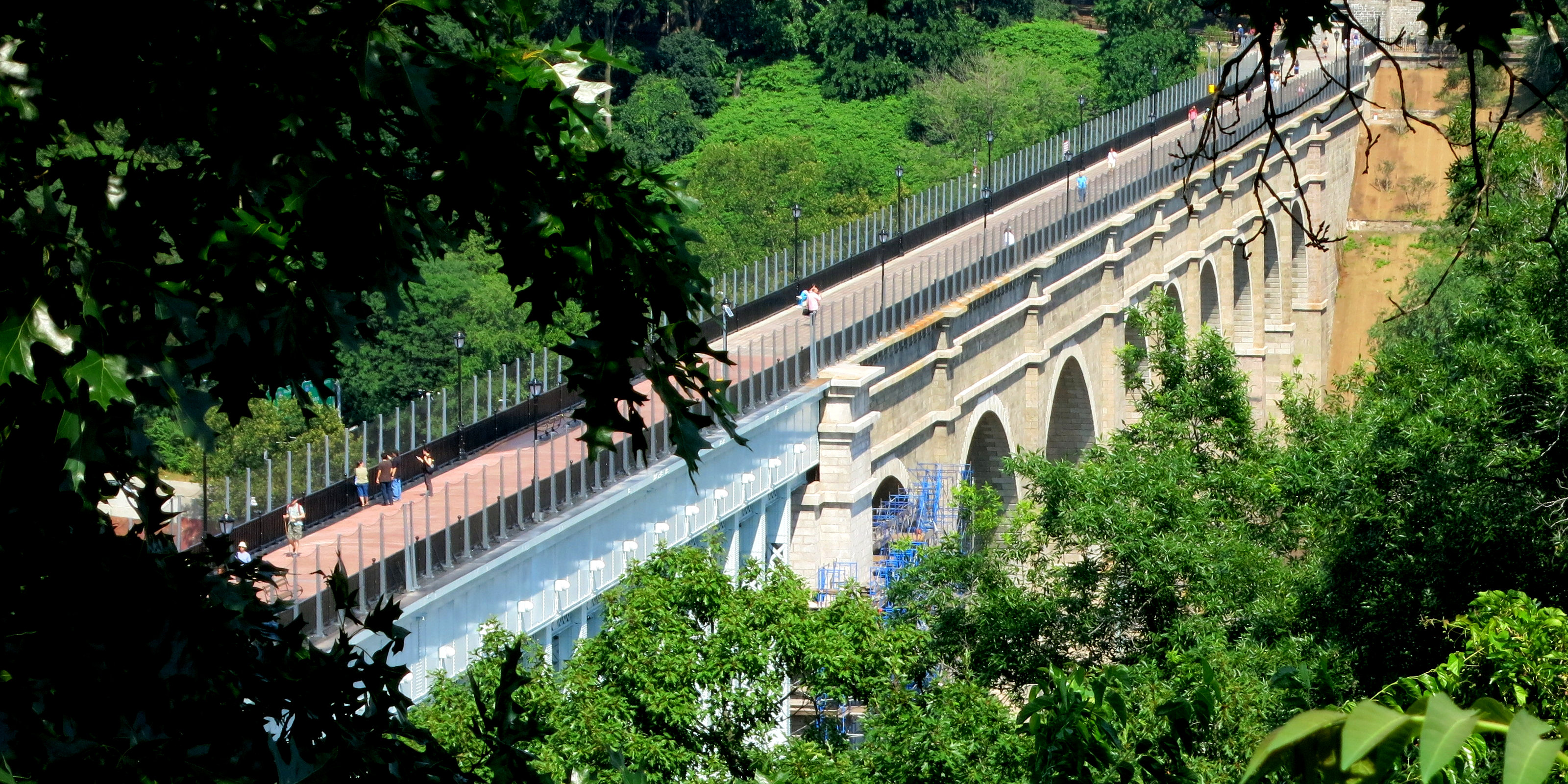
Our destination: the newly reopened High Bridge seen from above, near the tower
You should also remember that following the route of the OCA involves choices of where to go where the original route was changed and in one case, where it went through the city mid-block and is impossible to follow since there is no longer a path along the route to walk on. So I've laid out a route that I would take. I also point out subway stations near the route at various points, so you can decide where to start and how far you want to go. 

The last thing to make note of is that the maps I put in below have little red circles at certain points where you can see features or remnants of the OCA. 

Part 1: Fifth Avenue and Central Park — 4 - 6 miles

Fifth Avenue

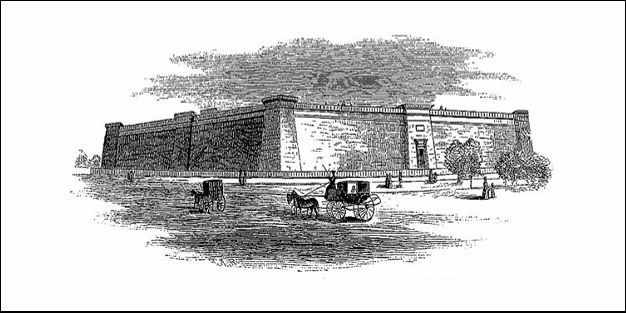
The Murray Hill Reservoir (1842)
The original OCA in 1842 consisted of the Distributing Reservoir (aka the Murray Hill Reservoir) between 40th and 42nd Street, west of Fifth Avenue — it was demolished in 1898-1901 to make way for the NY Public Library —  and a set of iron pipes under Fifth Avenue up to 80th Street which carried the water from the Receiving Reservoir which was in the future Central Park.

We certainly don't need a map for Fifth Avenue, Just go up from the New York Public Library (for out-of-towners, that's on Fifth Avenue between 40th and 42nd Street) to Central Park and enter the park on the path just past the 79th Street Transverse, just before the Metropolitan Museum. Got it? Sound pretty boring, no? Well, let's check out some of the sites along the way, some well known, others not so much. 

The Scene on Fifth Avenue

At first I wanted to highlight any buildings that either pre-dated or were built soon after the OCA was built. Well, there aren't any. Interestingly, the two oldest surviving buildings along Fifth Avenue are St. Patrick's Cathedral (cornerstone laid in 1858) and the Arsenal in Central Park (1847-51), plus, of course, Central Park itself. But the Arsenal is the oldest by far, predating St, Patrick's and Central Park by about a decade.

Central Park followed soon thereafter. Originally authorized in 1853, the plan of the park was approved after a design contest with the "Greensward Plan" by Olmsted and Vaux selected. It was constructed and opened to great fanfare in 1857. The old reservoir had been there for close to 20 years and the new one came along just as the park was being built and was included as an integral part of the plan. Then came the millionaires, and Fifth Avenue would never be the same. 

There's some good pictures in the slideshow below showing of some of the notable structures along Fifth Avenue.

Central Park

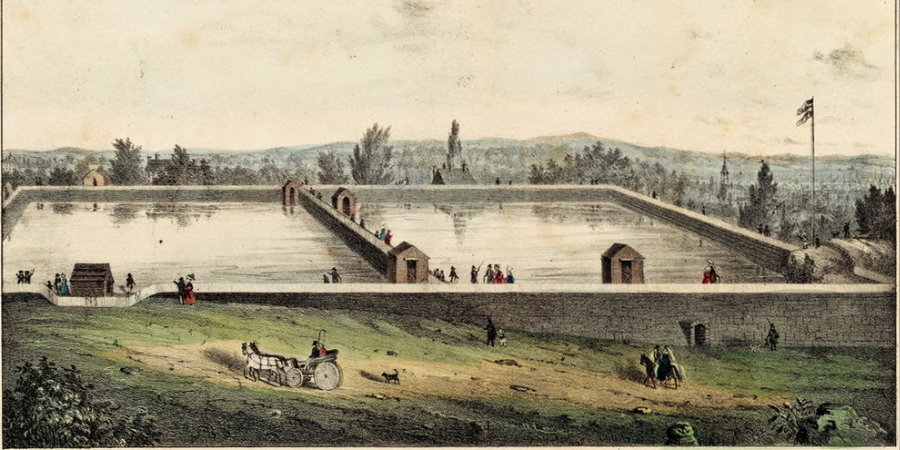
The Yorkville Reservoir (1842)
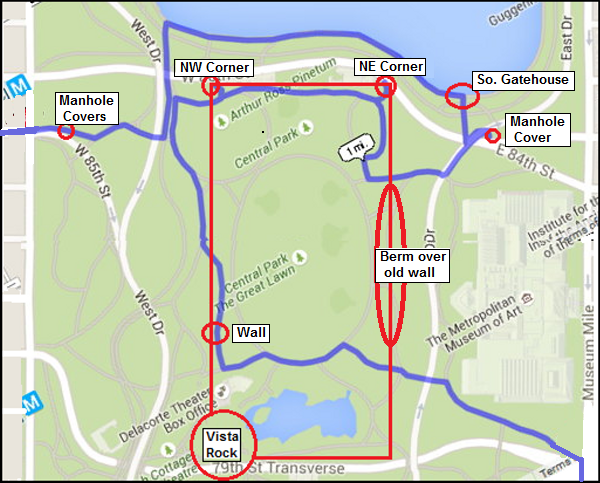
The original Receiving Reservoir (aka the Yorkville Reservoir) was built between 79th and 86th Streets from Sixth to Seventh Avenue.  It was decommissioned and filled in in the 1930s.  The current Central Park Reservoir was completed in 1862.


Look at the map to the right — why did I choose that crazy path (the blue line)? Well, you'll see an outline of the old receiving reservoir in red and red circles to note where present day remnants can be found. The suggested route tries to hit them all. 

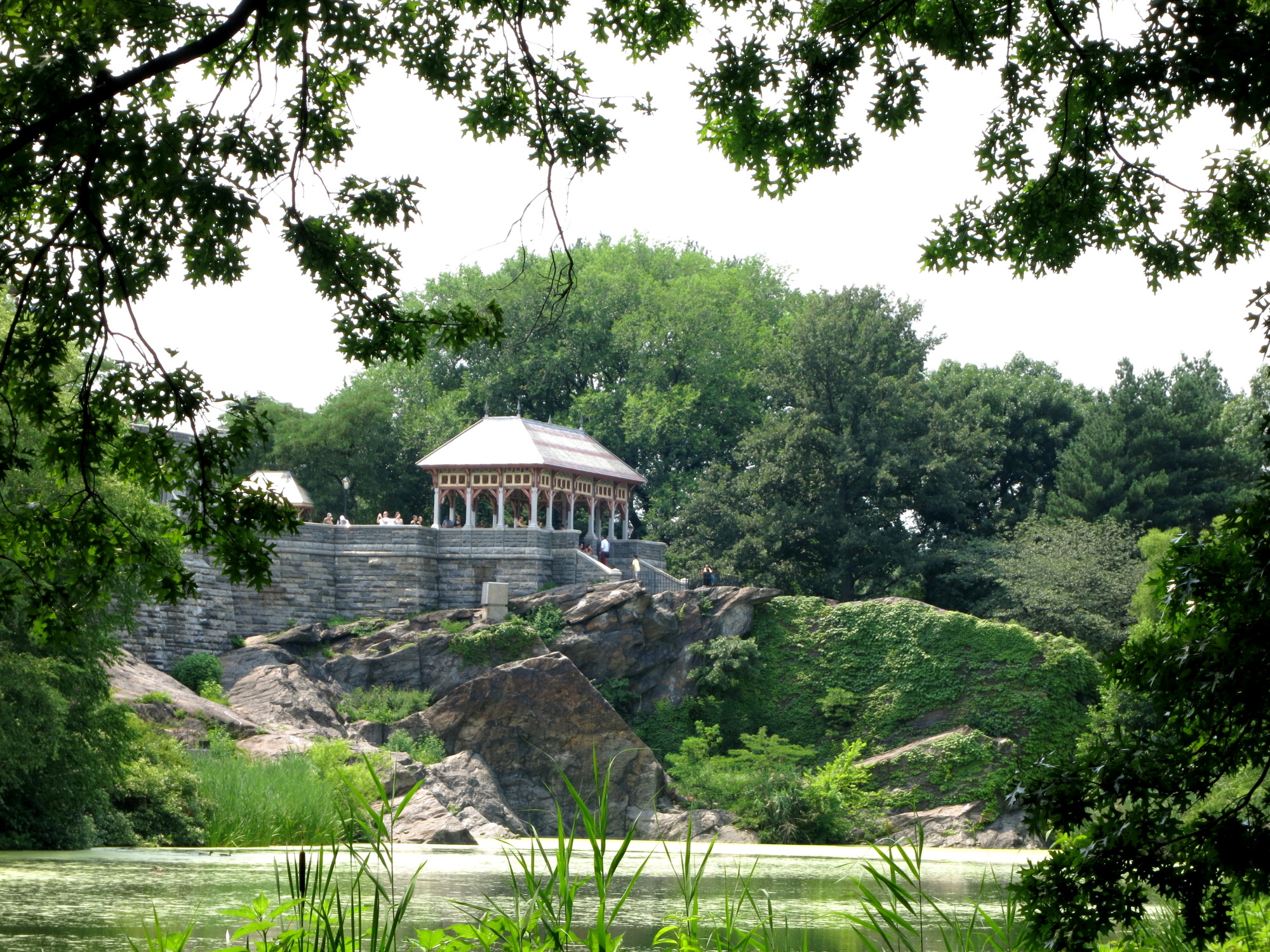
It enters the park on the path between the 79th Street Transverse and the Met, goes through Greywacke Arch under the East Drive and circles around to the west side. When you come out from under the arch make a note of the long north-south berm (mound of earth) that marks the buried east wall of the old reservoir. When the route gets near the Delacorte Theater it heads up roughly along the old mostly buried west wall and touches the NW corner. Before you turn north, look over your shoulder at Vista Rock.  The SW corner of the old reservoir snuggled up against this rock before the castle was built and before the Turtle Pond was even contemplated.

Vista Rock 
Then the route heads back east along the mostly visible north wall (the old brick building are all built up against this wall) to the NE corner. Then it goes up for a stint on the "New Reservoir" (aka the Central Park Reservoir) and goes west along that great lake and finally exits the park at 85th Street. Incidentally, the entry and exit points (80th & Fifth and 85th & Eighth) are both where the original aqueduct passed through the park. And in 1842, the old reservoir was the only above ground feature visible in the park. All the conduits and pipes passing through, were below ground. 

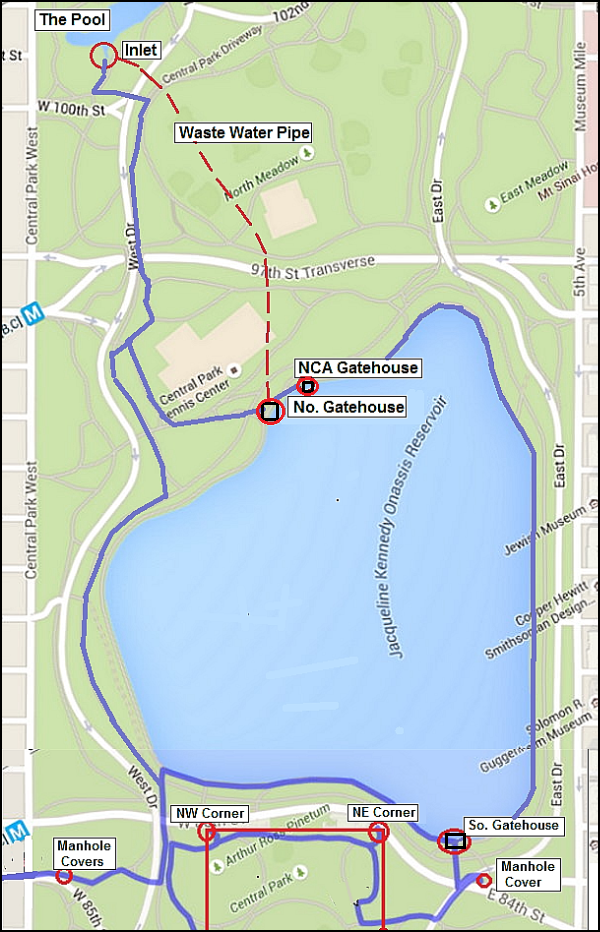
And there's more in the park if you're up for it. You can run completely around the Reservoir and even go up to The Pool at 100th Street on the west side. I've read that this small pond was created, in part, from the overflow of the reservoir — see the item in the remnants section (OCA Page: Features and Remnants).  

So I've added a map (left) for those who want to earn "Extra Credit" in Central Park. Just go right when you get to the South Gatehouse after exploring the Great Lawn, and circle around the reservoir as shown on the map. Now you can say to your friends "You mean you went to see OCA remnants in Central Park and DIDN'T see The Pool Inlet? Dude, that is just soo lame!" Or whatever.

The following slideshow includes the Fifth Avenue and Central Park portions of part 1 of the route. 
  

And now for part 2 of the trek —

Part 2: The upper West Side and Highbridge Park to the High Bridge — just under 5 miles 

Columbus (Ninth) Avenue

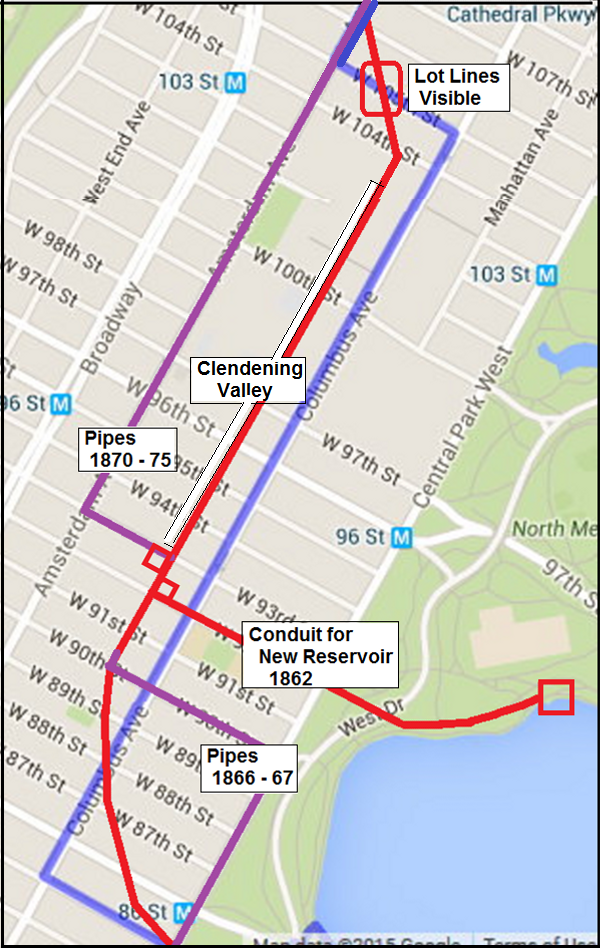
Clendening Valley Aqueduct (93rd to 103rd)
The OCA consisted of a brick conduit from Central Park all the way to 119th & Tenth (Amsterdam).  From about 93rd to 103rd Streets it was above ground between Ninth and Tenth Avenue. The conduit was replaced by under ground pipes in the 1870s. See the map below. 

Once you set foot outside the park you need to know about where the original OCA went. Look at the map to the right. It's not so much a route map for your run as it's a map of the various changes in the OCA over the 2nd half of the 19th Century.

The heavy red line is the route of the original 1842 conduit. In the map the purple lines show where pipes were laid to replace the conduit, first from 85th to 90th, and then from 93rd to 113th where the old conduit crossed the Clendening Valley and headed north up Amsterdam Avenue. And when I say replaced, I mean the old conduit was demolished and buildings were built on the former right-of-way. The only mid-block section to remain was from 90th to 93nd Street, and that too was built over after the OCA was deactivated in 1955. 

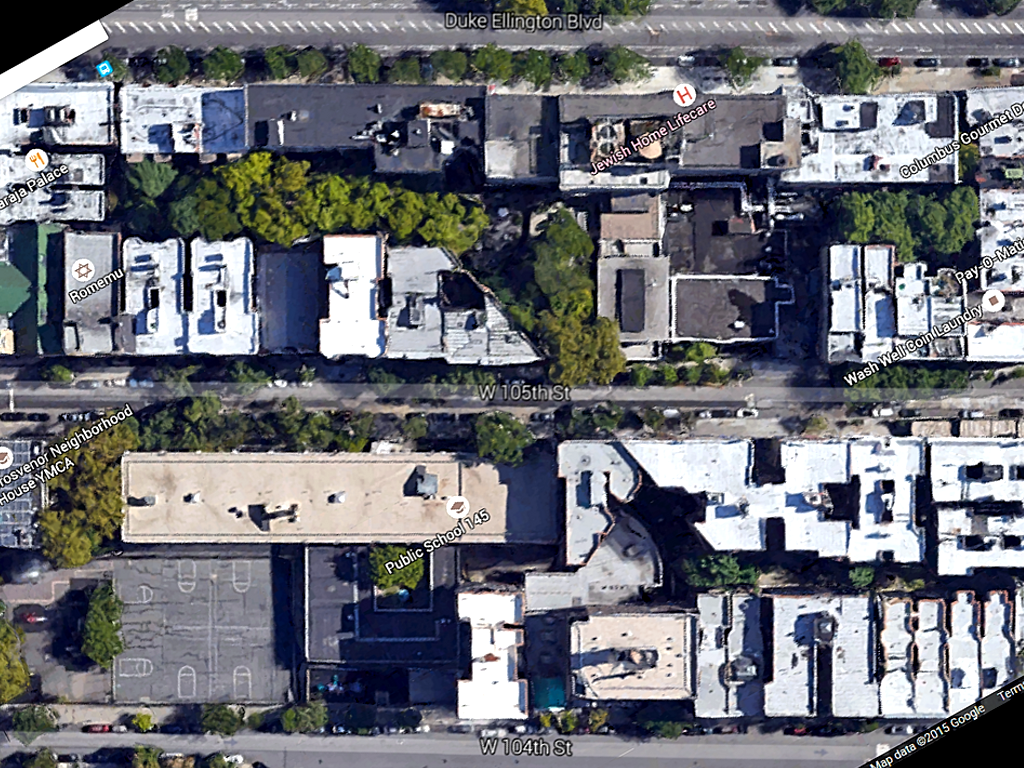
So where should we run? My choice is the blue line. I picked the route mostly to go up on Columbus Avenue since that is closest to the original route, and I cross over to Amsterdam on 105th so you can see the only surviving lot-lines mid block (see Google Earth photo below). It's really cool to see a building suddenly go off an an angle in good old rectilinear New York City.   

The 105th Street lot-lines, from Google Earth


Amsterdam (Tenth) Avenue

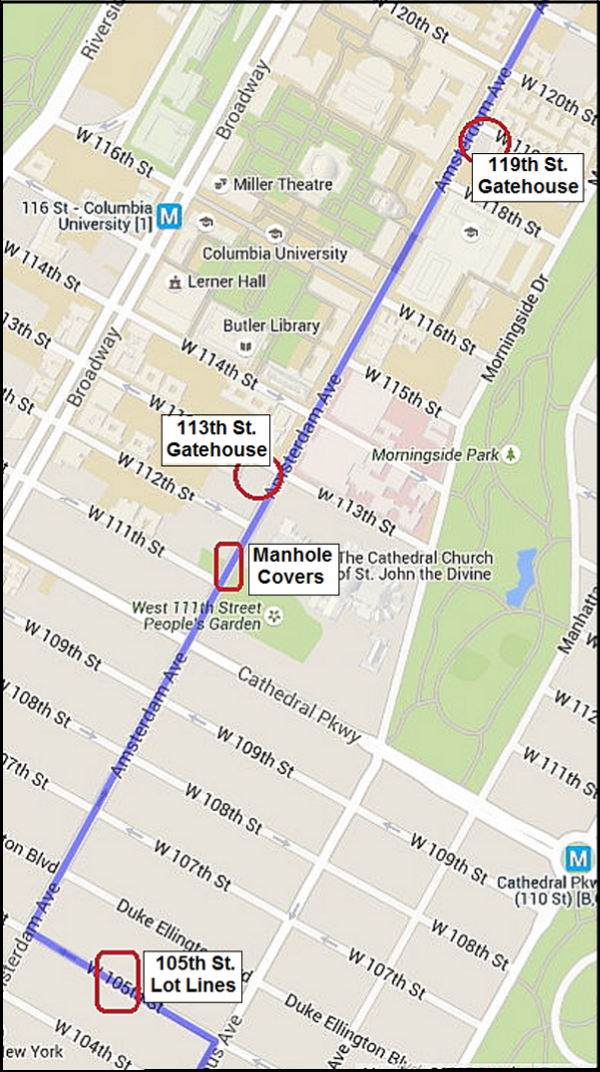
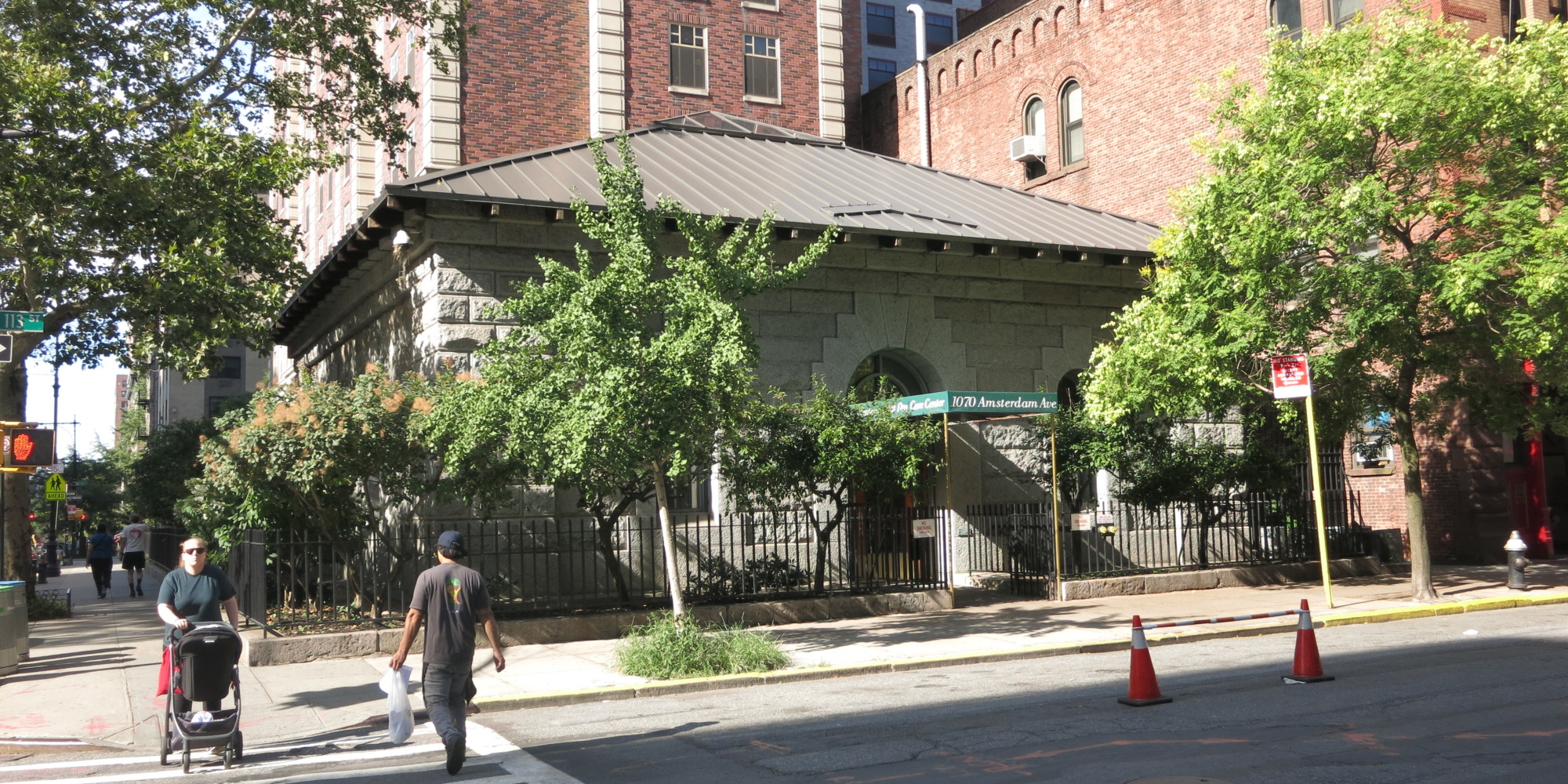
Now direct your attention to the next map on the left. It's really a map of features and remnants (and a few footprints). Starting with the 105th Street lot-lines it goes up to the 113th Street and 119th Street gatehouses with a few manhole covers thrown in between 111th and 112th. BTW: there's a great place for coffee and a sweets at 111th Street opposite the Cathedral. It's the Hungarian Pastry Shop and it's been an Upper West Side institution forever. After that snack break it's just 2 blocks further to the well preserved 113th Street Gatehouse. You'll step over two historic manhole covers in the sidewalk (look down) getting there. 

The 113th Street Gatehouse, now part of a home for the elderly

But before we get to the next gatehouse 6 blocks further on, why not take a break and make a side trip to the Columbia University campus. I did that on a recent scouting trip for this article. Enter at 116th Street and take a glimpse of the main campus with Low Library (formerly a library, now an administration building) on the north end and the Butler Library (an actual library) on the south end as you walk along College Walk. It's a great tonic from the endless low rises, high-rises, churches large and small and endless bodegas and bars along the avenue. And if you have an extra moment, find your way up to the overpass over Amsterdam Avenue between 117th and 118th Streets. Amsterdam Avenue from this vantage point is impressive all the way south to where it crosses the High Line and to the north you can really appreciate the Manhattan Valley and the vast impediment it was to the building of the aqueduct. 

Now back on the avenue, go under that overpass and you'll get to the dilapidated 119th Street Gatehouse. Look at it and weep. 

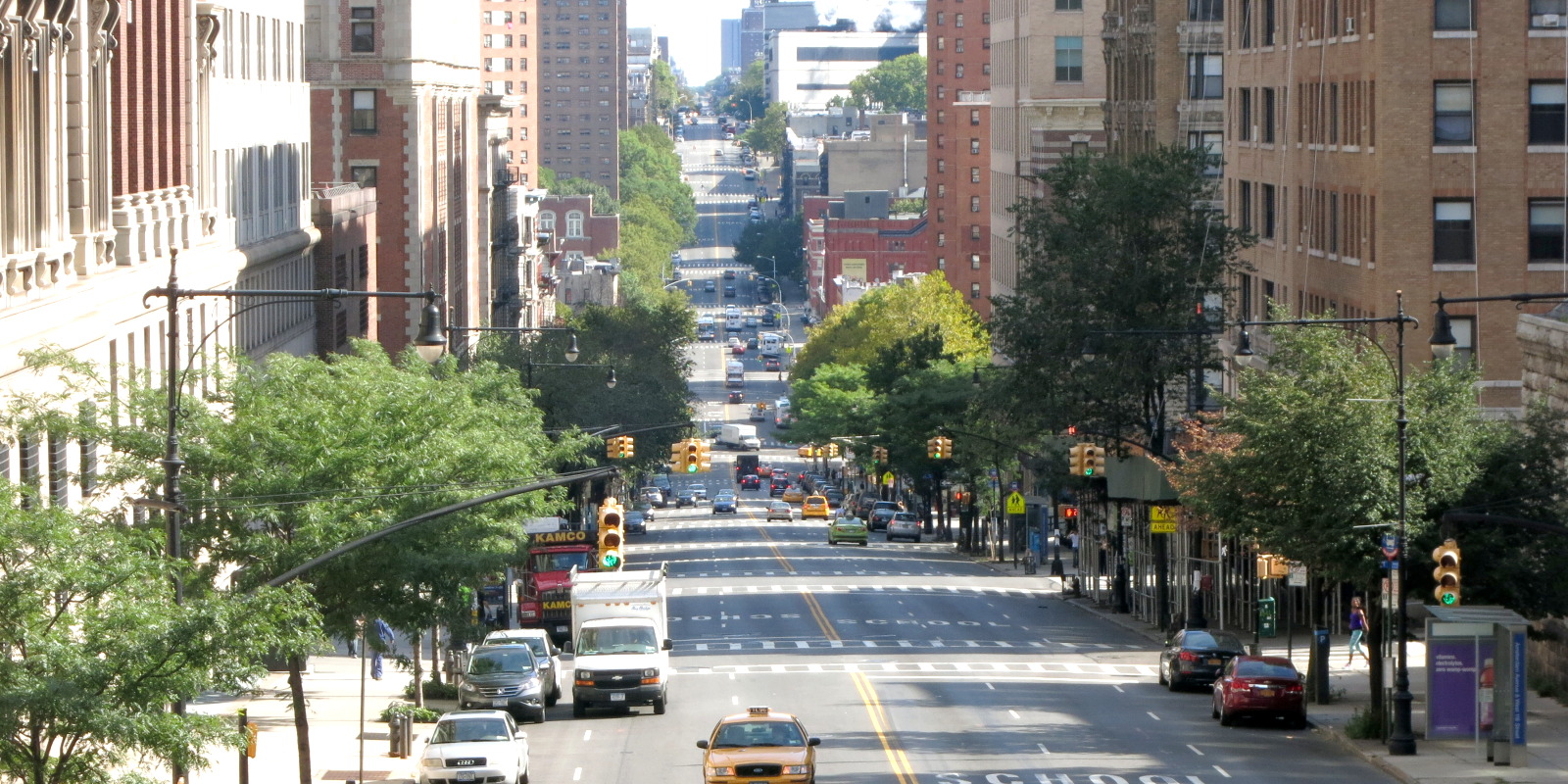
The OCA was a brick conduit (mostly replaced by pipes in the 1870s) from Central Park up to 119th Street and Amsterdam Avenue, but from there to 135th Street it consisted of underground pipes in what is known as an inverted syphon to cross the Manhattan Valley.  From 135th Street it again consisted of a brick conduit all the way to The High Bridge.

Then when we're through with Columbia comes the Manhattan Valley. Like the Fifth Avenue section, this is a bit boring. It's just 16 blocks along Amsterdam (Tenth) Avenue that goes down and up again. And by no special intent, its goes from Columbia University to City College — although neither one was there when the OCA was originally built. Instead, where Columbia is there was an insane asylum and where City is there was an orphan asylum on one side and a convent on the other (hence "Convent Avenue"). It is a valley, and a fairly deep one (over 100 feet below the line of the aqueduct), and there was some thought of building a huge above-ground aqueduct across the valley, reminiscent of the ancient Roman aqueducts, but that was ruled out due to the expense. So an inverted syphon of pipes it was. Originally it was two 36" pipes, but later a 48" and a 60" pipe were added.  

The Manhattan Valley seen from the Columbia University overpass at 117th Street
At the low point, where Tenth Avenue crossed Manhattan Street (now 125th Street) there was an underground vault (called a "blow-off" vault) where valves could allow the pipes to be drained for maintenance or cleaning. It may still be there under some manhole cover but good luck in finding that in that busy intersection which at the moment is a bit dug up. Maybe I'll go there some day when there's no traffic and sneak a peek down — wanna come? We may find alligators!

Upper Amsterdam Avenue

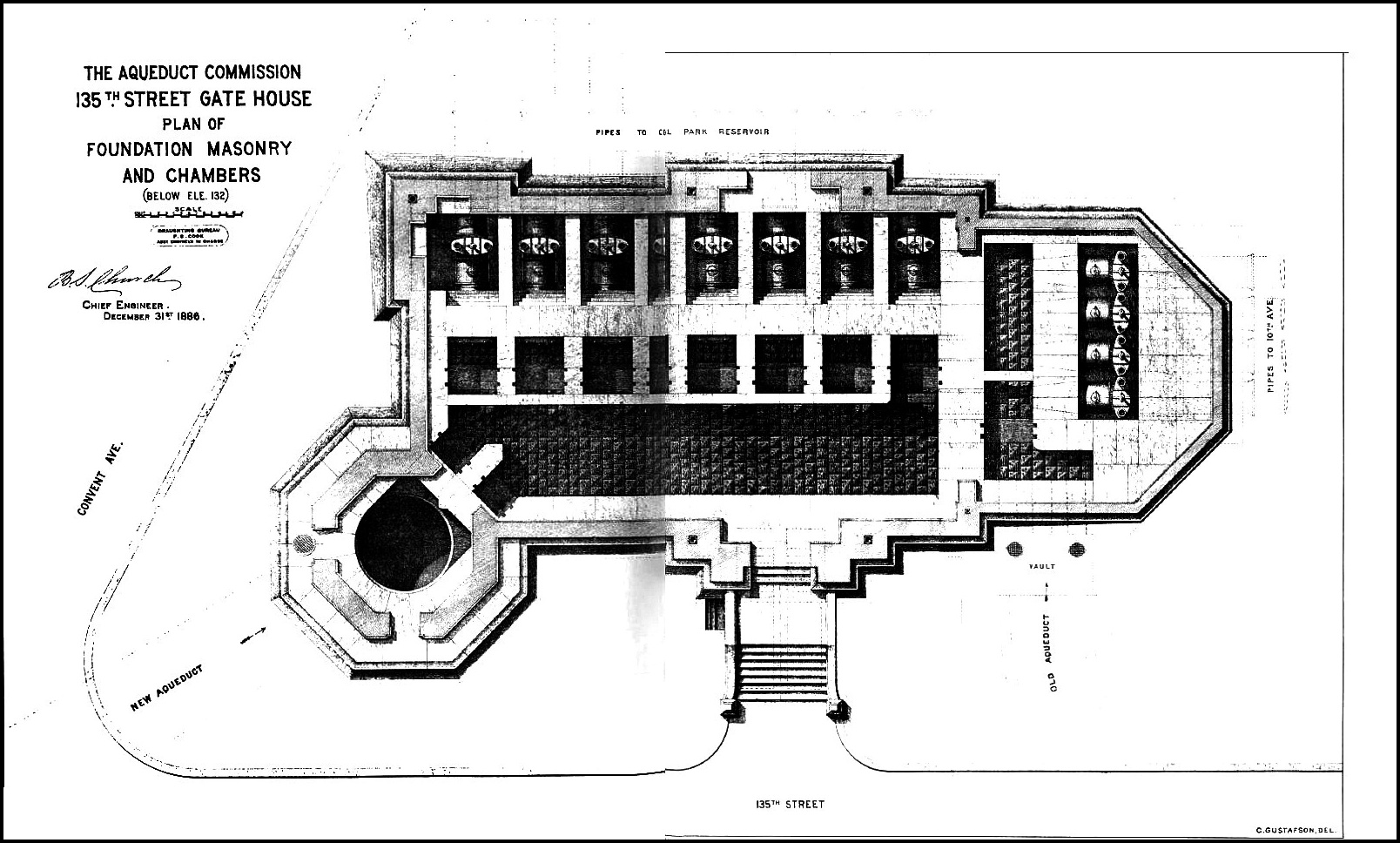
Congratulations, you've just climbed the only hill worth the name on the whole route and now you are in City College territory. But before checking that out turn right on 135th Street and you'll see the unmistakable gatehouse on the corner of 135th and Convent Avenue. If you think this looks rather different architecturally from any of the other gate houses, including the two you've just passed on Amsterdam and the gatehouses on the Central Park Reservoir, you're absolutely right. It was completed in 1890 for the New Croton Aqueduct (aka the "NCA", naturally) and shows a difference of some 50 years in both technology and sensibilities. 
 
The NCA, as it is called, differs from the OCA in several notable ways, 1) It's supplied by a much larger Croton Reservoir behind the New Croton Dam, 2) it was built entirely underground, and 3) it has a capacity of 3 times the OCA. This gatehouse at 135th Street was the end of the line for the NCA Conduit — about half the output went to the Central Park Reservoir and the rest went directly to the city water mains,


The 135th Street Gatehouse

This gatehouse had a peculiar set of needs to fill. First off, the OCA gatehouse at the north end of the Manhattan Valley syphon was sitting a half a block away in the middle of Amsterdam Avenue where it had stood for some 50 years — and it was blocking traffic that would have been unimaginable when it was built. Secondly, the New Croton Aqueduct came down under Convent Avenue from Highbridge Park after passing under the Harlem River and was close to 100 feet underground here, and under pressure. And Third, the NCA would not have a Manhattan Reservoir to hold its entire flow, but rather split it's output between the Central Park Reservoir and the city water mains. 

And as for that faux Egyptian fortress [sic] down on 42nd Street, talk was already in the air of getting rid of it. So this gatehouse had to do everything: control the input flow coming up through a shaft under pressure, control the output flow consisting of no less that eight 48" pipes to various parts of the city, and lastly replace the OCA gatehouse in such a way that flow from either aqueduct could be directed to either. 

The plan for its construction from Wegmann (The Water Supply of the City of New York, 1658-1895 by Eward Wegmann 1896 ) is on the left. Try to see the fine print and you'll get the idea. 

And it did it's job so well that this year, 125 years after its construction, the valves under the gatehouse were used to switch the water from the reactivated NCA into the distribution system of the city. 

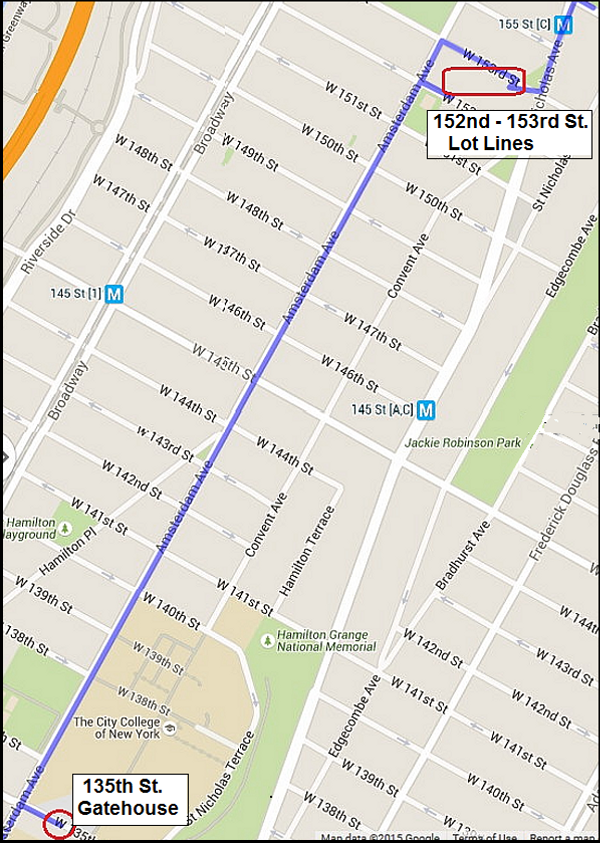
Now back to Amsterdam and on with our trek. As you crest the hill you'll see Amsterdam Avenue stretched out before you for about another mile to 155th Street. The old conduit is under the road here but not far under. On your right you'll pass City College with a mixture of beautiful old buildings of dark granite with limestone trim and a nondescript assortment of ugly new buildings. Its worth a look when you pass the main gates at 138th Street and 139th Street. 

Now keep moving and before you know it you're in the 150s. When you get to 152nd, take a right and on the left side you'll see that characteristic lot-line cut at an odd angle that just screams "AQUEDUCT". The buildings on both sides of this cut go off at about a 45° angle. The cut is now a community garden and it's gated at both ends but on the last two visits I made to this place, first one end, and the other end was open. So I would walk one way and had to turn around and the other time, ditto in the other direction. Maybe you'll be lucky and find both ends open. I call this the "last block of the aqueduct in Manhattan". Some day I'll get through it from end to end. When you go through it, or alas, around it, head up St. Nicholas to 155th (that's Macombs Dam Bridge down the hill — Note: all the 19th century maps and documents spell this "McComb's Dam" ) and cross the street; turn slightly to the left just east of the subway station and walk down along the little triangle of green and you'll be in Highbridge Park.

Highbridge Park and The High Bridge: at last the Real, Original and Genuine Old Croton Aqueduct!

The High Bridge from McComb's Dam (1849 watercolor)
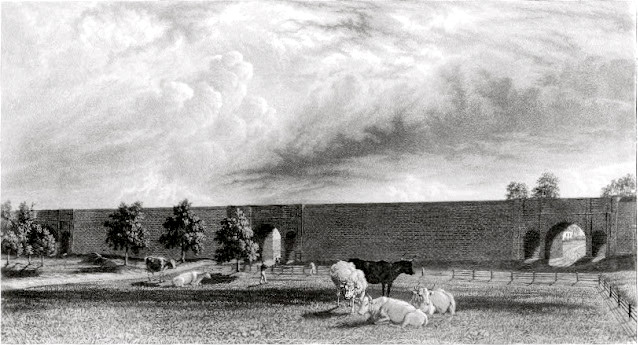
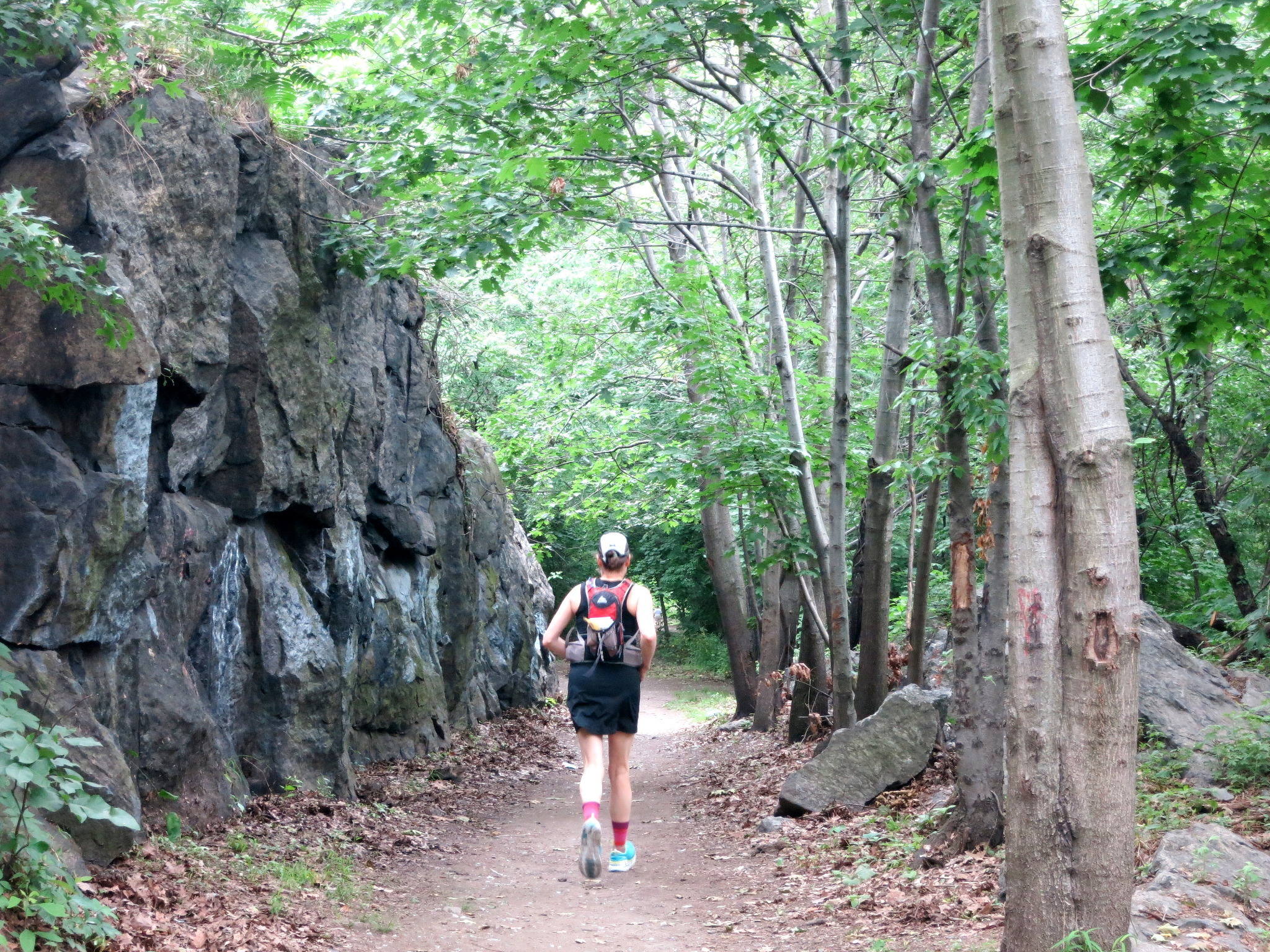
The last section of the OCA we will cover is in Highbridge Park.  It's the original aqueduct with rock retaining walls and deep rock cuts along the side of the steep cliffs in this park. The High Bridge took 6 more years to finish.  The watercolor on the left dates from 1849, within a year of the bridge's completion.

The OCA crosses 155th Street diagonally and heads down along the west side of the triangle of green west of Edgecombe Ave. Cross over and you'll be on the sidewalk next to Highbridge Park. (Note: the park is spelled "Highbridge Park", the bridge is spelled "The High Bridge"). After crossing a playground and stairs down to the bottom, get on the OCA opposite 158th Street. It's about a mile to High Bridge and the first half is on dirt. 

The OCA at a rock cut in Highbridge Park
And when you see the rock cuts the aqueduct went through, remember the workers had only pick and shovel and dynamite to work with. Those cuts plus the steep cliffs both above and below the route can only make you marvel. And whether this is the first or last segment you've seen, there is NOTHING else this rugged in the entire 41 miles of the OCA.

After a little detour around a rocky knoll, you'll get on a paved portion which also serves as a bike path. You'll know it when you get to the bridge since there will be lots of folks looking around checking out the newly reopened bridge. 

Glad you made it all the way.  Join me again for the next run – Papa Bear

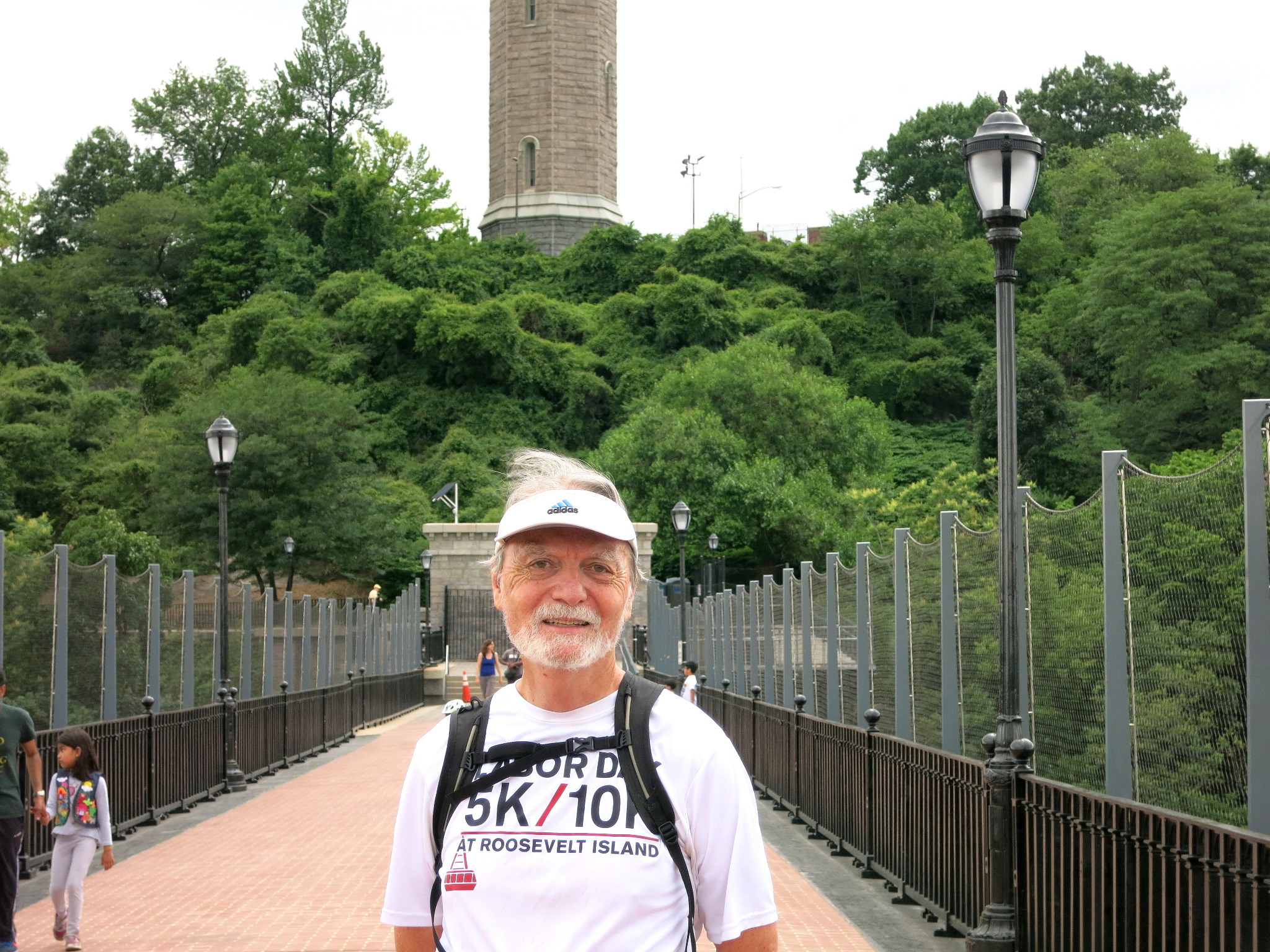
Even if you're not going on through the Bronx, go over the bridge and back anyway and enjoy the view. You've never seen the Harlem River from this vantage point. Take a look back at the High Bridge Water Tower which used to supply water to this portion of Manhattan. 


I put together a slideshow as part of a post about the bridge, its history, restoration and reopening this June on the main OCA page (here: Slideshow: The History, Restoration and Reopening of The High Bridge). The slideshow is especially informative on the bridge and its history.

If this is your end point, go up the stairs and find your way over to the A train at 168th Street and Broadway and if you're going on, good luck for a longer run. Go dté tú slán!

As always,
Papa Bear


Read more...

  © Blogger templates The Professional Template by Ourblogtemplates.com 2008

Back to TOP