FLYERS ONLY
Submit photos, stories, or video links for publication, via email to Dave K., our Blogmaster, at blogmaster@nyflyers.org
Who We Are
ABOUT OUR CLUB
The New York Flyers, established in 1989, is the most vibrant running club in all of New York City. Membership is open to all runners regardless of experience or ability.
To contact us, please send an email to our Member at Large at mal@nyflyers.org, or visit us on the web.
Blogmaster's Note: This is a slightly updated version of Joyce's post from about 2 years ago to highlight that registration for the 2014 Empire State Building Run Upopens today (click HERE to register).
As some may say, a typical New Yorker has never been to the top of the Empire State Building. Well, I guess I fell into that category. Growing up in Long Island and living the last 25 years or so in the New York City area, I am one of those people that never visited the top of the Empire State Building.
That all changed a couple of weeks ago, when I not only made it all the way to the top, I ran the whole way up -- all 86 flights, 1576 stairs, two at a time (in the beginning anyway) -- in completing the NYRR Empire State Building Run Up. Okay, so maybe I didn’t actually run. I am not quite sure what it was I did but I managed to keep a steady pace the entire way, and clocked in at 21 minutes 40 seconds. Five other Flyers also made the climb to the top.
Not bad for a first-timer with no real strategy, except for some training in my apartment building, going up 30 or so flights a couple of times a week. Of course, looking back I start to think of what I could have done better, smarter and more efficiently to get under 20 minutes. There’s always next year. Here’s what I learned:
Start slow, don’t lose your breath, or you will burn out quickly. I got this training tip through friends and from online reading. A good tip. During my first 20 or so flights I was passed by a number of people, all guys. On the last 20 flights, I passed a number of people, mostly women, but yes some men too!
Hand over hand on the banister. This tip was given to me by a gal I met waiting on line who has done the stair run for several years. I am really not too sure how much this tip helped or hurt me. During my training I never held onto the banister. But then again, during my training I had to stop to catch my breath a few times. This never happened during the actual event.
Take two stairs at a time. For someone with long legs, this method probably works well and saves time. For someone at my height of 5’ 4”, this worked well for about the first four flights until my quads started burning and I went back to single steps.
Don’t carry anything in your hands – you need both hands. This is good advice. During my training I always had my apartment keys, my phone, and usually a bottle of water. Knowing there would be a bag check and 2 water stops along the course, I was grateful to have a hands-free experience.
A little anxiety is good. The adrenaline is definitely needed to get you through the event.
It's not so hard. It is over before you know it, it is really easier than it sounds, and there is no reason to overestimate the complexity of completing a stair climb.
Doesn't Anyone Dust?Expect to have a dry, sore throat for a day or so. It is dusty in those stairwells!
The actual event was almost a blur, and I think I blocked out all the pain. It was over so quickly. Even a 5K takes me longer. What I remember most were all the great people I met that evening. They started the participants alphabetically, and my last name begins with an “S." There was well over an hour wait to start my wave, so I had the chance to chat with a lot of participants. Most of us got in through the lottery and most of us were first-timers not knowing what to expect. There were, of course, a few veterans happy to give us their advice. It was all good.
When I got to the top, I really didn’t care about the view, which was a good thing because it was a very foggy night. I was so just happy to finally make it to the top of the Empire State Building, giving high fives to all the people I just met that night, and getting my medal. It was definitely a night to remember.
To register for the 2014 Empire State Building Run Up, click HERE.
The Flyer Election Committee (Ed A, Janna G.E, Justine K, Debbie P and Stephanie T) worked hard finding candidates to serve on the board in 2014. And now it's time for your vote to count.
The time has come where each Flyer chooses who will serve on the board. We must also decide who will win the Flyer of the Year award for 2013.
Now each of us has a job to do. We all must all get out and VOTE! It takes only a couple of minutes and can be done easily via the Flyers website.
How does the Voting Process Work
Thanks to modern technology, our voting process is streamlined, efficient, and very secure. Each Flyer who has been a member of the club as of December 1st, 2013 was issued a VOTING CONTROL NUMBER. This is a simple 6 digit set of characters made up of numerals and letters. You simply enter your control number into the voting page and choose your candidates. Nothing could be simpler.
For the official start of the election, which began on December 18th, your voting control number was e-mailed to you. If you didn’t get or can't find the e-mail, you can locate your control number in your Flyer Member Profile on the Flyers Website. Or, you can e-mail anyone on the Election Committee and they will get you your unique control number.
This number is uniquely issued to you and you should keep this number secret. If you give out the number, then someone else will get your vote. Your control number can only be used once to cast a vote and cannot be used again. Please be aware that you cannot change your vote -- once cast, it is final. You will have until January 14th, 2014 to vote before the polls close.
Everyone is highly encouraged to get out and cast a vote, even if you don’t know the people for whom you are voting. One voting option you have is “abstain.” This simply means that you don’t like the choices or cannot decide on who you like best. This is a vote in itself and it counts.
Flyer of the Year
In addition to voting for the Executive Board (President, Vice President, Secretary, Treasurer, and Member at Large), you also can vote for the Flyer of the Year (example below). This is a very important vote. Every year, the Executive Board chooses 4 or 5 Flyers. These are Flyers who, for the past few years, have distinguished themselves by volunteering their efforts for the club in athletic, social and other activities. It is a very prestigious honor and only a handful of Flyers have ever won this award. It is a cherished award to win.
Also, this is the only award in the New York Flyers that is decided upon only by the members of the club. It is a very real validation of your hard work and the admiration you have earned from your fellow teammates. This award is presented at the Annual Flyer Awards Gala, which will be on Saturday, February 8th. So, you don’t want to miss this party.
But this award can only be won if members get out and vote so we want everyone to vote!
-Adapted from a 2011 Blog Post Written by Richard B.
Read more...
I've run the Palisades with the Flyers and with friends many times going back over 20 years. This report is actually two reports in one: one for running out and back along the road, and one to run out and back along the trail. And you can mix and match these in all combinations. A word on the slideshows: the slideshows are as important, if not more so, than the text. It's such a beautiful place, that you can't help but want to go there. Don't skip them! You'll be missing a lot. The photos were (mostly) taken during two runs we did in February and March of 2012.
The slideshows come up in separate windows in front of the post. You may want to use the control to set the interval (the default may be too fast – click on the "+") or you may prefer to advance the pictures manually (click on the arrows), and since they loop back to the beginning, you'll need to kill the window when you've seen the whole thing.
Enjoy, Papa Bear
The Palisades have been popular with runners and especially with bikers
for ages. One of the first
organized long runs of the New York Flyers nearly 20 years ago and run
every year since was a 20 mile run over the George Washington Bridge,
out along the park road and back.
At the same time, trail runners — rare in those days, but not today —
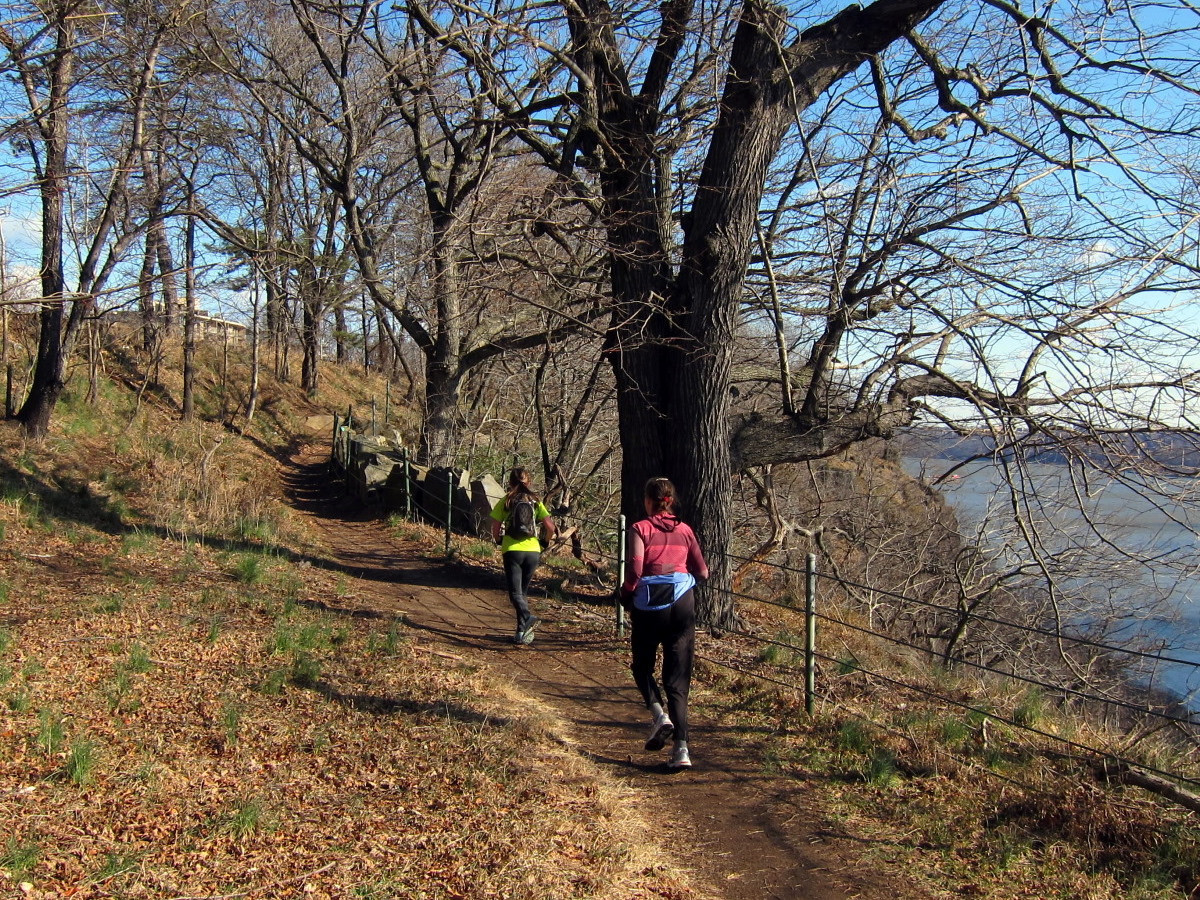
used the Long Path along the top of the cliffs as a great trail run.
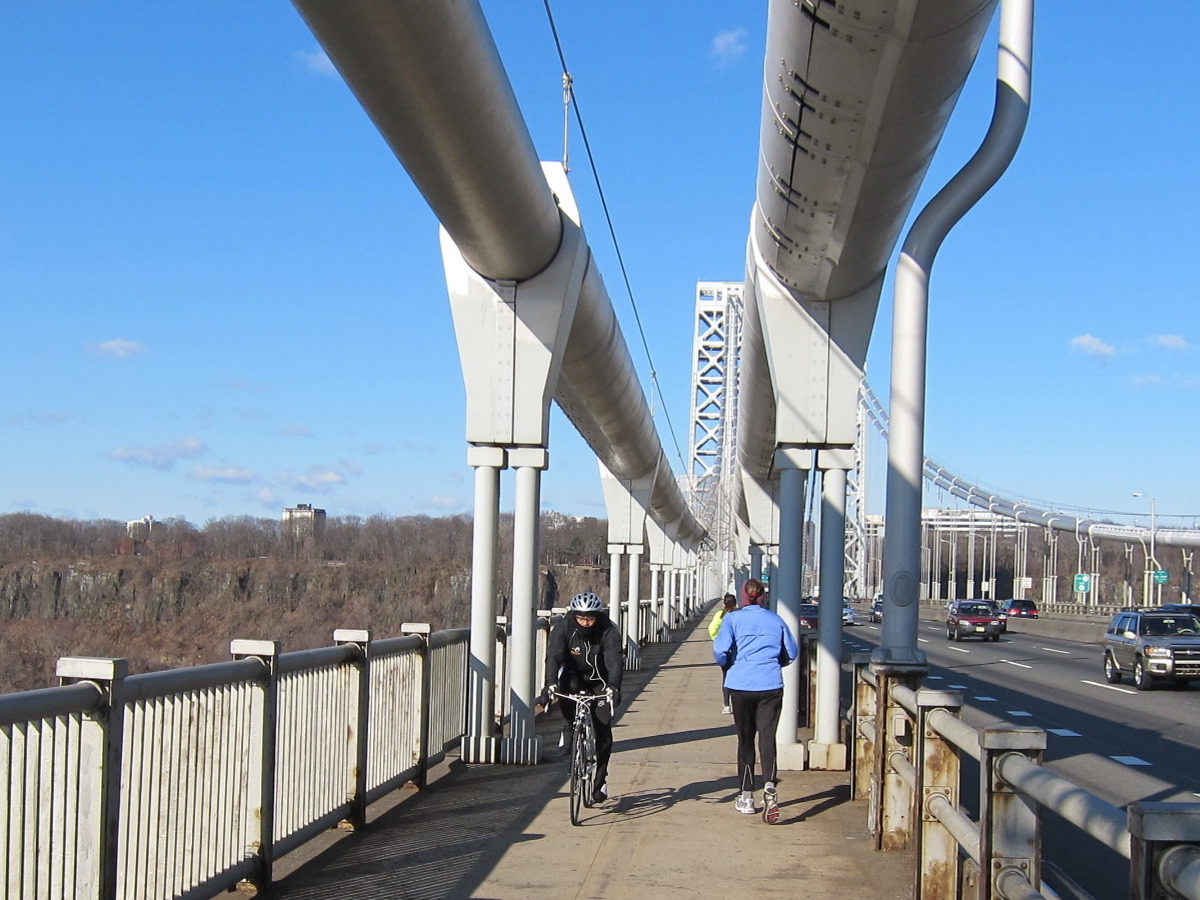
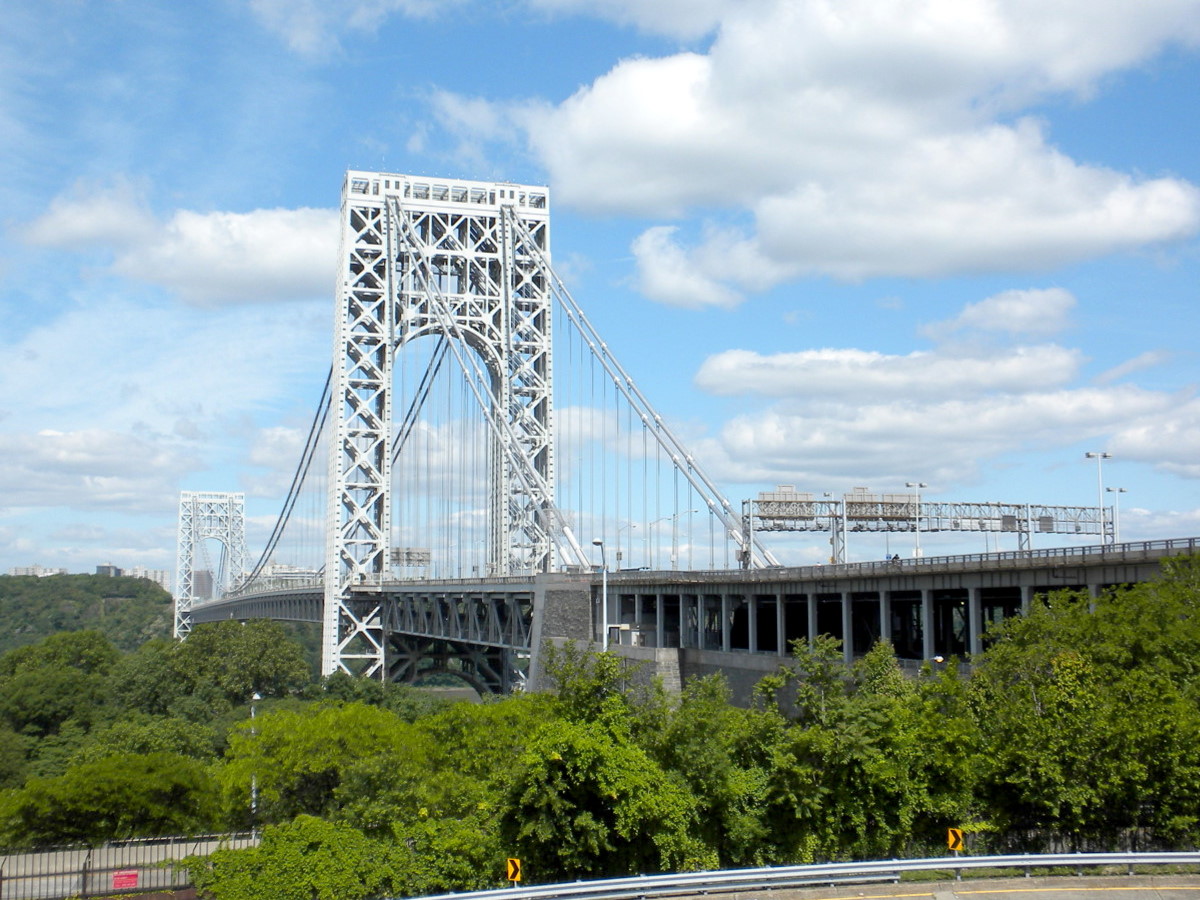
Crossing the GWB
There are also a number of trails and roads which connect the top to the
bottom. Besides the end of the park road which climbs the steep grade
from the
Alpine Boat Basin to the Park HQ at the top, there's the road down to
the Englewood Boat Basin (with the Dyckman Hill Trail along side),
there's the Huyler Landing Trail just north of Greenbrook Sanctuary
which connects the top to the botton abnout 8 miles out and lastly,
there's the Carpenter Trail, a steep route with no less that 320 stone
steps, which
climbs the cliff face about ¼ mile north of the bridge.
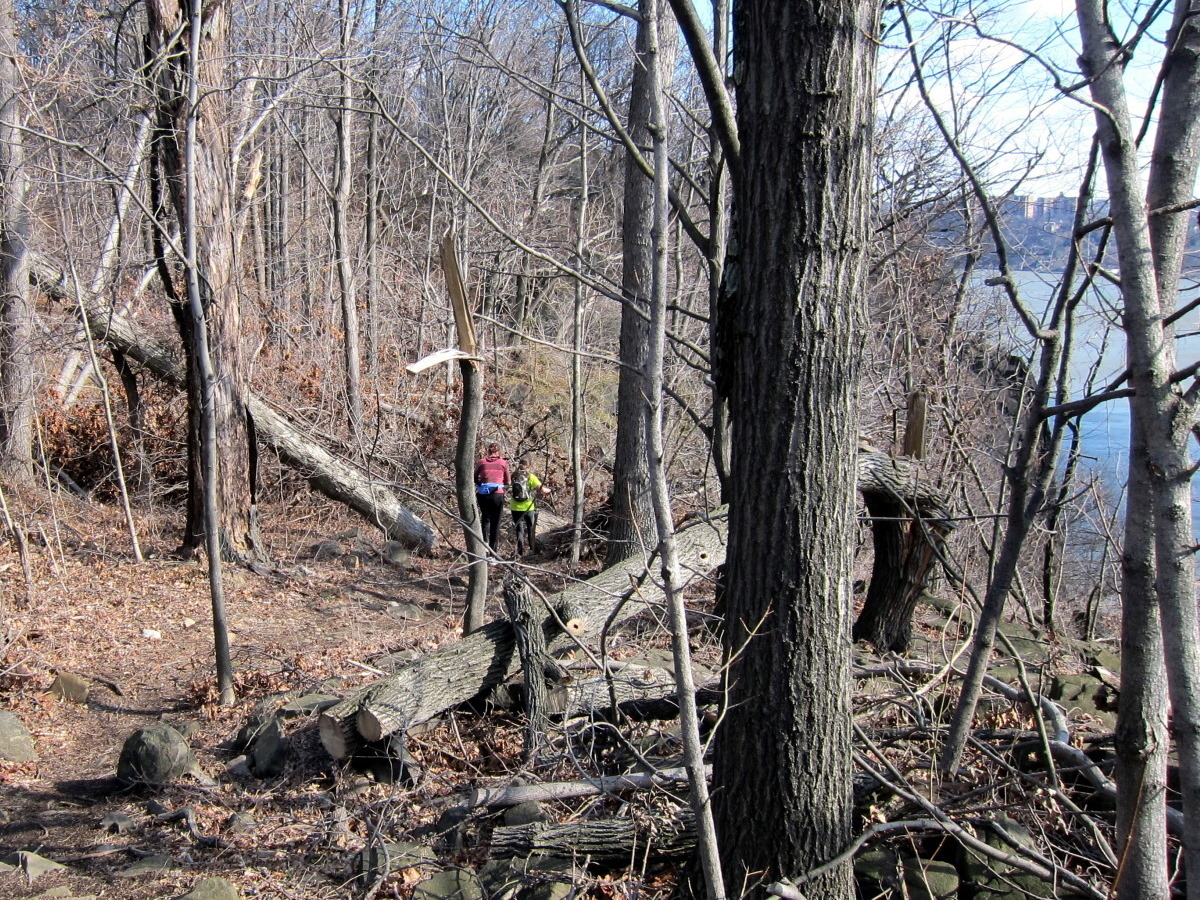
On the Trail along the cliff top
Officially, the park is known as the Palisades Interstate Park, New
Jersey Section, and besides the parkland, this includes the Palisades
Interstate
Parkway which lies along the west side of the parkland for its entire
length. There is an excellent web site
Here, which includes maps, detailed descriptions for the roads, trails and public
areas and a good deal of interesting historic information. If you have a few minutes sometime, I suggest you check it out.
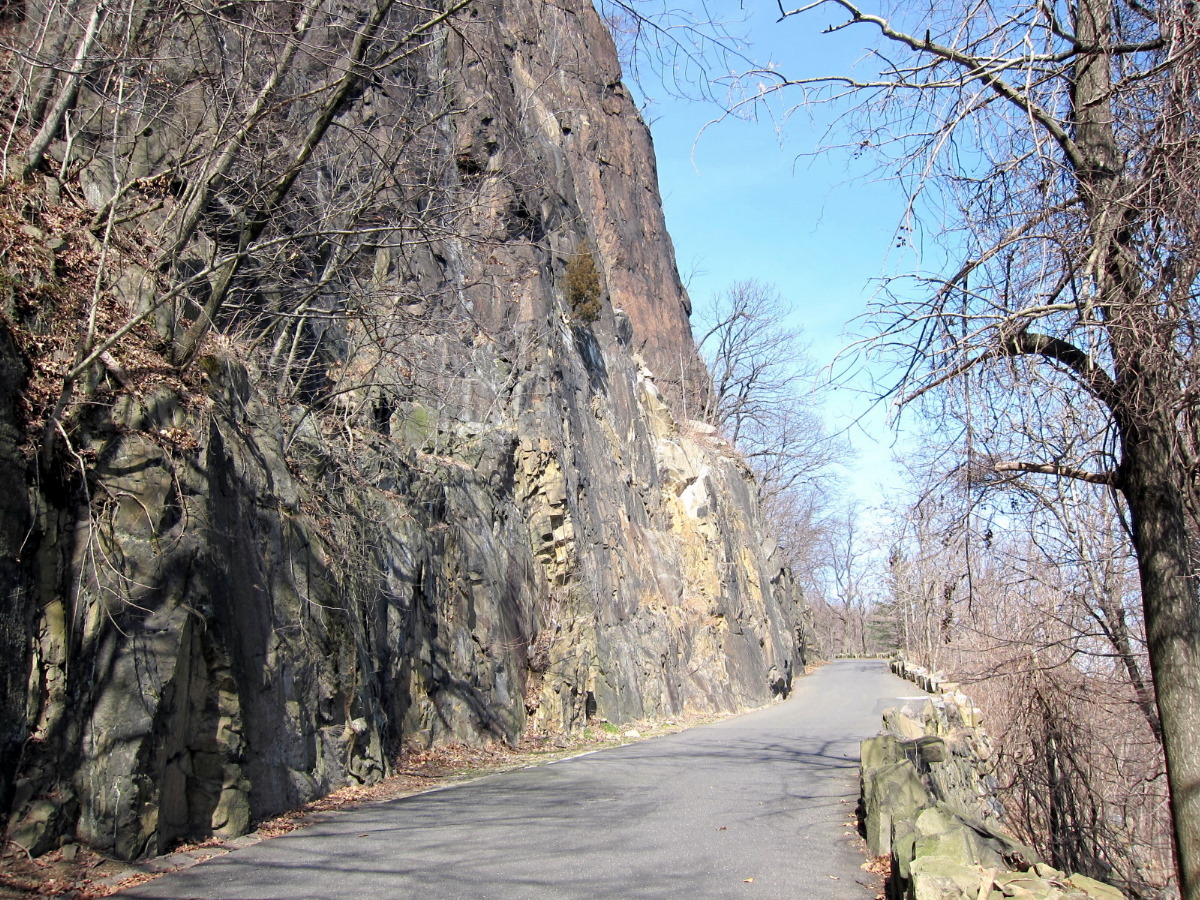
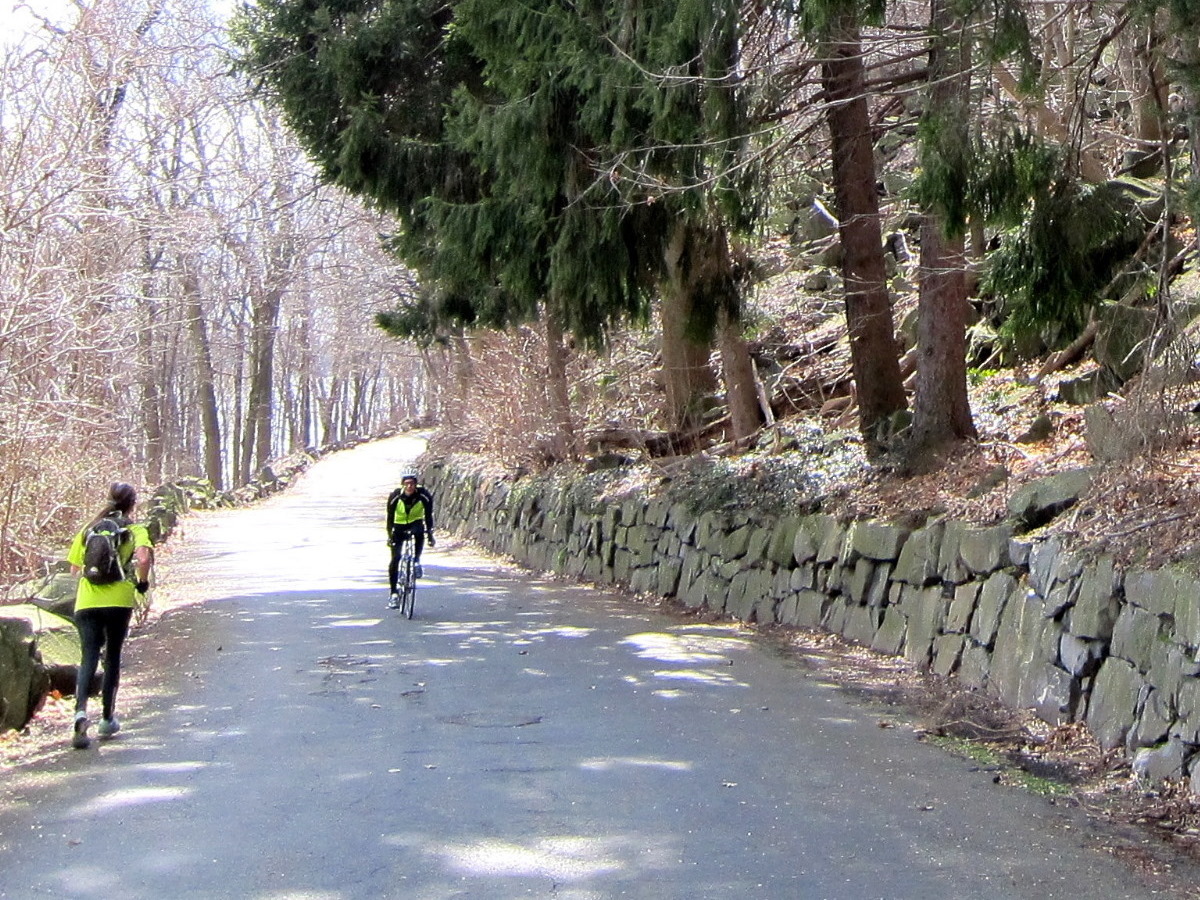
On the steep and dramatic road up to Alpine
In this article, I'll attempt to enumerate the many ways you can mix and
match these routes to make a perfect run. And no matter how you go,
it's
all spectacular. If you've never been there, you will simply not
believe you're just a hop, skip and a jump from New York City.
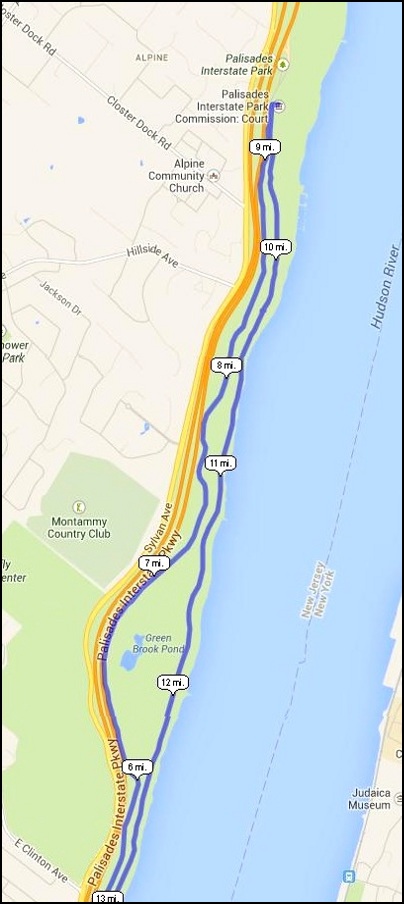
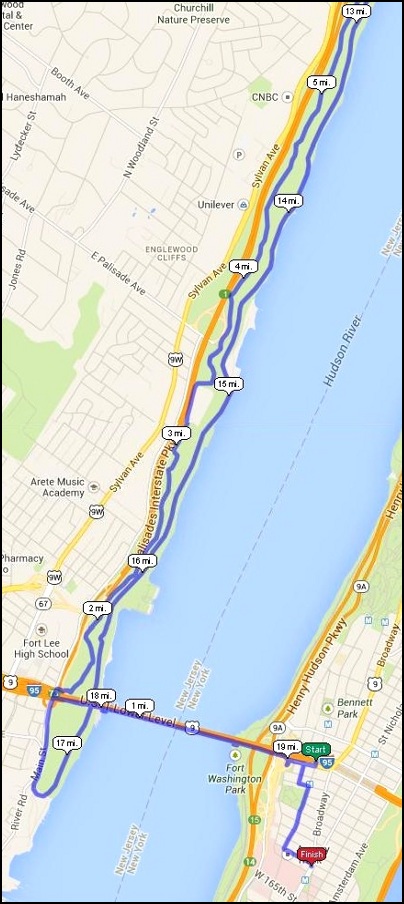
The Map (in two parts)
First, let's look at the map (in two parts above).
The Palisades are long and narrow and they are oriented about 30° to the east of north, like Manhattan. Consequently,
it's hard to show the whole of the Palisades in a single map, even a very long one. So I've divided it in half as you can see.
The Park actually goes about another 5 miles further north than any of
our routes, but that area is beyond what we will cover in this report —
but
yes, it you're a trail runner or a hiker, there are higher cliffs and lots
of spectacular terrain in that far northern section.
Take a look at the map, and you'll see the two primary north-south
routes are the trail along the top of the cliffs called the "Long Path"
(which I've
shown as the way out), and the park road which goes along the whole
length of the park from Fort Lee to Alpine (shown as the way back).
This is not to imply that you should take the trail outbound and the
road back. On the contrary you can run either an out and back on the
trail, or an out
and back on the road (like the Flyers do on the annual September
Palisades run). In fact this post details two complete 20 milers.
So mix and match trail and road to suit yourself.
I personally like to do the road out and trail back since the trail is
easier (at least for me) and the road has a lot more hills, some rather
steep.
But over the years, I've run the Palisades in all possible combinations.
After talking about the main routes, I'll also talk about are some of
the connecting routes between the top and the bottom
(I have included a little section on each of those). Using the
connectors, you can take short cuts and
cut the distance from 20 miles all the way down to 10. So long or short,
trails or road, it's all beautiful and it's all just waiting for you.
The approximate distances are 1.4 miles from the bus station to the
Jersey side of the bridge, 8.6 miles on the road from the bridge to
Apline, and
8.1 miles on the Long Path between those same two points. You can do
the math (remember to add in the bridge twice) and by adding a bit here
or there
you can get a 20 miler which is all roads, all trails (except fo the
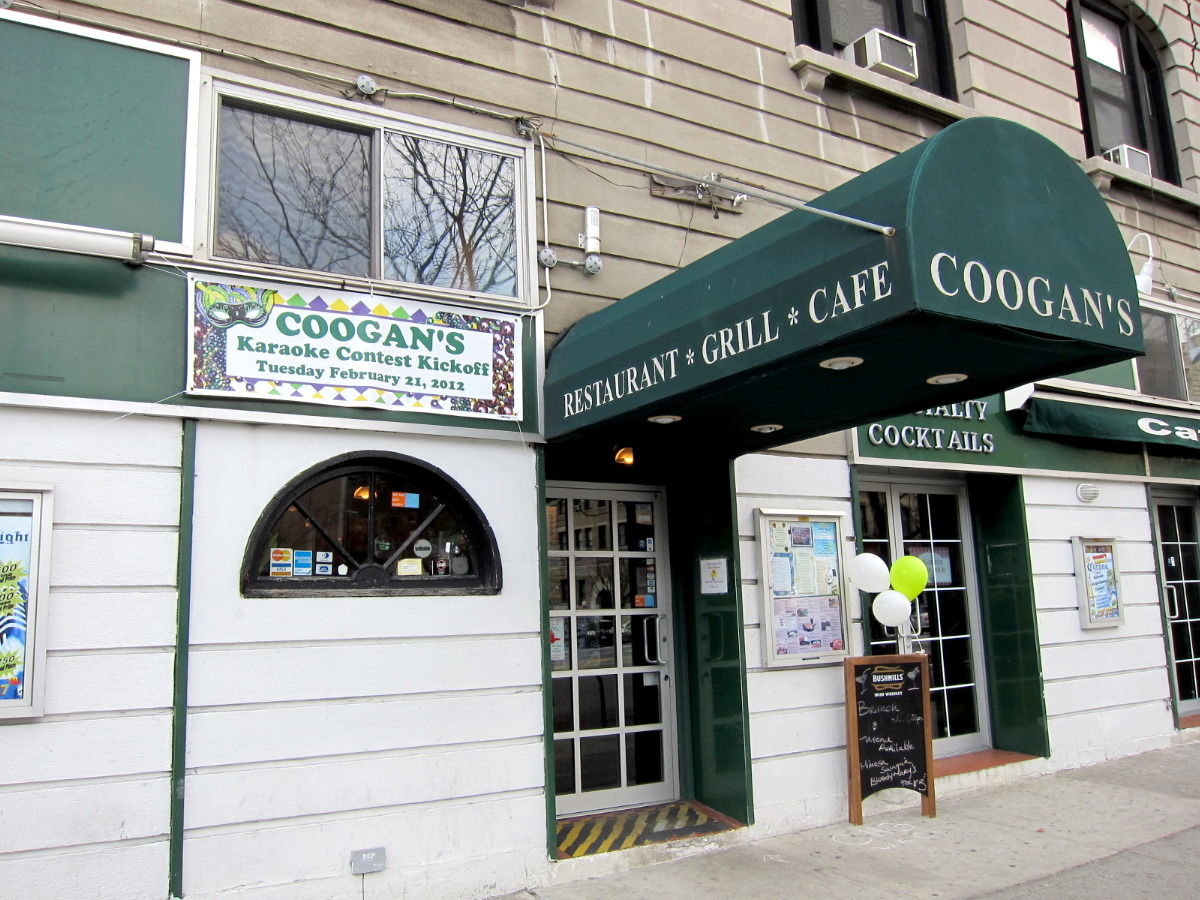
bridge) or half road, half trail. I've often gone to Coogan's for
brunch after
one of these runs, so that will give you a chance to top off your
mileage (and your thirst). From the Jersey side of the bridge to
Coogan's it's just
about 2 miles, so figure that in if you like.
I give a section below on each of the main routes and I've included just
about a zillion pictues, many of them in slideshows hosted by Picasa,
which
is a photo hosting site I use and it's free!
Most of the photos were taken during runs on February and March 2012,
which I did with some friends. In February we did a loop running the
trail
out to Alpine and the road back, and in March we ran the opposite way.
Each way to do it had some plusses and minuses but both were spectacular
and pleasurable runs.
So now it's your turn — what are you waiting for?
Over the Bridge
If you tried to imagine the perfect transition from the urban hustle and
bustle of Mahattan to the wild and
spectacular beauty of the Palisades, you would be hard put to come up
with anything as perfect as the George Washington Bridge (aka the "GWB")
spanning the majestic Hudson River. The bridge is so huge it rivals the
400 foot cliffs of the Palisades and so majestic it mirrors the Palisades' natural beauty with the best of human achievement. And when you run across it and experience the Hudson River
hundreds of feet below, you feel just as small as when you look
down from the rocky pinacles facing you across the river.
Getting there:
The traditional meeting place for Palisades Runs is the George
Washington Bridge Bus Station. It is connected directly to the A subway
line,
it's enclosed and it has bathrooms. Until recently, it also had lots of
retail shops for candy bars, Gatorade etc., but a renovation just
started has dislocated these. Hopefully they will return in the future.
It's good to have such a place since meeting others who depend on
various
buses, subways etc., especially on weekends, can be problematic. Delays
happen. Be happy you're waiting inside.
The New York Flyers used to
meet there for their yearly Palisades run (usually in September) but the
turnout has gotten so large that now they meet outside on the other
side
of 179th Street
To get to the bus station, take the A train uptown to 175th Street.
Upon leaving the train, walk forward to the front-most stairs and
then continue along the passageway that leads to the bus station. At
the end of the passage way go up the stairs and you'll be there. If
you get on the train along Central park West (72nd, 81st, 86th, or 96th
Street stations) you will need to take the C train to 125th, and then
switch to the A.
You can also take the #1 train to 181st Street. This is a few blocks
away and the #1 is usually slower than the A, so I don't reccommend it
unless
the A is out of service. You can also switch from the #1 to the A train
at 59th Street or 168th Street.
Slideshow: The George Washington Bridge
When you're all there and ready to go, go out the Fort Washington Avenue
exit, go a half block south and then go 2½ blocke west on 178th Street.
There you will see a pedestrian ramp the brings you up to the south
pedestrian walkway over the bridge. Next stop, New Jersey!
Occasionally they close the south walkway and open the north walkway.
If that's the case, worry not. Just go a half block north to 179th
Street, and 2
blocks west and take the entrance to the north walkway opposite Cabrini
Boulevard. You'll duck under an entrance ramp on a pedestrian underpass
and
then you're home free
The Park Road to Alpine and Back
We recently ran a loop of the road combined with the trail in both directions. In February
we ran the trail to Alpine and then the road back
to the bridge. Then in March we did it in reverse. If you plan to run
only on the roads (or only on the trail), that's fine too. The
traditional
NY Flyers Palisades
group run, usually run every September, follows exactly the same route
we did on the road out to the Park HQ in Alpine and then they return the
same way.
But first a few details.
Getting on the park road: Go left when you reach the NJ side
of the bridge. You'll be on Hudson Terrace in Fort Lee. Run south for
about 1/2 mile, passing the entrance to the Fort Lee Historic Park on
the left (don't go in). Enter Palisades Interstate Park at the turnoff
on the left
about a quarter mile further south as
the road starts to drop steeply and local housing appears on both side
of the road.
Car Traffic: In the off-season, cars are only allowed at both ends of the roads so they can get to the boat basins. In the summer, cars
are allowed on the whole length of the road and traffic can be heavy.
See Park Road Rules for details.
My advice: avoid running on the road during summer months.
It's always nice to run a route forwards and backwards. You see
different things and you almost think you're on a different route
entirely.
Heading Out on the Road
Some points of interest on the way out were going by Fort Lee Historic
Park just after getting off the bridge,
(you should visit this some time; I've been there a number of times and
it's a unique place),
passing under the GWB on the park road, passing by the three large
recrational areas (we didn't stop), hitting a couple of
fairly steep hills, making a quick jaunt to the beach with lovely views
where the road came down practically to the river
and spotting a huge Red Tail Hawk way up in a tree. Check out the
following slideshow which is for the outbound half of the run.
Slideshow: Heading out on the park road
Ther are two hills to worry about on the outbound run on the road. The
first is steep but not long. Starting at the Englewood Boat Basin it
rises
to the traffic circle. The road to the top (Dikeman Hill Road) turns sharply to the left
and the park road continues to the north. Ironically, this hill can be
nasty
on the way back as well, since having risen from basically sea level at
the Boat Basin. The road then descends almost the same amount and is
nearly
at water level just past a place called Undercliff. So you get this
hill both coming and going.
But the last hill, from the Alpine circle to the park headquarters is
the mother of all hills in the park. It's quite steep and almost a mile
long. Luckily when you get to the top there a nice place with
facilities for a break.
We have
measured the distance with various electronic gizmos several times and
got similar, but not identical results. Just for the record,
my friend Susan's iPhone claimed the distance from the bus station to
Alpine on the road was
10.01 miles. I got 10.20 using my hiking GPS, probably because I had
set the interval between sampling points as small as I could set it.
This would
minimize the effect of "cutting the corners" on a track. And I had lots
of corners, alwasy moving across the road for a photo or a view. If
you run
in perfectly straight lines with no curves, all the measurements would
agree, but that's just not how real runs work. Bottom line: stop
worrying!
We have always called the park road "River Road", but Google Maps has
"Henry Hudson Drive". The Palisades Interstate Park web site also calls
it that
so I guess I'm outvoted.
Heading Back on the Road
When
we went back to the GWB on the road in February, we had run out to
Alpine on the trail. And although both Susan and I were tired
from the trail when we finally reached the road (trails are more tiring
than running on a road), the roads, especially the down hills
felt easy. So instead of getting more tired in the second half, if
anything the second half was easier than the first half.
That mey not be the case if you run both out and back on the road since
at the turnaround point you will have just finished the toughest hill in
the park.
The main points of interest were the two Boat Basins — Alpine and
Englewood. We usually skip the Alpine Boat Basin since it is about a
quarter
mile further north off the main road, so the 5 miles to the Englewood
Boat Basin was the heart of the return run. But I have occasionally
stopped at
the Alpine Boat Basin instead of
climbing the steep hill to the park headquarters. There's bathrooms and
water, and if you're only after 18 miles, this is a good choice. On the
other hand, we have often stopped at the Englewood Boat Basin (a bit
past the 15 mile point) for a little break
since it has bathrooms and water and in season, a snack bar and lies
very close to the park road.
Slideshow: Heading back on the Road
An interesting point of interest comes just before the hill on the road
which lies a bit before the boat basin. It's an area called
"Undercliff". Looking
down on the river side of the road you can see various old stone
structures and on the uphill side there is a picnic area. It was
originally a colony
of fisherman which disappeared when the park was created.
The last hill on the road is from the Englewood Boat Basin, all the way
south under the GWB and then up and around to the park entrance
in Fort Lee. But that's not the end of it — the last half mile up
Hudson Terrace to the bridge can be a killer especially after you've run
close to 19 miles. Just do it.
The Long Path to Alpine and Back
When we ran out on the Long Path, we actually came back on the road. We
used several of the options to get from
the top to the bottom or vice versa. Melissa used the Huyler Landing
Trail down to the park road and then returned all the way back to the
bridge
on the road.
Susan and I went all the way to Alpine on the trail, then returned via
the road — but cut off the last mile of road by climbing the
Carpenter Trail. But for simplicity's sake, you can ignore those
details and just imagine running out along the trail and then returning
the
same way.
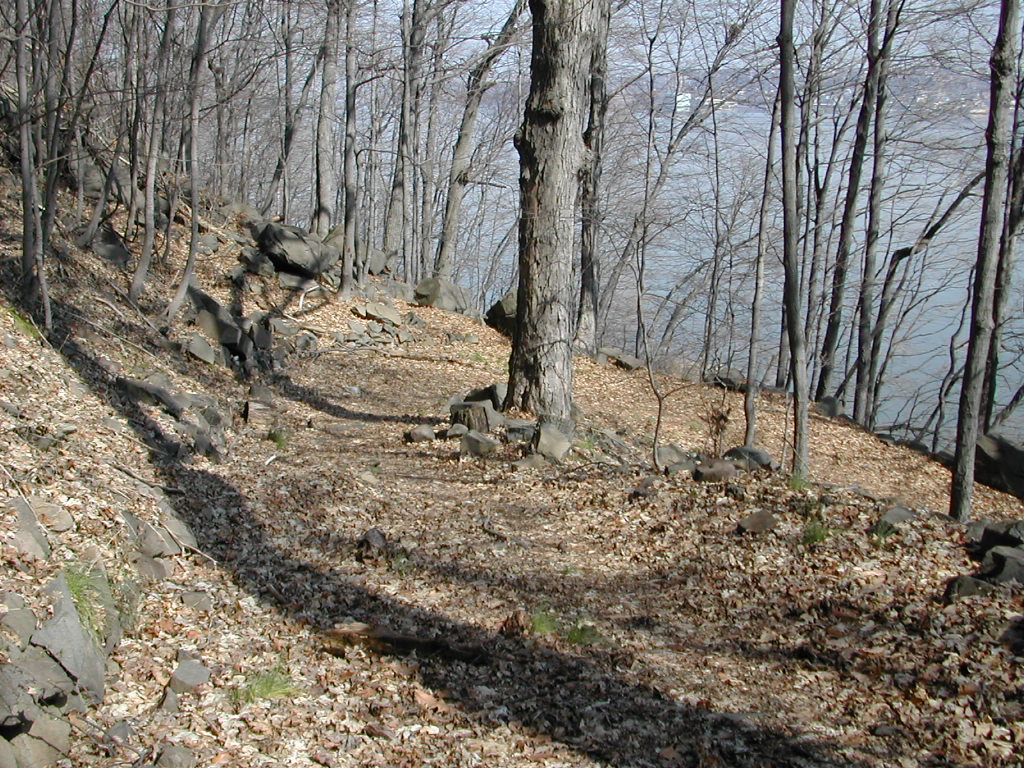
It's pretty easy to stay on the trail. It's marked throughout its
length with light blue paint blazes on trees. There are lots of lookout
points
and several places where paved roads intrude, allowing muggles of all
ages and sizes to intrude on the wilderness. I'll mention a few of
these.
Heading out on the Long Path (aka "the Trail")
Once over the bridge, turn right and go under I-95 on the local
Street (Hudson Terrace). The entrance to the trail is at a stairway on
the right,
just after the
underpass. You have to go up, and then cross over an exit road, and
then you are in the Palisades Interstate Park and the beginning of the
trail.
There a good web site for this park which includes some good maps and I
recommend you check it out:
Palisades Interstate Park.
Soon after getting started on the trail, you'll pass a gas station on
the Palisades Parkway on your left. The park is sometimes a very narrow
strip
between this highway and the cliff edge, and so sometimes you are very
close to — or even ON — the margin of the highway. The first major
interruption comes soon thereafter where you enter Allison Park in the
Town of Englewood Cliffs.
You used to have to skirt around and go in the front entrance, but a
storm last
year brought down a section of the park fence, so now you can run right
in where the trail first encounters the park. It's a lovely little park
with
a water fountain, bath rooms and a dramatic lookout. Spend a few
minutes enjoying this place — you don't have to run every d*mn inch of
the way! . After leaving the park, you come to St. Peter's College and you are forced to run along a very narrow strip
between the Highway and a chain link fence. But soon after, you enter a fairly wide section with rather beautiful ponds,
Slideshow: The outbound trail along the cliff-top
Next up is a brief crossing of the Englewood Boat Basin Road, aka
Dyckman Hill Road. Runners doing a very short route can go down the
hill here
(there's a walkway with lots of stone steps that parallels the roadway)
and take the road back to the
Bridge. After this there is a fairly long trail section with more ups
and downs until you hit the Rockefeller Lookout, one of two such places
on
today's route. Luckily, today there were no families of fat children
eating fried chicken and climbing on the fence by the cliff edge
, so this place was a fairly attactive place to take a break.
Greenbrook Sanctuary is the next in-holding and it's the largest such in the entire park
(see Greenbrook Sanctuary).
It's run by a non-profit (I'm a member) and consists of
165 acres of bogs, ponds, streams and upland wooded areas whose aim is
to preserve and protect native flora and fauna. It's a marvelouss and
beautiful
place where I have enjoyed many hours exploring and enjoying the area.
But not today. Soon after passing the northern end of Greenbrook, we
came to the
intersection with the Huyler Landing Trail where Melissa left us. It's a
short, steep route down to the road (and beyond to the Shore) and takes
about
2 miles off the total mileage.
After that there are a few things to mention: 1) the Alpine Lookout,
much like the Rockerfeller Lookout, and 2) remnants of several estates
which were
bought out by the Rockefellers before they donated the land to the State
of NJ for the park. But our outbound trail run had ended and it was
time for
a little break at the park headquarters (which also serves as the
Palisades Interstate Parkway Police station).
Heading Back on the Trail We
actually made our return journey along the trail two weeks later. Both of our recent runs involved the trail one way
and road the other way. But feel free to do the out-and-back on the trail alone. You'll be surprised
how different the route will seem running in the opposite direction.
At the Park HQ, we both ate something — I had a Snickers Bar:
the best trail food in the whole world and Susan had a bagel: not bad but not up to the Snickers level .
This place has
bathrooms, water and if you are very lucky, a lovely picnic area out the
back, This is normally closed to visitors, but we were fortunate to
hit
the place on a day when there was an "open door" policy.
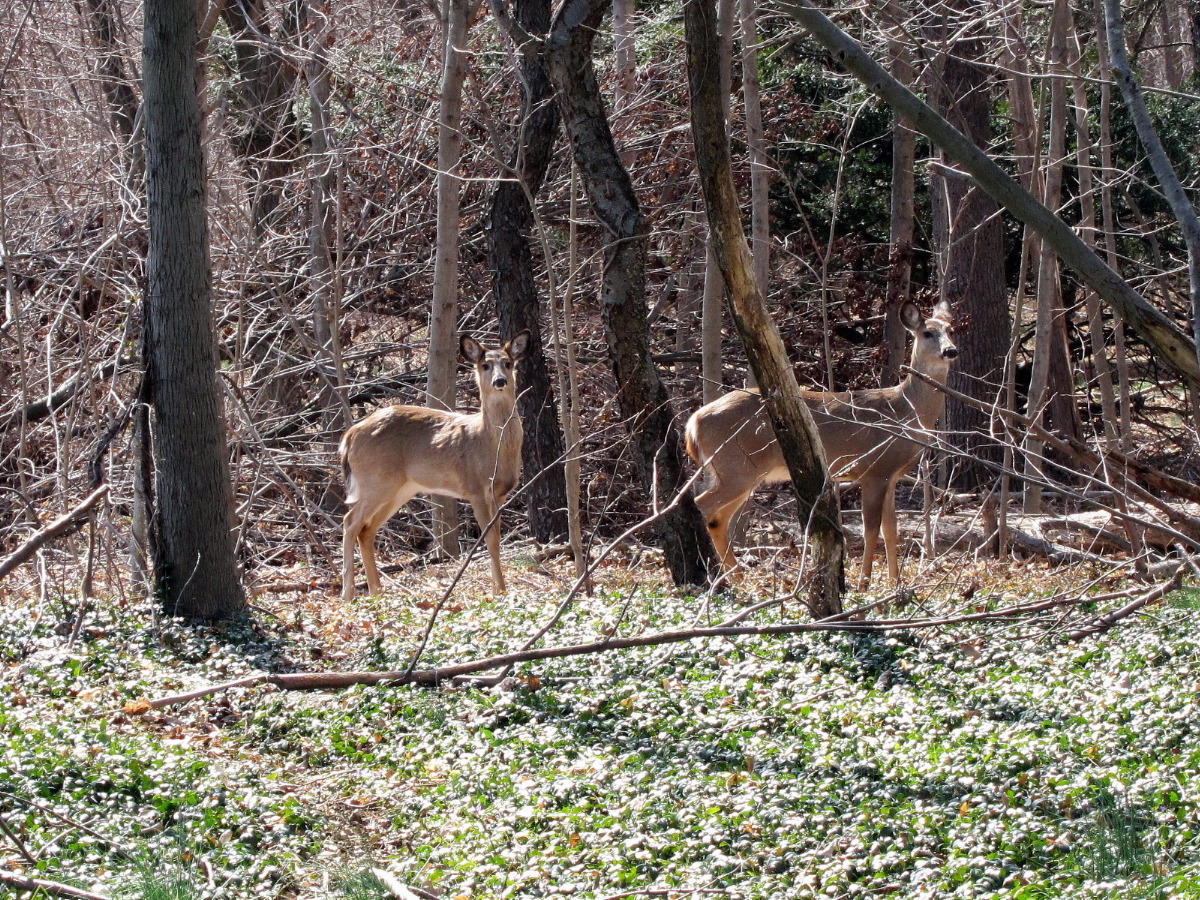
The first thing we saw after getting back on the trail, was a pair of
deer off to the side. We watched them (and they watched us) for a
couple of minutes and
I got some good photos. It was a pair of does. Susan thought they
might be mother and daughter. A precious moment indeed. Did I ever
mention that
you should not be overly obsessive about your running: if you see
something special (a hawk, a deer) stop and look for god's sake. This
is not the
olympic trials!
Slideshow: Heading back on the trail
We made brief stops at the Alpine Lookout, the entrance to Greenbrook
Sanctuary, The Rockefeller Lookout and Allison Park. All with great
views (except
the Greenbrook entrance).
We also saw a friend Deanna with a group of her friends at the
Rockefeller Lookout who were heading out just as we hit our 15 mile
point. They looked
fresh but by then we were beat (and I'm sure we looked it).
Breaking News:
I found out a few days later that Deanna and her friends were
doing a celebratory 32 mile birthday run! And here I thought 20 miles
was a big deal! Happy birthday Deanna, and congratulations.
And I guess I won't be doing my birthday mileage any time soon!
When we finally reached the GWB at about mile 18 we were exhausted, but
happy to be (almost) done. Somehow the last 2 miles to Coogan's seemed
easy.
The Carpenter Trail
The
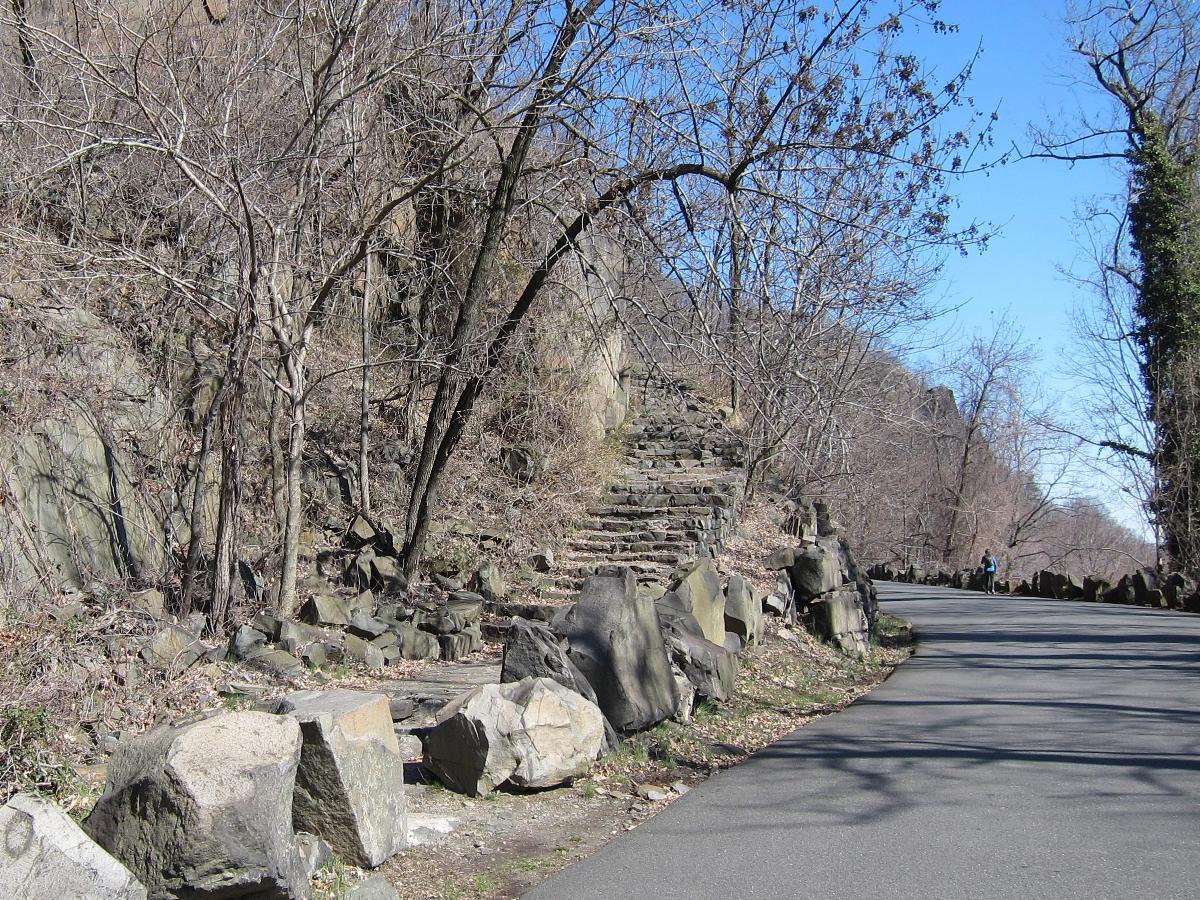
Carpenter Trail is one of the wonders of the Palisades. Built, I
think, in the 1930s, we used to
call it "The 1000 Steps". Well, if you know me you will not be
surprised that I actually counted the steps, and I did it 2 or 3 times
to make sure.
It's 320 steps with a few places where you're not sure it's a step or
just a rock. But the thing goes up the sheer cliff. It's the closest
you'll get
in the real world to what Frodo, Sam and Gollum faced when they climbed
the stairs to Cirith Ungol.
I've used the stairs numerous time over the years, always from the
bottom to the top and almost always as a short cut and avoid the long
climb on the park
road the climbs under the GWB and swings around to Hudson Terrace in
Fort Lee. You're actually climbing the same elevation but it seems
easier to
climb steps than to go up the 1.5 mile long and tiring hill on the road.
That's not to say the stairs are not tiring. They are true quad
killers, climbing
about 300 feet in a bit over ¼ mile.
Slideshow: The Carpenter Trail
The Carpenter Trail has in two sections. The lower section goes from the shore up to
the park road, where it crosses under the road
(actually two roads) in a tunnel. You don't get to climb that section on
this run (but it's shown in the accompanying slideshow).
The upper section, starting at the road, climbs the rest of the way to
the cliff top.
You can pick up this trail from the park road right before the road coming
up from the Ross Dock picnic area joins the park road at a small traffic
circle.
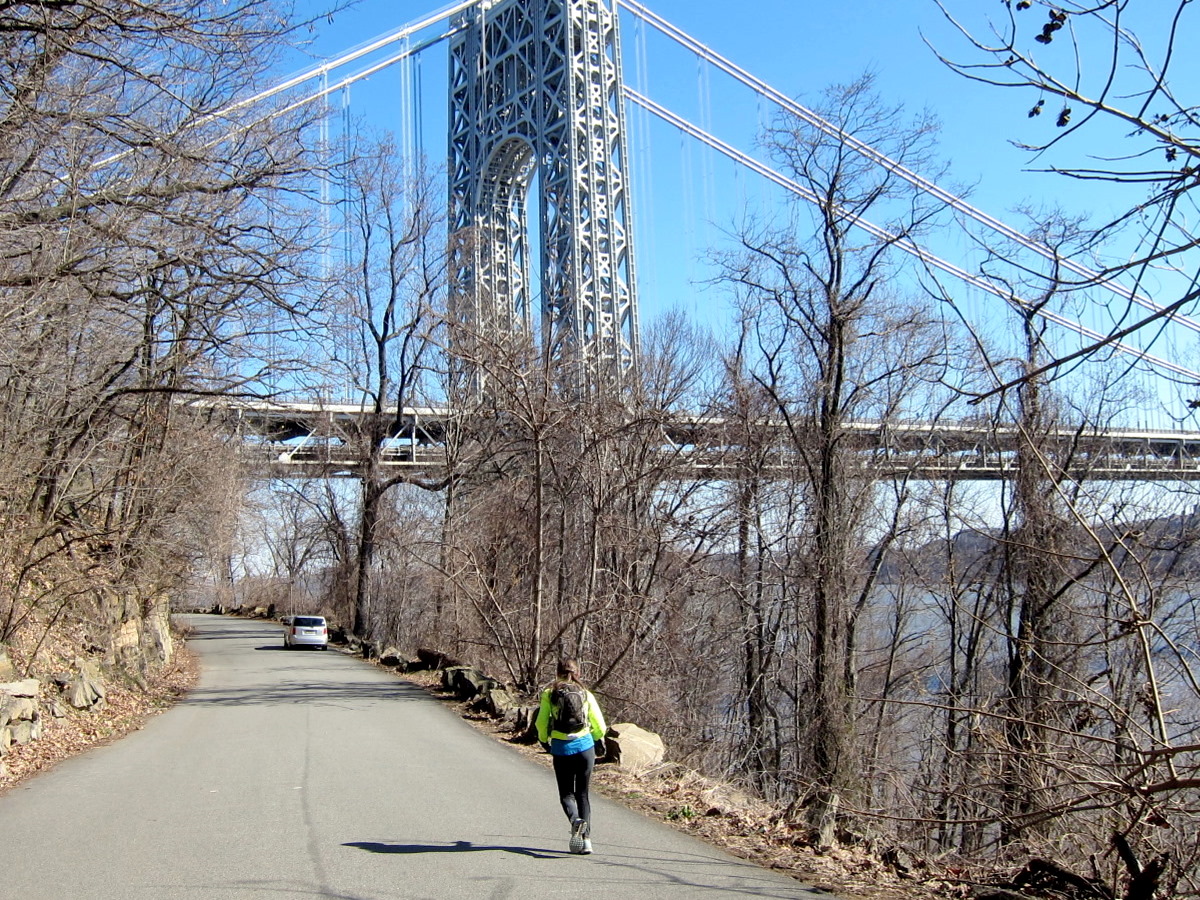
The GWB is in front of you about ¼ mile away. The picture above shows this point on the road (looking backwards from the direction of the run) and the stairs
going up (northward) along the cliff. If you have very strong quads, you might try
running up the stairs. I'm satisfied if I make it in a fast walk without any breaks.
You'll never see the likes of anything like this in Central Park, and
that's
for sure.
The distance saved over going all the way on the road is less that you
would think — about 1/2 mile. That's because there lots of switchbacks
and a
goodly amount of the Long Path to do once you get to the top.
The Huyler Landing Trail
The
Huyler Landing Trail is another potential shortcut of you're running
the Long Path. The trail starts shortly
after passing Greenbrook Sanctuary (northbound), soon after the end of
the chain link fence. If you're heading south and you get to the fence,
you missed it. See the southbound trail slideshow which shows the trail
intersection. But why would you want to take it going south
anyway? You already did the full loops distance. Whatever!
If you take the trail down to the road you can save about 2 miles
from a loop to Alpine and back.
Slideshow: The Huyler Landing Trail
The trail is very well graded and it's obvious that it was once a road,
probably in the 19th century. Huyler's Landing, on the shore, is still
evident — there's an old stone jetty that survives. This was one of
only a few crossing points of the Hudson since the topology afforded
this as the only place where a road could be built between Fort Lee and
Alpine. The current Englewood Boat Basin Road, aka Dikeman Hill Road
would
obviously have been impossible to build before the 20th century.
The Slideshow shows the trail all the way down to the river. You will be stopping when you get to the road and heading south. It also shows some summer pictures from another run. You notice the green leaves which stand out like a green thumb!.
And on to Coogan's
No matter which way you went on the Palisades, trail, road or both, you gotta refuel
when you're done. On our February 20 miler, we thought we needed about another half mile or so to make it to 20,
so we decided to run the rest of the way to Coogan's Restaurant and Bar
at Broadway and 169th street. So help me, that's the only reason we
ended
up at a bar.
Slideshow: On to Coogan's
So we zig-zagged along Cabrini Boulevard and then Fort Washington Avenue
and finally got over to Broadway at 170th Street and in one more block
we were at Coogan's, the final stop. And the beer I had (see the last
picture in the slideshow) was not bad at all. Truth be told, this was
not
the first time nor I expect the last time we will visit this great
Washigton Height's establishment.
I would say if there's any other bar in the city that supports runners
more that Coogan's, I have yet to find it. The walls are literally
covered with photos of famous and not so famous runners and the rafters
are hung with hundreds of team singlets. It's proximity to the
Armory has determined the focus of this establishment for many decadses.
The Palisades is a great and beautiful place where you can have a fantastic run! Just do it!
I never really
cared for running. My sister, Susan, got me intrigued a few years ago when she
began signing up for races. She, her husband, and my gorgeous 8-year-old nephew
have bibs galore peppering an entire wall of race achievements—but even still, nothing
ever really motivated me to run, much less sign up for a race. Nothing, that is, until April 15, 2013.
Although I consider myself a proud New Yorker (been here for 15
extraordinary years), I call Boston home. On April 15, 2013 at 3:03 pm, I
received a text and a Facebook post from my sister that read: “Explosions at
the Marathon finish line!! We are all here at my parents’ house. No idea if
pipe bomb.” —my heart stopped.
My parents live less than a mile from the finish
line, so they and my sister’s family always go to cheer on the runners approaching
the finish. Moments later, I got another text that my beautiful cousin and
her husband were also at the finish line but couldn’t be accounted for and weren’t
answering their phones. Later it was confirmed that they were among those
injured by the first bomb. How could something so horrifying happen at such a wonderfully
celebrated event, in my childhood back yard, and with my family in harm’s way?
A Family Tradition My Parents Crossing the Boston Marathon Finish Line with my Nephew in 2009
Both my cousin and her husband sustained severe shrapnel wounds to
their legs, and my cousin’s left hand was left shattered and partially
de-gloved. She’s undergone numerous surgeries to reconstruct her hand, and more surgeries lie ahead. To help with uncertain and undeniable mounting medical bills, I launched
a fundraiser website on GiveForward.com. Desperate for support, I posted links
to the fundraiser on Facebook and Twitter and got much reception, but something
was urging me to get off of my couch and get the word out—physically. So, I
turned to my local running community.
In keeping with the family tradition, this is my nephew, flag-in-hand, at the 2013 Boston Marathon. The flag was given to him by Carlos Arrendono, "The Cowboy Hero" who, about an hour after this photo was taken, saved Jeff Bauman's life.
I signed up for my first timed NYRR race (Run as One), and I ran
the race on April 28, 2013 while wearing a sign on my back directing folks to
my cousin’s fundraiser site. At first I didn’t enjoy the race. I found myself out
of shape and gasping for air, but I got so many thumbs-up from fellow runners
that all those good vibes somehow carried me to the finish line. Inspired, I
decided to sign up for a few more races, again, with the sole intent to wear
the fundraiser sign on my back.
My First Timed NYRR Race (Run as One) on April 28, 2013
By June, the fundraiser was in full swing. We had just hit
$30,000, and I had just completed my fourth race (Achilles Hope and Possibility).
While my pace was still a morbid 13:00-14:00 minutes per mile, I really started
enjoying these races—especially the thrill of crossing the finish line. To ward
off discouragement, I told myself that my slooooow pace gave people enough time
to read the fundraiser sign on my back :)
Moreover, I suddenly realized I only had five more races to go to
qualify for guaranteed entry in the 2014 NYC Marathon! “Me? Marathon? Never. Maybe? Nooooo…this is
not what these races are about…oh…but that would be SO COOL!” So there in June ensued
the spark of interest toward next year’s NYC Marathon.
On June 30, 2013, I posted this picture on Facebook with the following caption: “Boston was pretty strong today. We had a Boston Marathon victim, (Mery Daniel) race and finish with us today.”
By August, the fundraiser was finished. You can click HERE if you'd like to see the page with its warm thanks from my cousin. The link to my fundraiser website no longer is active, but donations to help the victims may be made via the One Fund Boston website. GiveForward.com gave us 133 amazing days, during which we raised $66,451 from 690 donations made by family, friends,
and complete strangers. GiveForward and other websites were being used by other
fellow Marathon victims, and we all visited each other’s fundraiser sites and
gave. So many runners and fans of runners left the loveliest messages on all
the different fundraiser sites, including ours. What an amazing community.
Meanwhile, back in NYC, I’d been running with thousands of fellow
runners over the course of what eventually became eight races. It felt
rewarding, but something was missing. I’d yet to make any friends or
acquaintances among the runners. Though fulfilling, running became an
individual activity. My co-worker and friend, Mark Pendarvis, kept urging me to
join a club if I was serious about training for the 2014 NYC Marathon. He told
me I needed a community around me for such a demanding endeavor. He was right. To
my blessing, Mark recommended the New York Flyers.
The morning of my first Half-Marathon, Grete’s Great Gallop. A huge personal accomplishment, but a little lonesome at the start and finish line, since I had yet to find a group in the running community
A few days after I joined the Flyers, I had the pleasure of meeting my
first NY Flyer, Alan G. What a blast he was! He and I were among the
volunteers giving out medals at this year’s ING NYC Marathon. I gave out medals
to hundreds of finishers, but only a few stuck out as most memorable. One was
that of an utterly gorgeous woman who approached me after she crossed the finish
line. She had this gorgeous cascading hair that flowed gracefully past her
shoulders. She looked like a Marathon Goddess, and of course she was wearing a
red NY Flyers shirt. She was the second Flyer I’d ever met. She told me she’d
completed several Marathons prior to that day, and I felt so honored to place
the medal around her neck. I believe she had the name “Isabel” inscribed across
her Flyer shirt. I can’t wait to meet her again. I’ve been told she’s Flyer Isabel J.
Marathon Sunday, the Day I Met my First Two NY Flyers
Now here I am a full seven months from my first real
race in April, and I'm delighted to have spent Thanksgiving with my family—including my dear cousin and her husband who are both recovering amazingly
well. Also, I am officially training for the 2014 NYC Marathon, although I’m no
longer training alone—I am now training as a New York Flyer. In fact, the day I
completed my ninth official qualifying race (Join the Voices) on November 17,
2013, I began at the start line with a fabulous crew of fellow NY Flyers, Victoria S, Dave K, and Howard C. Starting my ninth race, which I needed to complete for guaranteed entry to the 2014 NYC Marathon, alongside these lovely Flyers was so sweet and meaningful on so many levels. I
guess it’s true when people say that life’s paths can lead you to unexpectedly
wonderful places.
At the Start of my 9th Qualifying Race with Three Wonderfully Amazing Flyers: Howard C, Dave K, and Victoria S
For someone who never really cared much about running, I now
can’t imagine NOT running. What started as a desperate attempt to help my
cousin with her recovery from the injuries she sustained in the Boston Marathon tragedy, unexpectedly turned into my embracing running and then qualifying for the 2014 NYC Marathon. It also turned me onto a new path with the wonderful
community of the New York Flyers. Next stop: The NY Flyers Holiday Party!!!!!!
To give anything less than your best, is to sacrifice the gift -- Steve Prefontaine That quote
really inspires me every time I read it. In no way am I implying that I have such
a gift, either for running or writing
a blog post, but I feel very strongly that if you are going to do anything, you
should always give it your best.
I’ve been a
proud singlet-wearing member of NY Flyers since 2003, but really began running
seriously way back in 1990 when I ran my first NYC Marathon (no chips or net
times back then!). Since then I have run more than 150 NYRRC races, and 22 marathons or ultra-marathons including:
17
marathons (14 New York, Boston, Philadelphia, Paris) and
5 Knickerbocker 60k
ultra-marathons.
I have always
strived to give it my all for each and every one of these runs. However, over
the past few years my results have more consistently not met my expectations (especially
since “graduating” to “Flyers Vet" status) even while following some dedicated
personal training routines.
So in May 2013, and
with the NYC Marathon in mind, I was ready to do something bold and decided to
join the affordable 18-week fully personalized Fall Marathon Training Program
(MTP) designed by legendary coach Jack Daniels and the Run SMART Project, sometimes affectionately referred to
as “Running Under the Influence of Jack Daniels” (or so says the very cool
t-shirt that I bought at the pasta dinner).
I’m really glad
I signed up. Here's a summary of what stood out for me:
●PHILOSOPHY: The
program’s ultimate goal makes a lot of sense to me: Get each and every runner to the start
line fully prepared, rested, and healthy to run a great race. It’s too bad
that elite American distance runner Ryan Hall didn’t
follow this mantra, trained too aggressively, and was forced to withdraw from
the 2013 NYC Marathon.
●INTRO: The program kicked off with a "Meet and Greet" at Finish Line Physical Therapy in June which provided the opportunity
to hear about the program from Run SMART Founder and Head Coach Brian Rosetti,
to meet his coaching staff, and to ask questions.
●SIZE MATTERS: The program was capped at 80 runners to maximize personal
attention. My Run SMART coach (Steve Mucchetti), leader of the Lennon team
(each one of the running groups was named after one of the Fab Four) offered
additional advice, support and guidance throughout the training and was readily
available to answer my questions and address my concerns. A big shout out to
Steve and best of luck to him in his move out to London!
●PERSONALIZED TRAINING SCHEDULE: The program included an individualized 18-week training
schedule designed by Dr. Jack Daniels and every runner was given a precise pace
for each and every one of his/her workouts and runs based on running history. An easy-to-use online
training calendar was provided to log and manage this training. One key value
listed in the calendar and computed for each runner is something called VDOT. According to Jack
Daniels it is a better value from which to assess fitness and determine
training paces. With the result of a recent competition, a runner can find his
or her VDOT value and determine an "equivalent performance" at a
different race distance. For example, my
current VDOT of 40.2 predicated an estimated 4:15 NYC Marathon finish.
●WORKOUTS: Probably
the single most valuable aspect of the program for me was the in-person group coaching
led by Run SMART coaches every Wednesday evening in Central Park at 7pm.
Workouts consisted of repetitions, intervals, and thresholds, mostly on a rotating bases. There also were three MTP organized long runs, including two in Central Park
and the famous NY Flyers Three Bridges Long Training Run.
●NUTRITION: World-class
distance runner and coach Alicia Shay provided two very helpful live Google
Hangout marathon nutrition Q/A sessions at the beginning and end of training (please click HERE to view the video for Part 1 and HERE for Part 2).
●JACK DANIELS: Listening
to guest speaker Jack Daniels at the NY Flyers Pre-Marathon Pasta Party was a truly
inspirational event. At 80 years and looking as fit as can be, his charisma was
contagious and I pocketed a few of his pearls of wisdom for
the approaching marathon just a few days later.
Jack Daniels Holding Court at the NY Flyers 2013 Pre-Marathon Pasta Party
Some of his classic quotes
included these: If you want to do something special, do
it in the last 4-5 miles. When you run any race of any distance, run with your
head for at least two thirds of the race, and run with your heart for last
third. Don’t get carried away early.
Focus on the task at hand, e.g. you
should never have to breath harder than a 2x2 breathing rhythm = 2 steps
bringing in, 2 steps breathing out.
There are 3 kinds of people in the world:
1. Those who are dumber than they look, 2.
Those who are not as dumb as they look,
3. Those who are exactly as dumb as they
look. You might be an optimist and say that you are smarter than you look
but that’s really the same as saying that you are not as dumb as you look.
You need to practice drinking. Avoid losing 3% of your body weight.
Long runs shouldn’t be more than 25% of your total week. Instead, consider
“bunching” weekend runs (e.g. 10mi on Sat night, 12mi on Sun morning).
30 minutes is big time. Your body function improves tremendously with 30 minutes
of exercise. 60 minutes is more but only a very little more.
In the end, the
proof is in the pudding. As my old NYU accounting professor was fond of saying,
"figures don’t lie, liars figure." So, what results can validate this
18-week training investment?
Well, for this
year’s NYC Marathon, I did not meet the 4:15 time goal that my VDOT would have
predicted. Instead, I came in at 4:36, a difference of just over 20 minutes, a reasonable
portion of which I’ll blame on the ~15mph headwind that brutally greeted
runners for a majority of the race.
Still, I am
very satisfied with this result. This NYC marathon finish time represents my
best in the last 5 years and my 6th fastest marathon ever. I should have
mentioned much earlier, too, that I’m a middle-of-the-pack runner.
As a footnote,
I felt so good after the marathon that I also ran my 5th Knickerbocker 60k only 2 weeks later and posted a PR of 7:16, almost 20 minutes faster than my
previous best set back in 2009 (I guess those 20 minutes were owed to me from
the NYC marathon just a few weeks prior).
So, did the Run
Smart MTP contribute to my improved performance over recent years? Well, all I
know is that I ran Under the Influence (and Over the Top). I ran SMART. I truly
gave it my best.


 . After leaving the park, you come to St. Peter's College and you are forced to run along a very narrow strip
between the Highway and a chain link fence. But soon after, you enter a fairly wide section with rather beautiful ponds,
. After leaving the park, you come to St. Peter's College and you are forced to run along a very narrow strip
between the Highway and a chain link fence. But soon after, you enter a fairly wide section with rather beautiful ponds,