Showing posts with label General Running. Show all posts

Saturday, August 15, 2015

Barely Interesting Running Facts


Dave K

Did you know!?!....

  • Athletes dressed in red (NY Flyers Red?) are more likely to win events than athletes wearing another color (Nature Magazine) 
  • Physically active people have a 60 percent lower risk for Alzheimer's disease than couch potatoes (The Lancet Neurology - Sweden)  
  • In terms of on-site media coverage, the Boston Marathon ranks behind only the Super Bowl as the largest single day sporting event in the world (Boston Athletic Association) 
  • An average man has enough energy in his fat stores to run non-stop for 3 days at 15 miles per hour. (bbc.co.uk) 
  • Runners report average yearly injury rates from 24% to 68%, of which 2% to 11% involve the hip or pelvis (van Mechelen, W. in "Running injuries: a review of the epidemiological literature") 
  • 13.2 to 17.3 percent of all running injuries have been attributed to shin splints (American Academy of Orthopedic Surgeons) 
  • The risk of having a heart attack during a marathon is one in 55,000. (Journal of the American College of Cardiology) 
  • Runners who played ball sports as kids had nearly 50 percent fewer stress fractures than runners who didn't (Clinical Journal of Sports Medicine)
And there you have it.

-Dave K, Flyers Blogmaster

Read more...

Monday, July 15, 2013

Hot Times in the City

Dave K
Keeping Cool
With Our Cool Cats
I used to not mind running when it's HOT. Until a few summers ago when I had a scary heat-running incident (and this was before enduring the high heat of the 2012 Boston Marathon).

I ran a summer race in 2009, and then stopped to drink before continuing on for more miles to make it my long-run. I ran with a fluid belt and wore the right clothing, and unlike at Boston in the spring I was acclimated to summer running. So, I thought I'd taken sufficient precautions in the heat.

But I didn't head home right away, and soon after I got home I became extremely dizzy. And nauseous. And disoriented (i.e., more than usual). I lied down with the air conditioner blasting. I took a cold shower. I put ice packs on my head and neck. And I didn't feel any better.

No one else was home, and I started to feel a little bit scared. I called a friend whose sister is a doctor. I wondered if I was suffering heat stroke. It turned out that it was not heat stroke, but the less severe heat exhaustion. It took several days until I felt back to normal.

So, although I may still say that I don't mind the heat (much), and while I still want to preserve my tough-guy macho image (no laughing, please), I now take more precautions. So here's some advice that I'll pass along so that others may not pass out.  Actually, it's all pretty obvious stuff, below, and my real point is to just suggest to please be careful out there, heed your body's warning signals, and don't try to be such a tough guy or gal that you end up in the hospital.

  • Not Too Proud for the Med Tent.  After the 2011 Queens Half Marathon -- a very hot and humid day -- I felt nauseous and woozy.  Fearing heat exhaustion, I went straight to the medical tent.  There, I quickly was put in front of a fan, given COLD Gatorade, and had bags of ice put on my head, neck and under my arms.  NYRR CEO Mary Wittenberg even checked in on me and the other runners who were doing likewise.  20 minutes later I left the tent feeling fine.
  • Salt, Salt and More Salt.  I sweat beyond belief.  And on hot and humid days I'd been prone to muscle cramps after races.  Until Flyer Janis E turned me on to salt.  Now I take as much as one fast-food salt packet every six miles during a long-run or long race.  I find that it actually gives me an energy boost, real or imagined, and has helped with the cramping.  Sometimes I'll take Endurolytes instead, which also helps replace what I sweat away.
  • Chill Out Before and After. Elite runners and others have been known to wear ice vests that they take off right before they race in the heat.  I don't have a heat vest, but I do stay in air-conditioning for as long as I can before heading out, and have even brought a large 7-Eleven Slurpee to the starting line (yum!).  After a race or long-run in the heat, I'll try to get inside to air conditioning ASAP and it's a great time for an ice bath both to knock down muscle swelling and to cool off.
  • Lather up. Although my family has a history of skin cancer, I used to think I wouldn't get sunburned in Central Park with all the tree cover, but learned from experience that this is not true.  Now I'm better at coating myself -- Flyer Janine S still makes fun of me for my milky-white coating before a recent race -- and may stick a napkin or something in my pocket for when it mixes with sweat and irritates my eyes.
  • Read this.  I learned how to get heat exhaustion, but I'm no expert on how to prevent it. So if you're still reading, I suggest that you read elsewhere about hot-weather running.  Runner's World has a whole bunch of articles posted on their website on Running in the Heat that are excellent resources.  Click here to read Runner's World's heat survival guide. 
And, from Coach Brian D. and the RUN S.M.A.R.T. staff, leaders of the Flyers Fall 2013 Marathon Training Program, here's some additional advice:

  • When/where to run.  Running very early is your best option in this weather, unless you can get on a treadmill during the day or evening. If you can get on a treadmill and avoid having to sacrifice sleep from getting up super early to beat the heat - even better! No one sleeps enough so we're big on getting sleep first, if possible. You can have the greatest coach and training plan in the world (us!) but it won't matter if you're not getting proper rest and sleep. 
  • Go by effort.  Be honest in this heat - go by effort, not pace! Your pace per mile in 90 degree heat could be at least 20 seconds per mile slower than usual but still be about the same effort. 
  • Hydration. Hydrate a little more throughout the day than normal. And don't start the day in debt...everyone is very dehydrated when they wake up. Always drink two big glasses of water the first thing you do when you wake up. This will also help with digestion. 
For more from Coach Brian and Run S.M.A.R.T., click HERE for a link to their post on the Saucony Blog on beating the heat.

Keep cool,
Dave K
NY Flyers Blogmaster

Read more...

Sunday, June 2, 2013

A Short Video: On Running

Ilana S
My fine friend Ilana S, a Dashing Whippet and Friend of Flyers, is generally a solitary and very speedy runner, a writer, a psychologist, and an otherwise seemingly interesting person.  Lately, she's been creating short multi-media presentations as a means to express herself.  She combines her thoughts, drawings, voice, and music to conjure up short videos.  Some of the videos she's posted pertain to the novel she's been writing.

turn3cropped

Recently, Ilana posted a short video that she calls On Running.  I think it's delightful and powerful.  There's a stream of consciousness about it that resonates with me as it brings to mind my own thoughts, feelings, epiphanies, ramblings, nonsense, brilliance, purposefulness, pride, playfulness, peacefulness, loneliness,aggression, curiosity, and other happenings that I sometimes experience when on the run.  Yet, while her video seems to open a window into my own mind it also let's the viewer into the very intimate and personal perspective offered by Ilana by allowing entrance into her mind.


Click on the picture please, above (or click HERE), to view Ilana's video.  

I hope you may enjoy it, too.  Including as a bit of a tribute to Ray Manzarek of the Doors who died in May.

Dave K
Flyers Blogmaster

Read more...

Tuesday, January 8, 2013

THERE ARE SUPERSTITIONS....

Scott C
Runners, Roadies, Rituals and Superstitions

There are superstitions (so sings Stevie Wonder here)....  And then there are rituals.  And, then there is OCD!

Perhaps one of the most recent, popular and downright funny rituals is the setting up of the ubiquitous “staging area” that me and so many others take the time to build -- right down to the compression socks, the sunglasses, and the GUs we’ll use -- and then we’ll photograph the area and send out the pics to our several hundred Facebook friends.

Where do we draw the line? Where do we separate rituals from superstitions or make a clear distinction? What should pass for behavior inherent to an athlete vs. behavior bordering on OCD?


For several months prior to the 2012 Boston Marathon, hidden away in our closet at home, there was a gorgeous burnt-orange 2012 Boston Marathon jacket, women’s size small, with the Boston Athletic Association unicorn logo proudly embroidered in black stitching and declaring the 116th running of the Boston Marathon.


It’s truly a beautiful jacket that most would be chomping at the bit to wear when out running in Central Park or just casually walking around town, but its owner -- a certain Flyer Ms. Elle G -- had steadfastly refused to wear it until early in the afternoon of April 17th after she had crossed the finish line of her first Boston Marathon with hopefully a new PR (and possibly not until after taking a cold shower upon running in the near record heat endured by those who ran the race!).

Sound familiar? Anybody else out there who might also adhere to what might be the number one ritual (or is it a superstition?) among the running camp that you never ever wear your race t-shirt, jacket or any form of racing apparel until after you have actually run and finished said race?

I know I’ve always fallen in line with this ritual, superstition or belief that somehow wearing the race shirt before the race will have an adverse negative influence on how I run, how I think, how I perform on the stage I have wanted to be on through my hours of sweat, self doubt, shaken confidence, tearing up my body and mind in preparation for “the day.”

Or can it be more an issue of one’s OCD vs. superstition since we see plenty of runners wearing their race t-shirt during the actual race?  What are they thinking? Are they normal like me? Or clearly they must be a running “newbie” so untrained and unadvised in the “normal” ways of the distance runner who has taken on so many risks, sacrificed so many birthdays, weddings, bar mitzvahs and other assorted social opportunities in pursuit of one more PR!

Any body see themselves in the mirror yet?

Certainly there are other “items of distinction" held onto such as your lucky socks, or perhaps your running shorts from 1981, your lucky running shoes with holes on the bottom almost bigger than a newborn's fist or a running cap from your first “destination" marathon. Or, maybe it's your first marathon medal that you need to kiss before you’ll kiss your husband, wife, boyfriend, girlfriend or kids on your next 26.2 mile endeavor?  Or does the need to touch something, maybe once or twice or even three times reflect a superstition aimed to guarantee the optimal racing experience.  I’ve yet to hear anybody say they have a lucky or favorite “porta potty” they must visit but, hey, you never know, right?

Hard Luck Stories

For me, I have two hard luck stories to share here regarding “items of distinction" …..

The first was several years ago on a very windy Verrazano bridge at the start of the NYC Marathon. I was feeling good, ready to zip through Brooklyn like I stole something, ready to welcome all who clearly came out just for me as I bolted off the 59th Street Bridge onto First Avenue, ready to tear down any wall anyone or anything had the nerve to put in front of me when……the gusty winds at the start on the bridge blew my lucky racing visor clear off my head and into the direction of the forty thousand or more runners behind me!

What could I do? Stop and pick it up?

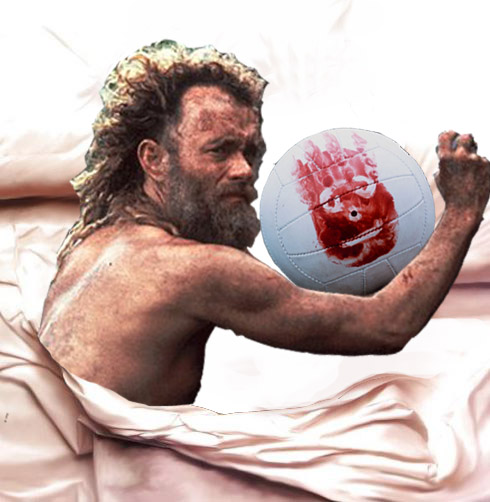
For a fleeting moment I felt like Tom Hanks in the movie Cast Away when Wilson (the volley ball) floats away and Tom can’t reach it so he sobs and sobs and sobs. I will forever miss that visor; we had some amazing runs and shared some great times together.

Tom Hanks in Cast Away with his Beloved Wilson
My other hard luck story involves my favorite baby blue t-shirt I got after finishing Ironman Austria in 2004, which in itself was a personal victory for me because I had to cancel on the event I was going to do with three other Flyers just a few weeks before the race due to an injury before finally redeeming myself.  On the bright side, I never lost it and am grateful that I still have what might be my favorite race t-shirt ever because of its color, its design, and its personal meaning for me.  But it’s long been riddled with holes throughout simply from wearing it too much, lifting weights in it too much, sweating in it too much, and running in it too much.  I believe that a lesson learned is to savor those things you love that offer some personal meaning or remembrance in your life.

It's Not Just a Runner Thing

So much for those crazy runners but what about “roadies” (i.e., cyclists) and their own habits, beliefs and superstitions?

The most common ones as you might guess are to talk about never “flatting” and of course then going out on a ride and actually getting a flat.


Others involve such important priorities as when is the right time to shave the legs before a big race, mounting a bike from the left vs. the right, never washing a race jersey while you're winning races or riding exceptionally well, never hurling a “loogie” from your left nostril over your right shoulder, and never ever getting a bib numbered “13”

This article would not be complete without including one more species of athlete….the “triathlete” or as the roadie cyclist might say a cyclist's “dysfunctional cousin.”

What strange customs abound in the triathlete’s world of aero bikes, helmets and wheel sets? Do we take the prize in “weirdness” because we have to perform not one but three different disciplines all in the same race?

Not a ritual but a mantra I have used in every Ironman I have raced is to repeat to myself  “It’s Showtime” as I’m nervously peeing in my wetsuit while waiting for the mass swim start of the race to begin. I find it helps me to focus a bit more.

Or are triathlete’s so Type A or so tightly wrapped in Lycra and compression wear that we are beyond any weirdness, ritual or superstitions?

Well…….NO not really as here are some samplings from some assorted racing forums I have read:

  • Don’t let anyone touch you on the morning of an Ironman except other triathletes
  • Always have race kit washed and hung up to drip dry the night before the event (guilty here)
  • Always say "thank you" to the volunteers (a case can be made that saying thanks is event-universal)
  • Pump tires in pre-morning darkness while squinting at pressure gauge so as not to…well you know
  • Make sure to touch the finish line three times the day before the race
  • Always mount the bike with the right leg
  • And, like our road cyclist friends…..when do I shave my legs?

The closing here is that there isn’t a closing and that superstitions or rituals abound whether you are a marathon runner who will only use a particular anti-chafing ointment or a baseball player who spits in his hands. They may possibly define us and can even add a measure of  “order” or a discipline that has become as common as the discipline or practice of running has become in our lives. Maybe the superstitions help us on some level.  Maybe the only differences are how weird yours might be viewed to the world vs. my own, but if it helps us cope with pre-race anxiety or serves our objectives in ways that work only for us, then let weirdness rule and may the athlete within always reign.


Keep calm and run like hell my friends J

-Scott C

Read more...

Friday, August 3, 2012

A FLYER'S RITE: LTR

David G
6:30 AM Saturday, the sun is up, yesterday's steam barely worn off and we prepare for another assault from summer. It's early in Central Park and Jo Ann M takes her place at the NYC Marathon Long Training Run (LTR) pace group leader table. She's dealing numbers, excellent singlets and instructions. An LTR fixture, we assume that Jo Ann will be at her station, year in and year out.  Many thanks to Jo Ann and Ed A for all of the detailed work behind the scenes and at the event to ensure that everything would run smoothly.

Flyers drag in, not so far removed from Friday night fun and the Olympics opening ceremony. We stayed up late to watch, but we're ready for this. I feel a little nervous, as I always do for the LTR, having signed up for 16 miles at 9:30 pace. I have run this distance in the past few weeks and I run this pace and faster all the time. There is something different, though, when you commit to it for your club and you have 40 people nipping at your heels. You can't let them down, can't let the Flyers down, and you never know when you might have an off day.

I think of 2005, when I was preparing for the Portland (OR) Marathon, where I would first break 4 hours. I signed up for the 2005 NYC Marathon Long Training Run and maybe a few hundred other runners showed up that day. My group was led by John W, a New York Flyer; and John led us well and provided friendly, helpful chat along the way. He assisted me in completing an important long run and I made my mind up to join the Flyers.


The LTR remains a different NYRR run to this day. It's not a race and there is no chip. We know what is in the participants' heads. They look up to the leaders and it is the Flyers turn to shine. We project an image of reliability, even invincibility, and the many first time marathoners feel just a little more confident with us around, peppering us with questions.

This morning, Ed A is barking out instructions, setting off each group on their first lap. The fastest groups skitter off - how can these guys commit to 20 at 7 minutes? 7:30, 8:00.  NYRR CEO Mary Wittenberg waxes poetic about the Olympic Marathon as we hold our groups at bay, preparing for our own Olympic effort.
7:30 Minute/Mile Pace Group:
DJ Van H, Bobby O, Mary D and James D
At last, 9:30, and there are so many runners that we field 3 groups at our pace. I'm paired with Denise I, Kettia M, and Khris D P. We take off, not quite sure of the pace, perhaps a bit quick. Mile 1 and we are 20 seconds too fast. It takes a few miles and we finally settle in, giving the extra time back on the way up to 102nd St. Our group is so compliant! Always a couple of folks staying ahead, but this time it seems to be just a few who need a little space. They are not pressing the pace, so we let them stay a bit free form. Behind us, lots of doubt, some deciding that 9:30 was too ambitious and others digging in for the long morning with us.

Kettia M, Khris D P, Denise I, and David Gaines
Summer training and it is humid. There is a fog over Columbus Circle. We are soaked with perspiration quickly and appreciate the two misting stations. We thank the volunteers and, as always, marvel at the beauty of our Central Park.


Back at the start after 6 miles, Dave K is on the microphone gathering the groups ahead for their next lap. One thing we know is that laggards get left behind here. Linger in the Port-O-Let and you can join the next group. We are off again on loop 2, now confident in our group and our mission. Colleen R joins our pace group for this loop, providing a breath of fresh air, and Denise continues to carry the load answering the questions of our runners and advising of upcoming water stations. I am so grateful to them both; they are pacing me.
Kettia M and Khris D P

The chatter and the questions tail off and we all start to go inward. I think of my own races this fall - we are training for our own challenges, not just helping our pace groups. Can't wait for a 45 degree start.

Two laps in, 11 miles and a few people declare their day done. I hear Ultra Claudia O announce that her long run is tomorrow - what's this??? NYRR is handing out nectarines, bananas, gels, pretzels and we are soaking them up. We've been lapped along the way by the speediest (Eric F, Sean J, Leslie L), which never ceases to amaze. It always freaks out the first timers ("What's their PACE?!?!?!).

Eric F, Sean J, Leslie L
All runners grow silent now and our group is smaller on loop 3. It's a grind at 90% humidity. I slip behind to patrol the back of the pack and ask how everyone is doing - no answer. I don't think they would be doing as well without us.

Done with lap 3 and I have satisfied my commitment. My toes are sore as usual, ankles feel beaten up like always, but I know there's 18 or 19 in these legs now and 20 will be coming in a couple of weeks. Off goes my group, finishing the 20. They are tough as nails and I feel a little guilty just hanging around the finish area. People are stumbling around, crawling off to get their baggage, and I admire both the 7 and the 11 minute runners. This is far and don't ever think it's not. It will always be far and today's runners needed us to get through.
Flyers LTR Organizer Jo Ann M Displays
Group Leader Singlet
As I walk away with my Fellow Fantastic Flyer brunchers, so many eyes are focused on the Group Leader singlets that signify some undeserved super-human status. They'll see that shirt again sometime in the park and they will remember back to when the Flyers got them through. Do they know that being a pace leader helped to get me through too? Maybe, but I ain't talking.

-David G

Read more...

Sunday, May 27, 2012

National Running Day

Dave K
A would-be Blogger never quite got around to submitting their write-up for the Blog.  It doesn't happen often, actually only once or twice before, so it's fine.  Grrr. 

Anyway, while I plot my revenge :) here's something from me that I'll post instead that also may be of interest to Flyers Blog readers. 

However, I'd like to first include one mention about the Brooklyn Half Marathon.  On behalf of all the Flyers and friends of Flyers who took the bus (102 of us!), a big BIG thank you goes to Richard B for once again arranging for the annual UES and UWS ride to the race.  The buses arrived at Prospect Park in plenty of time, and it was much fun for all to ride to the start with so many sleepy but eager and friendly Flyers.  Injured Richard then even headed out to the course to take lots of great photos of us in action (i.e., approaching the finish line, playing on the beach, etc.).


So on we go to the topic I'll enthrall you with in this current blog entry.  Wednesday, June 6 is NATIONAL RUNNING DAY.  New features to National Running Day this year include: an updated National Running Day website and design; National Running Day gear; daily giveaways; a fundraising race; and more events.  Click here for more info about National Running Day from the organizer of the events.
"What started as a grassroots initiative just a few years ago has now blossomed into a worldwide day of fun and movement," said Mary Wittenberg, New York Road Runners' president and CEO.  For information on events in NYC, click here for the link on the NYRR website.  As an extra bonus, if you click on that link (fine, here it is again) you'll see an NYRR photo that includes the Flyers own Brian H and Glenn W.

Desi Davila Trying to Catch Up to Brian and Glen
The NYRR events kick off with a 12-hour fun run relay around the Central Park Reservoir.  U.S. Olympian Desi Davila will join in the morning.  More fun to follow, including a "Singlets Mixer" Fun Run and Happy Hour in the early evening in Prospect Park.
 
Happy Running!
 
-Dave K, Flyers Blogmaster

Read more...

Thursday, November 3, 2011

Inspiration for Runners: Notable Quotables

Dave K
With the NYC Marathon, Philly Marathon, other marathons, and cold winter running ahead, here are some quotes that may inspire.  

If you have your own favorite quote, please share it in the comments section below (if you don't have a Google account, just sign in as annonymous)

"You have to wonder at times what you're doing out there. Over the years, I've given myself a thousand reasons to keep running, but it always comes back to where it started. It comes down to self-satisfaction and a sense of achievement." 
- Steve Prefontaine

"I always loved running...it was something you could do by yourself, and under your own power. You could go in any direction, fast or slow as you wanted, fighting the wind if you felt like it, seeking out new sights just on the strength of your feet and the courage of your lungs." 
-Jesse Owens

Jesse Owens

"The will to win means nothing without the will to prepare." 
-Juma Ikangaa, 1989 NYC Marathon winner

Juma Ikangaa
"In running, it doesn't matter whether you come in first, in the middle of the pack, or last. You can say, 'I have finished.' There is a lot of satisfaction in that." 
-Fred Lebow, New York City Marathon Co-Founder
Fred Lebow
"Running is the greatest metaphor for life, because you get out of it what you put into it." 
-Oprah Winfrey

Oprah
"Racing teaches us to challenge ourselves. It teaches us to push beyond where we thought we could go. It helps us to find out what we are made of. This is what we do. This is what it's all about." 
-PattiSue Plumer, U.S. Olympian 


PattiSue Plumer
"Believe that you can run farther or faster. Believe that you're young enough, old enough, strong enough, and so on to accomplish everything you want to do. Don't let worn-out beliefs stop you from moving beyond yourself." 
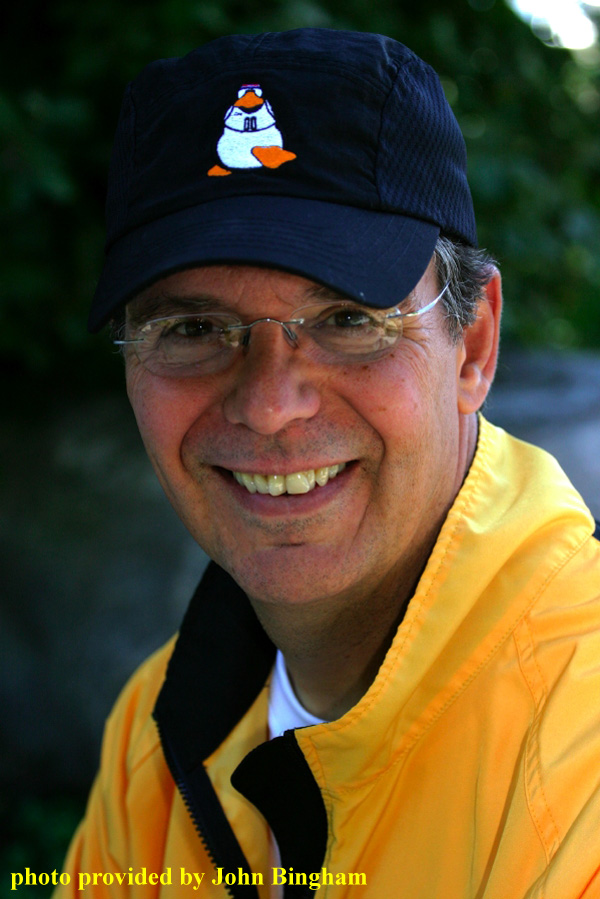
-John Bingham, Running Speaker and Writer

John "The Penguin" Bingham
"Running is a big question mark that's there each and every day. It asks you, 'Are you going to be a wimp or are you going to be strong today?'" 
- Peter Maher, Canadian marathon runner
Peter Maher
"Ask yourself: 'Can I give more?'. The answer is usually: 'Yes'." 
-Paul Tergat, Kenyan professional marathoner

Paul Tergat
"We run, not because we think it is doing us good, but because we enjoy it and cannot help ourselves...The more restricted our society and work become, the more necessary it will be to find some outlet for this craving for freedom. No one can say, 'You must not run faster than this, or jump higher than that.' The human spirit is indomitable." 
-Sir Roger Bannister, first runner to run a sub-4 minute mile.

Roger Bannister
Got an inspirational quote? Put it in the comments section below, please.
-Dave K

Read more...

Friday, April 15, 2011

Running Galloway-Style


Liz G
 You never know what kind of reaction you’re going to get when you tell another runner that you use the Galloway Run-Walk Method for running marathons.  Generally the conversation starts with your having to explain just what that means – namely, that you incorporate regularly timed walk-breaks into your runs.  Some people think it sounds cool, others want to know how I know when to stop, and some ask if this just for really long runs or anytime I lace up (my answer is just long runs).  But many folks simply dismiss it out of hand – “you’re not really running a marathon,” is usually how the conversation goes.  I’ll admit that the Galloway Method is not for everyone, but I do think it should be considered as a serious training plan for runners at all levels.

In a nutshell, the Galloway method, developed by Olympian Jeff Galloway, incorporates active recovery into the distance run by dropping in regularly planned walk breaks.  His method is described in detail in Galloway's Book on Running.  Depending on the runner’s physical and mental capabilities and the distance of the race, the ratio of the run-walk break can range from one-minute run with one-minute walk, to shuffling your feet for 30 seconds at every mile marker, to just about every permutation in between.  The theory behind this is both physical and mental. 

Physically, Galloway believes that by shifting back and forth between walking and running muscles, you distribute the workload among a variety of muscles, increasing your overall performance capacity.  In a way, you are building active recovery into your run, allowing you to remain strong throughout the race; indeed, most Galloway runners have a stronger second-half than if they were to run without stopping.  The Galloway program’s tag-line is “run injury free.”

Mentally, the walk breaks cut the 26 miles into digestible segments, which you know you can do.  Instead of thinking at mile 20 that you have six more miles to go, a Galloway runner will rationalize that he or she has one more mile until the next break, or that s/he’s running for another five minutes, and then another five minutes, and so on.  Even when the going is tough, you know that you can always run that shorter distance, and before you know it, you’re at the finish line.

Another central idea of the Galloway program is that the “wall” is located at the length of your longest endurance session.  That is to say, for example, that if your longest long-training run is 20 miles, you will hit the wall at mile 20 of a marathon.  Consequently, Galloway encourages people to go the full 26 miles in your last training run before your marathon.  That also means that the training schedule is six months, as opposed to the more common four months, as people move up gradually to a 26-miler.

For the slower marathoner and those trying their first-ever distance races, I think the Galloway method is a no-brainer.  I’ve heard lots of first-timers say that they would never do a Galloway-style marathon because they wouldn’t actually be “running the whole distance.”  That’s nonsense.  I’m covering the same 26.2 miles as everyone else.  Moreover, I’m in control of my walk breaks – unlike many first-timers who run 18-20 miles of a marathon, getting slower and slower with every mile, and finally break down and walk the last bunch of miles because they’ve hit the wall.  With the Galloway program, you don’t hit the wall and the walking is spread out into 30-60 second segments, and not done in a depressing 30 minute slog.  Importantly, to receive the maximum benefit you must start the walk breaks before you feel any fatigue, in the first mile.  If you wait until you feel the need for a walk break, you’ve already reduced your potential performance.

But this is not just a program for first-timers or slow-pokes. I’ve completed 16 marathons, 15 of them Galloway style – which, I should mention, I picked up after having trained for and run my first marathon the more traditional way…which included a long, miserable walk from the Bronx to Columbus Circle.  For the faster marathoner, the program is worth trying out.  In the marathon where I had my own personal best time, I ran 5-and-1’s (five minutes of running and one minute walking) for the first 20 miles, and then ran straight without walk-breaks for the last 10K.  My mile splits improved mile by mile, and my last 10K was my strongest mentally and physically.  Taking regular walk breaks, I was able to push my heart rate higher during the run segments and recover a few beats during the short walks. In the second half of all my races, I’ve found myself passing lots of runners who passed me in the first half!

Yes, there are things about Galloway runners that annoy other folks on the road – the starting and stopping can get annoying to other runners who have to maneuver around them – but aside from that, I can’t understand why mere mention of the program elicits such strong emotions from others. A couple of years ago when the New York Times’ Tara Parker-Pope was training for her first marathon, she used the Galloway method and wrote about it in her article titled Better Running Through Walking.  As she wrote, colleagues of hers “snickered” when she told them.  Over 260 people wrote in to comment on her article, many of them furious to be considered marathoner finishers on an equal footing with people doing 26.2 miles of run-walking.  But, Parker-Pope concluded, she was convinced that “those of us run-walking the marathon will have the last laugh.”  I, for one, will be there laughing with her.

Jeff Galloway will be convening a free kick-off of the NYC training program that's open to the public on April 20, 2011 at 6:30 PM.  The event will take place at PS 6, at 45 East 81st between Park & Madison (please use the middle red door).  For more information about the kick-off and about Galloway running in NYC, please click here.
Liz G

Read more...

Sunday, March 13, 2011

Writing About Writing About Running: The Fall-Out

Diederik v. H. in Central Park
COURAGE

Until I started doing it seriously it was hard to see running as an act of courage.  Then I learned from experience, and from watching others, that the solitary runner at the starting line of a race is exposing himself or herself.  Regardless of distance and pace, it is just you, embracing the challenge from yourself for the world to see, without the comfort of a team or a coach.  It takes something to be there and give it your all, in public.  It may be courage.


When I once ran with ultra-marathon champ Dean Karnazes, he told me that he loves running with others -- often admiring strangers -- because the fellow runner is as 'naked’ and vulnerable as he or she will ever be.  Dean enjoys connecting with people in those moments, when all pretense and natural defenses fall away in the struggle with pain, weather, exhaustion, and self-imposed limits (‘I can’t’).  That is pure courage, Dean told me.

VULNERABILITY

Another thing I didn’t realize until I did it was that writing a memoir creates a whole new realm of vulnerability.  I could have known, of course.  But experience is different.  In fact, writing about running, as I did in my first book, The Running Dutchman, turns out to be like a 50K.  Not that it’s necessarily too much.  But definitely a lot.  A lot of exposing and vulnerability, meaning you can easily get shot down, or lifted up, or both.

NUSport, a pre-eminent sports magazine in the Netherlands, reviewed my book, which was published in Dutch as De rennende Hollander. I occasionally write for NUSport and I was glad to see that my status as a contributor did not keep the reviewer from saying what he really thought!

Kind words from Runner's World
The good news: he gave me a 7 out of 10. The less pleasant news: the book should been 80 pages shorter (perhaps), my editor should have been tougher (true), too many errors made it into print (shamefully: yes), and some personal anecdotes were dreadfully boring (what can I say?).

Before all of this could depress me, the review concluded by saying that the author is a pretty fast runner for an aging former smoker, and a compelling writer. The Dutch edition of Runner’s World had earlier described my love for running as infectious and simply recommend the book.

The trick has been to not take any of it too seriously.  Both criticism and compliments can be meaningful - but it’s also true that both usually say a lot about the person expressing the views. A negative response should not bring me down, just as I cannot let a public DNF (Did Not Finish, or Did Nothing Fatal) --like the NYC Half in 2010-- devastate me.  A kind word about the book is nice, as is a PR, but neither should go to my head.

PUSHING THE LIMITS

Only those who will risk going too far can possibly find out how far one can go.  T.S. Eliot

As time passes since the book’s publication last fall, I also realize more and more that I am far from the only one impacted by the book.  Other characters show up by first name (like Eric, my best friend / doctor), role in my existence (like Mom, or sisters), or anonomously (when I sensed that an ex-lover might not be pleased by her appearance in my abbreviated life story).

Nobody has really complained. But some commentary has been unspoken.  One of my sisters, a voracious reader, never said a word about the book, which I gave her with a personal message inscribed.

My poor dear parents have both been very supportive, even though I treat some elements of my childhood not so kindly.  I dedicated the book to them. I meant that; I love them and I am grateful.  But I also think it made them less inclined to take offense.  Nice pre-emptive move, I say.

Many of my parents’ friends and distant relatives -- gently and not so gently pushed by my parents / personal PR agents to buy the book, now! -- have expressed kind words.  Some have been surprised.  One of them wrote me a nice hand-written letter, a gift of a former time amidst the piles of direct mail and email that buries us nowadays.  She said she learned a lot about my folks, and about me.  'There were elements I’m not sure I wanted to know,' she added. ‘I wondered why they were there.’

Writer About Writer About Running Completes Caumsett Park 50K
It’s a question I sometimes ask myself I find myself at the starting line of a 50K or a 5K: what am I doing here?  I suppose it’s the sense that doubts and fears can be shaken off.  That limits need to be pushed. Whether that is courage or stupidity, or a little bit of both, remains an open question.

Diederik v. H.

Read more...

Friday, January 28, 2011

The Flyers Are Dead; Long Live the Flyers!

Every year we race. Like the ebb of the tide, each year comes and goes, and each looks pretty similar to the last. The Manhattan, Brooklyn, Staten Island Halfs. The Joe Kleinerman 10k. The Club Championships. Father’s, Mother’s, Japan Day. Etc. Sometimes a Dash is a accompanied by a Splash, and sometimes the dates change and sometimes the distances change, but it all ends up blending together after that first run at the stroke of midnight at the start of the year.

And as the year comes and goes, we keep running, and striving to set another PR. And another. And another. And another.

So what’s in it for you, in all this running? The question is rhetorical of course. No one has an answer for keeps. Each time you think you’ve figured it out, you run another race and the question arises again, if in a different way.

Rising above it all is our little club. OK, big club. Although we might run alone during the races, away from them we’re part of something big. All those races might blend together, but we relish – or hate – each and every one for their most subtle differences, and love to ponder those differences with our friends in the club. One 10k is not the same as the next, even if they’re the same race on the same course at the same time of year in the same conditions. So we tell our stories and bond together.

When it’s all done, we gather to party. We figuratively hoist our success stories on our collective shoulders and cheer, while we sweep our misfortunes under the rug and let them go. We embrace the volunteers who motivated, maintained and carried the club over the past year, and we send newly elected and appointed ones on their journey forward to lead us. At this cold, dark, and snowy (very snowy!) time of year, we can look ahead to renewal and rebirth. The days are getting longer. The temperature will rise. The snow will melt. Spring will come. And we will – our club will – set many more personal records again. And again, and again, and again.

This Saturday is our Gala. We will eat and drink. We will celebrate the year gone by. We will dance. Oh my, we will dance! We will share our love of our sport and say good bye to our past and from the night we will emerge, a new club, eyes set to the future, with one collective, uniting thought:

Go Flyers.

Read more...

Thursday, January 13, 2011

Run-to-Work Day, Everyday!

Commuting sucks. Crowded sidewalks, crowded buses, crowded subways. Monthly MetroCards costing 17 percent more.

Fortunately I've discovered an alternative that involves doing something I truly enjoy: running.

You can do it, too. All you need is some planning, some place to lock your valuables in the office and, if you are commuting to work, access to a gym.

It's four miles door to door from my apartment in the Upper East Side to my office near Penn Station. I can add a mile by going through Central Park or another few miles by going along the Hudson River. If you live too far from the office, you can consider running part way and jumping on a train for the rest. Every minute to spend running is a minute avoiding the getting squished on a bus or a subway. At the height of my training, it wasn't even worth getting a monthly MetroCard, because I'd need the transit system for community so few times.

The toughest part is getting started. I recommend starting out with a run home every week. Then make it two. And then three. Bring running clothes to change into once you're ready to leave work. Bring along some cash, IDs and other important cards – including any keys or building access card you'd need to return to work the next day. Lock the rest in your drawer or conceal it under that folder you know no one will ever check – it might be marked “high priority” or something like that. Bring along your house keys, and you're on your way. You can retrieve your work clothes the next day or later in the week.

Running to work takes more planning, as you'd need to bring work clothes and shoes you'd need ahead of time. Also if you pack lunch, you'd need to bring extra the day before. After you get used to running home two or three times a week, try running to work once a week. You might not have room to bring your entire wallet or purse, so just bring the cash, cards and IDs you'd need. At the office, swing by your desk to grab your work clothes. Head to the gym, shower and start the work day refreshed.
Once this becomes a routine, you might plan ahead for the week – bringing enough stuff for a few runs to the office and a few runs home after the work day. You'd also have to make sure you have enough coats at each place, lest you'd have to return home or start the next morning without warmth. I save at least an hour a day in commuting, and I can't even recall the days I'd take a subway and bus home only to change into my running gear and spend another hour on the run. - Nick J.

Read more...

  © Blogger templates The Professional Template by Ourblogtemplates.com 2008

Back to TOP