Saturday, January 26, 2013

New Flyer Profile -- Fran B

Fran B
I started running about seven years ago when I was 65 and recently retired from public school teaching in Lawrence, Kansas, because my daughter asked me to join her as she did a half marathon -- so I did a 5k and won in my age group.  Although my husband Dan and I have been in New York since 2007, I am still an avid University of Kansas Jayhawk.  


I began running with NYRR when I came in to visit our son and his family in about 2005.  Since I was born and raised in Brooklyn, coming back to NYC was coming home after 30 years of being away while my husband taught at the University of Kansas.

In Kansas I joined the"Mad Dogs" -- a running group that met under the "noon day sun"  made up of faculty and staff and their families.  When Lawrence developed its own community running group called "Run Lawrence," I joined that as well. I hold several state records for my gender/age group in Kansas that are still unmatched.

I run numerous NYRR races every year, but I enjoy running with the Flyers on Saturdays best of all.

Here in New York I have run as an adjunct Flyer with the 6am and 7am Flyers running groups that meet on the UWS at W.72nd and CPW.  Recently, I finally decided to be "honest" and actually join the Flyers.  I have never met such a nice group of people.

I also take classes at the Westside YMCA to keep fit.

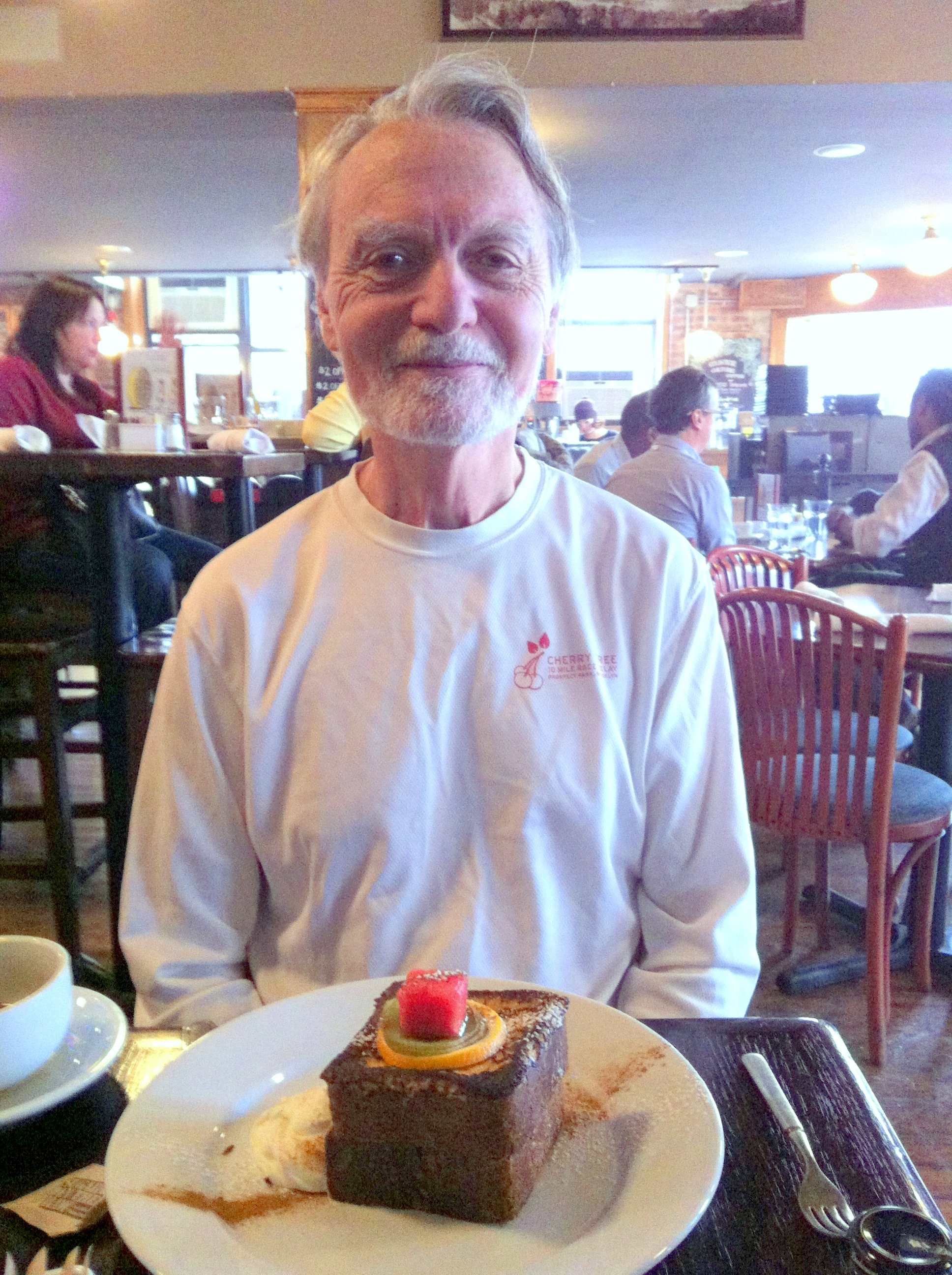
I've included my picture in this blog post that shows me ready to run the 2009 NYC Marathon -- I finished in less than 5 hours at age 69!

-Fran B

Blogmaster's Note:  Fran is one of four NY Flyers nominated by NY Road Runners for a distinguished age group award (along with Pat D and Shevaun T, and 14-yr-old Lauren P in their respective age groups), with the recipients to receive their awards at NYRR Club Night on Thursday, March 7th.

Read more...

Sunday, January 20, 2013

To the Tip of Manhattan: 14 - 20 Miles


Mix and Match Miles to Brunch

What's It all About

Indian Road Cafe
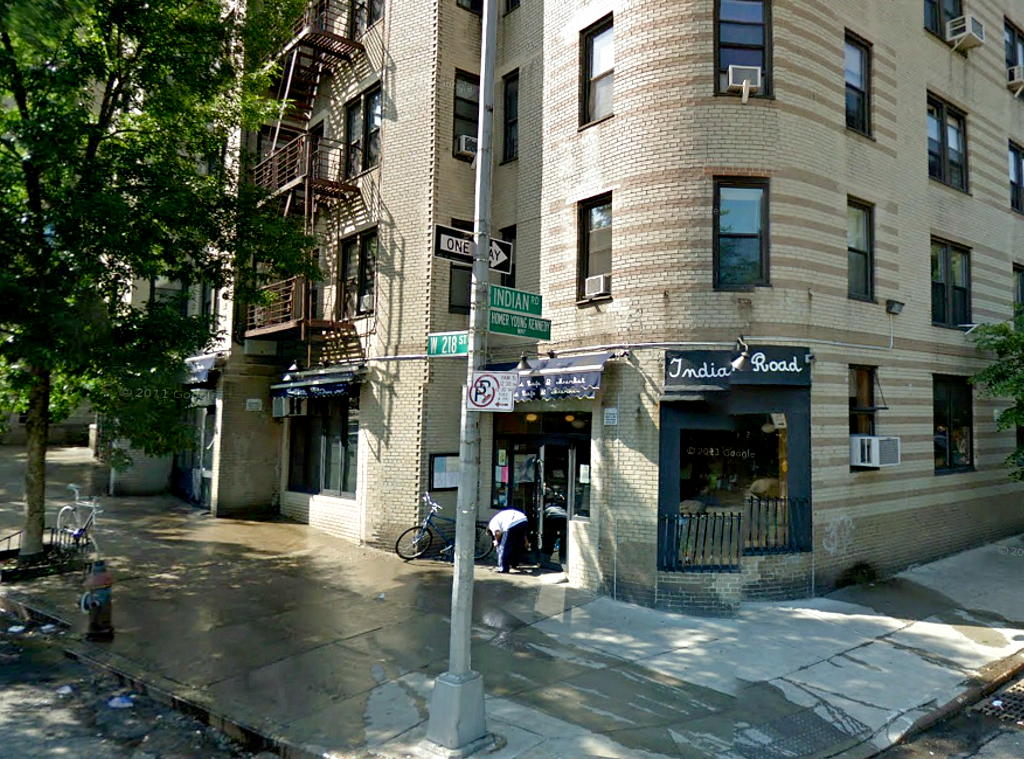
Last summer, Susan, my running partner, and I discovered a great brunch restaurant in the Inwood section of Manhattan: Indian Road Café . I carefully checked maps and Googled this and that and determined that this is the northernmost eating establishment in Manhatten — it's at 218th Street and Indian Road. Well, in light of it's location, why not lay out a long run to this place and try to come up with mileage adding up to 20 miles? So I did.

And because this was not a purely intellectual exercise, I actually ran a variation of the ultimate route twice: early in December I ran a 14 miler, mostly through parks (see THIS) and late in the month I ran a 20 miler with a big stretch on city streets (see THIS). In both runs I did 3 portions: 1) ran up to Central Park; 2) ran around the park by a variable amount, and 3) ran from the park up to the northern tip of Manhattan. The variability comes from how much you do in the park. If you just pass through the park, you end up with 14 miles. If, in addition, you do a whole park loop, you end up with 20 miles. And you can obviously do something in between.

Here's the outline of what I did with a few more details (mileage is approximate):

·      Run up along the East River, and over to Central Park (5 miles).
·      Run straight through to the north end of the park or add up to a 6 mile loop in the park, depending on the mileage you want: straight through gets you 14 miles total; adding one 6 mile loop gets you 20.
·      Run from the north end of the park and up to Fort Tryon Park, either along streets (St. Nicholas Avenue, Broadway and Fort Washington Avenue) or through a series of parks (Morningside, St. Nicholas, Jackie Robinson and High Bridge), and finish up by running through Fort Tryon Park (home of the Cloisters) and Inwood Hill Park — or take a short cut along the east side of Inwood Hill Park. (streets: 7 miles, parks 7¼ miles).

I started on East 20th Street where I live and I entered Central Park at the Engineers' Gate. If you live somewhere else (as I expect you do), just figure the distance to the Engineers' Gate from where you live and adjust accordingly. For example, if you live on 72nd and Riverside Drive, it's 2 miles to the Engineers' Gate so add 3 miles somewhere along the way (e,g. add 2 Reservoirs, or run up to the Sailors and Soldiers Monument and back).

So I'll assume you can get to Central Park, and do what ever loops or side trips it takes to get to the north end of the park. Then you have 7 miles to go and you will probably be covering new ground. Here are some maps:     

Central Park to the Tip                  Central Park to the Tip
Via Streets                                      Via Parks

Click for USATF Map                         Click for USATF Map                    

Parks vs. Streets? Sounds like a No-brainer.

Normally, if you asked me if I would prefer to run from point A to point B by traversing a series of parks versus running between the same two points along some city streets, I would say, "Are you kidding? Parks, of course!"

But wait: look at the two maps: the streets route (the map on the left) is shorter by about a mile and has one gradual climb all the way to Fort Tryon Park. Not only is the parks route longer — although we make up the difference — but there are numerous ups and downs. It's clearly more tiring. I have done both routes and although the parks route is my normal preference, when I did my 20 miler in late December, I took to the streets route (map on the right). Bottom line: do what you want, they're both nice routes, especially on a Saturday morning when there is little street traffic.

The Streets

From the north end of Central Park, at the Lenox Avenue (aka Malcolm X Boulevard) exit, get onto St. Nicholas Avenue. This starts across from the park and goes diagonally up to the left of Lenox. This is long avenue which, under a couple of names, goes all the way up to the north end of Manhattan. It's actually the old "Kings Bridge Road". At 168th Streets you merge into Broadway and follow that to the GWB bus terminal (178th Street). Then you leave the Kings Bridge Road and zig one block left (to the west) to Fort Washington Avenue. For this zig, we usually cut through the bus terminal for a pit stop. Now follow Fort Washington to it's end and you will be at the entrance to Fort Tryon Park.

The map to the left (see the two maps, above) shows it all (click here to bring up the on-line Google Map version), but a few details are worth mentioning: there was little street traffic, a big plus since I don't usually like to run so many miles on city streets; once out of the park, the route is almost all up hill till we got to the cloisters; and lastly, it helped greatly to have such nice running companions — sorry, you'll have to supply those yourself.

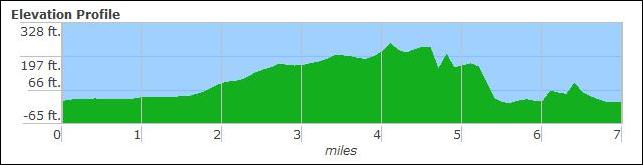
Elevation Profile: Streets Route

The elevation profile is instructive: it really is one long hill, but it's never too steep. Good for you training to. Incidentally, those two bumps from around mile 4 to mile 4½ are the co-highpoints of Manhattan. If you're interested in high points, read THIS). And careful examination of the map will show we actually ran THROUGH the GWB bus station, A good place for a pit stop (plus I cheated and took the escalator! ).

The Escarpment Parks

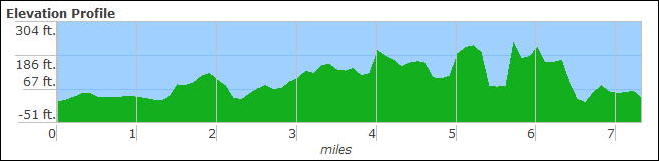
The route through the parks can be seen on the map at the right (see the two maps, above). Although I mentioned it's about a mile longer, I actually took a short cut along the east side of Inwood Hill Park (the northernmost park), so that on that day the difference was only around ¼ mile. One thing the elevation profile clearly shows is how upsy and downsy this route is compared with the streets route. Your muscles will know the difference — both on the day you run and the next morning!


Elevation Profile: Parks Route
I call the series of parks, starting at the north end of Central Park and following up through Morningside, St. Nicholas, Jackie Robinson, High Bridge, Fort Tryon and Inwood Hill, the "Escarpment Parks" since they follow a line of steep ridges up through northern Manhattan. You can see on the map that the parks align themselves along the Manhattan street grid and all involve steep ridge lines. Click here to bring up an on-line Google Map version (produced using the USATF route application). You also can get a detailed description in the report I wrote a few years ago, Carl Schurz Park to Wave Hill (just don't go all the way to Wave Hill ).

Simply put, head up through Central Park, down through the Conservatory Garden and around the Lake and out the northwest entrance. From there head west on 110th Street a block and head up through Morningside Park to the north end at 123rd Street and Morningside Avenue. Then head up Morningside Avenue for four blocks to 127th and hang a right and then a left on St. Nicholas Terrace where you will arrive at the south end of St. Nicholas Park. The bathroom is a few blocks north in a playground. Head all the way up through St. Nicholas staying on the westernmost path (along the top of the hill). Finally at the north end, go down the stairs and exit at 141st Street and St. Nicholas Ave. It wouldn't hurt to look at the map to follow this description (use the on-line map and zoom in).

Now head down (east) on 141st St. one block to Edgecombe. If you zoom in on the map you'll see I missed Edgecombe. No big deal — in any case head up to 145th Street and you'll get to Jackie Robinson Park. Make sure you're at the entrance at the top of the hill, not the bottom (like I was). The simplest way to traverse this park is just to stay on Edgecombe along the west side of the park all the way to 155th Street. I actually went down into the park about half way up and followed an old abandoned path. At 155th Street, head left up the hill and make sure you go past the road heading down the hill to the Harlem River Drive, and cross 155th St. to the Jackie Robinson Park. You should be on Edgecombe (again) heading north up a hill, with a triangular park on the other side and housing beyond. This is High Bridge Park, my favorite.

I like to head through this park on the Old Croton Aqueduct (aka the OCA), starting at 158th Street, or you could also just stay on Edgecombe, but I strongly recommend the OCA. When you finally get to the end point of the OCA at the Manhattan end of High Bridge (yes, there is an actual bridge, unfortunately fenced off), head up the stairs, check out the tower, and get onto Amsterdam Avenue (yes, Amsterdam, the longest Avenue on the Manhattan street grid, extends all the way up here). Go up Amsterdam, cross all the highways and finally take a right on Laurel Hill Terrace. At this point I normally go down into the park and follow the park roads another half mile north, but this time I stayed on Laurel Hill.

When I finally got back to Amsterdam, I took a short cut. Instead of following the park all the way up, being cold and hungry, I crossed over on 190th Street and headed west. Then I took two "secret" underground shortcuts: The subway elevator & tunnel at the 191st St. #1 Train station (west side of St. Nicholas just north of and 190th) and the tunnel & elevator at the 190th St. A Train station (west side of Bennet Avenue north of 192nd St). Check the map carefully if you go this way. The later tunnel (the Bennet Avenue A-train station) takes you to an elevator which puts you right at the entrance to Fort Tryon Park.

The tunnels are free, safe, well lighted, have lots of traffic, and they save you some very steep ups and downhills. Don't believe that? Just check the elevation profile above and look at that steep sided valley at mile 5½. That's where you would have to run down from High Bridge Tower to Broadway and then up again to get to Fort Tryon Park. In fact you couldn't possibly run up to that park even if you wanted to — it's a sheer rocky cliff, see this! And it's very cool to traverse these old pieces of New York City infrastructure, all but unknown outside this neighborhood. Besides, how many long runs have you done which include two tunnels and two elevators? And according to the long run gods, these tunnels/elevators count!

The Final Stretch

Fear not, you are in the final stretch. When you get to the entrance to Fort Tryon Park. Go north through the park staying on the westernmost path and circle around the Cloisters and take the steep winding path down to Riverside Drive and then down another block to Dyckman Street.

Cross Dyckman and for the short cut (paired with the parks route) follow Payson, Seaman, 214th St. and Indian Road — skirting around the eastern edge of Inwood Hill Park (see map) — to the Indian Road Café, our destination.

For the long route (paired with the streets route) go west on Dyckman all the way to the Hudson River and enter Inwood Hill Park after going under the three bridges. Follow the path north on the right of the playing fields till you get to the pedestrian bridge. Cross over the tracks and follow the walkway all the way around under the Henry Hudson Bridge. Stay to the left at every fork. When you come out of the woods, pass the memorial rock ("Shorakkopoch Rock", where Peter Minuet stole purchased Manhattan from the Indians —  see THIS) and head around and to the left all the way out to the street. Cross the street and you're there.

Indian Road Café

At the Cafe:
One Happy Camper
For both the 14 miler and the 20 miler, I walked into the place very close to my mileage and time goals. Both Susan and I enjoyed a scrumptious brunch. The place has a great menu of brunch food, plus wines, beers, coffees, etc. etc. And just what is that I'm eating in that photo? It's Baked Stuffed French Toast with Maple Whipped Cream Cheese, Chocolate Chips, Dried Cranberries, Pecans, Cherries and Currants. An astounding dish. I'll be back soon, wanna come? You won't get lost with me.

Perfect Snow — Almost

The day before the 20 miler, I read this blog on the NY Times web site: Tomorrow, It Will Snow, Perfectly, a lovely and clever essay on what makes a "perfect" snow storm in the city: enough snow but not too much, cold but not too cold, etc. In the blogger's words, "blankets the landscape without burying it, beautifies but does not burden, transforms and cocoons without paralyzing or even particularly inconveniencing". Well, when we left the Café and walked the several blocks to the subway, the falling snow seemed just that. It gave that quiet sense that new snow gives. Then down into the subway we went to wind our way home. About 45 minutes later I climbed the stairs out of the subway in my home neighborhood. Oops ... cold rain and sleet! The spell had been broken. No longer the perfect snow, but just another yucky winter day in the city.

Oh well, at least we finished our run and finished our brunch before reality intruded. Happy New Year and Happy Running everyone!

This account was adapted from a post on  Papa Bear's Running Blog: Beyond Central Park 

- Papa Bear (Richard G.)

Read more...

Monday, January 14, 2013

Metabolism: Bust the Myths (Part 2)


Reyna F
This is Part 2 of a two part blog post on metabolism. Part 1 explained RMR/BMR and how to determine these factors (click here).  Part 2 explains what will and will not impact metabolism.

Part 2 is written in a myth-busting format since I get so many interesting questions regarding how to increase metabolism.  See how many True/False questions you get right!


Your body burns more calories digesting ice cold beverages and foods (T/F)

True. But the small difference in calories probably won't make a significant dent in your diet. Different studies have suggested that five or six ice-cold glasses of water could help you burn about 10 extra calories a day equaling about 1 pound of weight loss each year.


Drinking the right amount of water can help you burn more calories (T/F)

True. There are 2 theories:
1.  All of your body's chemical reactions, including your metabolism, depend on water. If you are dehydrated, you may be burning up to 2% fewer calories, according to researchers at the University of Utah who monitored the metabolic rates of 10 adults as they drank varying amounts of water per day. In the study, those who drank either eight or twelve 8-oz glasses of water a day had higher metabolic rates than those who had four.
2.  In 2003, an article was published in the Journal of Clinical Endocrinology and Metabolism. It spoke of a study involving seven healthy men and seven healthy women. All participants were of normal weight. Each participant consumed 500 ml of water per day (a half-liter or about a pint). When their metabolic rates were measured, the researchers found that all metabolic rates were increased by roughly 30 percent. This spike in the metabolism, according to the study, occurred quickly after water consumption: the metabolism was at its greatest spike within a half an hour and was maintained for more than an hour. In that time they burned an extra 25 calories.

What is the reason for this? Researchers theorized that most of the effect comes from warming the water in the stomach. In the male participants, the calories came mostly from stored fat, in the women it came from stored carbohydrates. The water enters the body cold and must be warmed up in the stomach. This "warming up" causes the body's metabolism to increase briefly.  This study further substantiates the idea that ice water, in particular, can help burn calories. Just as the researchers stated above, the ice water in your system must be warmed up by your body. It goes in cold, but when it exits it's no longer freezing. The conversion from ice water to warm water burns calories.

Dieting drops your resting metabolic rate, making it harder to keep weight off (T/F)
True. For every pound you lose, your resting metabolism drops by about 2 to 10 calories a day. Lose 10 pounds, and you now have to eat 20 to 100 fewer calories to maintain your trimmer physique, not factoring in exercise. However, you can prevent your metabolic rate from slipping while you get slim. One way is to lose fat but maintain muscle. You can do this by reducing calories and increasing aerobic and resistance exercise.

Hot foods will fire up metabolism (T/F)

True. While capsaicin is often linked to an increased metabolic rate, specific information varies by study.

ü  In 2008, a study published in the Journal of Biological Chemistry indicated that "the consumption of [capsaicin] is linked with increased metabolic rate and core body temperature." The study found the active chemical in peppers can directly induce thermogenesis, the process by which cells convert energy into heat.
ü  Another study reports that about 1 tbsp. or 30 milligrams of capsaicin, or one tablespoon of chopped red or green chili pepper, has been shown to temporarily boost metabolism by 23 percent.
ü  Stanford University claims that there could be as much as a "50 percent increase in metabolism for three hours after eating capsaicin."
ü  Other reports indicate that an increase may be as negligible as less than 10 percent.

Eating more protein will rev up your metabolism (T/F)   

True. Evidence exists that protein exerts an increased thermic effect when compared to fat and carbohydrate. Evidence is also convincing that higher protein diets increase satiety when compared to lower protein diets. In general, the typical thermic effect of protein is 20% – 35% of energy consumed, and for carbohydrate this number usually falls between 5% –15%.

The thermic effect of fat is a subject of debate. Some have found that fat has a lower thermic effect compared to carbohydrate, while others have found no difference between the two. A main reason for the difference in the thermic effects of food may be due to the fact that the body has no storage capacity for protein and thus it needs to be metabolically processed immediately. The synthesis of protein, the high ATP cost of peptide bond synthesis as well as the high cost of urea production and gluconeogenesis are often cited reasons for the higher thermic effect of protein.

Eating a grapefruit before every meal speeds metabolism (T/F)

False. Grapefruit won't work miracles for your metabolism, but it can help you lose weight. Half a grapefruit before meals helped individuals lose about 4 pounds in 12 weeks, according to a study published in the Journal of Medicinal Food. The reason: its fiber and water fill you up on fewer calories, so you eat less at your next meal. 

Celery is a "negative calorie food" because digesting it uses up more calories than it provides (T/F)
False. The thermal effect of food (TEF) causes the body to burn calories as it processes food. But this process accounts for anywhere from 0 to 30% of the calories consumed. A medium size rib of celery has about 6 calories; its TEF is approximately 1/2 a calorie.

If you have limited time, exercise at a higher intensity for a metabolic after-burn. (T/F)

True. The exercise after-burn, or the calories expended (above resting values) after an exercise bout, is referred to as ‘excess post-exercise oxygen consumption’ or EPOC. This represents the oxygen consumption above resting level that the body is utilizing to return itself to its pre-exercise state.

The physiological mechanisms responsible for this increased metabolism include the replenishment of oxygen stores, phosphagen (ATP-PC) resynthesis, lactate removal, and the increased ventilation, blood circulation and body temperature above pre-exercise levels. Studies have found that the magnitude and duration of EPOC is dependent on the intensity and duration of exercise. It generally takes anywhere from 15 minutes to 48 hours for the body to fully recover to a resting state. Other factors influencing EPOC include training status and gender.

Lifting weights boosts your metabolism more than a cardio workout (T/F)

False.  Leading exercise physiologists conducted a comprehensive review of the research on exercise and weight loss for the American College of Sports. While resistance training was recommended for its beneficial role in potentially improving muscle, strength and power, they found no evidence that it enhanced weight loss, especially when combined with dieting.

A common claim is that every extra pound of muscle burns from 30 to 50 calories per day. Some sources cite that one pound of muscle can burn an extra 100 calories per day.   In reality, one pound of muscle burns about 7 to 15 calories a day.

A high-intensity workout that combines weight training and cardio without any breaks will raise your heart rate, burn the most calories and provide the longest sustained metabolic boost--though it won't have a permanent effect on your RMR. The increase in metabolism is due to the increased excess post-exercise oxygen consumption (EPOC) which some people call the “after-burn”.  EPOC is the total oxygen consumed after exercise in excess of a pre-exercise baseline level. The greater the EPOC, the longer you will burn calories.  Incorporate high intensity interval training (HIIT) and sprints for the increased “afterburn.”


PMS cravings are related to the boost in metabolism before your period (T/F)

Studies do not agree: One theory states that our resting metabolic rate may increase during the luteal phase of the menstrual cycle (the day after ovulation to the first day of your period). The metabolic boost can equal as much as 300 calories a day which is why our appetite increases during this phase.

But another study indicates metabolic rate and calorie expenditure do not increase during that time of the month. What does happen is a change in hormones that cause an increase in appetite to prepare the woman's body for pregnancy and to increase weight.

Green Tea boosts metabolism (T/F)

Possibly. Green tea is one of the most common herbal supplements that is being added to thermogenic products because it has been suggested to affect weight loss and is now the fourth most commonly used dietary supplement in the U.S. Green tea contains high amounts of caffeine and catechin polyphenols. The primary catechin that is associated with the potential effects on weight loss through diet induced thermogenesis is the catechin epigallocatechin gallate, also known as EGCG.

  • Dulloo et al reported that green tea supplementation in combination with caffeine (e.g., 50 mg caffeine and 90 mg epigallocatechin gallate taken 3-times per day) significantly increased 24-hour energy expenditure and fat utilization in humans to a much greater extent than when an equivalent amount of caffeine was evaluated suggesting a synergistic effect. 
  • Research by Di Pierro and colleagues reported that the addition of a green tea extract to a hypocaloric diet resulted in a significant increase in weight loss (14 kg vs. 5 kg) versus a hypocaloric diet alone over a 90 day clinical trial.
  • Maki and coworkers also demonstrated that green tea catechin consumption enhanced the exercise-induced changes in abdominal fat.
Green tea has been theorized to increase energy expenditure by stimulating brown adipose tissue thermogenesis.  Note there are also human and animal studies that have not supported these findings and have reported that supplementation of these extracts does not affect weight loss.


What can you do to increase your metabolism?

  1. Exercise more and/or add interval training and sprints into your weekly workouts. 
  2. Add chili pepper and turmeric to food, and drink green tea.
  3. Include weight training to maintain or build muscle mass, but include cardio for weight loss and wellness.
  4. Avoid products that are “metabolism boosters” since they are not regulated and there are possible risks associated with these products. And once you stop using them, you end up gaining the weight back.
References:
  • American Journal of Clinical Nutrition
  • Journal of Applied Physiology
  • Journal of Biological Chemistry
  • Journal of the American College of Nutrition
  • Journal of the Academy for Nutrition and Dietetics
  • Journal of the International Society of Sports Nutrition
For more information, contact Reyna Franco (Reyna@reynafranco.com). She is a registered dietitian, certified personal trainer, certified specialist in sports dietetics and NY Flyers member.  Her office is located on the upper west side and she counsels individuals and groups on sports and medical nutrition.  Her new and improved website is www.reynafranco.com.


Read more...

Tuesday, January 8, 2013

THERE ARE SUPERSTITIONS....

Scott C
Runners, Roadies, Rituals and Superstitions

There are superstitions (so sings Stevie Wonder here)....  And then there are rituals.  And, then there is OCD!

Perhaps one of the most recent, popular and downright funny rituals is the setting up of the ubiquitous “staging area” that me and so many others take the time to build -- right down to the compression socks, the sunglasses, and the GUs we’ll use -- and then we’ll photograph the area and send out the pics to our several hundred Facebook friends.

Where do we draw the line? Where do we separate rituals from superstitions or make a clear distinction? What should pass for behavior inherent to an athlete vs. behavior bordering on OCD?


For several months prior to the 2012 Boston Marathon, hidden away in our closet at home, there was a gorgeous burnt-orange 2012 Boston Marathon jacket, women’s size small, with the Boston Athletic Association unicorn logo proudly embroidered in black stitching and declaring the 116th running of the Boston Marathon.


It’s truly a beautiful jacket that most would be chomping at the bit to wear when out running in Central Park or just casually walking around town, but its owner -- a certain Flyer Ms. Elle G -- had steadfastly refused to wear it until early in the afternoon of April 17th after she had crossed the finish line of her first Boston Marathon with hopefully a new PR (and possibly not until after taking a cold shower upon running in the near record heat endured by those who ran the race!).

Sound familiar? Anybody else out there who might also adhere to what might be the number one ritual (or is it a superstition?) among the running camp that you never ever wear your race t-shirt, jacket or any form of racing apparel until after you have actually run and finished said race?

I know I’ve always fallen in line with this ritual, superstition or belief that somehow wearing the race shirt before the race will have an adverse negative influence on how I run, how I think, how I perform on the stage I have wanted to be on through my hours of sweat, self doubt, shaken confidence, tearing up my body and mind in preparation for “the day.”

Or can it be more an issue of one’s OCD vs. superstition since we see plenty of runners wearing their race t-shirt during the actual race?  What are they thinking? Are they normal like me? Or clearly they must be a running “newbie” so untrained and unadvised in the “normal” ways of the distance runner who has taken on so many risks, sacrificed so many birthdays, weddings, bar mitzvahs and other assorted social opportunities in pursuit of one more PR!

Any body see themselves in the mirror yet?

Certainly there are other “items of distinction" held onto such as your lucky socks, or perhaps your running shorts from 1981, your lucky running shoes with holes on the bottom almost bigger than a newborn's fist or a running cap from your first “destination" marathon. Or, maybe it's your first marathon medal that you need to kiss before you’ll kiss your husband, wife, boyfriend, girlfriend or kids on your next 26.2 mile endeavor?  Or does the need to touch something, maybe once or twice or even three times reflect a superstition aimed to guarantee the optimal racing experience.  I’ve yet to hear anybody say they have a lucky or favorite “porta potty” they must visit but, hey, you never know, right?

Hard Luck Stories

For me, I have two hard luck stories to share here regarding “items of distinction" …..

The first was several years ago on a very windy Verrazano bridge at the start of the NYC Marathon. I was feeling good, ready to zip through Brooklyn like I stole something, ready to welcome all who clearly came out just for me as I bolted off the 59th Street Bridge onto First Avenue, ready to tear down any wall anyone or anything had the nerve to put in front of me when……the gusty winds at the start on the bridge blew my lucky racing visor clear off my head and into the direction of the forty thousand or more runners behind me!

What could I do? Stop and pick it up?

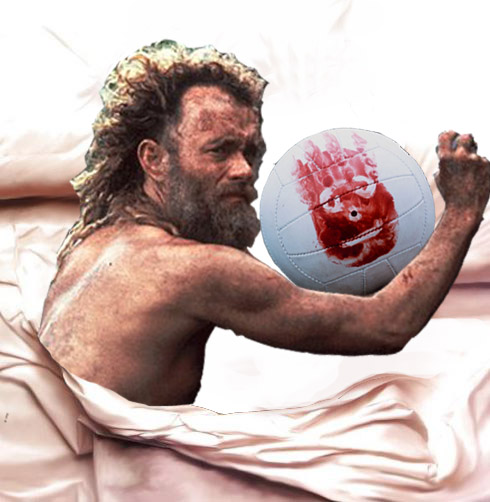
For a fleeting moment I felt like Tom Hanks in the movie Cast Away when Wilson (the volley ball) floats away and Tom can’t reach it so he sobs and sobs and sobs. I will forever miss that visor; we had some amazing runs and shared some great times together.

Tom Hanks in Cast Away with his Beloved Wilson
My other hard luck story involves my favorite baby blue t-shirt I got after finishing Ironman Austria in 2004, which in itself was a personal victory for me because I had to cancel on the event I was going to do with three other Flyers just a few weeks before the race due to an injury before finally redeeming myself.  On the bright side, I never lost it and am grateful that I still have what might be my favorite race t-shirt ever because of its color, its design, and its personal meaning for me.  But it’s long been riddled with holes throughout simply from wearing it too much, lifting weights in it too much, sweating in it too much, and running in it too much.  I believe that a lesson learned is to savor those things you love that offer some personal meaning or remembrance in your life.

It's Not Just a Runner Thing

So much for those crazy runners but what about “roadies” (i.e., cyclists) and their own habits, beliefs and superstitions?

The most common ones as you might guess are to talk about never “flatting” and of course then going out on a ride and actually getting a flat.


Others involve such important priorities as when is the right time to shave the legs before a big race, mounting a bike from the left vs. the right, never washing a race jersey while you're winning races or riding exceptionally well, never hurling a “loogie” from your left nostril over your right shoulder, and never ever getting a bib numbered “13”

This article would not be complete without including one more species of athlete….the “triathlete” or as the roadie cyclist might say a cyclist's “dysfunctional cousin.”

What strange customs abound in the triathlete’s world of aero bikes, helmets and wheel sets? Do we take the prize in “weirdness” because we have to perform not one but three different disciplines all in the same race?

Not a ritual but a mantra I have used in every Ironman I have raced is to repeat to myself  “It’s Showtime” as I’m nervously peeing in my wetsuit while waiting for the mass swim start of the race to begin. I find it helps me to focus a bit more.

Or are triathlete’s so Type A or so tightly wrapped in Lycra and compression wear that we are beyond any weirdness, ritual or superstitions?

Well…….NO not really as here are some samplings from some assorted racing forums I have read:

  • Don’t let anyone touch you on the morning of an Ironman except other triathletes
  • Always have race kit washed and hung up to drip dry the night before the event (guilty here)
  • Always say "thank you" to the volunteers (a case can be made that saying thanks is event-universal)
  • Pump tires in pre-morning darkness while squinting at pressure gauge so as not to…well you know
  • Make sure to touch the finish line three times the day before the race
  • Always mount the bike with the right leg
  • And, like our road cyclist friends…..when do I shave my legs?

The closing here is that there isn’t a closing and that superstitions or rituals abound whether you are a marathon runner who will only use a particular anti-chafing ointment or a baseball player who spits in his hands. They may possibly define us and can even add a measure of  “order” or a discipline that has become as common as the discipline or practice of running has become in our lives. Maybe the superstitions help us on some level.  Maybe the only differences are how weird yours might be viewed to the world vs. my own, but if it helps us cope with pre-race anxiety or serves our objectives in ways that work only for us, then let weirdness rule and may the athlete within always reign.


Keep calm and run like hell my friends J

-Scott C

Read more...

Wednesday, January 2, 2013

New Flyer Linda Chan

Linda C
I am a little over one year short of being a born and bred New Yorker and Brooklynite.  At the tender age of 13 months old, I emigrated from Hong Kong to the United States.  For me, there is no other place like New York City.  I recognize that I am very much one of “those” New Yorkers who don’t really think anyone else is a New Yorker unless they grew up here or at least have been here for 25+ consecutive years.  

My mom will tell you that I was an early walker and that I was a speedy toddler running everywhere.  Well, beyond my formative years, my running stalled.  I was educated through the New York City public school system and while we had gym every day in school, I don’t remember ever having run a mile at any time while I was in school.  Running was always doled out as a chore or a punishment in gym class.  At some point in my adulthood, I started tuning into television coverage of the NYC Marathon. I ran a race here and there in my early 30’s, but really with no running at any other time.

In 2009, I ran the NYC Half Marathon.  I have no recollection as to what possessed me to register for the race (it was the last NYC Half that was held in the summer and the last one for which there was no lottery for entry).  Before race day, the longest distance I had run was about 7 miles a couple of weeks earlier as part of my “training” – I had actually planned a 6 mile run, but missed my exit in Central Park and ended up running an extra mile.  I may have run two other times in the weeks preceding that, probably no more than 4 miles each of those two times.

Am I naturally talented and required little to no training to run my first half-marathon? No.  I was just determined.  I enjoyed the race, but it was a long slow race for me.  Running down the West Side Highway, I turned back more than a few times to see if the “sweep” bus was coming behind me.  Only when I saw groups of runners still behind me was I reassured that I would not be picked up by the bus (maybe it’s a car, I’ve never seen it and hope I never do).  I finished the race and started having thoughts about running the NYC marathon. 
NYC Half 2009

Me and Meb!
I was on Central Park South when Meb Keflezighi came in to win the 2009 ING NYC Marathon, ending a long drought of Americans winner of the marathon.  That day I fell in love (or was it just a crush?) with the NYC Marathon (and Meb).  I signed up for the lottery for entry to the 2010 NYC Marathon and started looking into what was required to actually train to run a marathon.  I didn’t know much about running, but I knew enough to know that I needed to train to run and finish the marathon.  Luckily, I did not win the lottery.  Instead, I got an extra year to wrap my head around running the marathon and completing the 9+1 requirements.  In the extra year I had to train for my first marathon, I took some NYRR running classes and ran the nine qualifying races for guaranteed entry.  

Sometime in 2011, I started to think of running clubs, but I did not join any clubs.  I did start to “stalk” the Flyers’ Facebook page and what I found were runners who supported one another and who were active in the community.  While I found the Flyers to be much to my liking it still took me a while to join.  I admit it, I may be commitment phobic – I don’t even belong to a political party and I’ve been voting a lot longer than I’ve been running. 

I’m happy to be a Flyer and hope to become more involved with the club socially and as a runner representing the club.  I hope to run more regularly and learn from my fellow club members. I was registered to run the 2012 NYCM, and didn’t get out to run a substitute marathon.  The next big races that I have scheduled are the NYC Half and the Puerto Rico Marathon.

I live in South Brooklyn, but spend almost all my waking hours in Manhattan.  Other than running, I enjoy knitting and karaoke!  Anyone up for a tune or two?  Perhaps a Flyers karaoke outing?  It’s been a while and I need a fix – I’ve been singing (off key) in the street!  Oh, and if you want to learn to knit, I’m willing to give lessons. 

Thanks for having me.  If you see me in Central Park, give me a holler. 

-Linda C

Read more...

  © Blogger templates The Professional Template by Ourblogtemplates.com 2008

Back to TOP