Showing posts with label Trail Running. Show all posts

Monday, May 5, 2014

Trail Running 101

Papa Bear

by Papa Bear

The ABCs of getting off the roads and onto the trails 


A couple of Aprils ago I ran in a 10K trail race in the Bronx. Yes, the Bronx, just at the end of the No. 1 subway line. I had been coming back from some problems in my calves over the winter, so I was pretty far off my pace, but the experience was a tonic for both body and soul. The early spring forest, the weather, the (very modest) crowds and the sheer beauty of the experience — just wonderful!

Interested? Here's a few pointers for making the transition from the crowded roads to the decidedly uncrowded trails.


First, the Whys and Hows

I guess everyone knows the difference between a road and a trail. A road is something (probably) built for cars, it has a hard surface, but a uniform one (except for the odd pot hole in New York City), and although we hate to admit it, the uphill grades are rather mild. Trails were built (or often just "happened") for foot traffic, they're usually soft — but watch out for rocks, and the uphill grades can be pretty severe.
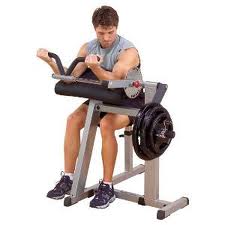
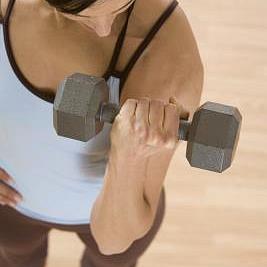
The differences affect our running and training. Think of road running as being like a weight machine in a Gym. Say the "curl" machine. You sit straight, you rest your upper arm on the support, grab the lever and do your reps "just so". The lever will only go in a nice smooth arc. The machine is designed to exercise just those muscles for which the machine is designed. Running on roads is a bit like that.

Trails are more like free weights. With free weights you get no help in posture or specificity. Your arms can move every which-a-way. The peripheral muscles that control lateral movement and balance are suddenly engaged, and you might even injure yourself if you're not careful. Running on trails is more like that. 

But the flip side is you'll develop stronger calf muscles from the effort of taking off from soft ground, stronger ankles and foot muscles and generally much better balance. And that's to say nothing of how much easier it is on your joints without the pounding your knees and ankles get from the roads. 

It's somewhat like comparing a good runner with a good basketball or volleyball player. You may be fitter on the roads than you college buddies, but if you join them for a pick-up game in the gym you will be very, very sore that night! Not so, if you're a trail runner. 

Now, the simple ABCs for getting started

  • A: Use the bridle path

    I've been running on the Bridle Path in Central Park as much as I possibly can for probably 25 years. Folks occasionally tell me "Oh, I can't run there — I have weak ankles". Balderdash! The whole point of running there is to strengthen your ankles and your overall balance. And they're so well trodden and flat (except after a downpour) that it would be hard to stumble or trip. (Secret: I have managed to stumble and even hit the ground hard once or twice in my 25 years of Bridle Path running. Don't tell anyone .)
    Of course the Bridle Path is hardly what you would call a trail, but it may be your first step off the roads, and it's right here in Central Park. Just watch out for all the horses. BTW: if you live in the outer boroughs, you'll find bridle paths in Forest Park, Queens, Prospect Park, Brooklyn, and Van Cortlandt Park in the Bronx (actually, no bridle paths there, but there's an old rail trail, and an even older aqueduct that will suffice).

  • B: Do cross country races

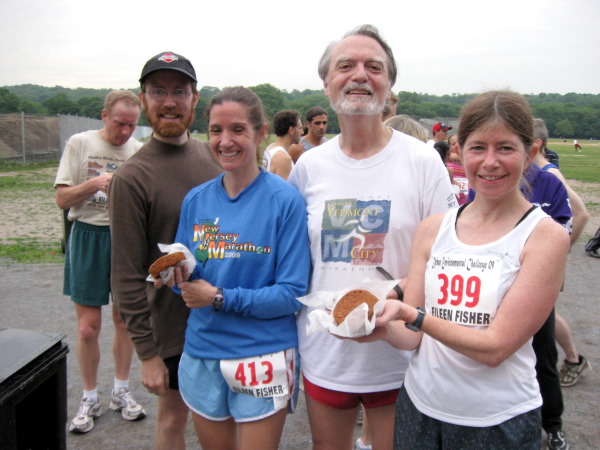
    Some of the best cross country races in the country take place in Van Cortlandt Park, a subway token (or a metrocard swipe) away. High schools and colleges have been taking their teams there since before you were born (even before I was born!). The NYRR has a series of 4 or 5 races every fall, but I think the best races are on warm summer Thursday evenings — the Van Cortlandt Track Club summer 5K series. Why? they are smaller with a more "small town" flavor, and instead of winning medals, you win carrot cakes. And besides, the people running them are really nice.
    I 've included a description of the series with some background information below as told to me by Fred Daly, the Race director.

  • C: Run and race on easy trails

    Cross country courses are not trails. They'r really just soft roads that are narrower, curvier, and steeper tha then your average roads. Trails, on the other hand, are trails. Narrow, sometimes rocky, very curvy, and occasionally very steep. I give some routes on local trails below that are good for beginners once you want to move beyond the bridle path and cross country.

    And lastly, I describe what I consider to be the best starter trail race around (in the words of Jill Staats, race director). The VCTC Urban Environmental Challenge 10K Trail Race. It's short, it's easy, it's easy to get to, and it's fun.
    Just do it!

The Local Scene

The local running club at Van Cortlandt Park puts on the summer cross country series, every other Thursday evening in the summer (the "B" of the ABCs), and the Urban Environmental Challenge (the "C"), a trail race in April. 
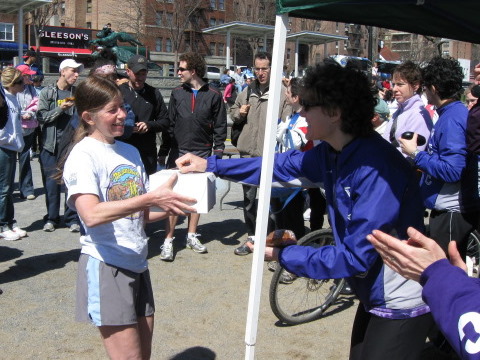
Susan S. takes home a carrot cake
These are possibly the best introduction to trail running, and they're just a subway ride away. You are not likely to see more that 150 runners in any of these. They’re all hand timed and scored. The carrot cake and carrot muffin are the prized awards, and it’s all a volunteer effort. This is the Real Deal!

I've run all of these over the last 5 or 6 years and I'm not looking back. 

A couple of years ago, I asked the race directors of these races (actually, 1 races and a race series) — whom I've gotten to know well — to give us a glimpse of the inside story of putting on these races. The Trail 10 K is coming up on April 13th and the cross country series starts in late May, so get training and some Thursday evening, come on up to the Bronx and enjoy your introduction to cross country — the "B" of the ABCs of trail running. Note: the directors of these races have changed since this report was originally written, but the fun hasn't changed a bit.  Enjoy!

The VCTC Summer 5K Cross Country Series
by Fred Daly, Race Director
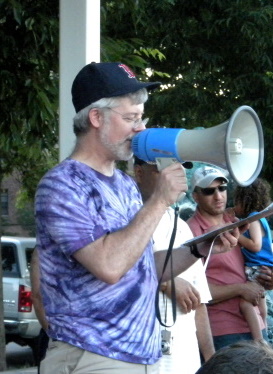
Fred Daly,
Race Director
I think the first year for the x-c series was 1999, but it might have been 1998. It was the brainchild of Bob Velez, who since moved to Puerto Rico, though he still shows up once in a while for the race. I took over ten years ago or so. 

All those years, Otis Matthews and I teamed at the registration table, and Bill Smith handled everything else — water, course marshals, etc. I have always thought that Otis was the guiding spirit of the series — his calm, low-key manner embodied the atmosphere we wanted. I love the series because there's a kind of community feel to it. Somehow the muffins are a symbol of the ethos of the thing. They were Bob's idea. I think it's neat that we hand out muffins instead of medals or trophies, and that we charge only $5.00.

Some carrot muffin winners among the Flyers
A couple of times in the past folks in the club have wanted to make a bigger deal of the 5K series, and I've resisted. We don't need or want 400 runners, and we don't need it to be a cash cow for the club. Scoring by hand is a little stressful, especially on a wet or windy day, but I prefer it to spending tons of money on an electronic system.
In the first years we'd have maybe 40 runners at the start of the summer and build to about 80. For a long time, 100 was basically our max. In recent years it's gotten bigger; the first two this year were about 140, which makes me a little nervous because it might mean we'll have huge fields at the end. The most we ever had was about 210. 

What else is interesting? One of the best features has been the participation of younger runners, especially the Rabbits Club from East Harlem. They missed last year (transportation was not available), but we got them back for the first race this year.

Link for the 5K Cross Country Summer Series (this still has last year's schedule, but I expect they will update it soon): Cross Country Series  

The Best Starter Trail Race Around:
The VCTC Urban Environmental Challenge
by Jill Staats
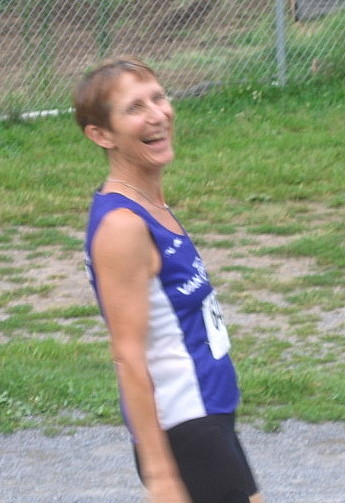

Jill Staats

This 10K trail race, as with the summer cross country series, is an easy race to put on. We do not need permits as you do to run the roads nor police to help direct traffic. I start in October and decide on a date early in April and apply for a parks permit. In January I get the application together, post it on the website and get it printed so we can hand them out. I start to work on the “give away” in February. In the past we have done bags and this year we did a great T-shirt. By the end of March the bibs are done, ambulance ordered, portable potties ordered and we are ready for the race. Our club is fabulous when race day comes. People just show up and the work gets done, there is no need for any anxiety. You could not ask for a better group of people to team with. 

Over the years we have had different sponsors for this race. Last year it was the clothing company, Eileen Fisher and this year it was Capital One Bank. We either break even or make a little money on this race. The “give away” items are usually the biggest cost. Lloyd’s Carrot Cake has sponsored this race since the beginning. We get 16 small cakes and 21 muffins as our awards to the age group categories.
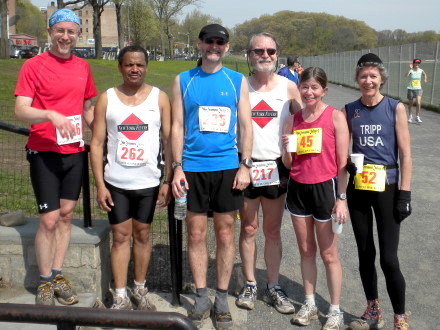
Flyers at the 2010 UEC
The first year I directed this race, it was the year of the nor’easter. I came close to canceling it, but because the high winds had died down, I decided to go on with it. I had 100 pre registered and 20 of those showed up. There were 40 people that came the day of the race and registered. I got the most emails that year from people telling me how much they loved the race. I think people that run this race almost like the weather to be bad. It was certainly challenging for a newbie race director. It didn’t stop me; I have done it now for 4 more years. I have loved doing it and my favorite part is the day of the race and everyone coming together to make it happen. That is the great part of being a member of the Van Cortlandt Track Club.
Link for the UEC 10K trail race: UEC Link  
  

Some Easy Trail Training Routes:
1) Old Putnam Line and Old Croton Aqueduct Loop

This loop (about 6 miles) goes through some of the parts of Van Cortlandt Park and Westchester that you will likely never see. Marshes, woods, old aqueduct structures built in the 1840s, and the lovely Tibbets Brook Park, not a destination for the average New York City runner. The route starts at the south end of VanCortlandt Park on Broadway, a couple of blocks north of the 242nd Street subway stop. 

A Note on the Slideshows: the slideshows come from Picasa Web Albums (a free service) and don't allow much control for embedded albums.  The rep. rate is 3 seconds and the show keeps looping around when you reach the end.  You can slow them down using the control at the bottom of the screen and just kill the window when it's looped around (unless you liked it so much you want to watch it again).

The Old Putnam Line in Van Cortlandt Park


  • Enter the park and head past the old mansion. Bathrooms are available at the nature center.
  • Continue across the south end of the field on the track. Enter the woods at the path where the track turns left.
  • Go down the path through the woods about 20 yards to the old Putnam Line — a straight dirt path which was formerly a rail line.
  • Go north on the path. After about 1.5 miles, you will enter Weschester County where the path is paved and is known as the South County Rail Trail.
  • Continue north to Tibbets Brook Park, a paved path to the right just after a bridge.
  • Go north on the park road to the bridge over the brook, just before the last lake.
  • Circle all the way around the lake (clockwise) and head up the hill to your left, on the path just after the bathroom at the southeast corner of the lake. This climbs several hundred yards to the Old Croton Aqueduct, a level straight dirt path. This is the original aqueduct from Croton to New York City completed in 1848.
  • Head south on the aqueduct about 3 miles. The Aqueduct will disappear and you will find yourself on a rough paved path. This will drop down to the right and follow the Mosholu Parkway south, for about 1/4 mile and then head up to the left.
  • The rough path will end at the north sidewalk of the Major Deegan. Turn right and cross the overpass where the Deegan crosses over the Mosholu.
  • At the west end of the overpass, the sidewalk will disappear and an old stairway will be on the right. The top of the stairway is fenced off. Go around and down to the golf pathway below.
  • Circle around to the left (don't go under the Deegan) and follow the golf pathway to the Golf House.
  • Cross the road and head straight west on the path through an underpass, and continue along the south end of VanCortlandt Park, arriving back at Broadway at your starting point.
It's much easier than it sounds — here's a map of the route: Old Putnam Line — OCA loop

2) Riverdale Park

This a a great little park in the Bronx, and is a largely undiscovered gem. It goes along the Hudson River from a little north of Spuyten Duyvil, up to the Riverdale Train station at 254th Street. It's rolling, but not really hilly, and is very scenic, with views across the Hudson seen through the trees. 

Link for Riverdale Park: Riverdale Park
 
Riverdale Park overlooking the Hudson


Here's a brief description:
The route starts at 225th Street and Broadway on the Bronx side of the Broadway bridge, underneath the 225th Street No. 1 subway stop, aka Marble Hill. You can walk the first part, on streets, but hey! why not run.
  • From the Bronx side of the Broadway Bridge, go left on 225th Street for 1 block.
  • Go right on Marble Hill Avenue and stay on it as it bends to the left, and then back to the right.
  • Go left on 230th Street and go all the way to Irvin Avenue.
  • Go left on Irvin, which becomes Johnson and go up the long hill.
  • On the way down the far side of the Johnson Avenue hill, approach the Henry Hudson Bridge far overhead.
  • Continue on Johnson, which becomes Palisade Avenue at the bridge.
  • Stay on Palisade down and to the right. After about 1/2 mile you will get to 232nd Street with Riverdale Park on the left.
The trail route starts at the south end of Riverdale Park, on Palisade Avenue and 232nd Street 

  • Enter Riverdale Park at the opening in the fence.
  • Stay on the main trail and head north. Eventually you'll get to a street with a few houses.
  • Go right up the hill to Palisade Avenue; go left and pass by the houses, then reenter the park at the opening in the fence.
  • After about a mile, the trail will come out onto Palisade Avenue and Spaulding Lane will head up to the right. Palisade Avenue will disappear here.
  • Get back on the trail and continue through the park to 254th Street, about another half mile.
  • From here you can go down the hill to the Riverdale Station and take the train home, or up the hill and right on Independence Avenue to Wave Hill.
  • Link to detailed route map: Map (Note: this map shows an expanded route with an extra loop down under the Henry Hudson Bridge and a side trip all the way to the College of Mount Saint Vincent and back.) 

2) The Palisades

Palisades Park has a trail anong the top of the cliff, which is actually part of the Long Path, a trail that goes from New York City north to Albany. The Palisades portion goes along the top all the way to the State line, nearly 12 miles. Another trail called the Shore Path follows along the river far below. At intervals along the route, there are trails or roads connecting the top to the bottom, so lots of nice loops are possible. You can run over the GWB or take the bus to Fort Lee. From there you can do an out-and-back, a loop, or do a one way run and take the bus back. The trail is steeper and rockier than the others I've mentioned, but it is absolutely great training for trail racing or running in general. 

Link for Palisades Park: Palisades Park
Link for Palisades Park Maps: Palisades Park Maps
Link for bus along 9W (which stops near points on the Palisades): Route 9W Bus


The slide show depicts a loop I ran with a friend last year. After crossing the GWB, we followed the Long Path (along the top) to just past the road to Greenbrook Sactuary (A wildlife sanctuary run by a non-profit). We then took the Huyler's Landing Trail (marked by red paint blazes) which takes you down to the shore, where you can head back to the GWB either on the road or on the Shore Path. It's about 15 miles total including about 3 miles on the bridge. 

The Palisades on the Long Path at the cliff top

Distances given are from the start of the path on the Jersey side and are approximate. Add about 1.5 miles (each way) for the bridge

  • Cross the GWB, turn right where the bikers hang out, go under the overpass and enter the park via a pedestrian overpass signed "Long Path".
  • Head north through easy woods and meadows passing around Allison Park and St. Peters College after about 1.5 miles.
  • Continue north on the left side of the fence at St. Peters College, soon crossing the park road down to the Englewood Boat Basin. Continue with ocasional forays onto the highway verge, to the Rockerfeller Lookout at about 3 miles.
  • Continue through more rugged tarrain, crossing the Greenbrook road at about 5 miles
  • Turn right on Huyler's Landing Trail (red blazes). Go down to the shore and head south either on the road or the Shore Path at about 6 miles.
  • Head south on the road (rolling hills) or path (rough and rocky), arriving at the Englewood Boat Basin (rest rooms, snack bar) at about 10 miles
  • Continue south on the shore path, which in this section is wide and flat, to Ross Dock at about 11 miles
  • Head south and take the park road about .5 miles to the start on the Carpenter Trail, Do not head up the exit road, stay on the road along the shore.
  • Climb the Carpenter Trail (370 stone steps) to the top, bear left and exit the park where you entered.
  • Total mileage about 12. Add 3 more for the bridge and back. See this detailed route map: Map. See also the Palisades Park maps linked above. 


Papa Bear


This post is adapted from a report on Papa Bear's web site: Beyond Central Park: Trail Running 101 , which in turn was adapted from an article in the April, 2011 NY Flyers Newsletter.

Read more...

Wednesday, May 15, 2013

Flyers May Monthly Trail Run With More to Come

Felicity L
I recently had the notion that it would be fun for there to be a monthly Flyers Trail Run, so I decided to organize the first of a series of monthly trail runs, including with a sign-up page on the Flyers website.  Other Flyers liked the idea, and so on a warm morning in May, a group of ten intrepid Flyers woke up at the crack of dawn and headed out of the city to check out the running trails in Rockefeller State Park. The park is just a quick 40 minute drive north of the city (or if you’re not lucky enough to have Dave K and Eric F volunteer to drive, about 50 minutes from Grand Central Station on the Metro-North Hudson line train). 

Dave K, Debbie P, Anagha A, Eric F, Bill S, Russ S,
Felicity L, Luiza S, Meg B and Francesco P
This park was born in 1983, with land donated by the Rockefeller family, and has more than twenty miles of carriage trails. The carriage trails are an excellent introduction to trail running as they are relatively smooth and even, and the hills (though constantly rolling) are not steep.

Russ S, as our designated navigator for the day, met us at the nearby high school parking lot, and led the group on an 8 mile run, reaching the park via the OCA trail. The OCA (Old Croton Aqueduct) trail follows the route of the old aqueduct, which carried water from the Croton River in Westchester, down to NYC, using only the force of gravity. 

Russ S Leads a Few of Us as We Spread Out
Into Casual Pace (i.e., Chatting) Groups
There is not much of the aqueduct system that still remains today other than some stone ventilators and other support structures here and there, to remind you of the 41 mile system that once existed. After leaving the OCA trail, we had a quick ramble through some farms en route to Swan Lake, which is more or less the hub of the park, with a variety of trails branching out in all directions. 

Part of the group headed back to the car via the Overlook Trail, and part of the group added on a 5-K loop beyond the lake before heading back. We all reunited back at the parking lot behind Sleepy Hollow High School, where Debbie P treated us to some amazing (and well-deserved!) homemade banana chocolate chip cookies before heading back to the city. Another amazing run with an amazing group of Flyers!

Anagha A. Snatches a Cookie Before the Group Devours Them All
As Debbie P and Eric F Look On With Smiles
(Having Already Consumed Quite a Few!)
If you missed this one (or if you were there!), save the date June 22 for the next Flyers trail run!

-Felicity L

Read more...

Wednesday, April 10, 2013

The Tobacco Road Marathon and other Rail-to-Trail Marathons

Kathy K
On Saturday, March 17th, I ran the Tobacco Road Marathon -- a beautiful, tranquil rail-to-trail course in the Raleigh-Durham area of North Carolina. 

The race features both a marathon and a half-marathon.  What makes the event special is that more than 20 miles of the marathon are run on the American Tobacco Trail. 


Photo: traillink.com
(Erie Canalway Trail: Little Falls to Albany - Mohawk Hudson Bikeway, New York State)
Rails-to-trails is a nationwide network of recreational multi-purpose public trails and paths created from former railroad corridors. The trails can be unpaved or paved. They are most often flat or follow a gentle grade, they traverse urban, suburban and rural America. They are ideal for many uses, such as bicycling, running, walking, cross-country skiing and equestrian use.  The Rails-to-Trails Conservancy reports that there are 20,000-plus miles of rail-trail throughout the country, and more than 9,000 miles of potential rail-trails waiting to be built.

I have now run the Tobacco Road Marathon twice.  Raleigh-Durham is an easy city to get to from New York.  There are frequent non-stop flights, and the price is usually reasonable.  The weather is comfortable, and it is  easy to get around.  The host hotel, Embassy Suites, Raleigh-Durham Research Triangle, is a very nice hotel with an airport shuttle.  The expo, held at the Embassy Suites, is good for a small race.

The race organizers and volunteers do a good job at setting up the races, and of providing support (water, Gatorade, GU, medical and enthusiastic cheers) along the course.  I like running on the flat, packed unpaved course. To me, the scenery is lovely.  I don't find it repetitive or boring.  I think its cool to follow historical paths. Most days of the week, I'll gladly trade the hoopla of the big city marathons for the serenity of a peaceful trail marathon.


WOW!!!
I've run two other marathons that took place largely on Rails-to-trails: The Mohawk Hudson River Marathon, in upstate New York, and the Deadwood Mickelson Marathon in South Dakota.  Both were beautiful and memorable.  I think that I would like to run some more rail-to-trail marathons.  Below are some links for websites for Marathons that are run on rails-to-trails.  It is only a beginner list - feel free to comment below with more links. 

Please click HERE if you'd like to read my full report posted on my blog.

-Kathy K.

Blogmaster's Note: Kathy, as a travel and running blogger, is competing in a KLM contest so please check out her entry and "like" it if you like it so that she may win -- you can click here for the link to her contest entry. -Dave K

Read more...

Tuesday, October 30, 2012

The Paine to Pain Half-Marathon – My Birthday Race

Richard G
Friday, October 12th, was my 70th birthday. Yes, 70! At one time it was almost scary to say that number, but not anymore. I'm on track, moving along and doing fine — after all, that is what this blog is all about.

My son Peter came down for the weekend and together with my wife Joy, we had a nice quiet celebration on Saturday at a fine local restaurant. But Sunday had been reserved months before for my birthday race, the first in my new age group. And I made sure it was the kind of race I have grown to love over the last decade or so: a true small town race held in beautiful environs. And even better, it was close by, a mere 35 minutes by car on a traffic-free Sunday Morning. Here's the web page: Paine to Pain Trail Half-Marathon. This was the fifth running of the race, but if you read through the history of the race on the web site, you'll see establishing the race was a labor of love stretching back over a decade. 

The Thomas Paine Statue near the Start
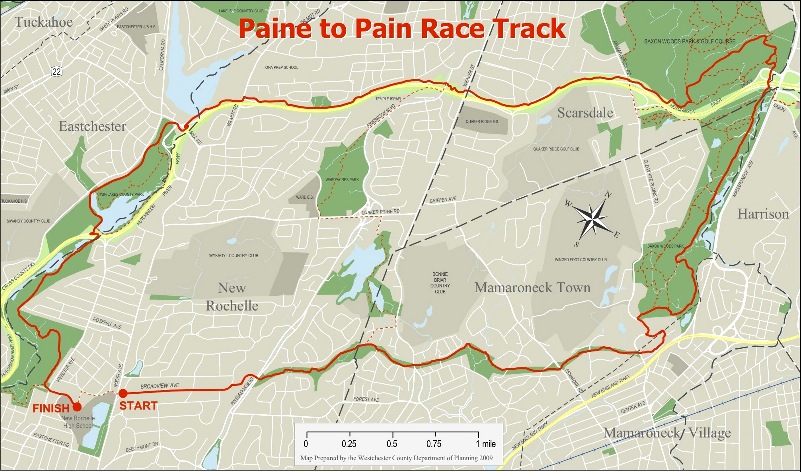
The race is a true trail race, mostly on one-track trails and is laid out over town and county parks in New Rochelle (the start and finish), Mamaroneck, Scarsdale and Eastchester. There's a few sections on roads, mainly to get on and off the route and to connect the segments together. Considering these upscale towns, which epitomize suburban living, you might ask "where would you find 12 or 13 miles of trails in that area?" Well, you can. Look at the following map (click Here for the full size map):


We got to the start area near the Thomas Paine Cottage in New Rochelle a little before 8:00 AM . The sky was cloudy with just a hint of sprinkles and with temperatures in the 60°s — perfect running weather! Peter and I walked over and I picked up my stuff at the registration table. As we walked back to the car, I met up with Gabby, an old friend whom I had not seen in years. We both reminisced about the 2000 Vermont City Marathon where she qualified for Boston. I ran the last 5 miles with her to give her encouragement ("Am I going to make it?" "YES", "Can I slow down?" NO!). I ditched my extra clothes in the car and took a brisk walk of about a mile along the park on North Avenue. It never ceases to amaze me how awesome the New Rochelle High School is, seen across that lake. They certainly don't have high schools like that where I come from.

The race start was in waves, which means the runners were divided into groups of a little over 200 runners each. The waves went off at 5 minute intervals, and yes, the starting gun was really a colonial musket! I was in wave 2. Using waves reduces congestion, important at the start and even more so on the trails. Along with me and Gabby, Tim was also in wave 2 so we started together. The other member of the Flyers, Deanna, was in wave 1. I thought she had a shot a winning the race so she belonged in the front. 

Myself at Around Mile 2
The starting musket went off at 9:05, exactly on time and we all headed up Broadview Avenue. This is a long hill that rises about 100 feet in a half mile and is ideal for spreading out the pack. The worst thing they could do is would be to dump the whole throng onto the trail at the start. Soon after we crested the hill we hit the trail. This first trail section a long linear park (I've read it was destined to become a highway but that plan was scrapped). There's about 3 miles of rocky ups and downs interspersed with boggy areas bridged by long sinewy "cat walks". This is the most technical section of the route. Don't trip!

Next comes the longest and I would say easiest portion of the race — along an overgrown bridle path which follows along the south bound lanes of the "Hutch". This is the least "wild" of any section and occasionally goes along the verge of the highway and crosses a few entrance/exit ramps. Some of the motorists were not amused. Unfortunately for myself, although the going got easier, I didn't pick up much speed as I felt pretty worn down from the prior sections of the race. The occasional walking I did on a few inclines were disheartening (although my friend Susan pointed out that occasionally walking may actually speed up your overall pace).

Deanna Cruising at Around Mile 12 
The last section of the race goes through two parks which contain reservoirs for some of the surrounding towns. In Eastchester it's called Twin Lakes County Park and back in New Rochelle it's called Nature Study Woods. These are quite beautiful with wooded sections and a section that follows a stream. If your legs had some power left, this is where you could really cruise. Well, mine didn't and I couldn't. I barely averted a dissaster near mile 12 when I tripped and nearly fell. I staggered for about 6 or 8 steps trying to get my feet under my body, which I just barely managed. I really needed a breather there so I walked and got both my breath and wits back. 

Then it was out of the park, along a short section of a city street, onto the high school track and across the finish. I surprised myself that my finish time was actually slightly better than when I ran the race 2 years ago. What with my walking and my near fall, to say nothing of the fact that I was less well trained, I hardly expected that.

Deanna, Tim, myself and Gabby after the Finish
My finish time was 2:14:17, which got me 2nd place in the 60+ year old group. 60+ year old group? What happened to 70? Well, most races have few or no 70 year olds, so most just go with 60 and up. But it was an accomplishment that of the 10 men in this group, almost all in their 60s, I was second. Both the number 1 guy and the number 3 were just 60. I got a nice glass mug (and a fancy water bottle that I don't know what to do with). And I got a nice bit of recognition from the crowd when the announcer gave me the award and said "Richard is the oldest runner in the race, 70 years old".

Sure enough, Deanna was first woman overall and demolished the course record by over 7 minutes. Way to go Deanna! Meanwhile, we were all getting cold waiting around so after the final awards we were off to the car. 
Awards Winners
A word about the race folks: from the race director and the timing crew, down to the myriad volunteers, and to the New Rochelle pep squad which cheered us on, they were spectacular! You would do well to find a race with half this amount of enthusiasm and support.

Joy and Peter at Lunch
My son was heading back to Massachusetts, so we had a nice lunch in the diner on North Avenue. And then Joy and I got dropped off at the train station after we said goodbye to Peter. And to complete the picture, the sky had cleared and the sun was warming us up. A great start to my new decade!

(This account was adapted from a post on  Papa Bear's Running Blog Beyond Central Park)


- Papa Bear (Richard G)


Read more...

Sunday, June 24, 2012

Slip-Sliding Away


Reyna F
No, it is not Tough Mudder, although I might do that next. I am talking about something classic – trail running.  First let me tell you that I am not a trail running expert. For that matter, I am not even a running expert.  I consider myself a running newbie.  I started running sporadically when my son was born because pushing him in the jogging stroller was a great way to exercise. But once he could sit in the bicycle seat, I gave away the stroller.  That was the end of running until I decided to do triathlons five years ago.


I appreciate running as an efficient and minimalist exercise modality.  In less than one hour, I can get an intense cardio workout that is also bone building.  But don’t tell anyone: I would rather be biking, hiking, skiing, climbing… I probably shouldn’t say that to a bunch of runners. Please don’t kick me out of the club.  Why do I enjoy those sports? Because I love speed.  When I am cycling and skiing, I prefer going fast. What is the best part of going uphill?  It is the downhill on the other side.  Even hiking has this aspect.   When you see me hiking, it is a fast walk up and a speedy jog down. I feel like I am flying when running down a mountain.   Last month when I was hiking in Harriman State Park with my husband, an injured man asked about the fastest way down.  Charlie said, “Just follow her.” 


Since I started running regularly, I have stuck to the bridle paths in Central Park.  And I would dream about running on real trails.  This winter I did a long run through Van Cortlandt Park to Inwood Park, which whet my appetite for real trail running.  Jumping over logs and avoiding tripping on rocks makes the run much more interesting.  Then I found out about the Berkshire Memorial Day Marathon Trail Race.  It coincided with the bicycle trip I organize yearly for the New York Cycle Club (NYCC).  Would the cyclists be upset if I run instead of bike ride?  I have been going to the NYCC Berkshire weekend since 1989 and have been coordinating it since 2004.  I deserved to do something different.  So I signed up for the 15 kilometer trail run race on May 26.  I also had the option to sign up for the marathon the following day, but I wanted to ride at least one day with the club (good excuse!).

The day before the race was wet, and it rained the night before.  Fortunately, the day of the race was dry and warm.  There were 107 people in the race.  This was the smallest race I ever ran. I am used to the crowded NYRR races.  I enjoyed the camaraderie and competition of a small group.  We lined up and waited for the horn to blow.  I was in the back of the line chatting with friends when the boom started the race.  Lesson number one: In a small race, unless you want to run slow or don’t care about your time, move up as close as possible to the start.  Particularly when the clock and timing does not account for when you actually cross the starting line.


The race began on an uphill which caught many by surprise who did not pace themselves.  After 1½ miles it leveled out and then went downhill. Then uphill, then downhill, and so on. There were some uphills that were so steep that walking up was faster than running up.  And some of the downhills were so slippery you had to walk or else slip and fall.  At about five miles, there was a turnabout.  It gave me the opportunity to see the lead runners walk up the hill as I ran down it.  That made me feel better – If they can walk up, so can I.  Unfortunately, I passed one accident.  There was a young woman on the trail unconscious and being tended to by race volunteers.  I had no idea how they were going to get her out. An ambulance could not get through the trail.  Apparently, she regained consciousness and was walked out.  I don’t know if she was down because of a fall or a medical condition.  That is a danger of trail running.

Towards the end of the race, there was a one mile descent – I was loving it.  I took pleasure in running straight through the mud and puddles.  It was a good thing my shoes did not get stuck in the mud.  A friend told me that once happened to her.  She had to stop and put her muddy shoes onto her muddy feet.  That is another risk of trail running.  If we went barefoot, that wouldn’t be a concern.

At this point, I saw Tanglewood. Hurrah, the finish line is close.  I thought it was all downhill until the finish line. But I was wrong.  I had to run up a hill, across a field, then down again. No problem. I was almost done.  Then at 1:41:01, I crossed the finish line as the 7th woman.  I felt great.  It was much more difficult than the Brooklyn Half that I ran the prior weekend, but much more fun.  I went to stretch afterwards and as I bent over, I saw that my legs and sneakers were caked with mud. Being Tanglewood, there was a very nice and clean restroom to wash up in.  While cleaning up, I chatted with the #1 and #2 women who agreed that this race was more difficult but more enjoyable than the Brooklyn Half.  What surprised me is that they traveled to race in Brooklyn.  And they must have been surprised that I traveled to race in Stockbridge, MA.

We don’t really need to travel for trail races. Van Cortland Park has their Thursday night at the races (but they are only 5K). I am on the look-out for longer trail runs that are within one hour of the city. Who else wants to trail run and doesn’t mind a few rocks, logs and mud?


-Reyna F

Read more...

  © Blogger templates The Professional Template by Ourblogtemplates.com 2008

Back to TOP