Friday, July 31, 2015

From the Jersey Palisades, with Love

Oscar G
Late June 2015, without much pomp and circumstance, the New York Flyers held what could very well have been the 25th anniversary of its famed Palisades Interstate Park LTR. My sources tell me that founding members Jerry Flower and Ed O’Donnell organized the first run as early as 1990 (or maybe 1991).  

Rumor has it that in the early years Mr. and Mrs. Flower would throw a BBQ after the run in their place near the finish line. Since then, dozens of Flyers have stepped up to help keep this tradition going year after year. Although the Flyers online photo archive only goes back to the year 2000, a quick search turned up a few nice gems of organizers from years past.


Twenty five years later, the Palisades run keeps going strong. Nearly thirty runners braved rain and windy conditions to enjoy a touch of suburban running away from the weekend crowds of Central Park or the Hudson River Greenway. Five stand-up Flyers volunteered to staff hydration stations and to ensure all were safe on the course. Naturally, as dictated by our long Flyers tradition, the run was followed by brunch at nearby Cabrini’s restaurant.


So what makes the Palisade LTR so popular with Flyers and non-members alike? For sure the camaraderie and social aspects are a big draw, but that’s not necessarily unique to this particular event. What does make this run special is the striking natural beauty of the Jersey Palisades and the challenging elevation profile of the course. Let’s also not forget the George Washington Bridge, which most New Yorkers seldom have the chance (or inclination) to cross on foot. 


The run normally starts at the corner of Fort Washington Ave and 179st St, right on the steps of the Holyrood Episcopal Church and across the street from the GWB bus terminal. After a very short safety and information brief, runners are on their way with their chosen pace groups.  Within a minute or two, runners become part of a small minority of New Yorkers who know how to access the pedestrian walkways of the GWB.


Like many structures in large cities with long histories, the GWB is an unsung marvel of modern engineering. An estimated 106 million vehicles crossed the bridge in 2014 giving it the dubious distinction of being the busiest in the world. The original design called for its imposing 600 ft steel towers to be encased in concrete and granite, but cost constraints during the great depression forced engineers to alter the final design leaving the steel cross-beams exposed.

Crossing the bridge on foot affords participants a more intimate connection with a landmark we have all grown accustomed to view mundanely for its utility rather than its grandeur. The LTR gives runners unique views as they navigate the course across, over and under the GWB. 


On the New Jersey side of the bridge, the course turns south for about a quarter mile before entering the Palisades Interstate Park on Henry Hudson Drive then heading north along the Hudson River shore. The park was open to the public in 1909 as a result of what could be considered the earliest victory of environmental activism in the United States. Under pressure from civic organizations such as “The American Scenic and Historic Preservation Society” and the “New Jersey Federation of Women’s Clubs,” officials from both New York and New Jersey formed the Palisades Interstate Park Commission (PIPC) to stop the daily blasting of the Palisades cliffs by numerous quarries extracting gravel and building materials. 

The change in scenery is both dramatic and swift. The noisy bustle of the GWB gives way to a quiet and narrow country road. Mature trees on both sides of the road provide nice cover from the sun and offer but a glimpse at autumn’s early colors, especially when the LTR falls in late September as it did last year.


A mile or so after entering the park, the challenging nature of the course becomes clear. The first few miles feature mild (mostly downward) rolling hills, reaching water level at the Englewood picnic area, just past mile 4 on the course. The first significant climb follows, rising about 140 ft in only 3 10ths of a mile.  Fortunately, the first fluid station is just half a mile from the top of the hill in the Undercliff picnic station.  Anyone running 10 miles can hydrate, use the bathroom and turn back from this location.


The next aid station is located on mile 9. Volunteers provide water, Gatorade, gels, bananas and much cheer and encouragement. You’ll need it to tackle the next mile to the Park Rangers’ station. It is almost a 400 ft climb on weary legs. By comparison, Harlem Hill (counter-clockwise) climbs almost 90 ft in about a third of a mile. The timing of the LTR and the course was perfect this year for three Flyers training for the 2015 San Francisco marathon.

In summary, the Palisades LTR is a great event and the 2015 Palisades LTR #2 is scheduled for Saturday, September the 19th. It is easily accessible by the A or 1 trains. It offers a chance to run through a course full of history, natural beauty and one amazing feat of civil engineering. It will challenge you and help you improve your fitness level. I found it surprisingly rewarding to look back at the history of this event. It reaffirmed my belief in the club’s goal and activities. I look forward to another 25 years of fun running in The Palisades. Go Flyers! 

-Oscar G*

*Special thanks to Richard B and Tim D for providing historical information about the Flyers Palisades LTR.

Read more...

Friday, July 24, 2015

A Run on the Old Croton Aqueduct

By Papa Bear


 My Introduction to the "OCA"

I have had an interest in Old Croton Aqueduct (commonly called the "OCA")  for close to 50 years.  When I was a graduate student at Columbia in the 1960s I worked at a lab in Irvington NY and "the aqueduct", as we called it, went right through the property.  I asked about it but no one knew much about it.  So I went to the NY Historical Society and learned that it was built in 1837 - 42 and it brought water from the Croton River all the way to Manhattan. It ran almost entirely at ground level and was gravity powered.. So  I organized a few friends from the lab and we walked first from Croton to the Lab (about half way) and then another day from  the lab to Manhattan,  One problem was the aqueduct bridge over the Harlem River was closed to pedestrians.  And it stayed closed for some 50 years till this year.  But I was hardly idle all those years, I have run many miles on the OCA, particularly in Highbridge Park and in various parts of the Bronx, Yonkers, Hastings-on-Hudson, Dobbs Ferry, Irvington and Tarrytown. 

Fast forward to this year ...

The Reopening of The High Bridge

The High Bridge c. 1850
(click for large image)

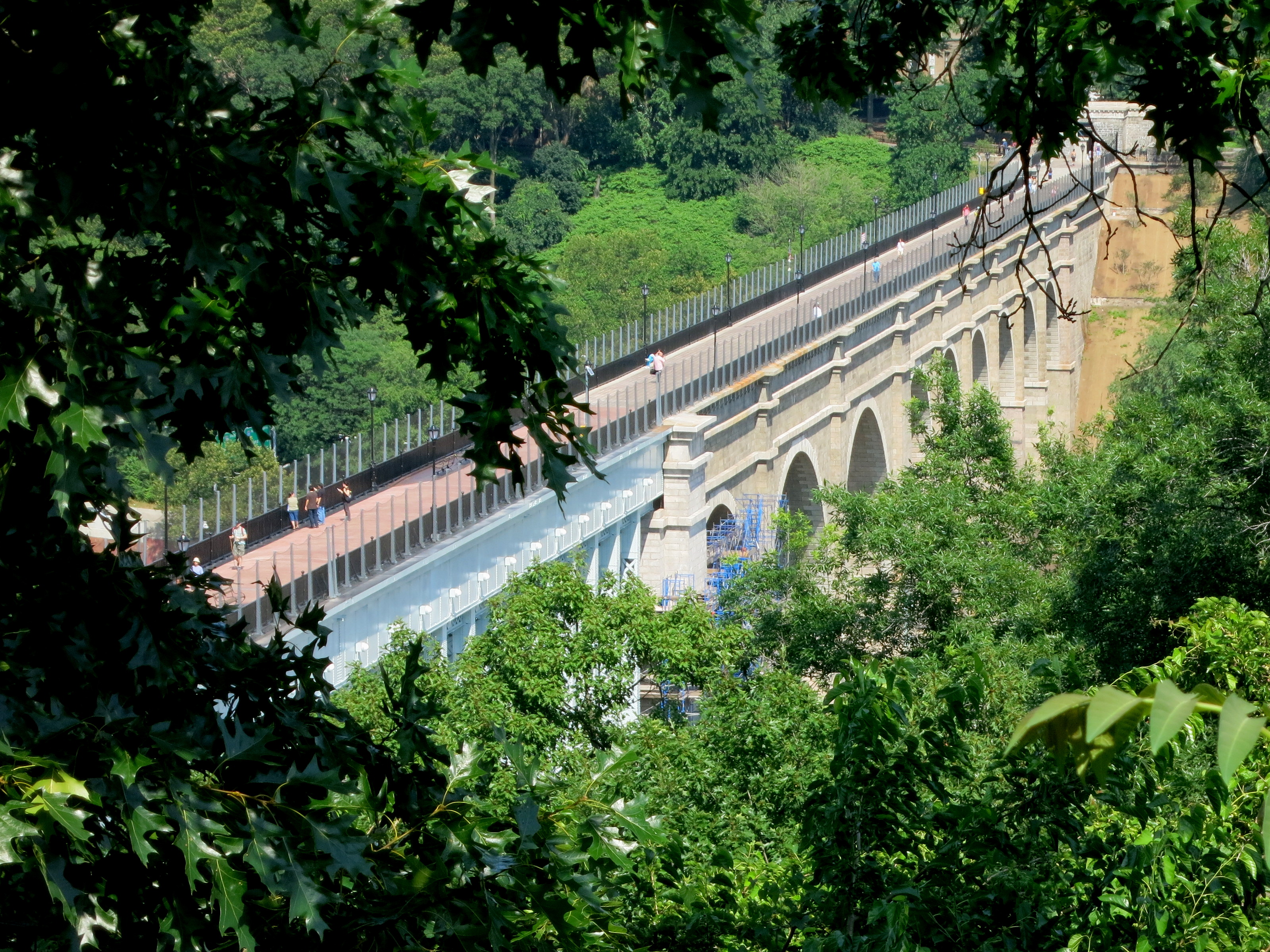
On Tuesday, June 9th, I left home about 7:45 to go up to Highbridge Park for the opening of the High Bridge. (A word on typography: the name of the park is "Highbridge Park"; the name of the bridge is "The High Bridge".) I was told there would be an opening ceremony at 9:00 and then we could cross the bridge for the first time in 50+ years. But when I got there about 8:40, it was already open and there was no ceremony. Oh well, whatever. It was a cloudy, drizzly day which was unfortunate since I wanted to get some good pictures. Too bad, we do the best we can.

There were just a few folks out on the bridge, maybe 30 or 40, and it was very casual. People took photos of others or themselves and we looked into every nook and cranny of the bridge. And the views — up and down the river the views were marvelous. I had seen the bridge many times over the years (back to the late 1960s), but always with a big metal gate across the entrance, and for the last 2 or 3 years with a construction fence and the bridge itself with scaffolding and coverings. But Tuesday was the day.

The High Bridge looking Down from the Top of the Stairs
(Click for Large Image)
I decided to intersperse my photos in the slideshow with a number of historic pictures all the way back to the 1840s. The pictures tell the story. What more is there to say? I went there, walked across and back and took a bunch of pictures. But the story actually goes back some 165+ years and you can be sure I'll be running over it in less than a week.  

The slideshow is a must for this post since some of these photos are worth more that a thousand words!  When it's done, close the slideshow tab and come back here.

When you run the slideshow I suggest you turn the rep rate up (or is it turn the rep rate down?) so you can take time to read the captions. The default is just 3 seconds. I find 5 or 6 seconds works for me.


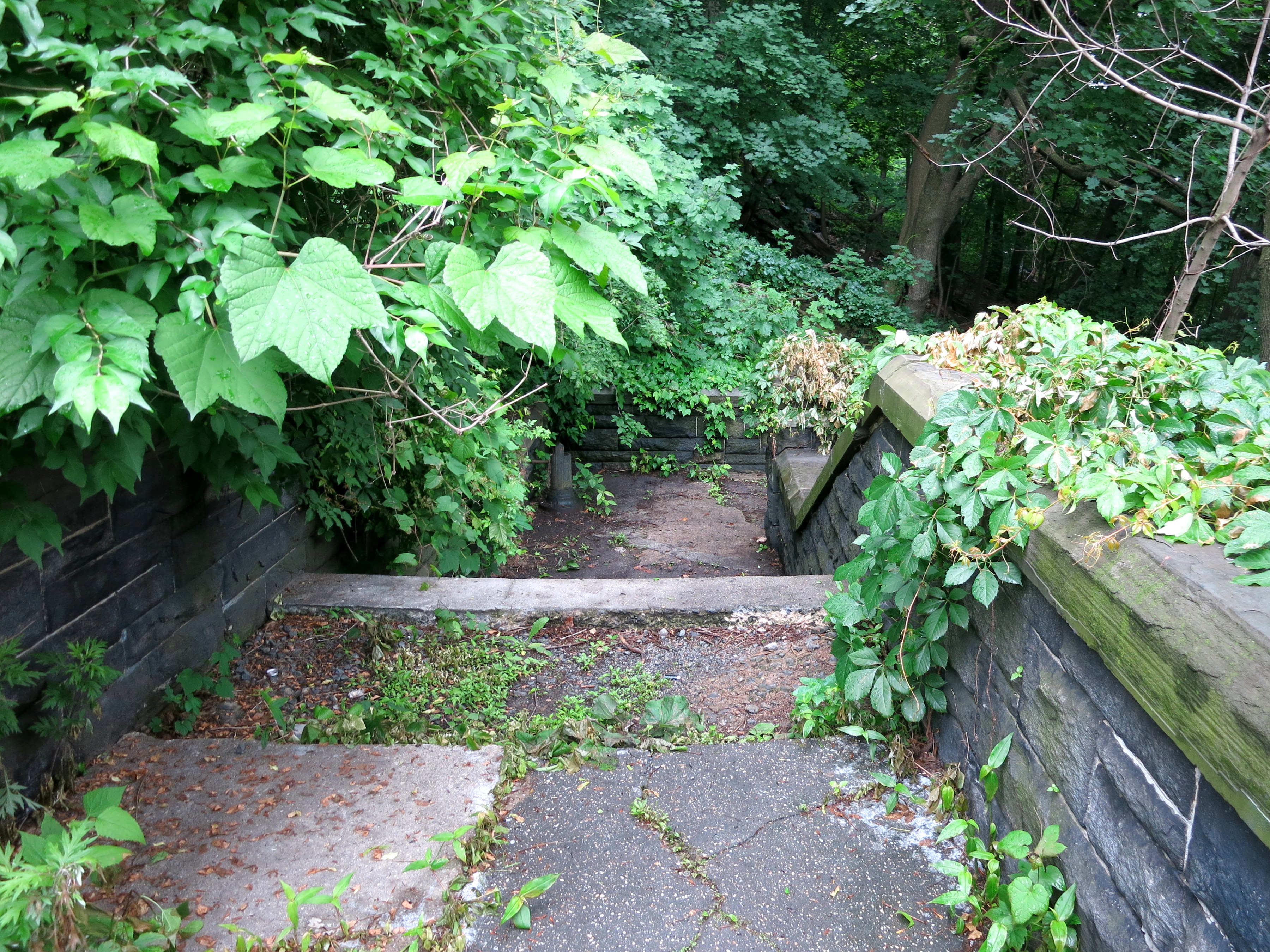
The Grand Staircase could use some work
But you might ask  since the bridge restoration was so beautifully done, what's with the "Grand Staircase" shown in my pictures. The Parks Department docents said that the stairs are on Department of Transportation land taken when the adjacent highways were built and they were hopeful that the stairs would be transferred to Parks which would fix them up. Hmm ...


An OCA Run from Highbridge Park to Van Cortlandt Park

Once I had done the bridge, I could not wait to do a run of the OCA, over the High Bridge, then up through the Bronx.  Van Cortlandt Park was a good target since I was in no shape to run much farther.  And besides since I planned to document it, it would pay to break it up into bite sized pieces (about 5 miles each) so others could put several pieces together as they wished.  So I did it — twice.

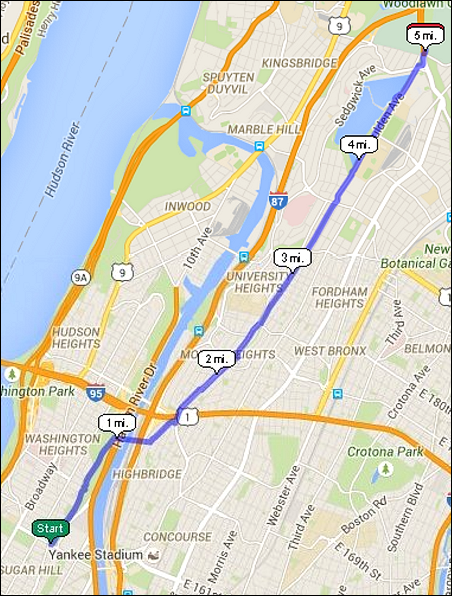
Click for the on-line USATF map
(click for large image)
I ran it first with Melissa the weekend after the opening of the Bridge, and again with Ed the following weekend.  Melissa and I started at 155th Street right where the OCA enters Highbridge Park and Ed and I started at the north end of Central Park.  The length of the run, not counting getting there or going to brunch after was just over 5 miles

I you look at the map at the top you might think that after crossing the High Bridge, the OCA follows virtually a straight line all the way to Van Cortlandt Park. Well, in 1839, it pretty much was a straight line. But in the meantime all the streets were put in plus 2 major bridges across the Harlem River (The Washington Bridge in 1889 and the Alexander Hamilton Bridge in 1963). So the details are worth a few words.

Two things will help 1) the map (next section, below) shows where we have to detour off of the original route and 2) the slideshow shows all the details. The slideshow is important since it show what the text can't easily explain.

Highbridge Park and The High Bridge

The first part is in Manhattan within Highbridge Park. Take the C train (NOT the B train) to 155th Street and when you get out of the station you are standing on the OCA. Then again you could run here, no? This is, after all only a 5 mile run. I've done it many times but for now I'll leave that up to you.
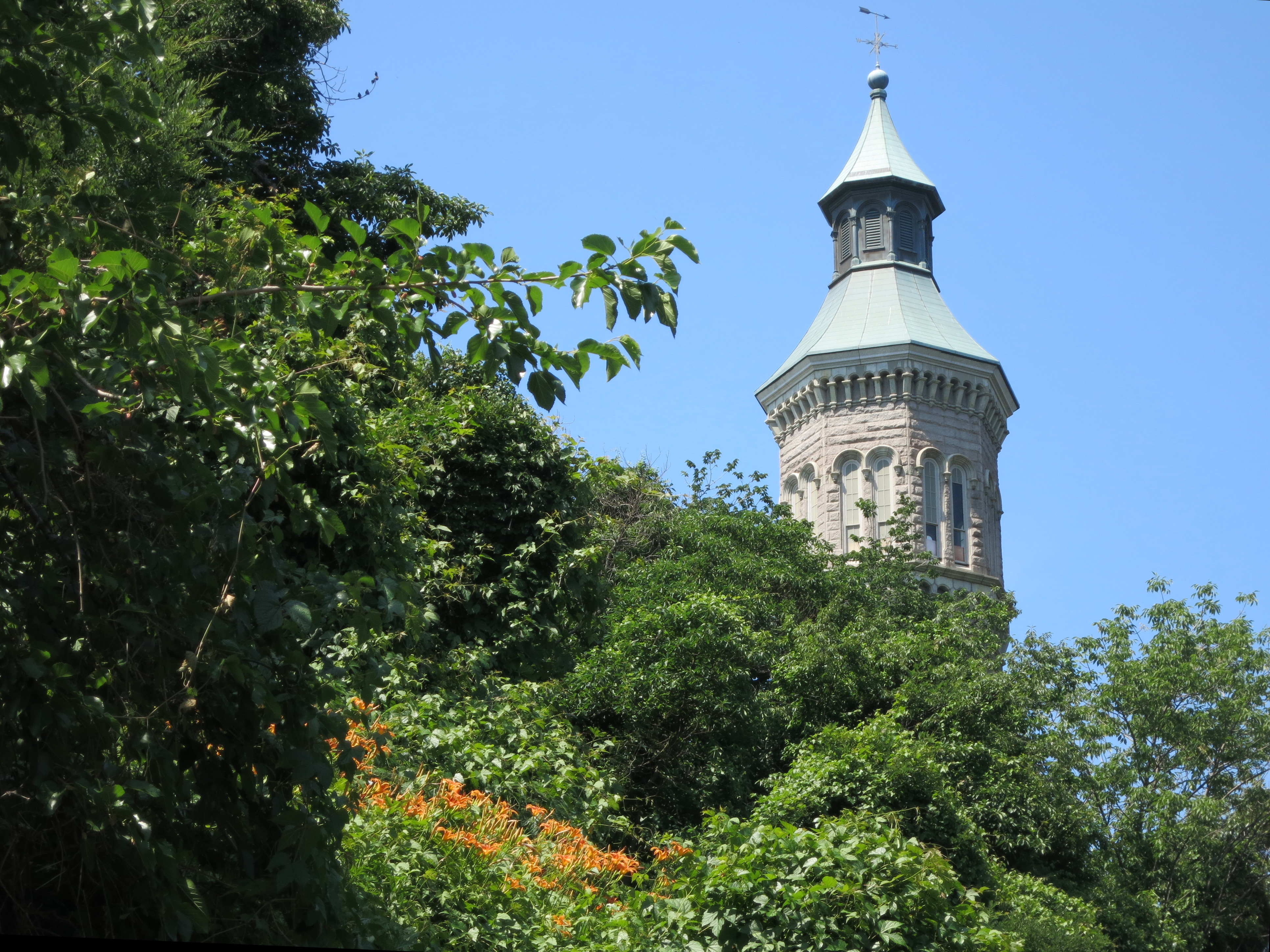
Highbridge Tower as seen from the OCA
(Click for large image)

The OCA comes up from downtown and crosses St. Nicholas Avenue diagonally and heads down along the west side of the triangle of green west of Edgecombe Ave. Cross over and you'll be on the sidewalk next to  Highbridge Park. After crossing a playground and stairs down to the bottom, get on the OCA opposite 158th Street. It's about a mile to High Bridge and the first half is on dirt. After a little detour around a rocky knoll, you'll get on a paved portion which also serves as a bike path. You'll know it when you get to the bridge since there will be lots of folks looking around checking out the newly reopened bridge. Cross the bridge and enjoy the view. You've never seen the Harlem River from this vantage point. Take a peek back at the High Bridge Water Tower which used to supply water to this portion of Manhattan. The slideshow show this portion as does the other slideshow above about the reopening the High Bridge.


University Avenue

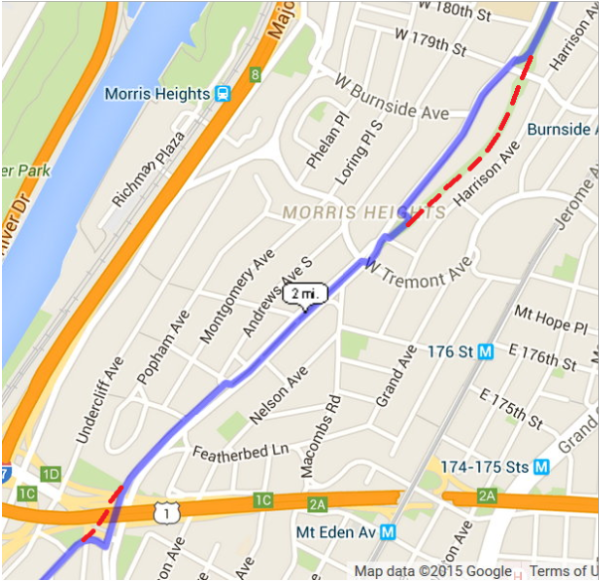
Original OCA path shown in red
(click for large image)
Once off the bridge in the Bronx, you'll be on University Avenue, originally called Aqueduct Avenue. The OCA follows University, mostly in the center, all the way to West Tremont Avenue. There is one detour around the Alexander Hamilton Bridge, shown on the detour map (left). And from about West 175th Street to West Tremont there is a little park along the center of the avenue which is right over the OCA. A little past Tremont the OCA turns east off of University (at the Morton Playground). This is the start of the Aqueduct Greenway but unfortunately the first section is closed. You'll have to stay on University one more long block to West Burnside where you can get on the Greenway.


The Aqueduct Greenway
(click for large image)


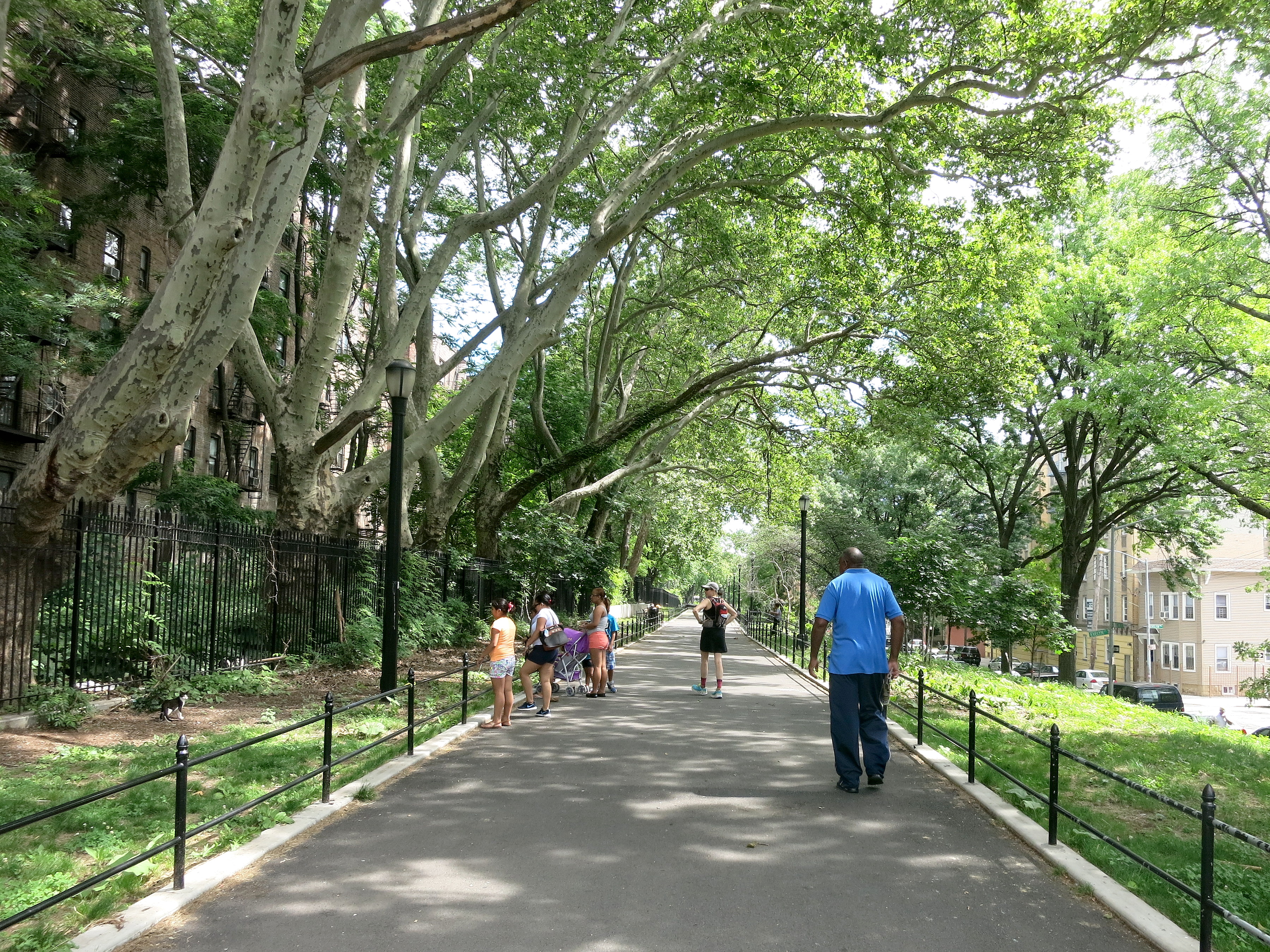
The Greenway is marvelous. Sources say it was originally laid out by Frederick Law Olmstead (see below). If you've never been on it, you will love it. There's 6 sections starting at Burnside Avenue (unfortunately we must skip the section between Tremont and Burnside). The last section ends at the Kingsbridge Road and you will see the 1911 Kingsbridge Armory across the street,


Reservoir Avenue and the Jerome Park Reservoir

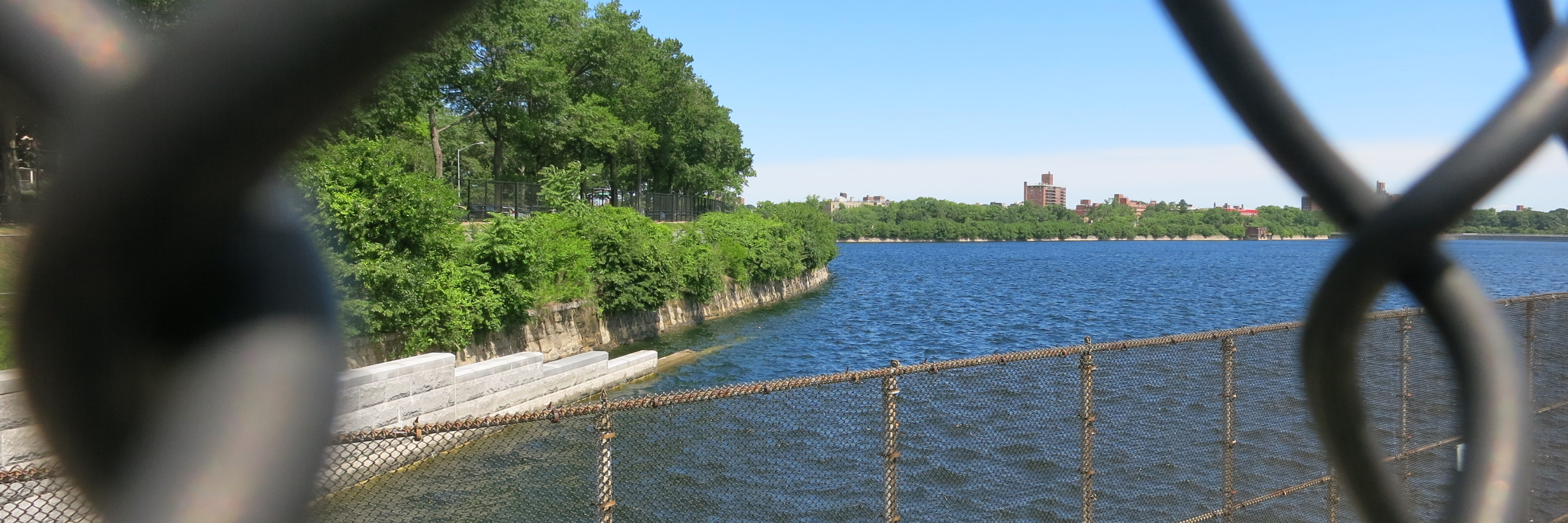
Looking through the fence at the reservoir
(click for large image)
When you cross the Kingsbridge Road you will be on Reservoir Avenue for a couple of blocks and then on Goulden Avenue. The OCA is buried along here in a wall that was originally planned to go down the center of the Jerome Park Reservoir but is now simply the east wall (see the section below on the details).  The OCA is under the walkway on your left, which has not one, but two fences to keep you out. The local neighborhood wants to open it up (like the Central Park Reservoir) but so far the officials are resisting. Just run along Goulden Avenue and enjoy. At the north end, you'll come to the intersection of Gun Hill Road and the Mosholu Parkway as it enters Van Cortlandt Park and this is the end of our run. See the slideshow or map to see where the next section begins.

Brunch

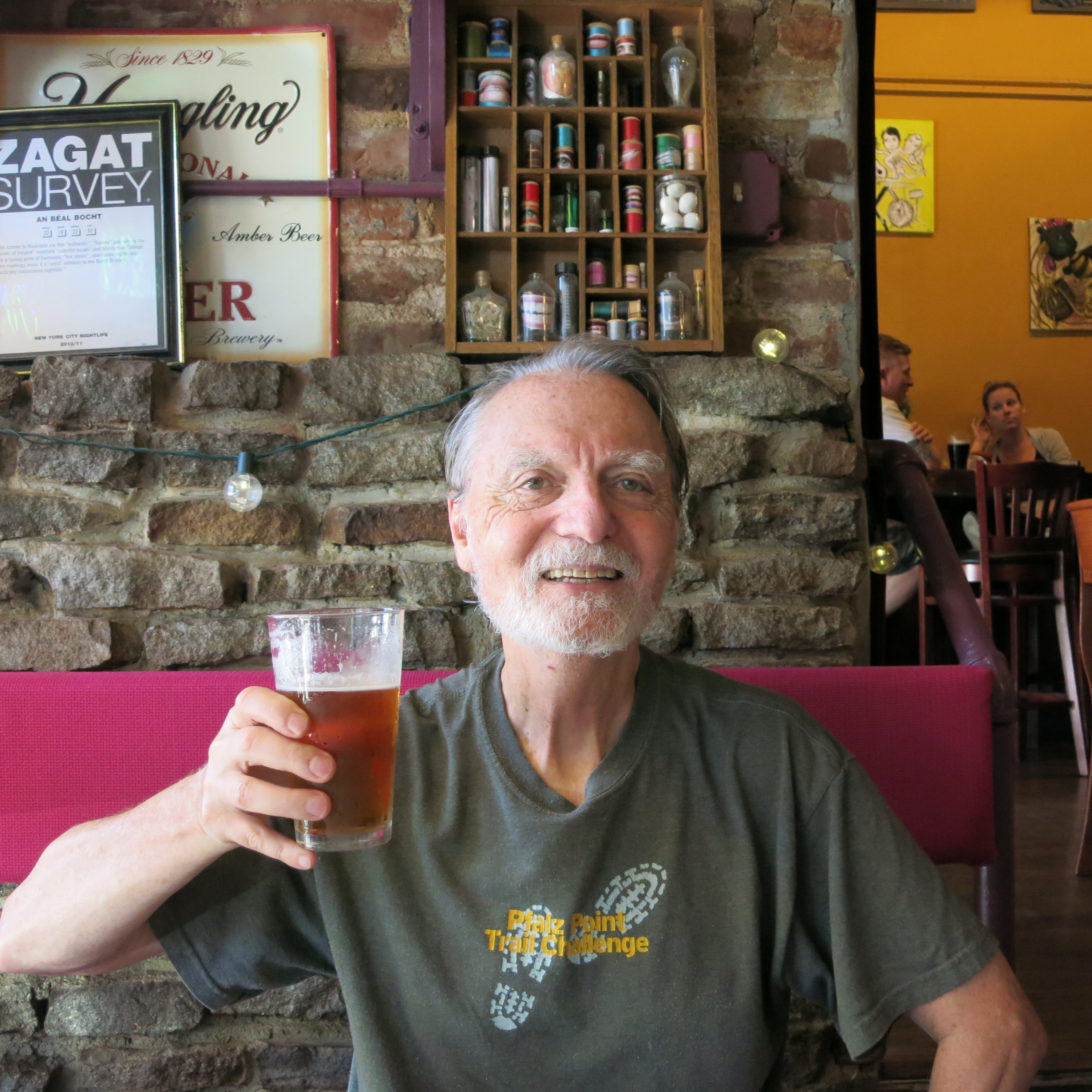
Followers of my blog will know that no good run ends without brunch. Why else would we run? So after we completed the OCA section (which ends at the southeast part of the park where the Mosholu Parkway enters the park — see the map), we followed a path along the south side of the park down to Broadway, and then down to 238th Street and up to An Beal Bocht - our Bronx favorite. Two pictures are worth 2000 words:
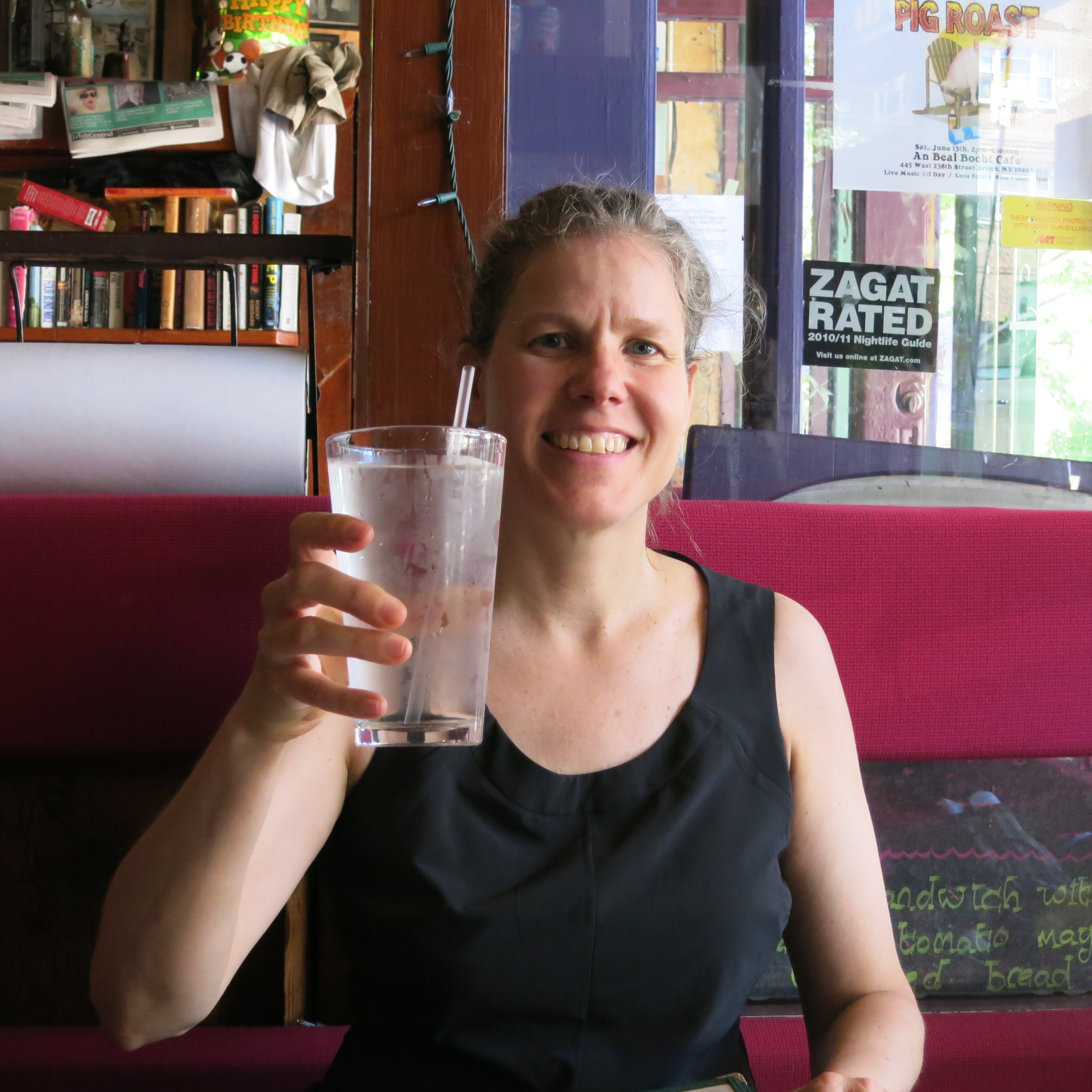

Melissa

Me


The OCA and the Jerome Park Resevoir

When I ran with Melissa we ran along Goulden Avenue which runs just to the west of the reservoir.The following weekend  when I ran with Ed, we went along the other side of the reservoir. I really never thought about where the OCA went, other than more or less in the north end and out the south end of the reservoir and ultimately to Kingsbridge Road, across from the Kingsbridge Armory. But some of the parkland along Reservoir Avenue (Ed's route) looked a lot like the OCA sections further south between Kingsbridge Avenue and the Harlem River. So I did a little research and found out a couple of interesting tidbits (see this) from the NYC Department of Environmental Protection (aka NYC DEP) web site.

First off, in the 1870s when this part of the Bronx became part of NY City, none other than Frederick Law Olmsted, one of the designers of Central Park, laid out a plan for the streets and parkland in this area. Much of that plan was accepted and the lovely streets and parks Ed and I discovered in our run west of the reservoir reflects Olmsted's design.

Then in the decades following, when the New Croton Aqueduct (aka the NCA) was being built and the reservoir was designed, it was intentionally fit into this plan.  I know, first we introduce the Old Croton Aqueduct, and now there's a New Croton Aqueduct!  Seems like NY City never has enough water.

1907 Plan for the Jerome Park Reservoir
(click for large image)
Olmsted's overall plan also included a linear urban parkway along the route of the OCA south of Kingsbridge Road (the Aqueduct Greenway), a gem that survives to this day. Who knew we had Olmsted to thank? Compare this to Manhattan where practically all remnants of the OCA south of Highbridge Park were entirely obliterated.

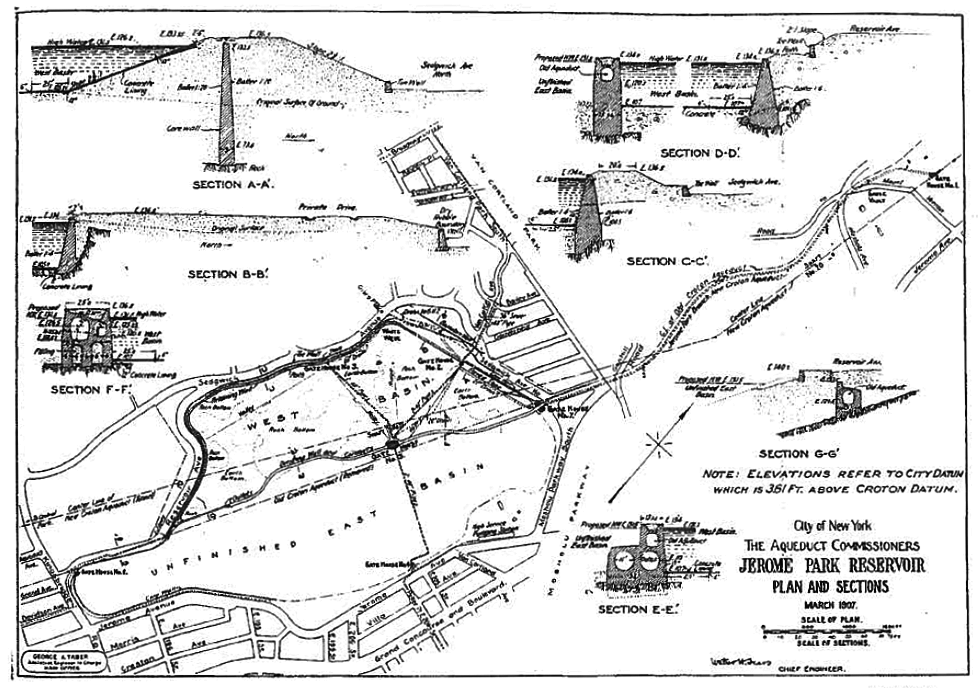
And lastly, the original plan for the reservoir was to have a portion east of the present day Goulden Avenue as large as, or larger than the portion actually built. See the 1907 design plan to the left. Due to politics and budgets the "East Basin" was never built and the land already taken was eventually given over to other city departments. So all the schools from Dewitt Clinton High School, Bronx High School of Science and Lehman College are sitting in the old East Basin. The unbuilt part was originally designed to go all the way south to Kingsbrige Road to the site of the Armory (built in 1912 after the East Basin plan was scrapped).So what was once a wall dividing the West Basin (built as designed) and the
The OCA and the Jerome Park Reservoir
(click for large image)
unbuilt East Basin is now simply the east wall of the reservoir.


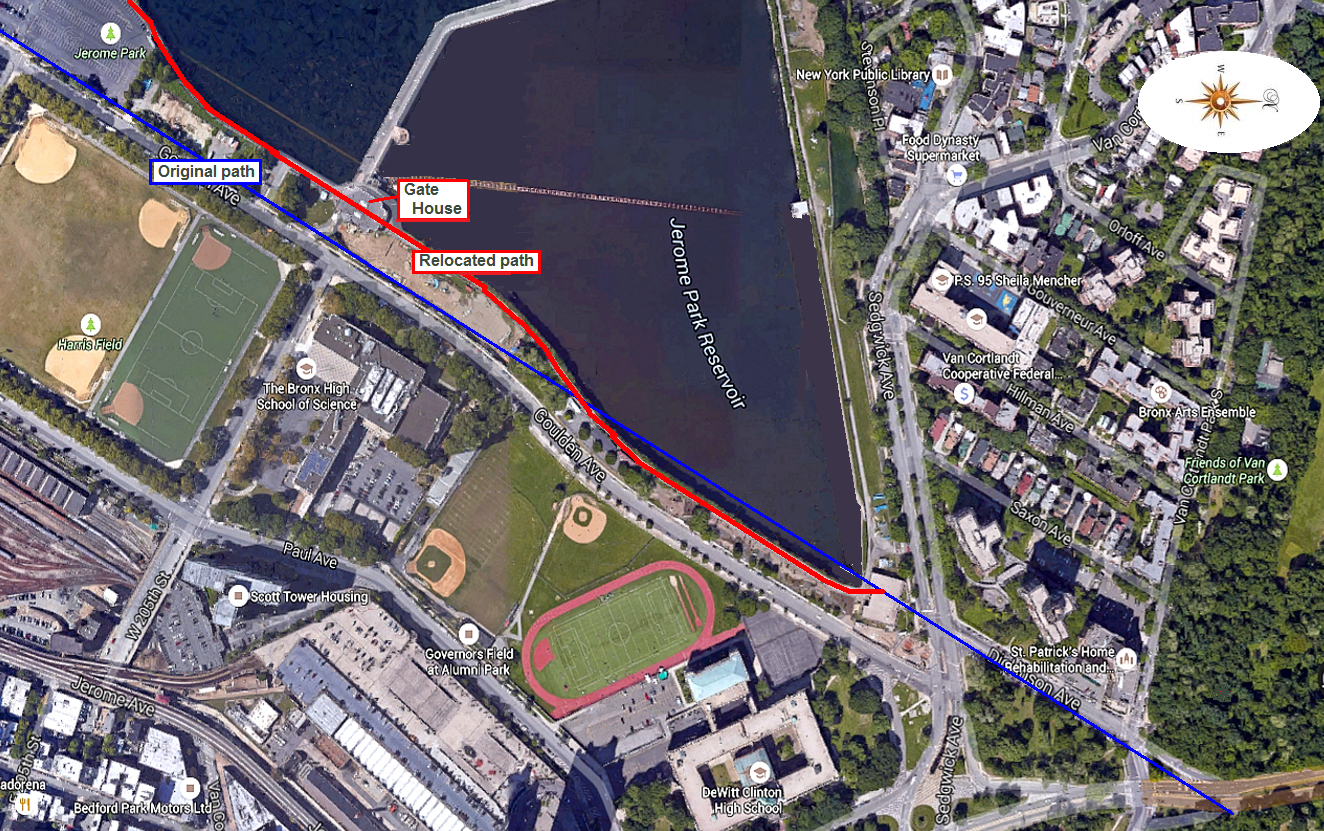
The OCA originally ran through farmland near where this wall was to be built, so they relocated the OCA slightly and put it inside the east basin wall, mostly to protect it. Look carefully at the 1907 plan above left and you can see the dotted line for the original OCA path and the East Basin wall built very close to it. Here's a Google Earth screenshot which I have annotated to show the relocated path of the OCA from the Gate House to Van Cortlandt Park: here (the original path is shown in blue, the relocated path in red). 

Jerome Park Reservoir Gate House
(Click for large image)
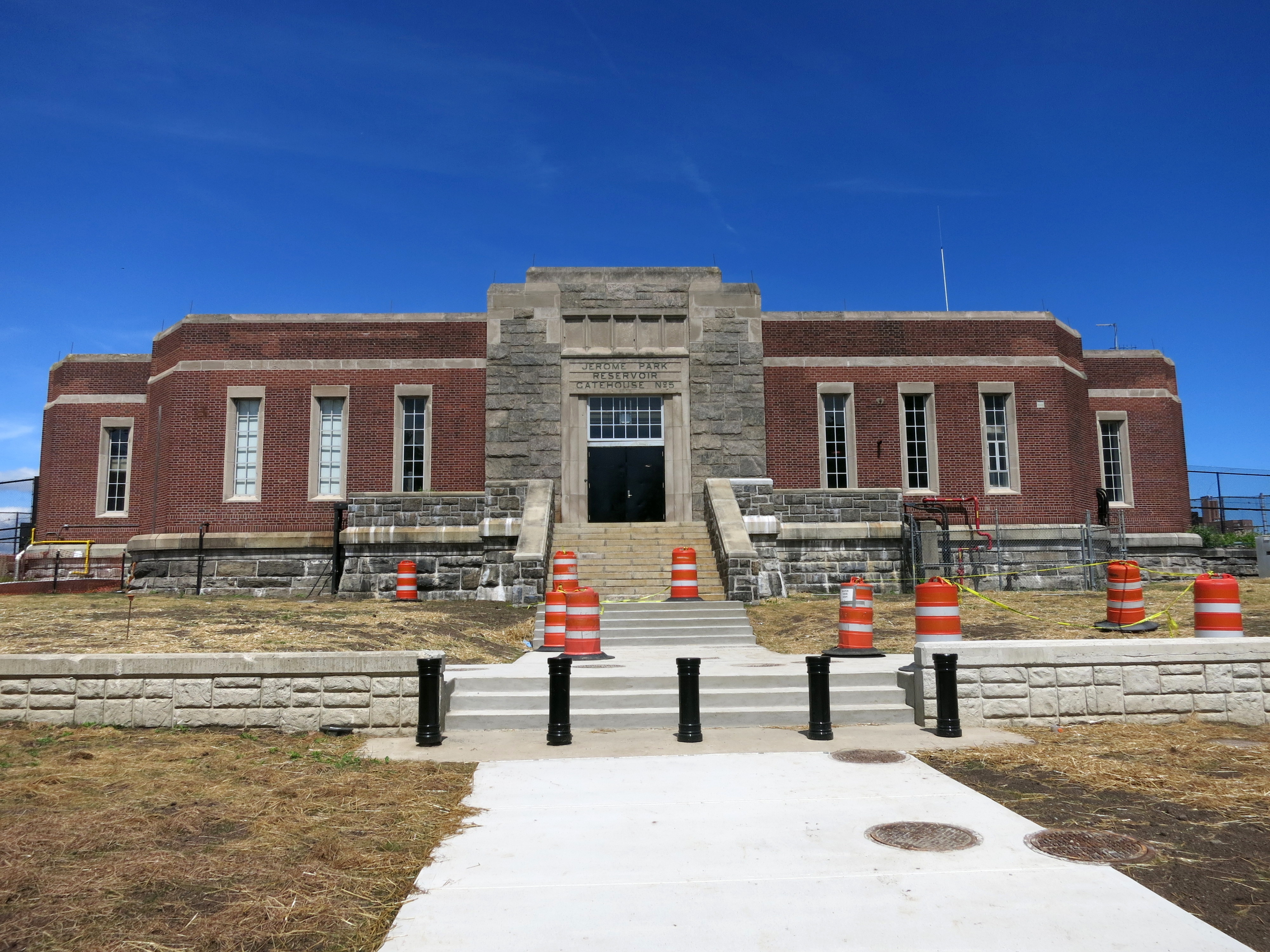
After the NCA's completion, the OCA would continue to serve as one of the major sources of water for the city and a backup for the NCA for close to 60 more years. So neither aqueduct just flowed in one end and out the other end, as I naively thought. They both entered and exited the reservoir through a gate house designed for that purpose (the gate house is still there, see photo on the right).

And for obsessives like myself who want to "get it right" when doing an OCA run, just running along the Goulden Avenue sidewalk is fine. Don't attempt to run along the reservoir wall. It's between two fences and you might get arrested as a terrorist, or at least as a wacko! Besides, in places the Goulden Avenue sidewalk is closer to the original path of the OCA anyway! 


That's me.  Come join me next run,
Papa Bear


This is based on material from Papa Bear's blog:
Beyond Central Park Running Blog


Read more...

Friday, July 17, 2015

THE GENESIS OF THE NEW YORK FLYERS

Jonathan Buck
Blogmaster's Note:  Last year was the Flyer's 25th Anniversary as a running club in NYC.  In honoring our long history last year, the Flyers Blog featured several posts from Flyers newsletters under the rubric "Flyers Flashback Fridays," dating back to 1992.  Today I'd like to share another piece, the following article from the July 1996 newsletter written by Flyers Co-Founder Jonathan Buck. that talks about the the forming of the Flyers. For prior posts under this category, please click HERE.   -Dave K, Flyers Blogmaster

Tim Kennedy and myself (Jonathan Buck) both worked at the New York Road Runners Club. Tim worked in the lobby handling phone calls and selling running merchandise. I worked in the library and often with race registration. 

We both worked at the New York Road Runners Club because it provided learning opportunities about the running business and more importantly -- the running community. We were both able to develop friendships with runners of many different levels and abilities. It became very apparent to both of us that all runners were very friendly and sincere people. One evening, 1 walked over to the sales desk and Tim seriously suggested the possibility of a new type of running club -- in essence, a club that would be open to all types of runners. 

Tim and I had discovered that manv clubs only lent themselves to fast, competitive runners, while shutting out average and slow runners. Our focus was then to create a club that would "promote the average runner", while still at the same time -- welcoming slow and fast runners. 

That evening, we joined the New York Harriers at a local establishment called "Kinsale" that still exists on the Upper East Side. After their nightly runs, the Harriers often gathered to discuss their running achievements and humorous moments. 

In many ways, they were a positive model for what a running club meant and how it should function. They were a fast running club, but more important than that, they were friendly to each other and even to other runners who were not members of their club. During that evening with the Harriers. Tim started to get very serious and focused about the function and structure of a more purposeful running club. 

We rebounded some ideas off the Harriers and then we embarked on our very own deep discussion. As the Guinness pints continued to evaporate, we were slowly able to put together a solid, strong, philosophical foundation. However we were stuck on one major obstacle - the name for our newly, founded running club. 

We spent the next few days brainstorming about possibilities. Finally, we decided on the New York Flyers because the first half of the name identified our proud community. The second half of the name described the sensation of what every runner felt, when they were running at their very best. 

Tim and I quickly spread the word and a week later we had our first meeting with seven new members. who were nicknamed "The Magnificent Seven". The meeting was held in The New York Road Runners' Library. Everybody was accommodated with their very own individual seat. 

It was an awkward -- and at the same time -- an exciting moment, because we really hadn't sat down to think about what we were going to say. Yet somehow, it didn't really seem to matter what we said, because what mattered that night was launching a feeling and a spirit about who we were and who we had the potential to be. Probably, the funniest statement we made that evening was "That some day we might grow to twenty or even thirty members". 

Never in our wildest dreams, did we expect the club to have over 300 plus members as it does today. However now it makes complete sense. because we were one of the few clubs who opened our doors to everybody no matter what their nationality, sexual orientation and most importantly -- their running pace. 

During the inaugural six months, the membership grew approximately from seven to fIfty members. After our first year, we had over 100 members. The single most important reason that we grew so quickly could be summed up in one word -- FUN! It was the key ingredient for our immediate success. We quickly created a yearly agenda that rewarded running with social functions. An incentive plan was mapped out for just about every possible social opportunity during the running calendar year. 

What personally impressed me was the fact that every New York Flyer had dreams and goals with respect to their passion for running. Many Flyers have transformed their dreams into memorable, concrete experiences. For example. the Flyers have not only run races in Central Park. They have run in races throughout the United States and throughout the entire world as well. We have never had any limits because as a club and a team. we are always searching for those experiences and interactions that will enrich us both as runners and as productive human beings. 

I have often thought about questions that other Flyers have said to me. They are complex questions, but they truly demonstrate the values of a reflective runner -- a runner who can think clearly and deeply while they run. 

How will we transform our positive running experiences into the more difficult schema of life? In other words, what can we give back to society from what we have learned through our most, meaningful, running experiences? How can we value and respect everybody's unique role and purpose in life?

When I think about my beginning running years, four concepts immediately come to mind. To some degree. these concepts reminded me of dialogues with other Flyers and their related experiences. 

First, I think about "fear" and how when many of us began running and especially when we ran our first marathons, many of us experienced fear about completing our intended running distances. Flyers have been known to share these anxieties with each other and thus transform this fear into a positive running focus. Second, I think about "PR"s or "personal records" and how as Flyers we share information and experiences that will extend our positive running focus. Third and fourth, I think about "self-esteem and confidence" that is not just restricted only to our running performances, but extends as well into our professional and personal1ives. 

I believe that being a Flyer teaches us to be a happier and more confident human being. Today. I still see all these processes and qualities evolving within the much larger Flyer organization. It is still a running club that believes in its roots and above all. It is the friendliest and happiest club in the New York City area. The New York Flyers has taught all of us about becoming leaders with our running and with our lives as well. 

Jonathan Buck

Read more...

  © Blogger templates The Professional Template by Ourblogtemplates.com 2008

Back to TOP