Showing posts with label Travel. Show all posts

Friday, April 28, 2017

A Trip to Washington DC for the Cherry Blossom 10 Miler (April 1st to 3rd, 2017)


by Papa Bear
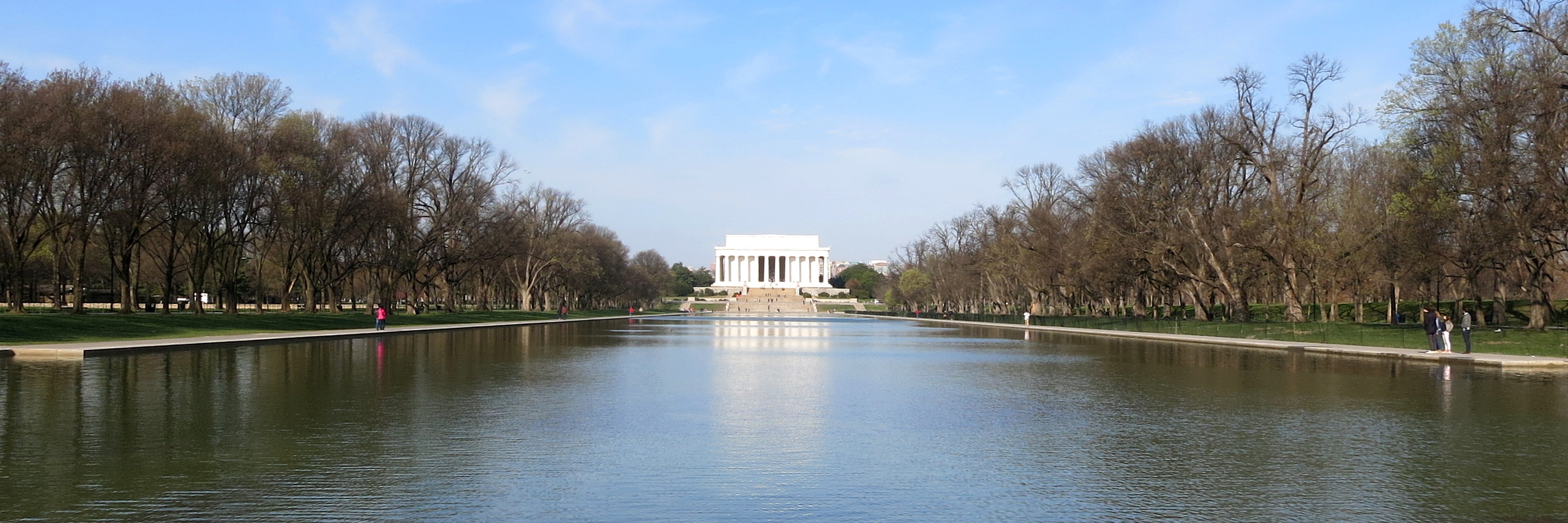

The Lincoln Memorial across the Reflecting Pool

Back to 1990

My 
first Cherry Blossom 10 Miler was in 1990 when there were a couple of thousand runners and a very informal organization. I don't remember if the starter said "go" or there was a horn, but it was typical of the good old days. This year there were over 17,000 participants and like a lot of races nowadays it was highly sponsored, well marketed and well organized. There were a number of corrals (something unheard of in 1990), and I think the announcer said that my corral had it's own sponsor — "The Orange Corral, sponsored by so-and-so, will be starting in two minutes". But you know what? I loved the race in 1990, and I still love it today although my pace has slowed about 3 minutes a mile. Ouch!

For the last several years my friend and running partner Susan and I had registered as a "group" so in the lottery we would both get in or both lose out. You have to apply for the lottery in December, so you do it on "spec", hoping you'll be ready and able to run the race. I was a bit under-trained when April came around, but Susan had sustained a knee injury about 3 weeks before. But she soldiered on and figured she'd just do the best she could.

Besides, we don't go only for the race — there's lots of sights and scenes in Washington, including good (but affordable) restaurants, museums, historic sights and even the ballet at the Kennedy Center (yes we went: The Little Mermaid, sad but beautifully done). And we always try to do it on the cheap: bolt Bus ($35 round Trip) and staying in the HI Washington D.C. Hostel ($43 per night).

Saturday

We took the 7:30 Bolt Bus and got to Washington around noon. We then took the "DC Circulator" bus to the Hostel ($1), dropped off our stuff and tried (but failed) to get dinner reservations at Capitol City Brewing, a favorite of ours (we tried again on Sunday night and got in with no waiting — everyone had left town!). So we walked to pick up our race packets at the National Building Museum (a beautiful structure inside and out) which was the race head quarters.

From there we walked down to the Mall and checked out the United States Botanic Garden, new to me and quite lovely — but not a match for our own NY Botanical Garden in the Bronx.

We then trudged back up the hill to one our favorite restaurants: Busboys and Poets, a must for you if you should visit Washington. To quote from their website: "The name Busboys and Poets refers to American poet Langston Hughes, who worked as a busboy at the Wardman Park Hotel in the 1920s, prior to gaining recognition as a poet." It is more than an eating place, it is a performance space and venue for many progressive happenings and is devoted the ideal of an egalitarian and inclusive community.

So, we had a long bus ride from New York, did quite a bit of walking, picked up our race packets, visited the Botanic Garden and enjoyed an excellent meal at a unique restaurant — AND — we had a 10 Mile Race to run early the next morning. The best thing to do would be to get back to the Hostel and to retire early to bed, yes?

No! Susan had bought tickets to a ballet (The Little Mermaid) at the Kennedy Center, way out on the west side of town and it started at 8:00 that night and we didn't know how to get there. So we got back to the Hostel, changed into our going-to-the-Kennedy-Center clothes and waited for a bus. It didn't come for 10 - 15 minutes, so we gave up and took a cab. Hey it's like a vacation, it's OK to take a cab!
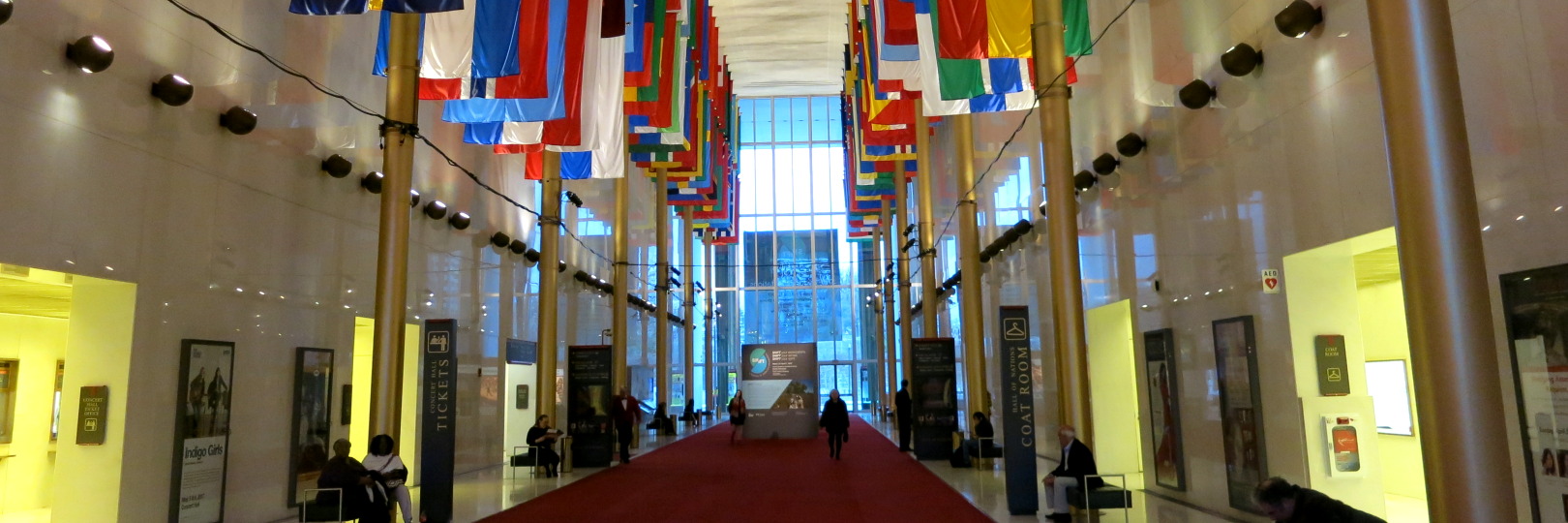
The Kennedy Center

We greatly enjoyed the whole experience, even though it's a dark tale. It was brilliantly danced by the troupe and although I thought I would fall asleep and was tempted to go home (and to bed) at the intermission, we stayed till the end and enjoyed the beautiful ending. We "ran today's race" from New York to the Kennedy Center and finished very satisfied (and took another cab home). Would we could do it again Sunday in the 10 miler!

Sunday Morning
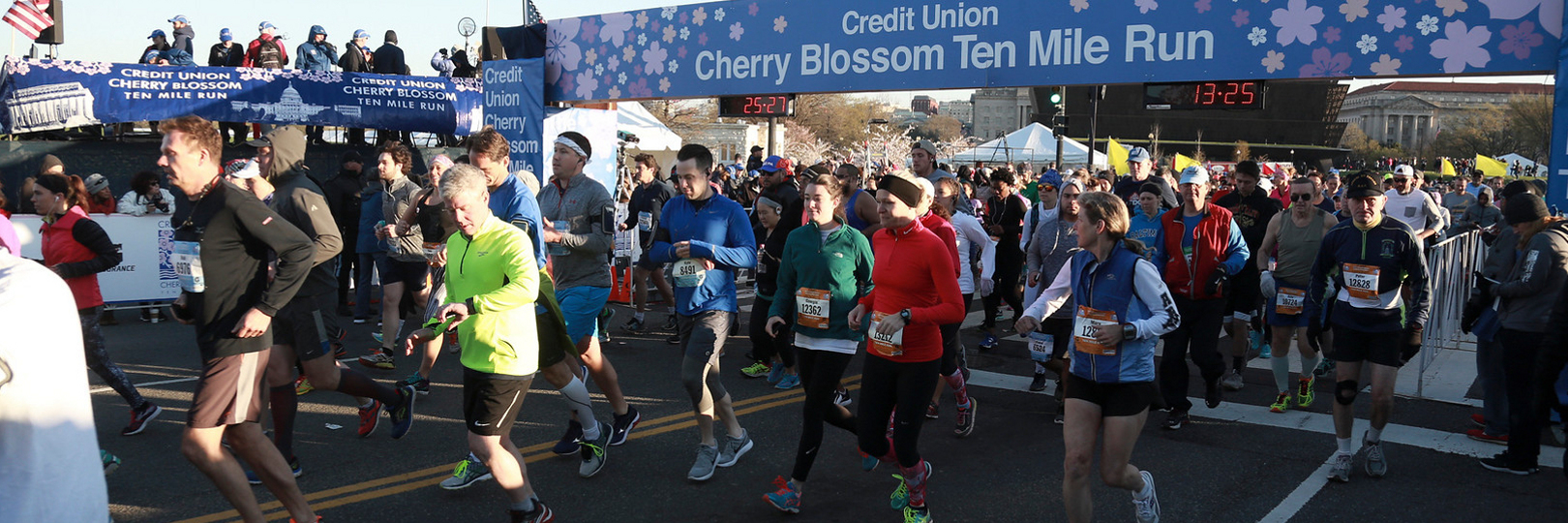
 
The Start of the Orange Corral

 Cherry Blossom
10 Miler
Mile Split
1 10:41
2 10:21
3 10:21
4 10:21
5 10:25
6 10:22
7 10:17
8 10:20
9 10:08
10 9:59
Finish 1:43:15
Pace 10:20

I met Susan about 6:45 in the kitchen/dining room. Breakfast was not officially served till 7:00 but we could at least get some coffee which is available at all hours. John, the manager of the kitchen, was setting up. We had chatted with him on Saturday and he knew us from previous years and had actually fetched some food for us (an apple and a muffin).

The elites didn't start till 7:30, so we back-of-the packers had plenty of time. My corral didn't start till about 7:45 and Susan planned to get at the very back of the pack, so her cut off to get down to the race start was 8:00 or something like that. I said good bye and started out about 7:20 and made it down in plenty of time to squeeze into the Orange corral. This group was expected to run somewhere in the 10 to 11 minutes per mile range so I was in the right place. (I looked up my 1990 race results and I had run that race at a 7:25 pace. Wow! What a difference 27 years can make!) I knew I was under-trained but I wanted to do as well as I could anyway. I recalled the Cherry Tree race in Prospect Park in mid February where I really died in the last 3 miles, and hoped that that would not happen here. Besides this was a flat course as opposed to Prospect Park which is very far from flat.
I got a good start (the wave starts work well) and ran cautiously the first mile and then picked it up a bit. It turns out my first mile was my slowest, no doubt due to the crowds, but my last mile was the fastest. Check the splits in the table on the right.

Two things surprised me in a very positive way: I never felt like I was running out of steam as the miles went by, and my right forefoot never felt numb. This latter was very welcome since I have lived with this problem for over 5 years and had learned just to put up with it.

The course was lovely, but the few cherry blossoms we encountered looked past their prime. The weather also cooperated with temperatures in the 40°s at the start and in the 50°s at the finish. And there were no howling winds like last year. And although we tried to forget politics for the weekend in this "seat of the government", we all got a chuckle from one hand lettered sign: "You run better than the government".

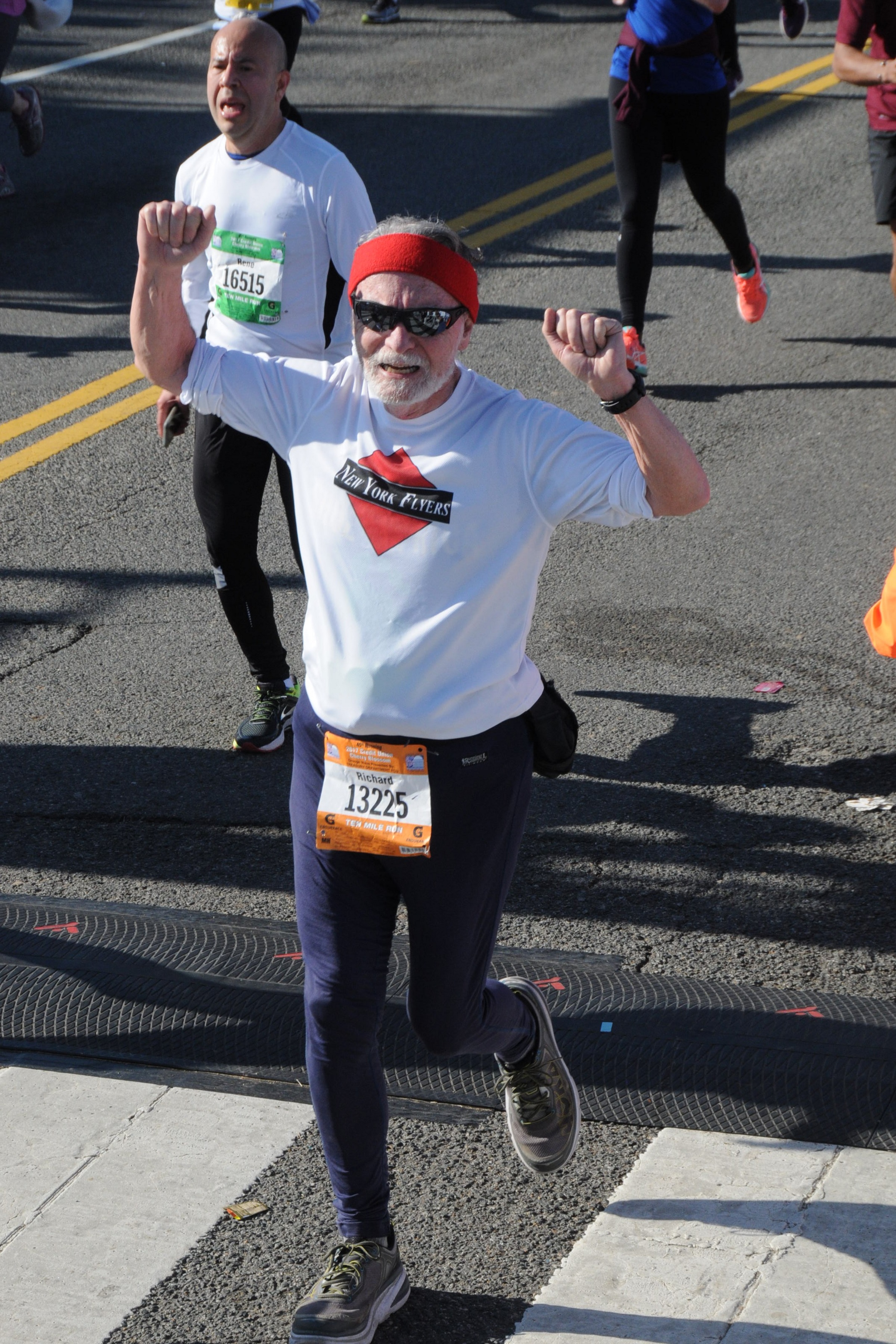
I had some strength left the last mile or two, and pushed as much as I could and they were the fastest two miles for the race. The finish line photo on the right certainly shows this.

Cherry Blossom 10 Miler
Split Pace
1st Third 34:51 10:27
2nd Third 34:33 10:22
3rd Third 33:53 10:10
Finish 1:43:15 10:20
Cherry Tree 10 Miler
Split Pace
1st Third 32:59 9:53
2nd Third 34:15 10:20
3rd Third 36:13 10:53
Finish 1:43:28 10:21
Well, how did I do compared to the Prospect Park race? The two tables (on the left, this race, on the right, that race) tell the story very well. Although the finishing times were close, the splits show a dramatically different story: in the Prospect Park race I had strongly positive splits (getting slower: 9:53, 10:20, 10:53) and this race I had negative splits (getting faster: 10:27, 10:22, 10:20). I was very happy with that and it encouraged me to train a bit more, especially by doing longer weekly runs to get some increased endurance and further improve my times.
Papa Bear at the Finish
I climbed the hill back to the Hostel and after cleaning up and recovering a bit, I met up with Susan and we had a bite to eat and planned for our afternoon: we would visit the new African American Museum.

Sunday Afternoon


The new African American Museum in Washington opened in late September 2016. The attendance was so overwhelming that they had to introduce "timed entry passes" which you could get on-line for future dates. At the time when we registered for the Cherry Blossom and received our lottery acceptances (December 12th), they were "sold out" for every day till March and their web site said they would not be opening it up for April, May and June till "to be announced".

Susan and I agreed we should really try for these passes and decided the afternoon of race day would be the best. So we checked the web site every day and finally in late December they announced the passes would be available on-line starting on January 4th. So we both logged in at 9:00 on January 4th and agreed who ever got through first would text the other. We figured since this was the first weekend of the new batch of timed entries and the weekend of the Cherry Blossom Festival to boot, that the demand would be high. Well, I won our own little lottery and I got two passes for us for 2:45 on April 2nd, race day.

Now, back to race day, we were a little "itchy" when afternoon came around so we went down to check out the National Gallery (just a bit east of the African American Museum) first. There were interesting archival photos and period furniture but we managed to lose each other and cell reception was poor. Well, all's well that ends well, and we did find each other and walked along the mall in the warm sunny April afternoon and got to our destination about 15 minutes early. A line was already forming up for the next "wave start", so I asked a security guard if we should get in the line (thinking it might be the 2:30 wave) but she just let us skip the line and go right in. And there we were.
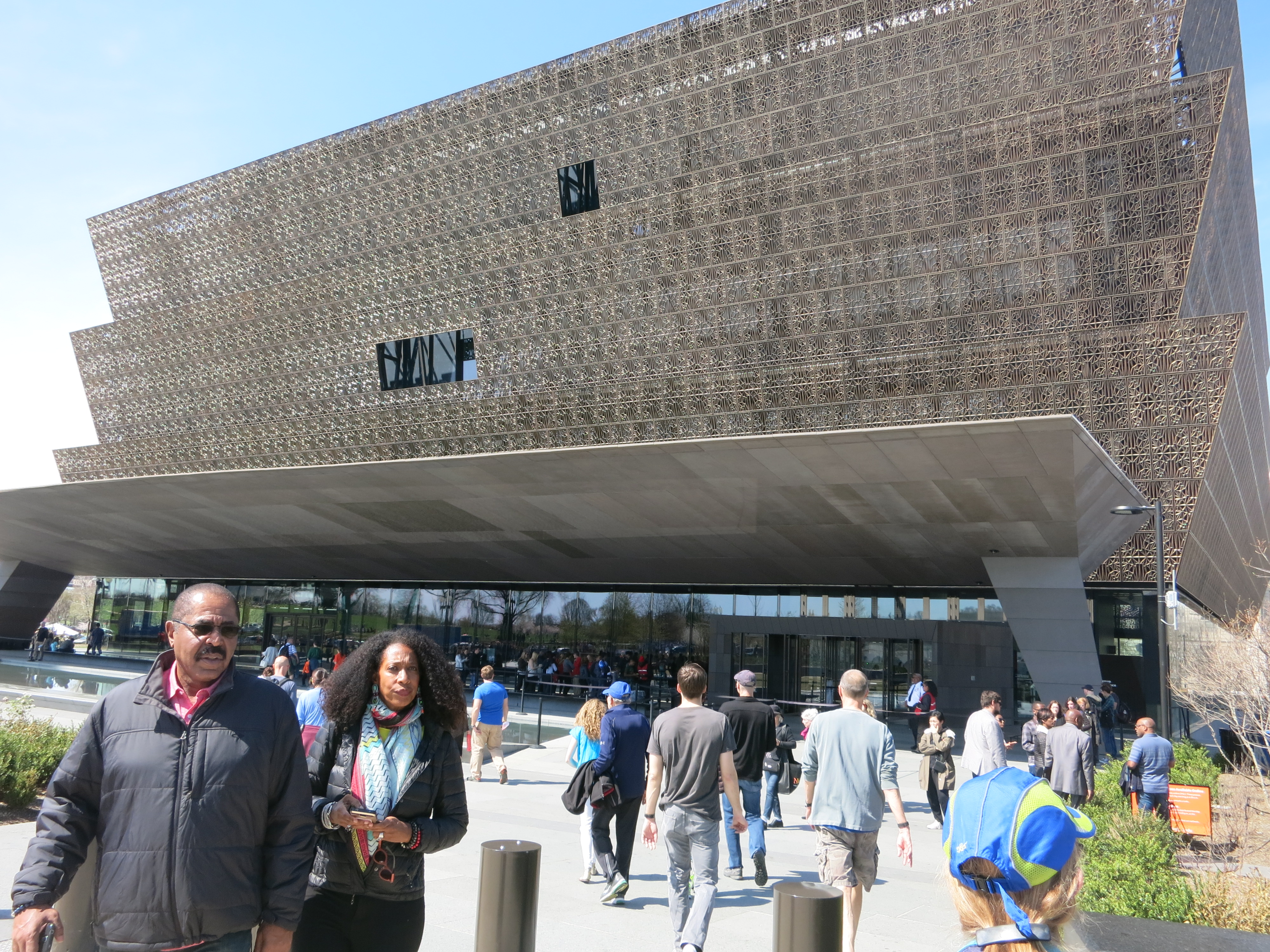
The African American Museum

The building which is shown above, although it appears to be rather large, is actually much larger. When we went in and looked at the guide pamphlet, we saw that there were three floors below ground level showing the history of the Black experience in North America from the beginning of the slave trade in the 16th century up to the present. And the three floors above showed African American art and artifice. So we figured we'd take the elevator down and check out the history first, and then explore the upper floors.

Well, it didn't work out that way. First off there were large crowds everywhere and we took our time and looked carefully at everything. We knew we may not make it back here for some time. As for the narrative shown in the history floors, which included historical articles, quotations from early leaders, both African and American, they showed every detail of that terrible period.

The narrative took us step by painful step from the start of the slave trade in the mid 16th century, where European traders found there was more profit in shipping a human cargo of slaves to North and South America than engaging in the trading of goods, though the colonization of the New World and the establishment of the U.S. — which at the time was highly dependent on slave labor in both the southern and northern states — through numerous slave uprising, which were brutally suppressed, through the abolitionists movement in the 18th and 19th centuries which fostered the "Underground Railroad", through the Civil War, the "Jim Crow" period, the "Great Migration", the Civil Rights Act and and up though the present day.

I'm sorry but I can't verbalize all I saw — it was just too powerful and moving. We were shaken. When we got back to the ground floor it was almost 5:00 and we had to leave. We vowed we would come back to visit what we had missed. If you go, try to pick a time when there would be less crowds and allow plenty of time. You may need two visits since you'll need time to digest what you've seen, which I'm sill doing.

Monday

We had tickets for the 12:00 noon Bolt bus back to New York City. So over breakfast, we figured we needed to leave the Hostel by 11:00 or at the latest 11:15 to make the bus. That would give us a couple of hours to check out the west end of the mall, in particular the Vietnam War Memorial, the Lincoln Memorial and some adjacent areas. Monday was by far the nicest day, weather-wise, so we both went up, packed our stuff up and met in the lobby for a nice Sunday morning walk.
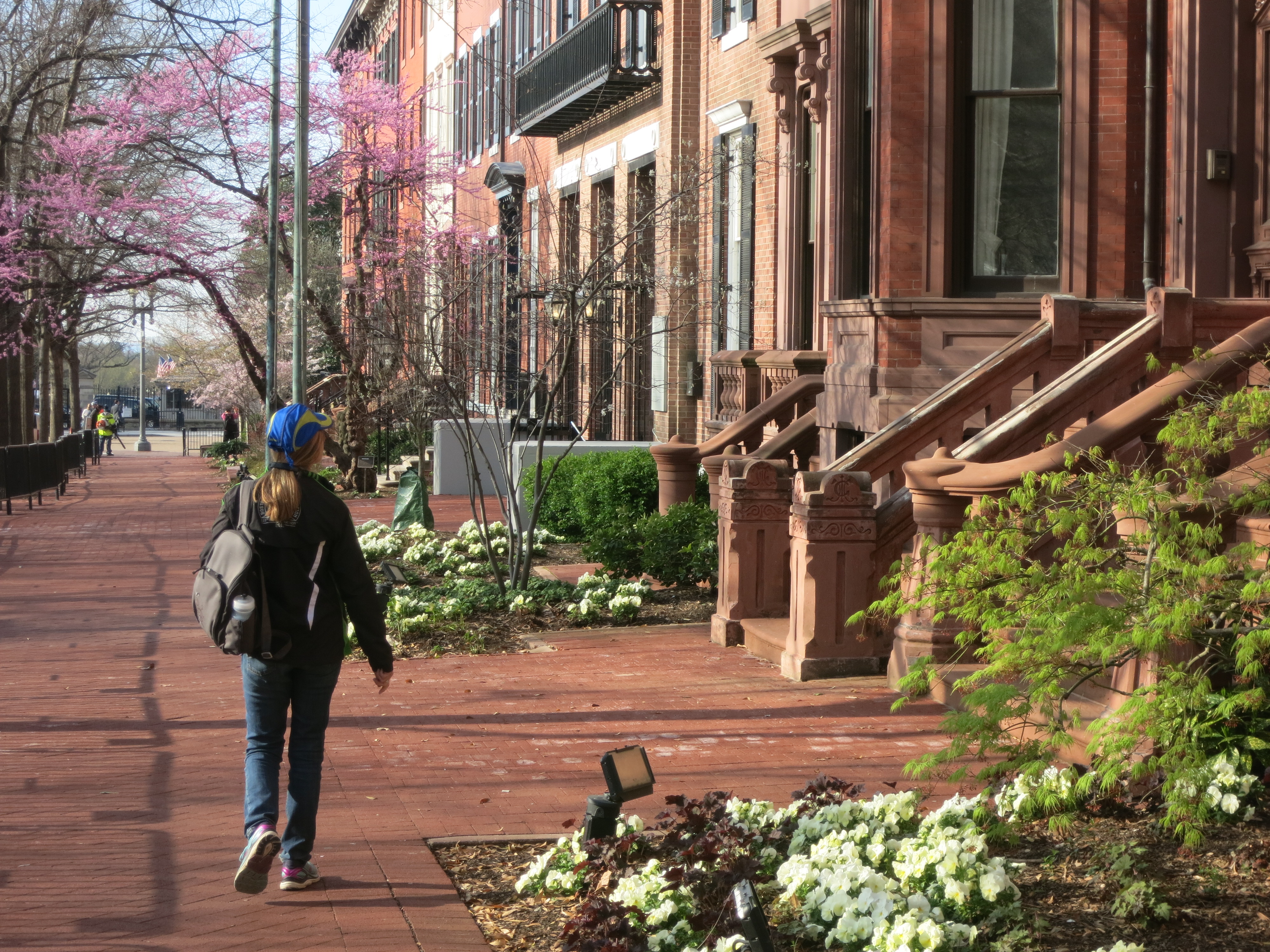
Beautiful Row Houses at Lafayette Square

We walked down and along the beautiful row houses along the west side of Lafayette Square (which were saved from development by none other that First Lady Jacqueline Kennedy in 1962 among others — see this), past the White House and down 17th Street to the Mall just west of the Washington Monument. It was totally cleaned up and you would never know there were 17,000+ runners here just one day before.

We had both seen this area numerous time but it's always an inspiration to visit. The Lincoln Memorial seen over the reflecting pool is just a marvel. I love that picture above with the clouds streaking up at an angle from the Memorial with the building and clouds reflected in the pool. We split up on the way back but this relatively long walk for a small number of objectives was well worth it.

We both managed to get everything down from our rooms, checked out and took a few minutes to relax. Then we left the Hostel and got the "Circulator" bus on time at 11:20. Unfortunately it didn't stay on time and we were held up by a construction project about half way to the station. So we got out of the bus with our luggage and walked the rest of the way to Union Station and got there with about 10 minutes to spare. And since we both had "Group A" tickets, we were first on the bus. About 4 and a half hours later we were in New York, and I was home about 45 minutes after that. It was a wonderful weekend!

This post is adapted from Papa Bear's blog  
Beyond Central Park 


Read more...

Sunday, August 23, 2015

RUN SMART RETREAT

Debbie P
Sea-level sucks! Not only a catchy slogan of Flagstaff t-shirts, it was also the slightly ambitious motto of the attendees at the 9th Run S.M.A.R.T. retreat, held from August 2nd-7th in Flagstaff, Arizona. More a vacation for runners than a training camp, 25 of us from across US as well as Canada, Australia, England, and Colombia, were captivated with the vistas of our daily runs at 7000 feet.
 
2 of the 7,000 Feet with
1 of the Captivating Vistas

Since 2009 the Run S.M.A.R.T. team (including its CEO, our awesome coach Brian Rosetti) have hosted runners in the idyllic town of Flagstaff, where elite athletes flock to live and train at altitude. I was thrilled to join this year’s cohort, which also included Flyers Jennifer C., Ilse A., and KC C., who has attended each year and manages all of the communications for the retreat.
With Jennifer C
Our Run S.M.A.R.T. hosts Mike Smith, Vince Sherry, & Sarah Sherry provided this year’s participants the opportunity to run scenic routes on which the elites train, and even to run alongside some of them! We were joined on the trails by 2012 Olympian Janet Cherobon-Bawcom & 3-time Olympic Trials qualifier Alvina Begay as well as ultrarunner Brian Tinder and various other elite trail & college runners. Even Ryan Hall stopped by our hotel, but clearly was too intimidated to come out with our impressive crew.
With Jack Daniels
Leaving our hotel each morning at 7, the group was caravanned to runs around Flagstaff, starting on Monday at Buffalo Park, where we started acclimating to the altitude on a local 2 mile loop with panoramic views of several peaks.  Alvina welcomed us in Navajo, sharing a bit of the local sacred history of the land which made the run that much more breathtaking (really, it wasn’t just the altitude!).

Views of the red rocks during a trail run in Sedona
Tuesday we had options of two trail runs through the stunning red rocks of Sedona, and Thursday along the awe-inspiring north rim of the Grand Canyon -- that turned out to be a walk-run due to frequent picture-taking.  And yet, my favorite run (and I heard others say the same) was on Wednesday, when we drove up another 2000 feet to Aspen Corner. There we ran 7 gently rolling miles on soft trails amidst towering aspen pines and in the shadows of Humphreys Peak, the highest in Arizona. 
Isn't It Grand?!
Wow These Trees Are Tall!
As the group spread out, each of us ended up enjoying some solitary reverie, absorbed in the placing one’s feet carefully and listening to the wind in the trees. It was so spectacular that I stood up short at one point, certain I’d either wandered onto a movie set entitled “beautiful wooded trail,” or into the after-life for runners.

To complement our daily trail runs, we were also instructed in active-isolated stretching, drills to improve our running mechanics, and offered instructional talks on topics including positive psychology and running nutrition. The “World’s Best Coach” (and Flyers’ 2013 marathon pasta party speaker) Jack Daniels was there to talk running, science, VDOT, & 180 steps/minute, and Rob Krar (winner of the 2015 and 2014 Western States Ultra) wrapped things up on Friday, discussing the physical and mental challenges of long-distance running.
If Gotta Do Running Drills,
Then Here's the Place to Do Them!

Jen C. & I went off our MTP plans for the week, as speedwork efforts at altitude apparently weren’t recommended by (awesome) Coach Brian, and I learned quickly how grateful I was that the goal was to run “easy” all week. I was already a bit nervous about running at 7000ft as my asthma often doesn’t like dry air, much less oxygen-thin dry air, and none of the runs in that sense were “easy”. However, I adapted enough that the splendor of the runs far outweighed the struggle to develop more red blood cells :)

Group Shot and Hoping to Come Back Next Year....
A wonderful group of new running friends, stunning panoramas & trails, good food, lots of learning and much laughter- what a fabulous vacation. The 10th Run S.M.A.R.T. retreat will be held in August 2016 (dates TBD), and I hope to be losing my breath again (literally & figuratively) again in Flagstaff next summer!

-Debbie P

Read more...

Friday, May 22, 2015

WHEN PIGS FLY

Stephanie T

Two weeks ago, I ran the 2015 Flying Pig Marathon in Cincinnati, OH in 3:48:03, my 17th marathon-plus! 

Although the marathon was not a PR, it ranked as one of the most special marathons, as it was my first postpartum.

 2015 Flying Pig Marathon Finish with Pei M, Ray T and Tran L

NEW TRAINING APPROACH AND EXPECTATIONS

I had trained well all season, which I was proud of, despite the fact that my daughter Keira was still only 9 months old. In fact, it was the first time ever that I had followed and executed a training plan so closely. I appreciated the science behind the Run SMART program and Coach Brian Rosetti’s extremely personalized and hands-on approach to coaching.

It was also my first postpartum marathon, and I am still breastfeeding. Instead of making time for group runs either before or after work, I had purchased a backpack that I ran with to go home from work two or three days a week with my breast milk, laptop and other items in tow. On Wednesdays, I would rush home to Brooklyn immediately after work so I could spend time with Keira before rushing back out to Central Park for the New York Flyers’ Marathon Training Program (MTP). On weekends, I would either get in a long run while my husband and fellow Flyer Ray watched our daughter, or we would go out for a run together with our running stroller.

Given the fact that I had run through my entire pregnancy, including a marathon and three half marathons, and I had read about a number of women running faster postpartum, including Liza Howard who won the Umstead-100 Mile despite stopping three times to pump on the course, and had given birth just six months prior, I had positive expectations about how the season would turn out. I believed that my expectations were valid, as I ran a 46:30 at the Scotland Run 10K in April, shaving 25 seconds from a my previous best time from 2011, and ran really strong all season long.

2014 Delaware Marathon at 7.5 Months Pregnant!

LEADING UP TO THE RACE

Ray and I left Keira with his parents for the weekend, our first time away from her overnight, and flew into Cincinnati, OH two days before the marathon. We dropped off all our belongings at the hotel, visited the race expo, which was next door to our hotel, and strolled through town before having dinner at Boca, a beautiful Italian restaurant I had made reservations for weeks ago. It was the first time we’d had dinner without Keira.

The next day, we met with fellow Flyers Pei M and Tran L for a 20-minute long easy run along the waterfront, returned to the expo with them and walked to Findlay Market, a local market with fresh and prepared foods, for lunch where Flyer Leslie L and his fiancé Noel C joined us. We enjoyed freshly made pasta, and picked up a few items for breakfast the next day. Ray and I returned to our hotel room to rest, as it had been a hot day so far and we had walked more than we had planned. The warm weather made me worry about race day, as I don’t run very well in warm weather, generally. We reconnected with everyone for an early dinner at Via Vita, an Italian restaurant near our hotel. After suffering from food poisoning the night before two marathons in the past, the 2011 Paris and 2013 Big Sur, I now always make sure to eat fully cooked, hot foods for two straight days before marathons, and kept it quite “vanilla” that evening–I had lasagna Bolognese and a side of roasted Brussel sprouts. We returned to our hotel early, and went to bed immediately.

Dinner with Fellow Flyers at Via Vite

RACE DAY PLAN

Brian had instructed me to run the first half of the race at an 8:18-20 pace. At mile 18, if I felt strong, I could pick up the pace. My projected finish time was 3:38.

Pei and Tran had planned to start slower than they had initially planned, so I considered doing the same. The temperature was going to climb to 80 degrees, and the Flying Pig was known for its tough hills on the first half of the course.

Miles 1-6 (8:22, 8:22, 8:22, 8:07, 8:21, 8:19).

We all took a group photo, Ray and I gave each other a kiss, and we wished each other good luck before the start of the race. Pei, Ray and Tran were all in the same corral as me, while Leslie was in front of us. Tran and Ray immediately headed out in front of me, and I was aware that Pei was behind me. I monitored my pace closely, aware that I typically run with a pace group, and tend to run too fast at the start of races. It typically takes at least six miles before I start to find my rhythm during a marathon, but felt strong during the start of this one. However, at around mile 4, I heard my name called, and turned around to see Tran behind me. I replied, “Hey! Oh no! I’m running too fast!” as Tran is faster than me, and I shouldn have been behind her!

Miles 5-13 (8:21, 8:19, 9:03, 8:22, 8:11, 8:26, 7:44, 8:16, 8:22).

The major uphill started around mile 5.5, and it was much more challenging than I had anticipated. I realized that I had slowed during mile 7, and despite the continued incline, and Tran exclaiming, “I’m not making up the time on the uphill,” I started to speed up shortly after. I was back on track to finish at my projected time by mile 9.

Miles 14-22 (8:24, 8:19, 8:25, 8:20, 8:38, 8:19, 8:25, 8:20, 8:38, 8:58, 9:21, 9:22, 9:43)

The hills, which were only second to the hills I encountered at Big Sur, increasing heat and constant adjustments I had made to my pace were all taking a toll on me. At mile 14, Pei had caught up to Tran and me, and we ran together for a few miles. At mile 18, however, at another incline, Pei continued running a strong pace, and I slowed down, unable to maintain my pace. At mile 20 or so, Tran passed me too, as I continued to fade.

Mile 23-26.2

I stopped checking my pace by mile 23. I saw the 3:45 pace group come from behind me at mile 24, and stuck with them for a mile before they passed me as well. I kept my legs moving, nevertheless, until I saw the finish line, and in front of me were Ray, Pei and Tran cheering me on! Ray draped the medal around my neck, and greeted me with another kiss. I was in awe that Ray had finished 12 minutes before I did, even though he hadn’t trained for this marathon at all, and we had all half expected to pass him on the course. I finished having given the marathon my all, but I was truly beat up. To serve as an example, I ran the last mile at 10:04.

 Keira and Me After Pacing the 2:00 Group for the 
2015 More/Fitness Magazine Half Marathon!

The Flying Pig Marathon certainly wasn’t my fastest marathon—it was actually my third fastest. However, it was my first since having my daughter Keira. I’m proud of all the hard work I put into training. And I’m ready to train for the next marathon.

-Stephanie T.

Read more...

Friday, May 8, 2015

26th Annual Bataan Memorial Death March

Howard C
The Bataan Memorial Death March is more of an event than a race. It honors the fallen soldiers and survivors of the infamous Bataan Death March, which occurred in the Philippines during World War II. The Philippines was a U.S. protectorate at the time. After months of battle and surviving on dwindling supplies, the U.S. and Filipino forces there surrendered to Japan in April 1942. Tens of thousands of soldiers were forced to march about 65 miles from the southern Bataan peninsula to prisoner of war camps further north. Over the course of several days, they marched under grueling hot jungle conditions with minimal to no food or water. Thousands died during the forced march.

A large contingent of the U.S. armed forces defending the Philippines at the time happened to be from New Mexico. In 1989, the Army ROTC at New Mexico State University began sponsoring a march to memorialize the event. In 1992, the New Mexico National Guard joined as a sponsor and the march moved to the White Sands Missile Range, an active military base. The event has been occurring there annually since then. This year was the 26th Annual Bataan Memorial Death March. While it is still a military-dominated event, it has gained a positive reputation in civilian marathon running circles as well. For someone like me, who has a goal of running a marathon in each of the 50 states, it was penciled in as my first choice for New Mexico. So when I got an email last fall from my running friend Nancy about trying to put a group together for doing this race in March 2015, I jumped on it. In the end, five of us decided to do this trip, all from the New York City area. Each of us registered in the “civilian” (vs. military), “light” (vs. “heavy”) and “individual” (vs. team) category.  We were “civilian” because you have to possess a military ID in order to enter in the military category. “Military” have to wear their full service uniform including boots for the march. “Heavy” means that you have to carry a 35 lbs. pack for the whole march, excluding water. Teams consist of five people, who must all finish within 20 seconds of each other. Teams are not allowed to abandon any members. Besides the marathon distance, there is an “honorary” distance, which is 14.2 miles.

Photo from http://www.bataanmarch.com/

The five of us arrived in El Paso International Airport, which is the nearest large airport, on Saturday (March 21, 2015), the day before the race. We drove for about an hour from the airport to a villa we rented out in Las Cruces, NM, which is the second largest city in New Mexico, and the nearest “big” city to the race course. After dropping off our luggage, we drove for another 30 minutes or so to the race expo at the White Sands Missile Range. This was also where the start line of the race was going to be, so the trip to the expo was helpful in learning the route we take on race day. We picked up our bibs, t-shirts, participant certificates and dog tag (finisher’s) medals without any problems. It was already pretty late in the day and the expo was clearly winding down. There had been survivors of the actual Bataan Death March in 1942 present at the expo earlier in the day, but they were long gone.

After taking care of business at the expo, we took a little time to explore the base. Outside of the expo area, there were numerous tents and campers set up on the grass, where some participants were staying overnight. There were military barracks nearby that were available for rent as well. We visited “Missile Park,” which is an outdoor museum for historic missiles tested at the base. Some of the missiles were the size of airplanes. White Sands Missile Range is actually a very historic site. This is where the super secret Manhattan Project (primarily based in nearby Los Alamos, NM) detonated Trinity, the world’s first atomic bomb. Besides the Missile Park, however, there didn’t seem to be a whole lot else available for civilians to see. This is an active military base (where, among other things, real missiles are still being tested regularly), so you can’t exactly just wander around unless you are unafraid of becoming missile fodder. As you can imagine, this base is in the middle of absolutely nowhere.


After visiting the base, we had a carbo-loading pasta dinner in Las Cruces and then went back to the villa for an early end to the evening. After long flights and a few hours in a desert climate, everyone was very tired and very dehydrated. I set my alarms and crashed quickly and hard.

In the early morning of race day (Sunday, March 22, 2015), the temperature was in the upper 30’s to low 40’s F. But it actually felt colder. One thing about deserts is that they can get quite cold overnight. I’ll never forget a hike I once did in a desert a while back where I saw patches of frosty snow on the sand in the morning, only for the temperatures to rise into the 90s later in the day, under a scorching hot sun. New Mexico, in addition, is mostly at elevation and thus has a much more temperate climate than you might expect. Although the temperatures were expected to go into the mid to upper 70’s later on race day, everyone was basically dressed for the winter that morning.
            
There was a mandatory opening ceremony that started at 6:35 AM. The March is clearly a very significant event in New Mexico. The two U.S. senators for New Mexico were there, as was the Philippines Ambassador to the U.S. There was a Black Hawk helicopter flyover. There were three actual Bataan Death March survivors who were present for the ceremony. Each firmly gave a “here!” when their names were called during a roll call. After that, the names of the Bataan Death March survivors who had passed away since last year’s Memorial March were called out, only to be answered with silence. There were a lot of names whose calls went unanswered. A lot. I could hear soft crying in the crowd starting to build around me. There was not a dry eye in the house.


After the ceremony finished, the various corrals started moving to the start line, led first by the Wounded Warriors. Cannons went off as the various waves started the race. As I approached the start line, I saw the three actual Bataan Death March survivors sitting to the side of the road. They were greeting everyone and shaking hands with the marchers. I waited my turn and shook hands with each of these three survivors. It was very humbling.

The race was scheduled to start at 7:05 AM, on a rolling basis. I did not cross the start line until about 7:45 AM. The course was closing at 8 PM, so there was plenty of time. We were starting off in civilization, on asphalt roads near base headquarters, so it felt basically like the start of most small city road marathons, except for the many uniformed military personnel.

After a short while, we hit a coarse sand trail, but it was mostly flat and quite runnable. A few miles further in, the course opened up and you could see far into the desert. I stopped and took some pictures. I ran together with Nancy for a bit before she had to fall back. Our three other friends were much further ahead as they are much more talented runners.


At about mile 7 or so, the main hill of the course started. It lasted for about 10 km (6.2 miles) and had an average grade of 4% (400 m rise over 10 km run). I was still pretty fresh so it wasn’t horrible, but it was nonetheless one of the most prolonged, steady hills I had ever encountered in a race. It was essentially the equivalent of running up an incline similar to Central Park’s Harlem Hill or Cat Hill, for a distance of the entire big loop of Central Park. For reference, per the New York Cycle Club, Cat Hill is 0.25 miles long and has a 3.7% grade. Harlem Hill is 0.32 miles long and has a 4.4% grade. Plus, there is altitude to deal with. The beginning of the Bataan Memorial Death March hill is at ~4000 ft elevation and the highest point is at ~5400 feet. This altitude is not too bad if you are just walking, but you can definitely feel the difference if you try to run. I slowly jogged this uphill section, with plenty of walk breaks, especially for the steeper (8% or so grade) sections.

Elevation and distance in meters. The numbers along the course are the aid stations.  Photo from http://www.bataanmarch.com/
The top of the hill was about the halfway point of the course. I reached there at about 2 hours and 19 minutes. At this point, I knew the original 4 hours and 30 minutes finish goal I had casually guesstimated was no longer possible. With a lot of downhills to go, however, 4 hours and 45 minutes seemed realistic. Meanwhile, there were matters of more immediate interest. At the top of the hill, there was an aid station. The wind must have hit us perfectly, because a fellow runner and I could smell something good cooking. The other runner kept going, but I was drawn to the smell like a tractor beam. I found the source of the smell, and it was a grill where they were cooking burgers and hot dogs! I could not turn it down. I was actually their first customer and ordered a cheeseburger and potato chips. At $4 with all the toppings you wanted, how could I say no? I resumed the race, running downhill for the next two miles, refueling myself with small bites of the burger and chips. The runners around me were incredulous as they saw me running by them, burger and chips in hand. “Protein” and “sodium” I explained. In total there was about a 10 km downhill section, which I mostly ran at a decent (for me) clip (approximately 8:00 – 8:30 min/mi pace).

There were some incredible views of the expanse of the desert around us. At about the 18 mile mark, the route merged with an earlier part of the course, which had marchers who were going the other way. They were roughly at their 10 mile mark, in the middle of their long uphill climb. These folks were mostly military team marchers, dressed in full uniform and carrying heavy 35 lbs. packs. It was an impressive sight. I did my best to salute, wave or otherwise cheer them on. They were friendly and cheered back.


A team of soldiers.  Photo courtesy of Nancy O.
Between mile 20 and 21, we hit a fairly longish stretch of deep sand. This section was tough, especially at this stage of the race. My legs protested loudly. I had no choice but to mentally adjust my goal finish time further down. I decided that if I could break 5 hours, I would be very happy. (For reference, I think if I had run a standard sea-level road marathon, all else being equal, I would have run it in roughly 4 hours and 15 minutes or so that day.) Fortunately, the course footing eventually improved to a firmer sand, then back to asphalt for the final stretch to the finish line. I was elated and relieved when I finally crossed the line. Although I’ve run a fair number of marathons (The Bataan Memorial Death March was my 44th marathon or ultramarathon), I never take finishing a race for granted. I’ve DNF’ed 3 times at marathons or ultras before. I was feeling tired, but great, and most importantly, I finished the run without any injuries. My primary race goal for the spring of 2015 is finishing the Comrades Marathon up run within the twelve hour time limit, and this race was superb training for that.

My official Bataan Memorial Death March time was 4:57:59 (11:22 overall pace), which was good enough for 78th place out of 885 in the civilian male light individual category. Normally, I finish in the middle of the pack, or in the second half of the finishers, especially in travel races. The median finishing time in my category was roughly 7 hours and 50 minutes. Thus, most of the participants at this event were clearly walking. Nancy finished about an hour later after I did. The other three of our travel companions on the trip are super fast runners. Keila finished in 3:30:12 (which is just unfathomable to me, on that course). She won the women’s civilian light category! Benny finished in 3:40:47, which was good for 7th in the civilian male light individual category. Brian H (a former New York Flyer) finished right behind him in 3:40:56, 8th place in the category. Benny and Brian were also #1 and #2 for their age group respectively as well.


We celebrated afterwards at a local restaurant/institution called La Posta De Mesilla, consuming the usual crazy amounts of food a runner eats after a tough marathon. Later that afternoon, we did the tourist thing and saw most of the recommended sites in Las Cruces, NM, which mostly revolve around local legend Billy The Kid. That took less than an hour.

The Bataan Memorial Death March is a race I would definitely recommend. For anyone considering doing this race, I would recommend doing it as soon as possible, because there likely won’t be too many actual Bataan Death March survivors around soon given their ages. I would definitely consider repeating this race in the future, probably in the “heavy” division with a pack. Overall, it was an unforgettable and exceptional event, and it deserves a place on every runner’s bucket list.

-Howard C

Read more...

Thursday, April 23, 2015

A Casual Runner in Africa

Francesco P
If your first thought when you are about to travel to some far-off place is: "how is this going to affect my running schedule?", you have definitely reached a high point in your addiction to running and, as you can well imagine, you are in very good company. 

Now, we runners love to think that nothing can ever stop us from running. But can it? 

There was a time, not long ago, when my work often took me to places like China and Mongolia, and I felt adamant that I would find a way to run no matter what. There is surely no better way to explore a Chinese village than on an early morning run, when the locals shuffle out to the streets and fill the parks for their daily tai chi practice. Admittedly, the occasional treadmill in the hotel gym gives you that extra security you need in case the weather conditions or the air quality make you think twice about venturing outdoors. But the treadmill is always the last resort.

Never until I moved to my current job in New York, however, did I have the chance to travel to Africa for work. For the past two years, my job took me to visit a few UN peacekeeping missions in tough places like the DRC, Somalia, South Sudan and Mali. It goes without saying that places that are ravaged by conflict and where security is a major issue, and on top of this triple-digit temperatures are the norm, are not the most propitious for a casual run. But, again, would this be a reason to stop a runner from going out and doing the job?

I have actually given this question some thought and I have developed 3 rules of wisdom.

Rule of wisdom #1: assess the risk. 

Dangerous road conditions, rampant crime, a history of violence or even the risk of terrorist acts against foreigners are all factors to consider carefully when choosing whether to go out or run on a treadmill. While no place is totally danger-free, it is important to be aware of the potential threats around you, in order to make an informed decision. Talking to people, finding out what time the sun rises, and scouting out your routes are all good tools to assess the risk in your environment. 

The evening when I arrived in Bamako, Mali, I was thrilled to discover that the area where I was staying had first-rate street lighting. The next day, I was out running well before dawn. The long, wide roads that stretched from my hotel to the government district along the banks of the Niger river were totally deserted and looked a bit eerie, but I could pretty much spot all the open potholes and the other "runners' traps" scattered on the way, and at the same time I managed to avoid running when the roads are awfully congested and clogged with motorbikes. 

Of course, I had also been reassured that, while violent crime could be an issue, no act of terrorism had ever occurred in Bamako. Mali is a country struggling with a deadly internal conflict between the government and the rebel forces and the Islamists in the North, and the towns of Gao, Kidal and Timbuktu, up in the North, are those that suffered the heaviest consequences of the conflict. Sadly, only three weeks after my visit, five civilians, including a colleague of mine who was serving for the EU Delegation in Bamako, were tragically killed during a terrorist attack. No reasonable precaution could have saved them from the brutality of that heinous aggression.

The UN base in Gao: not a good place for a casual run
Rule of wisdom #2: study the route. 

Once you have acquired a fair sense of security, you should figure out how far to go, what you want to see and how to get there. GoogleMaps can be very helpful to plan on an itinerary. I usually also try my luck talking to hotel staff, though that can be rather disconcerting at best, and totally useless more often than not.

The evening when I arrived at my luxury hotel in Addis, Ethiopia, the first thing I did after I was checked in, I went to the polished concierge who was idling by his stand next to the revolving door. I needed his advice on my run the next morning and I wanted to go all the way to the old town. The guy looked at me like I was crazy. The best place to run - he said - was the fancy shopping boulevards on the route to the airport, certainly not the old town. As for running in the early morning, he just could not get why I was dead set on doing my run when all the stores would still be closed...

And, finally, rule of wisdom #3: enjoy the run! 

Once you have overcome the headache of going over security and logistics, nothing beats the excitement of discovering the start of an ordinary day in the life of an African city. Two cities, in particular, hold a special place in my heart of die-hard long-distance runner: Nairobi and Addis. I cannot believe I have just managed to tick them both off my bucket list! I ran in Nairobi last year. At the time, I was advised not to venture too far from the safe area where my hotel was located, next to the UN headquarters. 

My run in Addis, this February, was quite a different story: I broke loose and scampered away into the bustling streets, as far as I could from my hotel. Thanks to my GoogleMaps, and in spite of my hopeless hotel concierge, I had a pretty good idea of where I was directed. I reached the National Theatre and the Lion of Judah, while the town was still waking up to a new day, children trotted to school, a small crowd gathered around a bus, guys in suits walked along to their work places. Then I turned a corner to cut towards the French School on the other side of the hill, and all of the sudden the streets were no longer paved and I remembered where I was: in a country that used to be among the poorest in the world, and had made huge leaps since and was climbing out of poverty.

Lovely day for a run in Addis!
Friends who lived in Addis say it is a special place for runners. People there value running like nowhere else. In the morning - my friends say - the streets of Addis literally fill with runners of all types. Even in my very short running experience in Addis, I can only corroborate it is a place like no other for runners. I cannot think of another city in my long years of running where people look so cheerful seeing a runner zip by. I would have loved to stop and converse with them about the secrets of their masterful endurance running. We think it has something to do with running, generation after generation, at a high altitude. I felt blessed by my altitude solo run, and ready to go back to New York and to my running buddies, full of energy, stronger than ever, and looking forward to my next African trip!

-Francesco P.

Read more...

Friday, March 27, 2015

Marathon Travel Planning 101

Kathy K
This post is adapted from a blog post written by Flyer Kathy K, which appeared in her own blog, Will Run for Miles, in February 2015.
1.  Plan Ahead.  First, and foremost,  planning is fun.  It’s exciting to start planning.  As soon as the idea is planted in my head that I might want to visit a city for a marathon or event, I go to Kayak and set up a price alert for flights – I always use the daily alert, not the weekly alert.  Fares can change like the seasons, and in order to take advantage of a good rate you need to know about it.
2. Early Bookings can be Great Deals.  I know we typically hear talk of “last minute bargains,” but I find that some of the best bargains are found sooner rather than later.  Some trips, especially for popular marathons in large cities, are best planned before the town wakes up and realizes that there is a big opportunity to make lots of money.  Point in fact….  In 2011, right after the Miami Marathon, I decided I want to go back again for the 2012 Miami Marathon.  Miami hotel rates, especially for the marathon weekend, are very VERY expensive (as in other cities such as New York, Boston, Chicago and Los Angeles).  But I looked around, and the Marriott Marquis downtown, a four star hotel very close to the start and finish of the marathon, had apparently not realized that the marathon was the last weekend in January.  So, I booked a government rate (yes, I’m eligible for that rate – – one should always explore and exploit all of the rates they are eligible for) for less than $110 per night.  Pretty incredible.
3. Flexibility.  Remain flexible and don’t commit if possible.  Yes, I said plan ahead.  But also recognize that you don’t want to back yourself into a corner if you don’t have to.  Plans sometimes change, and its great to know you can change your destination, your hotel or your dates of travel. Hold hotel rooms, but don’t opt for non-refundable if possible.  For example – I’ll cover it in another post, but knowing how to use Priceline can be great in planning trips.  However, on at least two recent occasions, I got fabulous deals on Priceline for a Friday to Sunday stay, realizing, long after, that I’d prefer to go from Saturday to Monday, and I was stuck.  A bargain is only a bargain, if you use it.
4. Keep checking.  Hotels, Airfares and Car Rentals change.  If you are renting a car, make a reservation early.  They can nearly all be canceled without penalty. Often, car rental prices keep increasing – and if you placed a reservation early, you will have the benefit of that rate.  On the other hand, if the price decreases (and you’ll only know that if you check back), then you can cancel and take advantage of the lower rate.  Some people say very good things about using Autoslash to keep watch on car rental rates.  Hotel rates can also change, or become available, over time – but you can only take advantage if you keep checking! (see, Keep Checking Trip Details Right Until the Last Minute).
5.  Use all advantages you have.  Read blogs and sign up for emails, and point and mile programs.  Much more to follow on this.  For example, based on a tip, I signed up for the frequent flyer program on Kingfisher Airlines.  Nope, I never heard of them either.  But, they were giving away “silver” elite status just for signing up.  And since they are a future partner of American Airlines, and other One World Airlines, that may mean the ability to check bags for free (ok, I almost NEVER check bags, but still….) or perhaps even boarding a flight early or getting a better choice of seats.  So… Hello Kingfisher. (Update: Kingfisher disappeared a few years ago).
6.  Be persistent, but not annoying.  Be nice.  Be very nice.  If  you are dealing with a representative on  the phone, and the conversation does not seem to be going in the desired direction, don’t argue and don’t plead.  Hang up and try again.  Because…. you never know!!! 
7. Priceline and Hotline are your friends.  Do not be afraid of sites such as Priceline or Hotline.  You can get some amazing deals.  There are lots of tricks to get the most out of these websites. (I love www.betterbidding.com – check it out!). (Update: I have not used Priceline or Hotline in years, preferring to use special rates or points and miles I have accrued).
8.  Apartment and Vacation Rentals.  I’ve heard some wonderful reports from people renting apartments or houses on websites such as Airbnb.  This might be especially suitable to family travel, or travel for more than a few days.
9.  Loyalty is rewarded. Show some loyalty, if possible.  If you can concentrate your flights on one airline, or hotel stays at one hotel brand, you may be able to get “status.”   Its not about snobbishness – its about good prices, good treatment, late checkouts, free wi-fi, etc.  A late checkout is worth the difference between showering or not showering after a marathon.  And to me, that’s worth A LOT!
10. Take advantage of credit cards. Get some credit cards that have special offers.  Don’t just buy because the card has a good advertisement.  Read up on the deals.  Listen to the experts’ reports on why one deal is good or not.  I’m sure I’ve gotten more than 20 credit cards, and earned hundreds of thousands of miles, since I originally began this post (and my credit score has soared to over 800).
11.  Earn and Burn.  This is a summary term.  People who collect points and miles, say its best to earn and burn them, because unlike money in the bank, points and miles don’t increase in value with time.
12.  Be organized.  Find a way to keep track of your planning.  Never, ever let points or miles expire.  There’s a myriad of ways, other than flying to earn points and miles. Try Award Wallet or other services to help keep track of your points and miles.
13.  Sometimes the Deal Chooses Me.  Sometimes I plan to run a marathon, and work my travel plans around it.  But sometimes a travel deal comes along, and I look to see if I can work a marathon into it.  A few years ago, there was a mistake fare on Delta, such that a round trip fare to Barcelona was $250.  I quickly researched when the Barcelona Marathon was and found that the fare would work.  So I ran with it.  Literally.  Remember, most airfares, even non-refundable fares, can be canceled within 24 hours of purchase.  So, if you come across a particularly good rate, book it right away, then cancel it if it won’t work for you.

That’s enough for now – I’m sure that I have to pack for another trip.  But I’d love to hear your comments – any pointers or tips you have, or any questions or topics you’d like to see covered.
-Kathy K.

Read more...

  © Blogger templates The Professional Template by Ourblogtemplates.com 2008

Back to TOP