Thursday, September 29, 2022

Berlin Marathon: An Epic Virtual Tour


Bradford G.

The incredible, astonishing, not-to-be-missed sites along the Berlin Marathon Route.

Keep an eye out for these memorable sites and you won’t even notice the 26.2 miles breezing by! But first, here's a brief history lesson:

Fast Facts

  • Population - City: 3.7 million (40% of NYC), largest city in Europe.
  • Metro: 4.5 million (25% of NYC)
  • Size - 340 sq miles (10% larger than NYC!):
  • Boroughs – 12!
  • Brandenberg – One of 16 Federal German States, it surrounds but does not include Berlin. Berlin is also a Federal State.

Background

Berlin is a young city by European standards. Berlin was long the capital of Prussia, which was an unlikely candidate to become the dominant state in Germany. Sandwiched between Poland and the (mostly) German Holy Roman Empire, Prussia was a marginal state that came to the world’s attention long after more powerful and established German lands like Austria and Bavaria.

Prussia enjoyed a string of highly effective Electors and Princes, especially in the 18th Century. As the State gradually expanded, its leaders were eventually allowed the privilege of using the title of King. They rose through a combination of effective administration and brilliant military campaigns. Wilhelm I united Germany through a series of wars against German and non-German nations, ending with the immensely successful Franco-Prussian War of 1871.

When Germany united under Wilhelm, he took the title Kaiser or Emperor. These Royal leaders dominated Prussia and, later, Germany’s government long after the royal families of Britain, France and other European royals became ceremonial leaders or were eliminated altogether.

After decades on the fault line of East and West, Berlin is one of the culturally compelling cites in the West. And, yet, it’s hard to run through the city without recalling its darkest moments: the World War I famine, the strife of the Weimar Republic, National Socialism, defeat by the USSR and, of course, the Holocaust. It can be said of Berlin and Germany that the people have worked hard to reclaim their place of leadership amongst the peoples of the world and that Berlin, today, is one of the most exciting cities to live, visit and run.

Three recurring motifs in the Marathon are the bridges over the Spree,  crossings over the former Berlin Wall and the TV Tower. While the bridges are much smaller than those in New York, most are pretty nonetheless. As for the Wall, the two cities diverged dramatically during  the Cold War. The West thrived while the East suffered from the inefficiencies of communism, exploitation by the Soviets and the horrific police state. West Germany has worked full out to heal the wounds, but East and West still have distinct personalities.

Lastly,  The Fernsehturm TV Tower was the fourth highest manmade structure in the world when completed by the East German government in 1969. Its soaring height had great meaning in the propaganda war between East and West Berlin. Today, it is a proud symbol for all of Berlin and a centerpoint that can be viewed from points throughout the Marathon.

Good luck on Sunday!

START: Grosser Tiergarten

 – The Grand Animal Garden is the largest park in Berlin. At 200 hectares it is 60% the size of Central Park. The park was built in the 1830s, 20 years before Central Park. The Parks and Palaces of Berlin (& Potsdam) are, collectively, one of Berlin’s three UNESCO World Heritage Sites. (NYC has six!) The famous Berlin Zoo is in the southwest corner of the Tiergarten. 

Strasse des 17. Juni 

– Named to commemorate the1953 East Berlin uprising that spread across East Germany. Originally a protest against lengthened works days, it grew into a people’s revolt against the German Democratic Republic government. After several days it was quashed by Soviet troops. 

KM 0.0 Soviet War Memorial 

Overlooking the corrals before the start, the Memorial honors the 80,000 Soviet soldiers killed and 280,000 wounded in the April/May 1945 Battle of Berlin. It is rather shocking to see a Soviet memorial in the heart of Germany because the Soviets were vengeful in their assault on Germany’s. But, even most Germans recognize that Nazi Germany was an evil that needed to be expunged. Although the site was in the “British” Zone of Occupation, it was guarded for decades by a Soviet honor guard. 

KM .75 Siegessaule 

– The 203’ Victory Column was built in 1864 to celebrate Prussia’s victory over Denmark. The Statue of Victoria was added in 1871 to celebrate Prussia’s monumental victories over Austria and France.

KM 2.0 Ernst-Reuter Platz 

– Named for Berlin’s post-war mayor, framed by three major universities.

KM3.7 FIRST BRIDGE CROSSING

KM 4.5 Otto Platz & Kleiner Tiergarten 

– Small parks astride Turmstrasse U-Bahn Station. 

KM 7.0 Spreebogenpark

(left) – First building on right is the modern Bundeskanzleramt (Chancellery), the second building is Paul-Lobe Haus, Berlin’s modern parliamentary offices. In between one can catch a glimpse of the Reichstag.

KM 7.0 Reichstag

– Completed in 1894, the construction of a grand parliamentary building showcased the liberal tolerance of the powerful Kaiser Wilhelm I and the political and administrative genius of his Chancellor, Otto von Bismark. Ironically, its more famous moments were its worst, the Reichstag Fire of 1933 – it remained burnt out through the Nazi era – and the planting of the Soviet Flag above its pediment, marking the unthinkable victory of the USSR over Germany in WWII after 27 million Soviet and 14 million German deaths.  The Norman Foster Dome, a sign of transparency and inclusion,  capped a complete restoration in 1999.

KM 8.0 Freidrichstadt-Palast

- Originally completed in 1865 for popular shows, circus acts and vaudeville, the theater hall failed commercially several times. It was rebuilt in 1919 and, again, in 1984. It is currently the largest “show palace” in Europe with 1,900 seats. 

KM 10.0 Rosa Luxemburg Platz

– “Red Rosa,” the ideological genius and Che Guevara of the German Revolution of 1919. A timeless hero to leftists everywhere, especially the German Democratic Republic, she was captured and killed by “Freikorps” paramilitaries after the failed Spartacist Uprising of January 1919.

KM 12.0 Straus-berger Platz

– Starting point for the East German Uprising of 1953.

KM 13.3 (On right before left turn) – Kit Kat Club

The name says it all. By most accounts, it lives up to its sordid reputation.

KM 13.4 Heinrich-Heine Strasse

– At last, one of Germany’s great literary figures. Heine was famed for his lyric poetry that was set to music by composers such as Schumann and Schubert in the mid-nineteenth century. He ran afoul of German censors and spent his last 25 years writing in Paris.

KM 17.7 Sudstern – Kaiser-Friedrich-Platz

was renamed Pioneer Guard Platz in 1938. In 1947, it was renamed Seven Star Platz for the seven avenues that enter the plaza. The 1897 Church at the South Star is a landmark in the middle of the road can be seen a kilometer ahead.

KM 19.5 Rathaus Kreuzberg

(right) & Riehmers Hofgarten

(left) – The 1951 Rathaus was built as for West Berlin Borough administrative offices. The Bauhaus-influenced building remains remarkably modern. The Hofgarten is a fin-de-siècle apartment building that set new standards for middle-class housing in the late nineteenth century.

KM 22.8 Martin-Luther Strasse

– For the record, Martin Luther King was named for the revolutionary German Protestant cleric, not the other way around. Luther changed the world of Christianity when he posted his Ninety-Five Thesis on the Wittenberg Cathedral door in 1517.

KM 23.0 Rathaus Schoneberg
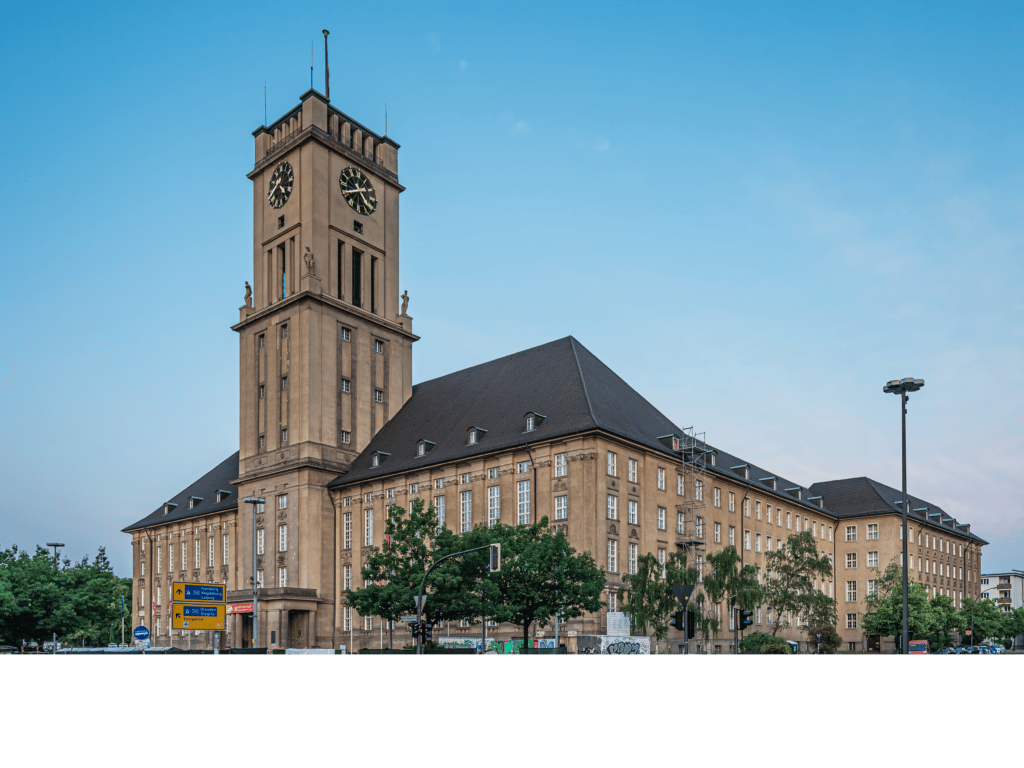
– Completed in 1914, just in time for WWI, the Rathaus has had many functions, but served mainly as a town hall for the Borough of Tempelhof-Schoneberg. The plaza in front has been the scene of many momentous gatherings including one of the most memorable speeches of the Cold War, John F. Kennedy’s Ich bin ein Berliner speech of 1963. The plaza was renamed for Kennedy after his assassination only a few months following his trip to Berlin.

KM 23.2 The radical concrete building on the left is the Catholic Parish of St. Norbert.

KM 24.0 Innsbrucker Platz
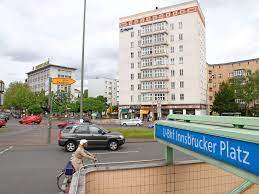
- Located between the old villages of Schöneberg and Steglitz, originally a path between Berlin and Potsdam. It was expanded in 1792 and become the first paved road in Prussia.

The Berlin Ringbahn, which passes through Innsbrucker Platz, was completed in 1877.

KM 31.4 Russisch Orthodoxe Kathedrale / Cathedral of the Resurrection of Christ

– First completed in 1938 with the cooperation and some financing from the Nazi government. A year later Germany and the Soviet Union concluded the astonishing Molotov–Ribbentrop Pact. Less than two years later Germany shocked the world by invading the USSR.

KM 31.6 Rathaus Wilmersdorf

- Wilmersdorf Town Hall was built between 1941 to 1943, making in one of the last non-military buildings constructed in National Socialist Berlin. It was expanded over the years, but now sits vacant as the Borough seeks to lease the space for a profit.

KM 34.7 Kaiser-Wilhelm-Gedächtniskirche

– The Kaiser-Wilhelm Memorial Church was dedicated in 1895, but not completed until 1905. It was severely damaged in a 1944 air raid, but was still in a repairable condition. Church authorities ultimately decided to tear down part of the remaining church to emphasize the futility of war. The original church was effectively replaced by the modern church and tower, which were completed in 1965.

KM 37.8 Kulturforum

– The Cultural Forum is the Lincoln Center of Berlin, with a library and museums thrown in. Built in the 1950s and 1960s when West Berlin was cut off from many of the city’s great cultural centers during the Cold War.

KM 38.1 Potsdamer Platz

KM 40.3 (On right) Deutscher Dom

KM 40.4 (On right) Konzerthaus am Gendarmenmark

KM 40.5 (On right) Franzosscher Dom

KM 41.2 Unter den Linden  

– Germany’s Champs Elysees, it was originally a 16th century bridle path for Elector John George of Brandenburg to reach his hunting grounds in today’s Tiergarten. His successor planted the famous lime trees that line the boulevard to make a grand entrance from his palace to the city gates. Many trees were cut down to build the S-Bahn, the rest were cut down for firewood in WWII. The current trees date to the 1950s.  

KM 41.9 Brandenburg Gate 

– It ain’t over! There’s 200+ meters left to go, but everyone feels victorious racing through this magnificent triumphal arch. This neo-classical masterpiece was completed in 1971 to celebrate Prussia’s role in crushing a popular reform uprising in The Netherlands! The Gate originally marked the start of the road to the capital of Brandenburg, one of 18 gates that surrounded Berlin in the 1700s. Ironically, the first army to march through the current gate was Napoleon’s Grand Armée.

The Gate stood in isolated desolation in the heart of the “no man’s” land between East and West Berlin, a symbol of the deep chasm separating two worlds, east and west, during the Cold War. Today it stands as a beacon of European unity and world-wide reconciliation.

Honorable Mention: Sites NOT included in the Berlin Marathon but that are worth seeing!

Museum Island, Altes Museum, Neues Museum, Alte Nationalgalerie, Bode-Museum, Pergamonmuseum, Berliner Dom (Cathedral), The Berlin Palace (King’s Royal Palace), Memorial to the Murdered Jews of Europe, Berlin Wall Memorial, Berlin Television Tower-the tallest structure in Germany.

-Bradford Goz


Read more...

Sunday, September 18, 2022

Star-Spangled Celebration: Running and Singing in Harmony in the Bronx


Rachel Duncan

I was so honored and excited to be given the responsibility of singing the national anthem before today’s NYRR Bronx 10 Mile Race. I’ve been singing ever since I was a kid. When I was four, I went missing in a drug store and my mom found me singing “Over the Rainbow” 🌈 to a shelf full of Band-Aids. I went to NYU for voice and worked in musical theater through my 20s, picking up a running habit along the way. When I was 25, I even wrote in my bio that I was going to run the NYC Marathon. I figured if it was in writing then I had to do it. In my 30s I had to let go of my Broadway dreams a bit to make room for things like bills and a baby, but I never really stopped singing. Or running for that matter. And both of these passions came to meet in perfect harmony today. 


If you ever get the chance to sing the national anthem in front of people, you should know this: it’s terrifying. The song itself is an octave and a fifth, and if you start even a half step too high you are screwed at the end. And then there are the lyrics.  But there are pitfalls and stage fright is real. But I thought about it, and realized, this is just another race!


So here’s my Bronx 10-miler plan for singing the national anthem: 


PRE-RACE: 

You wouldn’t go to the start line without the proper fuel, an easy mile, a few stretches, and maybe some short sprints, right? Same here. Though I have to admit, I did cheat this a little bit. Not being an opera singer, I hate scales as much as I hate Cola Me Happy–flavored Gu. So an actual warm up of 2 easy miles to the start worked for me. 


Ready to Sing After Warm-Up Run 🎤


Miles 1 through 3: O say can you see, by the dawn’s early light, What so proudly we hailed at the twilight’s last gleaming.  Do not go out too fast. Or too high! It starts off nice and low so you can kind of ease into it and get comfortable. Find your rhythm. Don’t weave around too much and add flourishes. You’re just wasting energy you’re going to need at the end. 


Miles 4 through 6: Whose broad stripes and bright stars, through the perilous fight, O’er the ramparts we watched were so gallantly streaming.  Ok you’ve sung this musical phrase already. You may start to get really comfortable here, even a little lazy. Keep the tempo up and don’t lose focus. It’s actually pretty easy to mix up that “gallantly streaming” thing with “twilight’s last gleaming” from the first two lines!


Miles 7 and 8: And the rocket’s red glare, the bombs bursting in air, Gave proof through the night that our flag was still there.  You are more than half way done! It’s going to start to get a little harder here, but if you’ve followed your race plan to this point, you should be able to open up a little bit. 


Miles 9 and 10: O say does that star-spangled banner yet wave. O’er the land of the free and the home of the brave.  Last two miles. I mean lines. You have already sung the highest note in miles 7 and 8 (red glare), but this time you have to sing it on that awful EE vowel sound. Singer’s worst nightmare. But just go for it because the end is in sight. Go ahead and treat “And the home of the brave” as your sprint to the finish line. It’s low, it’s easy, and by now you have knocked the ball out of the park. 


If you missed me in the Bronx, the video above can suffice, or head to Staten Island on October 9th, when I'll be putting the plan into action again for the Staten Island Half Marathon 😊

- Rachel Duncan 🎵


Read more...

Wednesday, August 24, 2022

SpeedPass Paves the Way Back to Running

Anne Halpern

Sometimes in life even the seemingly smallest decisions can evolve into incredibly gratifying and life-changing results.  This is what happened in the mid-1990s after I moved from Long Island into NYC.  


Upon moving to the city, I decided to join an up and coming running club – the NY Flyers – as a way to keep up with my fitness and to socialize.  That one small effort of filling out the application form, and sending it in the mail with my check for the nominal annual membership fee, launched the beginning of what became a wonderful and ongoing journey.  


I immediately started running with some neighborhood friends and kept up with them on the six mile loop of Central Park.  They were training for the NYC Marathon, so of course I took on the challenge, too – a challenge that felt intriguing yet daunting and completely unachievable. I loved it and quickly caught the marathon bug. 🥳


My Long Island friends were amazed and impressed that I took on the challene of running a marathon! Crossing the NYC Marathon finish line in 1995 was pure elation -- an experience that I credit to becoming a Flyer and receiving encouragement from my close NYF running friends and my other teammates, along with the guidance of former Flyers Head Coach Cliff Held.  


Finishing My First Marathon -- NYC Marathon 1996

 Reminiscing about those marathon days, it's amazing to see how much has changed.  GU or other sports gels were not yet on the market, and instead we gulped glucose tablets and gummy bears. With no wrist bands for tracking our splits – only markers – we wrote them up and down our forearms. While racing may have changed, running with my Flyer friends rooted me in my new home, NYC. 


My Girls
Liz Greco (Baer), Dorian Romer, Me,
Erin Stoeber (Mulvey),
Betty Margolin (Fuchs)

Over the next subsequent years, I ran a few marathons here and there, and also dabbled in completing a few triathlons.  Life was and remains good! Although my last marathon was in 2011, I continued to lace up my running shoes and stayed fit by training and racing other distances and also by attending NYF speedwork sessions.


NYRR Mini10K circa 1986 -- my first of 23
I was so nervous I didn't sleep the night before!


I am now returning to running after an 18 month hiatus. I knew what I needed to do. Start small and work back up with both distance and speed. I reminded myself of when I first started running in the mid-1990s. I set and achieved small goals that will establish the basis for working my way back. Easy for me to set goals, I'm a Capricorn!🌙


Thankfully, SpeedPass helped pave the way.  Coming back to running this summer after my hiatus, SpeedPass (or shall we call it "Motivation Mondays") provides me with everything I need to be this year's “comeback kid.”  The prescribed workouts are just what the doctor ordered!  Since it’s a small group, I've gotten to get to know my teammates better, which is – simply stated – so nice! 


The encouragement and instruction are invaluable at SpeedPass. I learn something new at each session from Coach Amy and Coach Jim such as improving my running mechanics and pacing myself more productively.  I started running stronger and faster in just a matter of weeks.  SpeedPass combined with strength training 3x per week is really doing the trick for my overall running performance!


Maybe One Day Coaches Amy & Jim
Will Take SpeedPass to the Beach! 🏖


Here are some of the details about the SpeedPass Program. Each of us receives two Quality Sessions per week. The first Quality Session is a coached group speed workout and the second is a long run or another speed workout, your choice!  Following a group warmup, we divide into smaller groups so we can run with others at a similar pace. 


SpeedPass Summer/Fall 2022


We meet up every Monday in Columbus Circle for our group speedwork. All workouts are published to each participant’s calendar, which provides our target goal paces based on the VDOT formula --VDOT measures current running ability -- developed by Jack Daniels, PhD.  Coaches Amy and Jim closely monitor how we're doing at each workout, and also online in the training app.   


Practices typically finish around 8 pm with some strength and mobility exercises. Amy and Jim are very accessible in between workouts so I can email them at any time with comments, questions or updates to my calendar.  Often they'll provide us input and feedback with their own comments and questions on our calendars, which helps us to feel held gently accountable, and very loved 💗💕


Working to Get Back to this Most Fit Version of  Me


So for those of you who want to get faster while enjoying the camaraderie and coaching SpeedPass has to offer, I strongly encourage you to give it a try next season!  I can't think of a better way to spend a weeknight. There’s nothing that beats schvitzing (or, in the winter, freezing) in Central Park, heading home with an endorphin smile on your face and then having the greatest night sleep ever. Join us!  Your journey awaits!🌄


-Anne Halpern


Read more...

Saturday, August 6, 2022

The Mount Everest Marathon: Part 1 -- Basecamp Adventures

Pei Muntawan Arsrairas


Part I: Traveling to the Mt Everest Basecamp to Run a Marathon


This is the first post in a two-part series. In Part I, you'll read all about my journey and adventures leading up to getting to the start line to run the Tenzing-Hillary Mount Everest Marathon.  


In Part 2, coming soon, you'll find out all about my racing the marathon! Do you think I completed it? Do you expect that it was an amazing experience? Well, you'll just have to wait and see in Part 2 to find out 👀


Running a marathon is a challenge in itself. Trekking to the Mount Everest Basecamp at high altitude in Nepal to run a trail marathon added to the complexity.  I would like to share my experience, my highs and my lows, and some tips I learned from this trip in case my adventure may inspire you to sign up for this race, too 🏔


PANDEMIC POSTPONEMENT


Back in 2019, a friend and I discussed taking on the 2020 Mount Everest Marathon. I had devised a plan that I hoped would help me with the preparation by running a few marathons in prior months including the Bhutan Marathon, also a high altitude marathon, before running the Everest Marathon. 


Then, COVID came along, putting the world on hold, along with most of my trips for nearly 2.5 years.  Finally, in 2022, this marathon became a reality. By then, I had recruited almost 10 friends, or friends of friends, to come join me in the fun. It was going to be a blast.  We were excited and nervous all at the same time. There were a lot of unknowns.  Most importantly, how would our body react at high altitude?  


GETTING STARTED


The marathon is held every year on May 29th in celebration of the historical successful ascent of Mt. Everest by Tenzing Norgay Sherpa and Sir Edmund Hillary on May 29, 1953.


I started my journey a month before all of my friends set out to meet me because I had scheduled myself to first run the Vienna Marathon and then the Prague Marathon prior to heading to Mount Everest.  I was in a panic when I started to pack my bag -- nervous about what was to come.


PACKING AND RE-PACKING AND MORE RE-PACKING


My challenge was how to pack for a 2-month trip where I would confront various climates from hot to extremely cold.   On top of that, we were restricted by the luggage weight (our bag plus our day pack) to the maximum of 15 kg.  What we had to have with us included a pair of walking sticks, a zero-degree celsius sleeping bag (I used a -20C sleeping bag), a sleeping pad, clothes, warm waterproof ski jacket, rain jacket, rain pants and the list goes on.  


When we received the suggested packing list we were amazed by how little we were suppose to bring with us.  We would trek for 2 weeks but we were advised to bring only 2 sets of clothes.  There would be some opportunities to get our clothes washed but no guarantees.  We would move teahouses (where we'd sleep) almost daily.  There wouldn't be enough time for laundry.  Of course, none of us agreed to the suggested list and we packed a lot of clothes for the trip regardless.  


The dilemma started when we were in a hotel in Kathmandu and met our guide for the first time.  We were reminded of the strict luggage weight limit, especially for flying from Kathmandu to Lukla.  We had to ditch a lot of stuff.  You should have seen us frantically repacking and reweighing our bags on the big scale that the hotel set up for us!


Most of what we brought didn’t make the cut.  We tried to be creative by wearing multiple layers and packing snacks inside clothes pockets since the airline wouldn't be weighing us, but only our baggage.  It was tough because Kathmandu was very hot, but we did it anyway.  Yet when we got to the airport, we couldn’t get through the airport security.  We must have looked ridiculous as they told us to remove the excess clothes to get through the security gate.  


To free up some baggage weight, I decided not to bring my sleeping bag and sleeping pad, and would instead rent them as we made our way to Everest Basecamp.  This meant that for the first few nights of trekking, I had only a blanket provided by the teahouses where we stayed at night. 


BRRR... IT'S COLD UP HERE! 🧊🧊


When we got to Namche, the capital city of Sherpa, we had a chance to do some shopping.  A lot of us bought more clothes, jackets and hiking pants. The price was much less expensive than in the US.  The quality wasn’t so bad, too.  I rented my sleeping bag there and was grateful to be able to use my sleeping bag to keep warm when staying overnight in teahouses.  


Open photo
Our Tent at Basecamp


There's no heating in the bedrooms in the teahouses.  There may be a fire in the dining room before sunset, but that's all.  It was very cold to be in the bedroom.  It was even very cold in the dining room when there was no fire.  The weather in Everest National Park could change quickly.  Several times, we had 4 seasons in the same day. 🌹🏖🍁⛄


SHORT ON CASH AND HOT WATER


When we were trekking higher and higher, we quickly learned about the law of supply and demand.  The price for everything jumped significantly.  It may not seem so much when you think in US dollars, but we were told that we wouldn’t need to use a lot of money so we didn’t bring a lot of Nepalise rupees.  We couldn't exchange money and most ATMs weren’t working since they were solar-powered -- and most of the time when we were there, we didn’t have nice sunny days.  🌞


The situation was the same with hot showers.  After a few days of trekking, I gave up taking showers. I didn’t sweat much and even if I sweat a little, it dried quickly.  It was quite cold to take showers anyway.  If the water pressure wasn’t good, I was better off wiping myself with a washcloth rather than paying for a shower service.  The cost of a hot shower starts at 350 rupees (about $4.50) to 1000 rupees (about $12.50) with a 10 minute limit.  Drinking water cost between 100 to 250 rupees.  Laundry costs by kg in Kathmandu became cost per piece the higher we went.  


Everything added up and we found ourselves short of cash.  Some places would take credit cards with a 13% surcharge.  I learned to like the hot water that the sherpa refilled in my water bottles every day.  First, it was free and second, it provided us extra warmth at night if we refiledl hot water in a Nalgene bottle and kept the bottle inside the sleeping bag at night.  The next morning, we would have some lukewarm water to brush our teeth or wash our face.  But we had to look the other way at some dirt in the water bottle -- the water is probably not filtered, but at least it was boiled so it was safe to drink.  


TOILET TRICKS 🤣


Another skill that you'd need to master before making this trip is the ability to squat for a toilet and learn how to aim. 💦 A lot of people did poorly at this task.  The bathroom situation got worse and worse the higher we went.  At the Basecamp, it was down to a bucket in the ground surrounded by 3 stones that were used for foot support.  Let me tell, you even though I was taking Diamox to prevent nausea, I hated to go to the bathroom.  


Toilet Facility


Basecamp Toilet


CARBS, CARBS & MORE CARBS


My last topic to help prep anyone who is interested to do this trip is the importance of fondness for consuming carbs.  For marathons, carbs are good, but not when you get three types of starchy carbs on every plate (i.e., we got potato, spaghetti and fried rice) with little if any meat or whole veggies.  Even the toughest guy in our group shook his head after two weeks of eating the enormous amount of carbs that we were fed.  


The first thing we did when we got back to Namche was to order yak meat, or any other type of meat.  I guess the food was prepared by teahouses, so those were considered fancy food for them as their normal meal is dal bhat -- consisting of steamed rice, and a stew called dal made from lentils or other legumes.  We, however, got surprised for the dinner at the Basecamp as we were served chicken, french fries, vegetables and fruit salad.  Later, I asked our Sherpa how we we'd been able to have meat and I was told that the company in charge of trekking flew everything in by a helicopter 🚁  The night before the marathon, the food we were provided was the best of all food we got for the whole trip.


Open photo


SPECTACULAR SCENERY WITH VAST VIEWS


Now you know the lows, so let’s talk about the highs.  The mountain view (when we could see it) was unreal.  It was so beautiful that we couldn’t stop snapping several photos of each view.  We'd forget the lows we went through.  Fun fact: you can show pictures and tell people the photos are of Everest, and no one would doubt you, but in fact there were only a few places where we could see Mt. Everest throughout the trip 😉


It was thrilling to be in a small plane flying to the most dangerous airport in the world and that has a runway of 527 m (1,729 ft) × 30 m (98 ft) with an 11.7% gradient.  But I think it was the most fun (if you didn’t think about it too much 🤔) when the plane took off -- it uses gravity to get the speed up high enough to then fly right off the cliff!  It felt like being on a roller coaster that was about to come down from the top.🎢  We all cheered (for those who still could say some words) when we flew away without falling off the cliff.👏


Open photo


And the best of all were friends we met on this trip.  They were nice and shared each other's experiences.  We bonded quite a bit during these 2.5 weeks from our extraordinary experience together.  I would encourage everyone to do things outside their comfort zone to learn a lot from new experiences.  It doesn’t have to be Everest, but let’s go explore the world 🌎  And stay tuned for Part 2 to follow -- running the Everest Marathon.


Open photo


-Munatawan Pei Arsrairas


Read more...

  © Blogger templates The Professional Template by Ourblogtemplates.com 2008

Back to TOP