Tuesday, March 27, 2012

Ergogenic Aids – Should I or Shouldn’t I? (Part 1 of 2)

Reyna F
Ergogenic aids are substances taken to enhance the production and use of energy during physical exertion and for the subsequent recovery in order to gain an advantage. They are considered dietary supplements. In the United States, dietary supplements are regulated under the 1994 Dietary Supplement Health and Education Act (DSHEA), which establishes legal definitions and label guidelines. The act does not ensure safety, effectiveness or quality of dietary supplements. It is the responsibility of the consumer to understand and judge those attributes. So you have to ask yourself “Is it safe?” and Is it effective?” And if you participate in events where you may be tested, “Is it legal?”


There are many products on the market and new ones are continually emerging. Here are just a few products that athletes may think about using and information that will help you answer the risk/benefit questions.

Amino Acids (AA): Arginine, Lysine, Ornithine

Claims about Amino Acids:

It is claimed that amino acid supplementation increases human growth hormone secretion. This secretion is believed to also affect the anabolic processes. As a result, muscle mass increases and body fat is reduced.

Research on Amino Acids:

Studies have shown that amino acid supplementation does not actually enhance performance. Although daily dietary protein requirements are higher for athletes, most athletes get enough protein to meet this increase without supplementing with amino acids, the building blocks of protein. Clinical studies have also shown that endurance does not improve with amino acid supplementation.

For instance, Corpas et al. examined if oral arginine and lysine supplements could effect hGH in older men. 16 men were divided into two groups, and received 3 grams of arginine and lysine twice daily for two weeks. Level of hGH were measured through blood samples. Both hGH or serum insulin growth factor were not altered significantly, thus oral AA supplementation did no prove to be effective.

In another research project, Suminski et al. studied AA ingestion and resistance training, and the effects it has on plasma growth hormone concentration levels in young men. 16 males partook in four separate trials. Each subject was randomly assigned either to amino acid and exercise, exercise and placebo, amino acid alone, or placebo alone. Those supplementing took 1500 mg of arginine and lysine just before exercising. Concentrations of hGH were elevated during exercise but there were no noted differences in performance between the two exercise groups.

Recommendations:

Amino Acid supplements are currently legal and not prohibited by any sports governing agencies. However, research has not found them to be effective. If you do choose to supplement with amino acids, be careful. Large intakes of some single amino acids may interfere with absorption, lead to metabolic imbalances and cause stomach distress. At this time, it is best to avoid large intake of single amino acids until its safety is determined.

Beta-Hydroxy-Beta-Methylbutyrate (HMB)

Claims about HMB:

HMB supplementation is used to decrease protein breakdown and increase synthesis. HMB is said to increase muscle mass, decrease body fat, and enhance power and strength.

Research on HMB:

Research has not found HMB to enhance performance in trained athletes. For instance, Slater et al. conducted a six-week study, which revealed that supplementation did not increase strength when combined with resistance training.

O’Conner and Crowe also examined HMB supplementation. They conducted a randomized trial with 27 elite rugby players. HMB did not affect aerobic performance during multistage fitness test or on anaerobic performance during a 60 second maximal cycle test.

With this in mind, only two studies show support that HMB reduces muscle proteolysis and increases strength and muscle size. These studies were published together by Nissen et al. The results for the first study, which examined 41 untrained male participants, were not statistically significant, but did reveal that those subjects supplementing with HMB gained more lean body mass in a dose-responsive manner. HMB groups were also able to perform significantly more abdominal exercises than the placebo group was able to do. The second study, which looked at 32 male, trained participants, found that HMB supplementation increased bench press strength by almost threefold; this was a significant increase. However, fat free mass was not significantly different between the HMB and placebo group. It should be noted that these two studies were conducted in the same lab group that developed HMB.

Recommendations:

HMB is a legal supplement; the International Olympic Counsel (IOC) and The National Collegiate Athletic Association (NCAA) do not prohibit the use of supplementing with HMB. Not found to be effective.

While Nissen et al., did find HMB to be effective, it should be considered that other experiments have not seen the same results. Additionally, no immediate adverse effects have been seen, however, evidence is lacking for long term consequences. With all of this in mind, it is best not to supplement with HMB.

Branched Chain Amino Acids (BCAA)

Claims about BCAAs:

Branched Chain Amino Acids are said to prevent fatigue and increase aerobic endurance by competing with tryptophan (f-TRP). TRP is released during exercise and contributes to fatigue. BCAA levels decrease during endurance exercise because our muscles oxidize them for energy. Thus people supplement with BCAA to prevent fatigue and increase their aerobic endurance capacity.

Exaggerated/Inaccurate Claims?
Research:

Research has been conducted concerning BCAA supplementation and its effectiveness. In one study, Klavs et al. examined the performance enhancing effects of glucose, glucose plus BCAA or a placebo on 9 trained cyclists. The cyclists performed in a 100-km time trial. Results found no difference in performance times between the three groups.

Davis et al., examined the effect of a 6% carbohydrate-electrolyte drink, a 12% carbohydrate-electrolyte drink and water placebo on prolonged cycling in fatigue at 70% of VO2 max. Subjects who drank the placebo saw a seven-fold increase in plasma f-TRP. For those subjects who drank 6 or 12 percent carbohydrate –electrolyte drink, the increase in plasma f-TRP was reduced greatly. Fatigue was delayed by about one hour in these subjects.

Recommendations:

While there is a logical theoretical basis that supports BCAA supplementation for endurance athletes, the data is limited and ambiguous.

One concern with BCAA supplementation is the fact that a large amount is needed to impact performance. This may increase plasma ammonia levels. High ammonia levels in the body could be toxic to the brain and impair muscle metabolism. Water absorption could also be slowed down from the gut and cause GI disturbances.

With this in mind, along with the fact that BCAAs are abundant in food, it is not recommended to supplement with BCAAs.

Caffeine

Claims about Caffeine:

This stimulant is said increase energy and decrease fatigue, as well as increases fat loss and endurance.

Research about Caffeine:

Research on caffeine as an ergogenic aid began in the late 1970s. Costill et al. conducted a study with nine competitive cyclists as participants. These cyclists consumed 330 mg of caffeine an hour before a cycling bout. The cyclists were able to ride 19% longer before reaching exhaustion. Costill et al. performed another study which found that consuming 250 mg of caffeine increased the amount of work performed in two hours by 20%. Both these studies also suggested that caffeine increased the utilization of fat for energy by 30%.

Research concerning caffeine supplementation continued. In 1980, a study created by Essig et al. discovered that supplementing with 5 mg of caffeine/kg during a 30 minute cycling bout decreased usage of muscle glycogen by 42% and was able to increase the use of muscle triglyceride by 150% . Following these studies research on caffeine’s effect on exercise performance was limited and inconsistent. For instance, in 1991 Graham and Spriet examined the effects caffeine has on competitive distance runners. Participants ingested 9 mg caffeine/kg an hour before running and cycling until the point of exhaustion. Those supplementing with caffeine saw an average increase of 51% for the cycling bout and 44% for the running test. However, caffeine levels in the urine in 4 of the 12 trials were close to or above the IOC threshold of 12 mcg mL.

Graham and Spriet conducted another study which analyzed various doses of caffeine on 8 well-trained participants. Participants avoided caffeine for 2 days and then consumed either 3, 6 or 9 mg of caffeine/kg or a placebo an hour before exercise. Those participants that consumed 3 and 6 mg/kg of caffeine saw an increase in endurance, while those consuming 9 mg did not. Plasma epinephrine levels increased in participants who consumed 6 or 9 mg/kg of caffeine. Those who consumed 9 mg/kg also saw elevated free fatty acids and glycerol levels. From this research, it was established that a low dose of caffeine, 3 mg/kghas an ergogenic effect without increasing epinephrine levels.

Further research supports caffeine as an ergogenic aid. Kovacs et al. examined caffeine as an ergogenic aid. Found that participants cycled faster when supplementing with caffeine. Finally, Bruce et al. examined the effect of caffeine ingestion on a 20000-meter rowing session. Discovering that those who supplemented with caffeine reduced their times by 1.2 percent.


Recommendations:

Caffeine is a legal substance. However, the IOC currently prohibits urinary concentrations greater than 12 mcg/mL. The NCAA also has created restrictions. Allowing up to 15 mcg/mL of caffeine urinary concentration. Supplementing with caffeine is generally seen as safe, however, side-effects can occur if caffeine is consumed in a high amount. This consequences are: muscle tremors, anxiety, dependency, headache, nausea, and palpitations. Those who are sensitive to caffeine may even experience these effects at low dosages.

Research has been able to suggest a safe amount of caffeine. Through their research Graham and Spriet deduced that consuming 3-13 mg of caffeine/kg can enhance performance by 20-50% in athletes. They also suggest that dosages of 3-6 mg/kg one hour before exercise may create an ergogenic effect and not increase urinary caffeine levels above the IOC doping threshold. Higher doses of 9-13 mg/kg may also enhance performance, but with consequences. They are also likely to raise urinary caffeine levels above the IOC and NCAA thresholds.

Creatine

Claims about Creatine:

This ergogenic aid is thought to improve muscle energy and strength.

Research:

Research conducted on creatine has revealed mixed results. For instance, Dempsey et al., conducted a meta-analysis of 16 controlled trials. In these trials they found that supplementing with creatine increased the maximal weight lifted by the young men that participated in the study. Women and persons older than 60 years old were not impacted by creatine supplementation.

Further more, a branch conducted a meta-analysis of 100 studies of varying designs found that creatine enhanced performance of repetitive bouts of exercise that lasted less than 30 seconds each. Supplementation did not show to enhance swimming or running performance.

Greenhaff researched the adequate dosage of creatine needed to be effective. He examined what happens to those who ingested a total of 20-25 g/day of creatine monohydrate (405 doses of 5g / day) for 5- 7 days. Discovering this method can create up to a 20% increase in muscle creatine levels. He also notes that after this loading period, a maintenance dose is needed of 2-5 g/day to maintain these elevated levels.

Volek et al. researched the effect creatine supplementation has on muscular performance during repeated bouts of high-intensity resistance exercise. The study concluded that resistance-training athletes may enhance performance through supplementing with creatine since the substance allows athletes to train harder.

Various research conducted has found creatine to be effective as an ergogenic aid. It has been shown to increase strength during resistance training in both football players and sedentary females. It has also been shown to increase maximal power output during sprints, enhance both single and repeated sprint performance, and increase the amount of time cyclists can cycle before reaching the point of exhaustion.

However, studies have also found adverse effects from creatine. Short-term supplementation of creatine (three-five days) has been showed to increase weight due to increase in total body water. Long-term side-effects also exist. A study conducted by Groeneveld et al. examined the long term effects of creatine supplementation. Creatine supplementation for 310 days was studied examining 175 participants. These participants showed an increase in limb edema at the 2nd month, but none after this mark. Participants did not show an increase in GI discomfort, nausea, diarrhea or renal dysfunction

Some studies have shown that creatine has no or limited effect on both sprint and strength performance. Studies have also revealed that creatine is not effective for endurance exercise. Engelhardt et al., studied the effect creatine has on triathletes. These participants received 20 g of creatine or a placebo for 5 days and were tested on their endurance performance. Results indicated that creatine supplementation significantly increased power performance by 18%. No impact was seen on endurance.

In young, healthy people creatine supplementation seems to have minimal effect on serum creatine concentration. Further studies are needed for older people and those with renal dysfunction. Supplementing with creatine also increases fat-free mass (FFM). Whether it is due to fluid retention or increase in protein synthesis has yet to be determined. Kredier et al., studied total body weight compared to body water over 28 days of supplementation in football players versus a control group. Results showed that creatine supplementation increased total body mass by 2.42 kg with no significant increase in total body water.

Recommendations:

Creatine is legal and can be effective. However, its effectiveness is in limited contexts. As a result, it is not recommended for everyone. Because it is only good for short bursts of energy, such as weight training and sprints, creatine is not recommended for endurance athletes.

Many reports have shown that supplementing with creatine has increased incidences of muscle pulls, muscle cramps, tendon pulls, and muscular injuries. However, studies evaluating highly trained athletes during heavy training periods have not reported these side effects.

There is also concern about the supplementation adding stress to liver and kidney function. Yet this has not been reported in healthy individuals.

However, keep in mind the long-term safety of creatine has not been established.

Dosage recommendations have been established. First athletes should begin a loading phase of 20-25 g / day for 7-5 days. Taking 5 g 4-5 times per day. After this a maintenance phase of 5 g /day should be implemented. A washout period should also be implemented of about 4 weeks. Creatine should not be taken for extended periods of times.

-Reyna F
MS, RD, CSSD, CPT
Nutrition and Exercise Consulting
www.reynafranco.com/

Read more...

Wednesday, March 21, 2012

Marathon Training Program -- Winter-Spring Edition

Bill H
I’m a masters veteran runner who first took up running when I turned 40, about 12 years ago, as a way of getting in shape to keep up with my two young boys and as a stress reliever from work. I live in Smithtown, Long Island and have a two-hour commute each way into downtown Manhattan where I work as a corporate controller for a financial institution.

I realized that the only time for me to run given my long commute and to not sacrifice family time would be to run early Saturday and Sunday mornings and maybe one or two late night runs during the week. So that became my running schedule to get in shape and prepare me for my first goal of running the LI Half Marathon in May 2000. Fast forward 11 years and several dozen races later — including 12 marathons from my first marathon in Mystic CT in 2002, to 4 NYC and Boston marathons — and that had been my running career up to last year.

With the Boys After Boston Marathon 2011
Two years ago I joined the NY Flyers after I saw the club listed on the NYRR’s website and clicked on their link under the listing of Manhattan running clubs. When I went to the Flyers website, I liked what I read about the club and the activities they participated in and thought it would be neat to be part of a running club when I ran my next race in Central Park. So during my first year as a Flyer I ran a few NYRR races in Central Park with my red Flyers singlet (by the way I always do hear “GO FLYERS “) but other than that I didn’t really know anyone in the Club.

Flyers Inaugural Marathon Training Program

Last April, after my 12th Marathon and fourth Boston, I ran my slowest marathon with a time of 3:46:57. I realized I shouldn’t have been too disappointed given that all my times at various race distances were getting slower over the last year or two. At 51, I thought maybe I should accept that my best racing times were behind me.

Then a few weeks after Boston, I saw on the Flyers website that then Flyers President Glen W was working with Certified USATF Coach Todd Weisse in putting together the Flyers Inaugural Fall Marathon Training Program (“FMTP”) that would consist of a 20-week training program beginning in June and include Wednesday night group speed workouts, organized long training runs and individual training programs designed by Todd and the assistant coaches for each individual in the FMTP based on their goals, age and fitness level. The group varied from first time marathoners to competitive veterans. It sounded perfect so I signed up.

Todd Weisse is very personable and knowledgeable coach in all aspects of running, training and racing and he selected an energetic team of assistant coaches (Kari, Evelyn, Will and Joe) also with solid resumes of coaching and running experience. I was excited to meet other Flyers who enjoyed running and shared similar goals as me. This would be my first time training with other runners and coaches. All my previous training and coaching came from training schedules out of running books or websites.

The FMTP was a great experience. The coaching was excellent and I met many Flyers of all different ages, running experience and abilities with one common goal of preparing to run their best marathon that fall whether it was their first or 13th like me. My personal certified coach was Kari S who is a talented runner/marathoner with a lot of enthusiasm and who had a real commitment to helping me and other Flyers meet our goals.

Reyna F with Coach Kari S
Each week Todd would vary the distance and intensity of the group’s Wednesday night workout in Central Park with intervals ranging from 200 to 1200 meters including hill work at various paces based on individual ability and progressive fitness levels at different locations within Central Park. In addition, there was several coached long training runs during the program, but with my LI commute I participated in only one of the 20-milers, which was the 3 Bridges Long Training Run that was an excellent training run in preparing for the NYC Marathon that fall.

The assistant coaches worked directly with each runner in designing a training schedule that would get them progressively stronger and more fit each week while keeping them healthy and avoiding injury. As the program went on each week I felt stronger and my intervals were getting faster. The camaraderie among the group was very motivating and rewarding. The final payoff was on the first Sunday in November when I ran the NYC Marathon in 3:26:55, which was 20 minutes faster than my previous Boston Marathon. That time qualified me for another Boston under the new faster qualifying times.


With Janine S at FMTP Social Event
It was very exciting at the NYC Marathon to have coaches Todd, Kari and Evelyn there cheering all the Flyers from the FMTP on at Mile 10 in Brooklyn and an incredible pick me up and surprise to see coach Kari also at mile 22 cheering for me to finish strong. The fall marathon season was capped off by an awesome FMTP post marathon social in mid-November organized by fellow FMTP training partner and Club photographer Bob C. All the coaches and many of the Flyers attended to kick back, drink and celebrate all the goals everyone accomplished that fall.

FMPT BROUGHT BACK FOR 2012 WINTER/SPRING

I was excited when Coaches Todd, Kari, and Evelyn were retained again by the Flyers, this time to coach the 2012Winter/Spring Marathon Training Program, which was to be modeled after the successful fall program. This program was designed to help runners train for a spring full or half marathon (including the NYC Half and Boston) or to get a kick start for the spring racing season.

MTP Runners Gather for Evening Speedwork
Not Rain, Snow (well, no snow this winter) Nor Dark of Night
Keep Us From Our Training Runs
Several of the Flyers I trained with from the fall program joined this program as well. The spring program incorporated additional training including dynamic warm ups lead by Coach Kari, which I’ve found very helpful. Everyone who came back from the fall program was starting at a much higher fitness level. I was happy to have Kari back as my coach.

Adam H Seems Spooked!
Or Is He Being Chased by FMTP Speedsters?
I’m two-thirds of the way through the spring training program right now, and running better and faster than ever. I just ran the NYC Half Marathon in a time of 1:31 flat, almost 2 minutes faster than my previous best NYC Half time from 6 years ago. I was happy to see many of my Flyer spring training partners (Allison B, Mitch C, Katie H, Adam H, Dave K, and Dave S) who also ran the NYC Half on Sunday post some awesome times that met or exceeded their goals.  Coach Kari Smith ran the race in 1:24:08 and was the 48th woman overall.  I look forward to congratulating them at this week’s speed workout and raising the bar for our next race as well as continuing my training with the next Flyers fall Marathon training program.
Running to a PR at the 2012 NYC Half
I'm hoping that the FMTP program will continue in a similar manner for the fall training season.  Keep an eye out on the Flyers website for announcements, as I encourage any Flyer interested in running their first or best half or a full marathon this fall to join the program.

-Bill H

Read more...

Thursday, March 15, 2012

Sister Act

Julie C
Everyone has their own introduction to running. For me the seeds towards my becoming a runner were first laid in high school, where, as member of the tennis team, I took running as an elective gym class. We would run the streets of our NJ town during class with the football coach who was also our gym teacher. I remember coming home one day after school telling my Mom excitedly how much I liked the class and she replied quickly and emphatically: “I always knew you would like running.”
Fast-forward now 10+ years, a time during which I would casually jog semi-regularly to avoid the dullness of working out in a gym. At that time a co-resident of mine encouraged me to sign up with her for the NYC Race for the Cure 5K. Somewhere during those 3.1 miles I became hooked. At the race’s end, I found the NYRR table at the post-race fair and promptly signed up for membership. My first NYRR race was the Mini 10K that same year. I now try to run the Mini every year, if possible, to celebrate my start in running. From that point on, 10 years ago this year, running became a major part of my life.

My sister Alyssa is 9+ years my junior. Coincidentally, her introduction to running also came in high school where she ran winter track. She was primarily a softball and tennis player, however, by signing up for winter track she avoided having to take a P.E class during the winter months. And, it allowed her more time to hang out with her close friends, all of whom ran winter track too. During college, Alyssa would jog around the Charles River in Boston from time to time but running was never her focus.
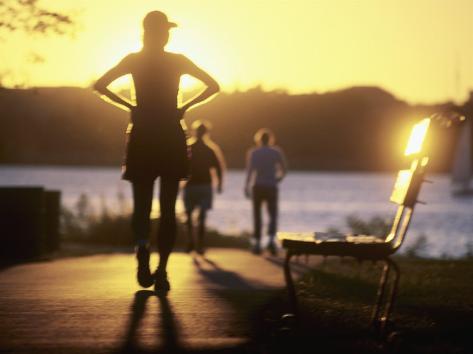
Alyssa Enjoys A Sunset Run Along the Charles River
(Okay, that's not Alyssa, but it is the Charles --
Sure Beats Running Along the FDR/East River! :)
Fast-forward to 2008, I ran my first NYC Marathon (my first marathon ever!) and upon finishing offered Alyssa a challenge: run the Disney Princess Half Marathon with me the following spring. We both grew up in a Disney-loving household so it only seemed natural to return there for her first half-marathon. I mean, who wouldn’t want the chance to run through Cinderella’s castle!?! Alyssa took this challenge on gamely. Over the course of the next few months Alyssa, who was living in New Orleans at the time, gradually re-introduced herself to running with dedication and focus. I even dragged her to Flyer Tuesday night speedwork sessions a few times when she was back in NY on long weekends. Alyssa wound up finishing her first half in Disney that spring with great success and from then on running also became a huge part of her life.

NYC Half 2009
(Dad In The Middle
Raced It, Too!)
Lucky for me, Alyssa moved back to NYC in the summer of 2009. Since then, it has been an awesome experience to train with my sister and watch her blossom as a runner. The park, not surprisingly, is our home away from home. Additionally, we have run many races together, not only here in NY but in many cities along the East Coast: the Cherry Blossom in DC (when I was sick with the stomach flu), the Rock and Roll Half Marathons in Philadelphia and Rhode Island (absolute pouring rain), the Boston 10K and another Disney Half-Marathon to name a few.

After NYC Marathon 2009
Greeted by Alyssa -- Still Wearing Her Disney-Half Princess Crown!
After having Alyssa as my designated post-marathon pick-up person the past few years, saving my parents from seeing me in a half-delusional state barely able to stand up, Alyssa ran her first marathon this fall. We ran together weekly as she prepared for NYC last November. It was incredibly important to me to be able to part of her training and she was a huge motivating factor in my choosing to run NY again, as well. Without being overly cheesy, I can say it was a real moment for me to be out in Fort Wadsworth with her as she was about to run her first marathon. Then to meet her at the end, to see she finished strong (in 3:23 nonetheless!!), was just so special. I was/and remain, so proud. This all made what was a personally hard year of running in 2011, due to injury, still a great year of running for me.

Alyssa and Julie:
"We Got Our Medals, But Where's the Crowd?"
Being the older sister, I am always secretly excited when Alyssa and I are asked if we are twins while running together. Seriously, though, I am incredibly blessed to have her as part of my running life. She motivates me to keep running and encourages me to stay positive when things are tough, as they were this past year. She helped me re-discover the fun in my running again; it had somehow gotten lost. I am lucky to have her as my cheerleader and part of my support team.

Post-Boston 2011
When she started back running in 2008, Alyssa was putting in 9 minute miles on the treadmill in the Tulane gym. This February she was the 6th overall female finisher in the NYRR Gridiron 4-miler! It is not always an easy experience to see a sibling out-achieve you in a sport -- it must have to do with something embedded in our DNA code I suspect. But I am just so proud of everything Alyssa has done in the relatively short time that she has been a runner. I cannot wait to continue to see where this running journey takes us both. The Mini 10K, though, will have to wait another year as this June 9th, the next running of the Mini, will be Alyssa’s wedding day! Not surprisingly, she is marrying not only a wonderful, lovely man but one who is also a kick-ass runner himself. Just don’t hold it against them that they are NY Harriers.

-Julie C.

Read more...

Saturday, March 10, 2012

RUN LESS RUN FASTER – “3Plus2” Training Program

Joe J
While recovering from yet another marathon training injury, I decided to rethink my approach to training. Running five plus days each week and logging high mileage was starting to take a toll on my 50+ year old legs and I was getting injured during each training season.

Looking for a new training program that would get me back into marathon shape without so many injuries, I discovered and read RUN LESS – RUN FASTER (ISBN 1-59486-649-X). The philosophy is that most runners do not train with purpose. “A training plan that fails to incorporate different distances, paces, and recoveries means that the runner will not reach their potential.” Nor will they garner maximum benefits from their training time. By focusing on efficient, purposeful training, the “3Plus2” program substantially reduces the risk of injury while producing faster race times.


After making a decision to try this new program, my training included three quality runs each week plus two cross-training workouts. The three runs, speed work, tempo run, and the long run are designed to work together to improve endurance, lactate-threshold running pace, and leg speed. The “3Plus2” program prescribes specific paces and distances that are based on a runner’s current level of running fitness. Each run has a specific goal and there are no “junk miles.”

My goal was to re-qualify for the Boston Marathon at the new faster qualifying times, while not getting injured in the process. Despite being somewhat concerned that the total mileage may be too low, I was willing to give it a chance. I did speed work on Tuesdays (sometimes on the treadmill), tempo runs on Thursdays, and long runs on the weekend. On the non-running days I would either swim, take a spin class or cycle. I did very little racing during the 16 week training program. The non-running days gave my legs a chance to recovery so that I felt ready for my next run.

I was extremely pleased with my results. I ran a half marathon PR three weeks before running my first sub-3:30 marathon. Most of all, I stayed injury free and my legs felt strong.

- Joe J.

Read more...

  © Blogger templates The Professional Template by Ourblogtemplates.com 2008

Back to TOP