
Breakfast of Champions
 |
| Reyna F |
Why is breakfast
important?
It is the most important
meal of the day for several reasons:
·
Increases mood and performance
·
Boosts energy levels
·
Allows for healthier eating throughout the day
·
Increases concentration
Is this based on
scientific evidence?
Yes. A number of studies
have found that all age groups have better mental acuity when the brain has an
adequate supply of fuel. The brain uses glucose as its main fuel, and that
means the brain needs carbohydrates. Often it is difficult for a person to tell
that their brain functions worsen when blood sugar drops, partly because they
are not thinking as straight as usual. But studies point out that speed and
accuracy of recalling information do decline.
A study from the Sussex Innovation Centre, Brighton, UK found that eating breakfast improves people's mental performance. Sixty one percent of test subjects showed improvements in English and mathematics tests after eating breakfast. Hand-eye coordination was also improved. Breakfast eaters also showed a reduction in anxiety levels when faced with stressful situations.
According to the Georgia Centenarian Study, people who regularly eat breakfast have lower rates of Type 2 diabetes and are less likely to develop heart failure over their lifetime than those who don't. This 21-year study of older Americans suggests that regularly eating breakfast may lead to a longer-than-average life span. These are only two of the many studies that provide positive relationships linking breakfast with wellness.
A study from the Sussex Innovation Centre, Brighton, UK found that eating breakfast improves people's mental performance. Sixty one percent of test subjects showed improvements in English and mathematics tests after eating breakfast. Hand-eye coordination was also improved. Breakfast eaters also showed a reduction in anxiety levels when faced with stressful situations.
According to the Georgia Centenarian Study, people who regularly eat breakfast have lower rates of Type 2 diabetes and are less likely to develop heart failure over their lifetime than those who don't. This 21-year study of older Americans suggests that regularly eating breakfast may lead to a longer-than-average life span. These are only two of the many studies that provide positive relationships linking breakfast with wellness.
What should I eat for
breakfast?
The structure of your breakfast will impact your performance
for the day whether it is running or working.
You need carbohydrates and “good” fat for fuel, protein for your cells
and muscles, and fruit and/or vegetables for antioxidants and overall
health.
The type of carbohydrates will be dependent on whether you plan on running soon after the meal (within 1-4 hours) or running off to work. If you doing a training run or race, your breakfast should be low fiber and moderate-high glycemic. Why? The low fiber is easier to digest and will prevent gastrointestinal issues during your run. Moderate to high glycemic carbs will give you quick energy to fuel your run. How much you burn while you run is based on several factors: the effort and your body’s efficiency to burn fat versus carbs.
The type of carbohydrates will be dependent on whether you plan on running soon after the meal (within 1-4 hours) or running off to work. If you doing a training run or race, your breakfast should be low fiber and moderate-high glycemic. Why? The low fiber is easier to digest and will prevent gastrointestinal issues during your run. Moderate to high glycemic carbs will give you quick energy to fuel your run. How much you burn while you run is based on several factors: the effort and your body’s efficiency to burn fat versus carbs.
If your morning race is running to the subway, then a high
fiber, low glycemic breakfast is what you want to fuel your day. This will keep
your mind and body alert and active for the challenges that you will encounter
at work or school.

Is it ok to skip
breakfast if you do a quick training run (less than one hour)?
Yes.
Afterwards enjoy a high fiber, low glycemic breakfast.
How much should you eat for breakfast?
If you plan on eating breakfast before a run, for every hour between eating and exercise, consume just under ½ gram of carbohydrate for every pound that you weigh (about 1 gram per kilogram of weight). Small amounts of “good” fat protein can also be included, but try to keep fat intake low as this will slow down digestion time. If you plan on running off to work, consider a healthy breakfast that is approximately 500 calories (more or less depending upon your weekly exercise and weight goals). See my examples below for breakfast ideas.
How about some
breakfast examples?
Vegetable Scramble
 1 whole egg
2 egg whites
½ cup spinach
½ cup sliced mushrooms
2 slices of whole wheat bread
Beat the whole egg with the egg whites. In a non-stick pan,
scramble the ingredients together. It is
that easy!
Calories 415, Fat 10g, Carbs 50g, Fiber 8g, Protein 28g
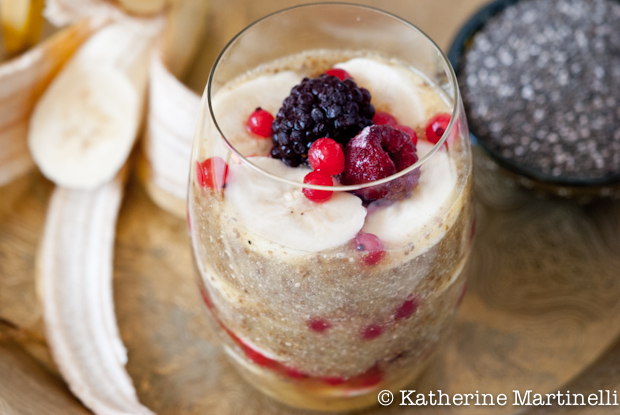
8 ounces Greek yogurt
1 tbsp. Chia Seeds
1 medium banana
½ cup blueberries
Mix it together to make a tasty breakfast or post long-run
recovery snack.
Calories 350, Fat 4g, Carbs 52g, Protein 28g

1 cup nonfat milk (or soy, almond, rice, hemp milk)
¼ cup Steel cut oats
1 tbsp. Chia Seeds
½ cup blueberries
½ banana
1/8 cup walnuts
Prepare the Steel Cut Oats according to the directions. Then
add the additional ingredients for a healthy and delicious breakfast.
Calories 491, Fat 16g, Carbs 74g, Protein 21g

1/2 cup chopped Walnuts
1 cup Whole Wheat Flour
1 cup Whole Wheat Flour
1 tsp. Baking Powder
½ tsp. Baking Soda
½ tsp. Baking Soda
3 tbsp. Chia Seed
½ cup Oat Meal -dry
½ cup Yellow Cornmeal
3 tbsp. Flaxseed Meal
2 cups nonfat Milk (or soy, almond, rice, hemp milk)
½ cup Oat Meal -dry
½ cup Yellow Cornmeal
3 tbsp. Flaxseed Meal
2 cups nonfat Milk (or soy, almond, rice, hemp milk)
1 whole egg
1 cup Mixed berries
1 sliced Banana
1 cup Mixed berries
1 sliced Banana
Heat up your griddle.
Mix together all the dry ingredients. Then add the milk and egg. Stir together. Add Fruit. Stir together. Then pour onto
griddle. Flip when bubbles appear on top.
This recipe is supposed to serve 8, but with a runner’s
appetite, it is closer to 4 servings.
Calories 432, Fat 16g, Carbs 50g, Protein 22g

This family recipe was shown on Rachael Ray, prepared by my
son Marc when he was 8 years old.
·
Slice a banana into thins slices
·
Beat together 2 whole eggs, 2 tbsp. of milk, a
drop or two of vanilla extract
·
Dip whole wheat bread in the egg mixture (or
challah bread if you want to the less healthy, but more authentic recipe)
·
Place the bread on a hot griddle
·
Place one layer of banana on top of the bread
·
Flip bread carefully when side one is slightly
brown, the banana will caramelize while cooking on the opposite side
·
Remove the Banana French Toast carefully when
done.
Enjoy! The sweetness from the caramelized banana eliminates
the need for syrup.
Don’t have time to
cook?
Here are some quick and easy ideas:
Here are some quick and easy ideas:
·
Whole grain cereal, nonfat milk (or soy, almond,
rice, hemp milk, berries and chia seeds
·
Whole wheat bread, peanut, cashew, soy or almond
butter, whole fruit jelly or honey, and a banana
·
Egg salad, chia seeds, whole wheat bread,
lettuce and tomato
·
Last night’s leftovers
Your mom was right. Don’t leave the house without eating
breakfast. If you need more advice on
breakfast or anything else related to nutrition, wellness or exercise, contact
NY Flyer member Reyna Franco, registered dietitian, personal trainer, board
certified specialist in sports dietetics, www.reynafranco.com,
Reyna@reynafranco.com
-Reyna F
-Reyna F


0 comments:
Post a Comment