Saturday, September 22, 2012

Yoga For Runners

Stephanie T
When I started training for my first marathon nearly five years ago, I would rarely stretch after a run, let alone take a yoga class. I thought that stretching was unnecessary—my leg muscles always felt tight and sore post-run, so why spend time stretching in an attempt to loosen them when they would tighten after my next run anyway?

I discovered the importance of yoga the hard way when I suffered from sharp shooting pains near my groin only three weeks before the New York City Marathon in 2008 from a pulled groin. A groin pull occurs when the adductors, or muscles in the inner thigh, are stretched beyond their limits.  Such an injury often results in small muscle tears that cause pain and swelling.

After weeks of R.I.C.E. (rest, ice, compression and elevation) and taking a break from running altogether, my groin pains magically subsided before race day.  However, I learned that increasing one’s flexibility, muscle strength and core stability, thereby correcting muscular imbalance, are imperative to injury prevention.

As endurance sports coach, Sage Rountree, author of The Runner's Guide to Yoga (April 2012) writes in Runner’s World:
“Running injuries come from imbalance. Occasionally it’s a literal imbalance, as in the case of a fall on the trail; yoga’s balancing poses can help there. But usually the injury is one of muscular imbalance between the quads and the hamstrings, the hip flexors and the glutes, or the legs and the core. Yoga poses work to correct these imbalances so that the whole body functions at an optimal level. Beyond that, yoga gives us tools to tune in to our body’s needs, so that we can find the right balance between training and rest. This is key for preventing overtraining and burnout.”
The practice of yoga helps us increase our awareness of alignment, range of motion, breath control, agility, flexibility and strength, which will help us continue to run long and hard for years to come.

My perspective on yoga has certainly changed dramatically since 2008—I’ve delved into my yoga practice, received my 200 hour yoga teacher certification, and opened my own yoga studio, Sacred Sounds Yoga, in Greenwich Village. 

The following are a few of my favorite yoga poses for runners:

Calves: Downward-Facing Dog (Adho Mukha Svanasana)

Core: Crow Pose (Bakasana)


Hamstrings: Wide-Legged Forward Bend (Prasarita Padottanasana)

Hips: Bound Angle Pose (Baddha Konasana)

IT Band: Pigeon Pose(Eka Pada Kapotasana)

Plantar Fascia: Hero Pose, Tucked Toes (Virasana)

-Stephanie T.

Blogmaster's Note: Sacred Sounds Yoga (Stephanie T's studio) is offering two workshops ($20 for one and $35 if you sign up for both) dedicated to runners to be held at her studio on Sunday, October 14th:
  • ChiRunning with NY Flyer Joel Matalon (click here for his website) from 11:30-1:00pm; and 
  • Yoga for Runners with Narisara Vanichanan from 1:30-3:00pm. 
For more information on classes and workshops at Stephanie's studio, please click HERE .

And for prior NY Flyers Blog entries on yoga for runners, please click HERE.


Read more...

Sunday, September 16, 2012

Ironman Race Report - Bienvenue Mont Tremblant!

Vicky T
One of my most favorite things about running (and swimming and biking…) is that it provides the opportunity to travel to a ton of great places and see them from a different vantage point.  To me there is something really amazing, in a world filled with increasing amounts of technology, to be able to power your own body across the land – a marvelous perspective.

So my latest adventure took me to Mont Tremblant, Canada for the inaugural Ironman Mt Tremblant. 

Note:  This is not a traditional race report but more of my take on the course and area for those that may be interested in doing the race in the future.

PRE-RACE

Mont Tremblant is a quaint, French-speaking city about 130K northwest of Montreal nestled in the Laurentian mountains of Quebec, Canada.  It’s part of the second largest national park in Quebec, aptly named, Mont Tremblant National Park.  The area is most widely known for its skiing; however the rolling terrain with hundreds of lakes and rivers makes it a nature lover’s paradise.


The pedestrian village proper is at the base of Mt Tremblant which is located next to one large lake, Lac Tremblant.  The city also consists of the Village of Mt Tremblant (on an adjacent lake) and Saint Jovite.   With an abundance of beaches, trails, running and bike paths, it’s a triathlete paradise.

Village of Mont Tremblant  –  So Picturesque, Oui Oui
I stayed nearby at the Village of Mt Tremblant, about 5K from the transition area.  This allowed for a condo with a kitchen and laundry, which are high on the requirements list.   My one gripe with the logistics is that if you do not stay on the ski mountain, you must hunt for convenient places to park, most of which have hourly rates similar to the streets of Manhattan.  The days leading up to the race were beautiful – chilly mornings with sunny afternoons in the 70’s.  This was a huge change to get used to after leaving the humidity of NYC and had me a bit worried that it would be difficult to warm up on race morning.  But with bikes and gear bags checked, along with a good night sleep, I was set to start the race and had everything in order.

SWIM
  
The 2.4 mi swim was one loop in a lake with a ton of room and a wide beach start.   The practice swims provided clean, smooth water that was a pleasure to swim in and race day did not disappoint.    There was the usual craziness that surrounds a mass start so I did have some difficulty getting clear water and finding my rhythm, but once I did the swim went off without a hitch.
Mont Tremblant's Crowded Race Start
Upon exiting the swim, there was a 400 yd run to transition, which felt so nice after being horizontal for a bit of time, but it made for a long T1 (first transition).

BIKE

I had a feeling that Mt Tremblant was going to be a supportive venue, and as I exited transition my suspicions were confirmed.   The roads were lined with enthusiastic spectators for miles.  Overall, this was an amazing bike course.  The roads were super-smooth with fresh pavement in some areas.  I even saw some sections of the bike course being power-washed in the days leading up to the race.  It’s amazing what a huge difference fresh pavement makes – it’s so much more forgiving on the body and quite speedy – very needed for a long 112 mi day.


The bike course is two loops and can be thought of in five sections per loop.  The first section is down Montee Ryan to 117 (about 10K).  The section has a few decent rollers but easy enough to get momentum to take you from one to the next.   It also contains the first ‘no pass’ zone as it crosses over a narrow bridge.   It’s well marked and I never had to worry about overtaking another rider.  The next stretch is from 177 out to Labelle and back (38K total).   This is a wonderful section of freshly paved road with an extra wide shoulder.   This is where you can dial in your aero position and get in your groove.   There are one or two larger climbs where you do have to get out of aero but nothing significant.  This is where I really found my pace and was just loving the scenery.    

The next section takes you through an out-and-back on the main street of Saint Jovite, a lovely village that has the best restaurants and grocery stores.  This stretch of the course is quite narrow and lined with spectators.  The turnaround has a short steep climb, but then has a good downside to hammer.   There is also another no-pass section in this stretch.

Main Street, Saint Jovite
After finishing up in Saint Jovite, the bike heads back from 177 to Monte Ryan towards transition, the opposite of the way out.  However, once hitting transition, there is one last out-and-back of about 20K, the Lac Superieur loop, which is arguably the most difficult part of the course.  It’s a continuous series of short, tough climbs that require the use of every single gear.   For those who bike in the NYC area, it’s very similar to the climbs that head out to the apple orchard.  The out portion is a bit more uphill in steps and the return is some great downhill.  This section is pretty tough on the second loop but I was happy to have paced well and felt pretty good.  My nutrition plan was spot on and the aid station placements were just right.  One fun note is that the aid stations had hockey nets to throw your empty bottles – after all it’s Canada, eh? Next stop was T2 and I was eager to get out on the run.

RUN

Similar to the bike, the run is a fair course.  A mix of rolling climbs and flats but nothing crazy.   The run is also two loops with out-and-backs and turnarounds. The first 5K portion is a bit hilly with a decent climb, short but steep, just out of transition. Then the rollers take you out to the packed dirt rail trail.   It’s a 10K out-and-back, which is a great surface but a bit narrow.  This is where I hit my groove and began to knock off some steady miles.


It also was a nice opportunity to say a hello to my buddies who were racing.  The end of each loop wraps through the ski village and the last 1K is completely lined with spectators cheering so loud that you can barely hear yourself think!  It made for an amazing finish!!  My run pace tapered a bit at the end and although not a PR, I was happy with my effort and in hindsight I know that I have a bit of work still to do on my biking.

RESULTS
  • Swim - 1:13:22
  • T1 - 7:13
  • Bike - 5:53:57
  • T2 - 3:34
  • Run - 3:45:54
  • Total - 11:03:58
POST-RACE

Poutine, Anyone?  –  Yum!
Not to be outdone by the finishing chute, the post race food area was first rate.   There were subs, pizza, beer and the Canadian specially, poutine – French fries covered in gravy and cheese curd.   A must try if you visit…  Then to top off the evening, a fireworks display lit up the sky.   A perfect ending to a great day!!

-Vicky T

Read more...

Monday, September 10, 2012

LTR: Manhattan Parks 20 Miler


By Papa Bear (a.k.a. Richard G)


This is a long training run of 20+ miles I've done with friends.  Actually we've done it a few times, and sometimes we've done just the northbound portion and sometimes the southbound portion.  The photos are from several different runs, so some will be sunny, some will be rainy.  It's all good! 
I hope to contribute a report of this sort to this blog every month or so.  They all follow the theme “Beyond Central Park” and are aimed at the runner who is tired of going round and round the park when you need those long runs in preparation for a marathon.  I love the park, but I also love to get out of it when I can.  Usually all you need is a Metrocard  and a spirit of adventure.

Although I put this report together in June 2012, I first did this route with my friend Melissa in late March, the first long run of spring, and it was beautiful. The flowering Trees were just gorgeous and the running route was spectacular. The route is actually a combination of two runs I had done previously, but to connect them together I made a few changes (such as starting at the Boat House in Central Park instead of Carl Schurz Park, and staying in Manhattan instead of going up to the Bronx). Those two runs are great runs in and of themselves, so consider doing them sometime. I've also kept the directions a bit sparse, but I think they are sufficient to keep you from getting lost. They were reported originally in the Newsletter and are now on my web site and they might be worth a read if you are so inclined.  (Carl Schurz Park to Wave Hill  /  The West Side Run).
Here is a Google Map of this run you can check (Full Size Map.).  It can be useful or even essential if the directions are unclear, especially when running from one park to the next. You can leave it in another browser window and jump back to it if you need to. 
I call this run the "Manhattan Parks 20 Miler" because it goes up to the northernmost point in Manhattan and back, almost exclusively in parks. It's true you could go over to Riverside Park and run up to the top of Manhattan and then turn around and come back (that's in fact, what "The West Side Run" does), but I like to cover more territory and hit every park just once. If you count all the parks both coming and going (not counting Riverbank State Park, which you go under), I think you get 11. That counts the little stretch along the Hudson at 125th Street as a park, since the sign says "West Harlem Piers Park". And guess what — I ran on one of those piers. And the real point is to minimize the distance run on city streets. In this run, the longest you run on the streets is getting from Riverside Park back to Central Park on 72nd Street. All other connections are just a few blocks. And to run over 20 miles in Manhattan through 11 parks (and not repeat any part of the route) — that's pretty darn good.
The running was made much more enjoyable than say, loops in the park, since almost all of the parks were nearly empty (except for bike riders along the Hudson portion), and the trees had that in-between look where the green buds were out, but few leaves, so you could still see the "backbone" of the terrain. And on the way up that meant steep drop offs and rocky outcrops. The site of St. John's Cathedral above Morningside Park or City College above St. Nicholas Park or High Bridge Tower above High Bridge Park or the Cloisters above Fort Tryon Park or the George Washington Bridge over the Hudson River — all of them, the next after the next after the next — made the juxtaposition of the natural beauty with the man-made beauty startling. Only in New York!
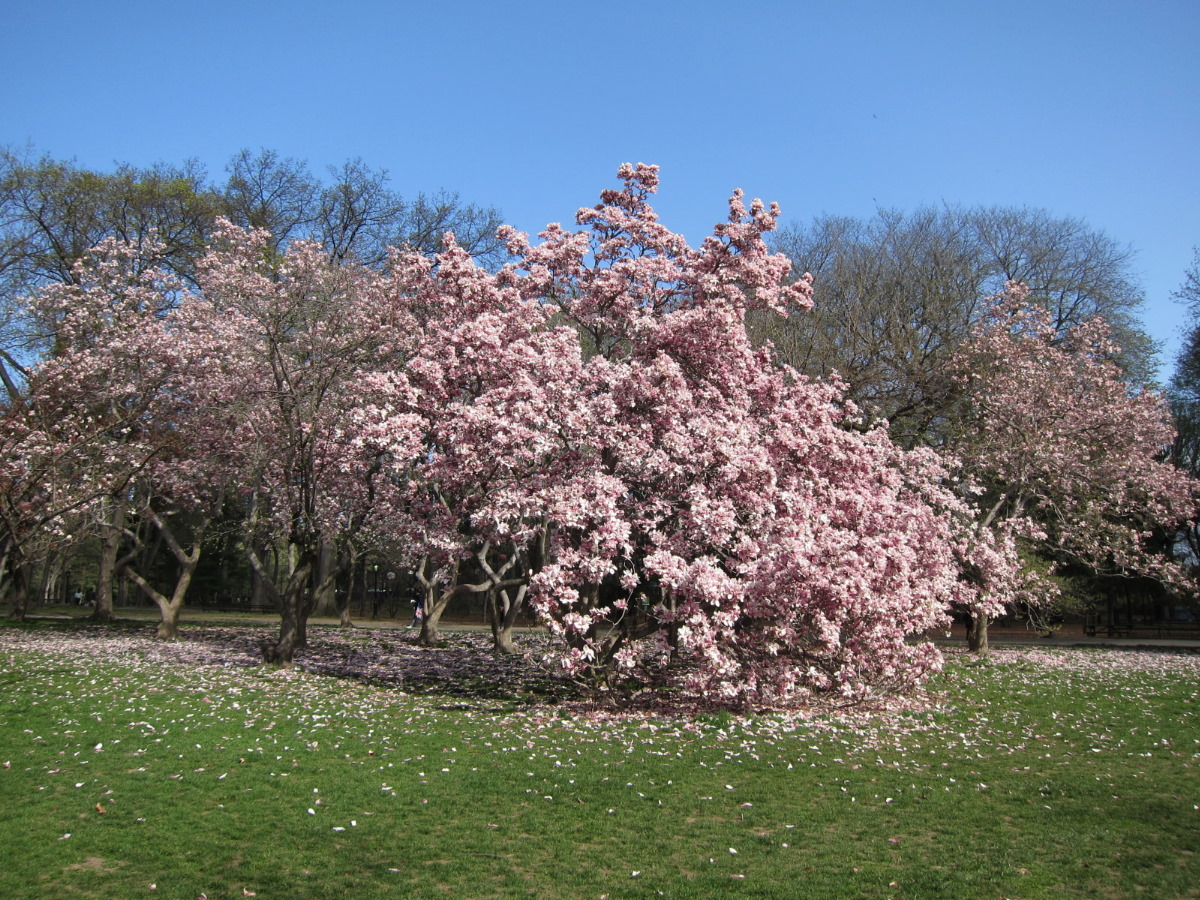
As I mentioned, the run was the first long run of spring, which began the Tuesday before. And the city was really getting into spring. Callery Pears in bloom lined the streets as I walked to the park from the subway. Central Park's trees finally have green buds — if not real leaves — on all the branches. The Cherry Trees were making a good start (although I'd give them another week) and the Magnolia trees were literally exploding! The parks further north were not quite as far along, but they have definitely made progress in the last week. And the weather, which was forecast to be chilly and rainy, was quite nice: temperatures in the 50°s and partly sunny. Just about a perfect day to be out there.

Details

This blog should be considered a “teaser” since space limitations prevent us from including many of the details of the run from park to park to park.  A full accounting of these details together with embedded maps and slide shows is included on my web site.  Please visit this web page for the full report: Papa Bear's Manhattan Parks 20 Miler

Manhattan Parks Northbound: Central Park to Inwood Hill Park


                                           Central Park Magnolia Tree

A glance at a Manhattan map, such as the one linked above, reveals a remarkable fact: many of the parks line up with each other and follow the street grid along the length of Manhattan in an almost straight line. This is not accidental — it's the geography (or the topography, to be more precise). Manhattan is built on a series of long, high rocky ridges and outcrops (called escarpments) which have survived the overlay of the street grid. In many cases the terrain was simple too steep and rocky for laying out streets and those areas became parks. In particular, Morningside, St. Nicholas, Jackie Robinson and High Bridge Parks are all built along the same escarpment, or ridge line, and the gaps between them are generally only a few blocks long. Gorman Park lies on the other side of the same ridge and Fort Tryon and Inwood Hill Parks lie to the west on another ridge line which extends into The Bronx where it provides the "backbone" of Riverdale. We ran through these "Escarpment Parks" on the northbound section of this run.

The turnaround point was at the very northern tip of Manhattan, underneath the Henry Hudson Bridge in Inwood Hill Park overlooking the Harlem River Ship Canal, with the Spuyten Duyvil section of the Bronx visible across the water.

Manhattan Parks  Southbound: The Hudson River Parks

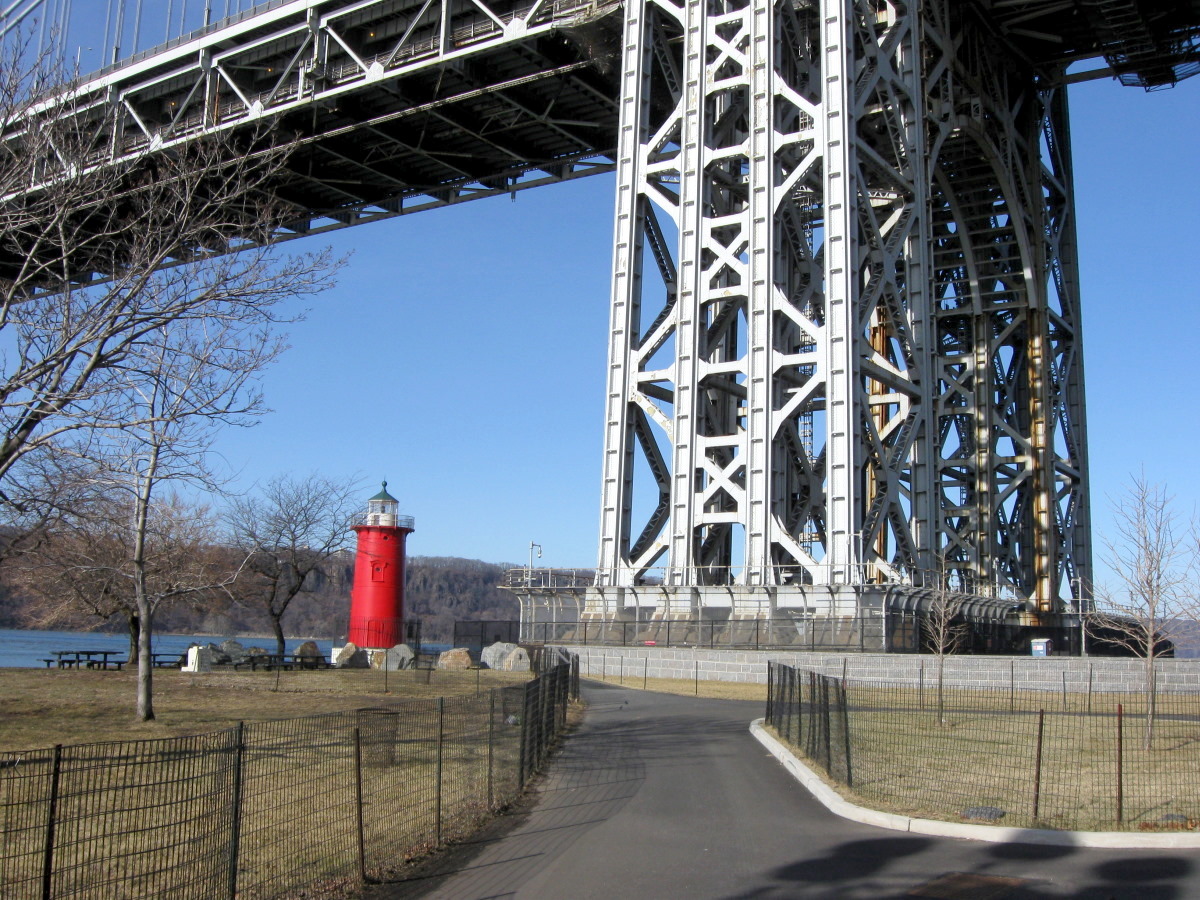
The Little Red Light House and the Great Gray Bridge

The return run was pretty much entirely along the Hudson River, or close to it. The route traverses Inwood Hill Park (from the tip of Manhattan to Dyckman Street), Fort Washington Park, Riverside Park and back to Central Park. But let's not forget Riverbank State Park (which we ran under) and West Harlem Piers Park, a recent creation. 

A note on Fort Washington Park and Riverside Park: I used to think of the entire strip of park along the Hudson from 72nd Street to Dyckman Street as "Riverside Park". In fact, the park, together with Riverside Drive, was originally laid out by none other than Frederick Law Olmstead. The drive was eventually extended to Dyckman Street (north of 181st Street it was taken for the northbound lanes of the Henry Hudson Parkway in the 1930s). Remnants of the old boulevard remain in the promenade and the pavilion (named "Inspiration Point Shelter") at around 190th Street. This far northern part of Riverside Drive still exists as a short segment of road from the Dyckman Street exit of the HH Parkway east to the intersection of Dyckman Street and Broadway. But as for the park, officially, the strip of the park north of 158th Street is called Fort Washington Park. So although 125th Street or the GWB might seem logical places to separate the two parks, it is 158th Street which goes completely unnoticed when you traverse this boundary. 


Putting it All Together

My legs and my running had felt good all the way up. But on the way back I started to feel first a tiredness and then some soreness in my legs. And on the long stretch of Riverside Park where there is little or no shade, I started to feel the affects of the sun. Fortunately, the tempratures stayed in the 50°s, so this did not get bothersome. But it brought back some unpleasant memories of a few of last summer's death marches along this same stretch. Remind me never to train for a marathon in the summer in New York City again! But enough of what hurt or what was sore.

When I finally got back to Central Park, I wasn't sure of the mileage, so I did the lower loop of the park rather that cutting straight across the 72nd Street transverse. It turns out I didn't need to do this since I ended up with over 21 miles. But it was good to know that I felt just as strong that last extra mile as those leading up to it — subject, of course, to the aforementioned aches and pains. When I finally got back to the Boat House I had a nice sit down, drained my hydration pack and then made my way over to 79th & Madison for some French Toast at the Nectar Café. Having lunch solo is no more fun than running solo, but my body appreciated the replenishment.
The return trip down along the Hudson was curiously just the same as the northbound section, namely 10.7 miles.  That makes he final mileage (including the lower loop)  21.4 miles. If you decide to just run across the transverse to the Boat House (wimp! :) it would be 20.4 miles, just about a mile less.

Full Report with Details

And to repeat a note (above), a full accounting of the details of this run together with embedded maps and slide shows is on my web site.  Please visit this web page for the full report: Papa Bear's Manhattan Parks 20 Miler

If you are hoping to do this run , but are not sure of anything, feel free to email me at papabear.newyork@gmail.com

And please check out my web site which has lots of other runs plus race reports and assorted odds and ends: Papa Bear's Beyond Central Park

- Papa Bear (Richard G)

Read more...

Tuesday, September 4, 2012

Flyers MTP: Worth Every Cent!

Dana M Reports on MTP
I've heard great things about the Flyers' Marathon Training Program (MTP) since it began last year, and it didn't seem like any coincidence that so many people I know who participated in the initial sessions suddenly got a lot faster and started hitting hefty PR's. I had already felt for some time that while I've continued to improve my marathon times on my own over the years, I had just about reached the limit of what I can achieve on my own. After seeing what the Marathon Training Program did for so many other people, when the program rolled around again this summer, signing up was a no-brainer.

The Summer/Fall 2012 MTP session offers twenty coached sessions and individual one-on-one coaching for $299. The coached sessions, led by Head Coach Todd W — and supported by Assistant Coaches Evelyn K, Kari S, Neal P, Rob B, Marianna B, and Joe Y — are divided by group, with pace targets and distance assigned for each group individually.

MTPers Charge Up Hill
The coaches made initial group assignments based on prior knowledge of the participants where applicable, along with information supplied in participant surveys conducted before the MTP began.  It's easy to move from one group to another in order to find the most appropriate fit for overall speed and fitness level.
And Jog Back Down for Next
Hill Repeat

The workouts include 600 to 800 meter intervals, 100 to 200 meter sprints, hill repeats, VO2 max and more. Workouts for the rest of the week set between each runner and his or her coach on an individual basis.

 
It's easy to see that the coaches keep closely in touch with each other so that they work together as a team.  Todd also makes a point to explain the objective of each workout and addresses questions and concerns with the group as a whole during each session.

Coach Todd Providing Pre-Workout Instructions
Workouts are scheduled every Wednesday evening, cancelled only by lightning, and there's a full calendar of coached long runs during the weekend throughout the summer and early fall training season.

While the Marathon Training Program sounded like a bargain from the beginning, it's easily exceeded all my expectations, and much of that is due to the really outstanding coaching advice and support from Coach Evelyn. From the beginning, Evelyn listened carefully to what I had to say about my goals and running history, and made a point of incorporating strength training (a priority for me) into my plan.

Coach Evelyn (right) at MTP Long-Run Advises Katie H
While I made it to the first workout, during which I was truly humbled by sprints of just 100 and 200 meters, my summer travel schedule resulted in missing the next three sessions. Evelyn worked closely with me while I was away to make sure that I had workouts that were appropriate for the available terrain (many hills) and my schedule, and I got through those three weeks without falling behind the rest of my group.

The best part about coming back to the workouts after being away was the opportunity to run with a big group of fellow Flyers who believe in working hard, having fun, and encouraging each other as much as possible. There's a huge difference between running speed workouts with a group and doing it alone, and I'd pick doing it with a group every time.  As the program progressed, I found that both my speed and endurance were increasing, and it was easy to see that most other participants were experiencing similar benefits.

MTPer Rachele A Strikes a Steel-Armed Pose 
Thanks to Evelyn's encouragement and persistence, I also started doing something that I really despise: regular stretching. To my surprise, although the changes are incremental (because it's hard to undo thirty years of running without stretching overnight), my flexibility has noticeably increased. More importantly, however, when I started experiencing increasingly severe pain that eventually impacted my ability to complete long runs, Evelyn talked me out of ignoring it and into scheduling an appointment with a sports medicine specialist.

The outcome of that appointment was that I was diagnosed with a moderately severe injury, so I'm benched from running for a minimum of four weeks and a fall marathon is off the calendar. As soon as I emailed the bad news to Evelyn, she jumped right in with questions and ideas about how I can cross-train to maintain my fitness level and still fit into my pants during the longest running hiatus I've had in at least fifteen years. While I'm a little anxious about what the next few weeks without running will bring, without Evelyn's encouragement and willingness to draw up a battle plan, I'd feel a lot more lost.

While a fall marathon isn't going to happen for me this time around, I still think the Marathon Training Program is worth every cent and then some.

MTPers Head Off on Long Training Run


Taking a Much Needed Water Break

I haven't heard yet whether there's a winter session on the calendar, but I hope there is: with Boston and New Jersey on the calendar for 2013, I'll be the first one to sign up and do it all over again.

-Dana M

Read more...

  © Blogger templates The Professional Template by Ourblogtemplates.com 2008

Back to TOP