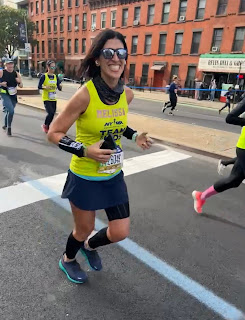
Endurance: The 2022 Antartica Marathon/Half Marathon
 |
| Michael R |
In 2017, I realized that I was within striking distance of running a marathon on all seven continents. Well, that is if you consider three out of seven already done as being within striking distance. Which I did. It was analogous to being 11 miles into a marathon and thinking “That wasn’t so bad, I’m almost done.” And so it became a new personal goal.
2017 was also the year Simone R and I became engaged and we were planning our wedding for 2018. Simone had become an avid half-marathon runner and the bulb went off -- honeymoon in Antarctica! At that point there was a four year waiting list for the Marathon Tours Antarctica Marathon/Half Marathon so we signed up for a guaranteed entry in 2021. Simone would run the half and I would run the full. It was a no-brainer for us to delay the honeymoon for an adventure like that so our honeymoon would wait until 2021 and that would be fine. It would also probably be my last continent by then. What could go wrong?

The year 2020 was to be the year of knocking off Africa (Carthage Marathon, Tunisia), South America (Galapagos Marathon, Galapagos Islands) and Oceania (Queenstown Marathon, New Zealand). My knees had slowed me down quite a bit but I could still pump out a marathon. Continent #7 would be Antarctica in 2021. That was the grand plan. And you know what they say about the plans of mortals.

It was shortly before my trip to Tunisia in February 2020 that things started going badly with respect to the rapidly spreading pandemic. As I was transferring flights in Rome on my way to Tunis, northern Italy was reeling and it was becoming obvious that life may not go on as normal for at least a while. The

Carthage marathon still took place and I secured Africa in my continent collection making my new total four. I was very lucky on that trip because it was only a few weeks later that international travel became almost impossible. As we all experienced, the remainder of 2020 would turn out to be a bust year for marathon running and so would most of 2021. While the running world was on pause the aging of my knees was not, unfortunately.
Needless to say I was not able to run any more international marathons during that period because they were canceled and our long-anticipated 2021 Antarctica trip was postponed until 2022. My next marathon after Carthage 2020 would be the 50th anniversary NYC marathon in November 2021. I thoroughly loved running that event but my finish time of 5:43 raised concern. The Antarctica marathon advertised a strict nominal finish cutoff of 6:30 on a significantly more challenging course and I wondered whether I would be able to finish under the cutoff.
The road to Antarctica leads through Bueno Aires and it was our first stop on this adventure. We were there for three nights as our group of fellow runners and their companions convened on our hotel from around the world. There were about 180 of us, in total. Simone and I arrived on Friday morning with no trouble and just had to navigate the required Covid testing before boarding our departing flight from New York. Little did we realize just how much such testing would come to overshadow every single day of this trip. But Buenos Aires was gorgeous and the weather was perfect for exploring on foot since we avoided public transportation or unnecessary exposure to people. We did a lot of walking and saw quite a bit of this beautiful, historic port city.


On Saturday night Marathon Tours held a banquet and welcome lecture for all participants. It was a bit unnerving to be among all of these people having dinner. Still, it was fun and the dinner was very nice. From Buenos Aires we were to fly down to Ushuaia, Argentina the southernmost city in the world and from there board our ship for the 2 1/2 day crossing to Antarctica. On Sunday morning, the day before the flight to Ushuaia, we were all tested for Covid before being allowed to leave our hotel the next day. The bad news came on Sunday afternoon for seven of us who tested positive. Simone and I were fine but these unfortunate people could not leave Buenos Aries and were forced to abandon our group. Of course this also raised alarms for many of us who were concerned about the exposure risk at the banquet since the seven who tested positive were almost certainly there, as well. But there we were and the dictum of taking life just one day at a time was never more apropos.


Monday morning we boarded our bus for the airport and the mood was quite sober. The seven who were not there with us were on many of our minds. We got on our plane, landed, and were taken once again for testing before being allowed to board the ship. Two more tested positive on this round of testing. We were also told that we would all be quarantined in our rooms for at least the first three days and tested every morning. The rest of the plan was left open-ended which was not terribly settling.
Those days of being quarantined on the ship were not as bad as they might sound. The room was beautiful and we had a relatively large balcony. No need for clothes, room service was really quite attentive and the food was pretty good. The sail through the Drake Passage, however, did not agree too well with Simone and she had a couple of rough days due to the rocking (which turned out to be nothing compared to the return trip!) But the hardest part was the daily Covid testing in the early morning and the subsequent afternoon announcement of results. On each of those days 2-3 new cases were found. But it wasn’t spreading like wildfire and the steps taken to quarantine us seemed to be working at limiting the spread.
On the fourth day we were free to leave our rooms. Though we were able to roam the ship the daily morning Covid testing routine never felt routine. It was always stressful until the afternoon results announcement was made and we would learn that we cleared another hurdle. The running event was only two days away and we had to make it that far. I wouldn’t mind being quarantined after that. But every day someone tested positive. At first it was only among the running group. Then it hit the crew but never in large numbers which was a comfort. It came to feel a bit like Squid Game if you are familiar with that series. We each took and passed 14 Covid tests while on this trip. Crazy.

The Marathon Tours Marathon/Half-marathon is famous for its improvisation. One year the weather prevented them from leaving the ship so they ran the races around the top deck. Another year it had to end prematurely because of unexpected bad weather and many could not finish. We heard many stories like this about last minute adjustments to the event which added to the sense of adventure.
In keeping with this uncertainty, our race was postponed by one day to take advantage of more promising weather. Race day started with a wake-up at 3:30AM for 4AM Covid testing. Very sadly two more from our group tested positive that morning and couldn’t join us. Race day weather, though, was near perfect. It was clear with no precipitation, sunny, somewhere in the 30s -- which is all very unusual for this part of the world so we really lucked out in this regard. I even had to stop for a few minutes to remove a layer of clothing. It was actually much colder in NYC that day!


Another feature of this event is that the course isn’t usually set until the day of the event. I don’t really understand how this works but much of it depends on which way the geo-political winds are blowing that morning because the race is held on the grounds of research stations belonging to different nations. The course itself is always very rugged and hilly.
Runners aren’t actually shown the full course map until the night before the race. Our course was a 4.4 mile out and back repeated three times for the half and six times for the full. It was a dirt surface that was rough, rocky, muddy, wet, uneven and crazy hilly. There was no flat portion on this course. Just up and down and up and down.


Simone toughed it out and successfully ran her half with great fortitude. Her 16th! Afterward, she said it was the most difficult, slowest half she has faced. I, after reaching the halfway point in 3:09, realized that my knee and the rest of me would not likely have tolerated a 6:30-7 hour marathon on this course and so, with discretion being the better part of valor I dropped down to the half and proudly accepted my medal. Therefore, rather than this being my 5th continent of marathon running it had become my 5th continent of half marathon or farther running.


Was I disappointed in this outcome? Yes, certainly. But in a strange way this course may have done me a huge favor and forced me to recalibrate my only remaining running goal by a notch. I think at this point in my running career I have to run less to be able to run more. C’est la vie.


I have saved the best and most memorable part of this trip for last- that was exploring Antarctica itself. No words can describe the stunning beauty and majesty of what we saw and experienced down there. Excursions from our ship were on inflatable 8-person Zodiac boats and we were out on two such excursions per day for the balance of the trip starting the day before the running event. On our first landing we didn’t quite know what to expect and we found ourselves bathed in raw nature, antarctic wildlife and indescribable beauty. Simone couldn’t stop crying for the first 30 minutes- it was that moving and I felt it, too.

Antarctica is the closest one can come on earth to the feeling of visiting another planet. It is that alien to our normal environments. I am at a loss for words to describe such alien beauty so I will simply end this essay with the pictures that we feel most capture the essence of this remarkable place.


Our journey home was relatively easy and uneventful with the notable exception of the 20-25 foot waves with swells up to 30 feet on our return voyage through the Drake Passage. Poor Simone. People were actually tossed out of their beds with their beds flipping over on them. That was a real 2-day roller coaster ride. We then spent a few hours in picturesque Ushuaia nestled in the mountains, another beautiful day and night in Buenos Aires (along with a few hours in a tattoo shop to commemorate our first equatorial crossings), passed our final Covid test and flew home to frigid New York City 😊
-Michael R.