
Training for Boston - A Bit of a Slog
by Papa Bear

But training is training no matter the motivation, and I have been putting in the miles and hours needed for a successful marathon.
However, this year, things were not easy for a number of reasons and it was probably the toughest marathon training I have ever done.
But I'm tapering now, and feeling good and expect a good race, so you can put these training issues in context and wish me luck on April 21st.
The Polar Vortex and Other Nasty Stuff
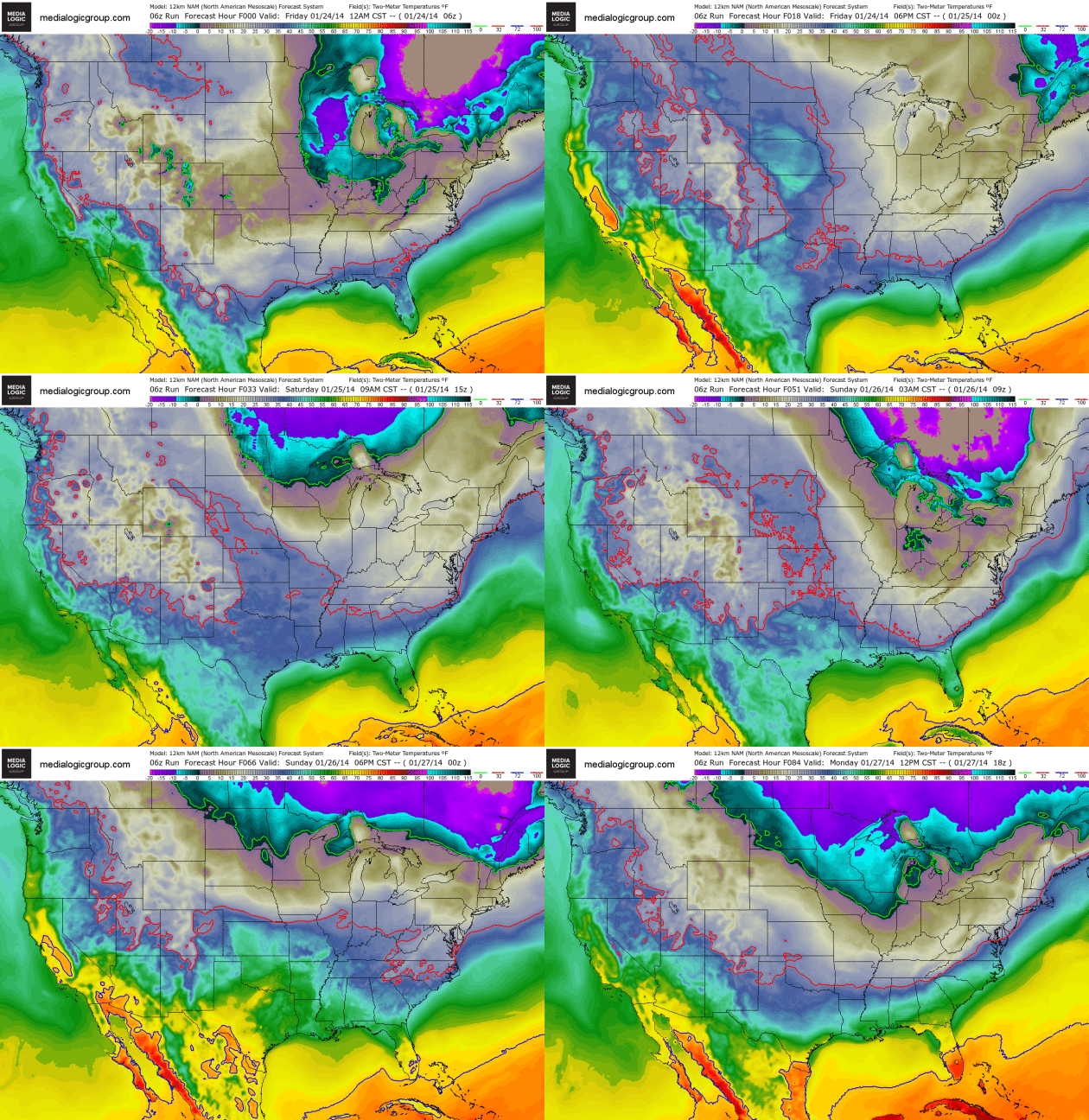
And the usual crowd of Global Warming deniers were quick to make fun of this as clear proof that if our weather was getting colder, then Global Warming must be a hoax. And of course the other side vehemently pointed out that the Polar Vortex, proved Global Warming was happening since it was warm air at the pole that was pushing this cold vortex south.
Most of the runners I talked to agreed that this was the worst weather for training they had experienced in a long while, or ever. I tried to keep to my training plan but ended up skipping a run here or there. The two races I ran (see below) were very cold — 16° and 23° — and one long run in the frozen snow was very sketchy. I tried to do some runs on the treadmill, but soon gave up. I guess I'm just an outdoors kind of guy.
But with the arrival of April, it seemed like spring was finally arriving. Early flowers bloomed in Central Park and I could at last run without wearing 2 or 3 layers.
Maybe it was all just a bad dream ...
January to March: Pains and Doctors
From the very start of my training, in fact for almost a year, I had been bothered by tightness and soreness in the right hamstring. Typically this caused a slight tightness during the first mile or two of a run and then later a soreness which eventually would necessitate stopping and massaging and stretching the problem area. This was manageable, but just barely, and seemed to be slowly improving. One thing that may have helped was a gradual evolution of my foot strike from the heel to the mid foot. But it was frustrating that what should have been a minor injury a year ago would become a chronic condition.
To add insult to injury, just as my hamstring problems seemed to be diminishing — I could run longer and longer without having to stop and stretch — another old nemesis, namely numbness (which would increase to the point of pain) in my right forefoot seemed to be coming back to haunt me. I first noticed this in 2011, and it would start towards the end of a few 20 milers I did that summer, and also around mile 10 in a couple of half marathons. Once again this started to bother me in the late miles of my long runs and it was getting worse, happening earlier and earlier in a run.
And lastly, throughout most of January and February, and extending into early March, I had persistent chest congestion. No runny nose, no sore throat, just congestion which would cause some coughing and shortness of breath. And not surprisingly, this, coupled with the interminable cold weather, had a strong negative impact on my running.
The General Practitioner
Having gone 3 or 4 weeks with little improvement of my chest congestion, and at the urging of my wife, I went to see Dr. K., my primary care physician, on February 11th.
 |
| That's me, not the doctor |
Well, it did slowly (very slowly) get better and had largely disappeared by March.
The Orthopedist
The X-ray report from the radiologist had lots of medico-speak such as "mild proliferative changes" and "mild subchondrial sclerosis". Big words can always seem scary, but Dr. P. said for a person my age this sort of reading was not problematic and in fact was better than average.
The only treatment that Dr. P. said might help was to administer cortisone shots to the affected area, which would first require an MRI to identify exactly where the best target area for the shots were located. Since the problem was slowly getting better, I declined.
Out of the Frying Pan and into the Fire
Meanwhile, as I mentioned above, I was gradually trying to move my foot strike forward. I was not trying intentionally to land on a particular part of the foot, but rather trying to move from my heel to the mid foot and on getting a good leg lift and a more rapid turnover. Whether by coincidence or by cause, my hamstring problem was improving and I only felt a little tightness and soreness. But low and behold an old problem which I had not experienced for almost a year started to come back: my right forefoot, especially near the big toe, would at first get a tingling, then numbness and eventually pain in the later miles of a run. This was particularly evident during a February 1st 14 mile long run.
This problem gradually got worse such that instead of occurring around mile 10 or 12, it would start around mile 5 or 6. It was time to see the podiatrist.
The Podiatrist
But now it was back.
This time, his diagnosis was similar but with more data he gave a more in-depth analysis. He said, yes indeed, moving from a heel strike to a midfoot strike could help the hamstring problem but exacerbate the forefoot problem. And he said the X-ray report which I showed him was one any 71 year old would be happy to get. Since I was planning a 20 miler that weekend, he put some padding in the arch as he had last year and said to call him early the following week to see if that helped.
On Wednesday of the next week, I talked to him on the phone and gave him a report on how the long run went (see below The "Longer Runs" Get Longer). In short it was not a bad run, but not everything went perfectly (what does?) So although the results were encouraging, more trials and testing lie ahead.
How am I doing? A Couple of Races
When my coach, Joe, started laying out a schedule for my marathon training, he said I should plan a race of about 10 miles to a half-marathon about 8 weeks before Boston to gauge how I was doing in my training. There was nothing I was interested in running just 8 weeks prior to Boston, but the Prospect Park Track Club Cherry Tree 10 miler (on February 16th) was about 9 weeks out. So he said that was fine. I said I would also like to run the Manhattan Half (now renamed the Fred Lebow Manhattan Half) three weeks before the Cherry Tree, so he said, go for it.
Interestingly, I ran these same two races last year — the half was a couple of weeks before I injured my hamstring, and the 10 miler was just after. The results were strikingly different: I ran a very strong Half at about a 9 minute pace and 2nd in my age group (see this). In the 10 miler I was practically limping and just managed a 10:25 pace (see this).
A year later things were quite a bit better. Although I still had a lingering problem in the hamstring, to say nothing of a very cold training season and some chest congestion, I managed a 9:49 pace in the half and a 9:27 pace in the 10 miler. No, I wasn't near my 2013 nine-minute per mile half-marathon pace, but I felt very happy to come back as far as I had. And furthermore, the hamstring problem was only a modest problem in the half, and the numbness problem was not a significant factor in either race.
Winter, on the other hand, was a factor. The January 26th half clocked in at 16° — I wore more layers than I can remember in a race and I even wore a balaclava (aka a ski mask), which I went out and bought for the occasion. The February 16th Cherry Tree was a balmy 23° — but to make up for the warm temperatures, an inch or two of fresh snow had fallen the night before. Luckily the course around Prospect Park was mostly clear, although you had to thread your way carefully at certain spots.
There's a strong similarity between these two parks. They were both designed by Olmsted and Vaux in the 19th century, and and both have hills to test the runner. The half is a bit over 2 loops of Central Park and the Cherry Tree is 3 loops of Prospect Park.
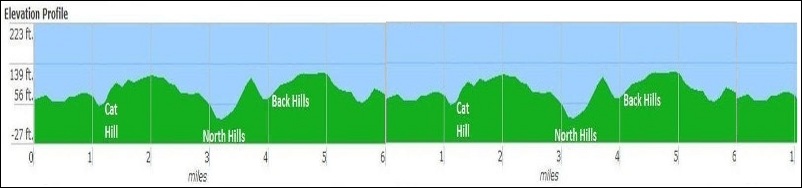 |
| Manhattan Half Elevation Profile |
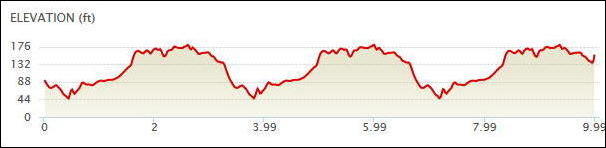 |
| Cherry Tree 10 Miler Elevation Profile |
The two profiles above give the gist of these runs (sorry, I had to paste 3 pieces together for the Manhattan Half profile). I would say the elevation gain per mile is about the same. I tried to line them up so they are at the same scale and both start at the same point on the page. If you look closely at the numbers on the Central Park profile, although the scale goes way up to 233 feet, the hills just barely make it to 130'.
My personal preference is for Prospect Park. Although it comes 3 times, I think of it as one hill per loop, for what that is worth. And even considering the shorter distance, my pace was significantly faster.
March: The "Longer Runs" Get Longer
I had been following a long run schedule laid out by Coach Joe since December. It was actually a schedule of a "Shorter Run" in the morning and a "Longer Run" in the afternoon. This schedule was designed to gradually help my hamstring problem heal (see earlier post), while at the same time moving my mileage up. Consequently it was much less aggressive, mileage wise, than many of my previous marathon training schedules had been.
The shorter run / longer run combination was meant to build endurance in smaller increments while building on the ability to run a long run while the body was tired. Of course, a 3 mile shorter run plus a 15 mile longer run was not the same as an 18 mile run, but the 3 plus 15 combination did give more training value to the 15 miler than if I had (as I usually do) taken off the day before and the day after the long run.
Here's a quick outline of the schedule (as run):
| Date | Shorter Run |
Longer Run |
| Build-up Phase | ||
| December 7 | 3 miles | 12 miles |
| December 14 | 3 miles | 12 miles |
| December 21 | 3 miles | 13 miles |
| December 28 | 3 miles | 10 miles |
| January 4 | - | 12 miles |
| January 11 | 3 miles | 12 miles |
| January 18 | 3 miles | 13 miles |
| January 26 | Manhattan Half | |
| February 1 | 3 miles | 14 miles |
| February 8 | 3 miles | 15 miles |
| February 16 | Cherry Tree 10 Miler | |
| February 22 | 3 miles | 16 miles |
| Peak Phase | ||
| March 1 | 3 miles | 18 miles |
| March 8 | 3 miles | 16 miles |
| March 15 | - | 20 miles |
| March 22 | 5 miles | 12 miles |
| March 30 | - | 20 miles |
| Tapering Phase | ||
| April 5 | 5 miles | 10 miles |
| April 13th | 10K Trail Race | |
| Boston Marathon | ||
I'll talk a little about the two 20 milers, since those are the epitome of the training.
The first 20 was in good old Central Park on March 15th. It was a mild, partly cloudy day in which NY Flyer friend Melissa C and one of her friends ran 7 or 8 miles of the run with me. In rough outline, it was 4 miles for me from home up to the park where I met Melissa and her friend. Then I did two 6 mile loops, of which the others joined me for the first. Then it was 4 miles back home to make 20. Here's a map (although most of you will be intimately familiar with this territory.
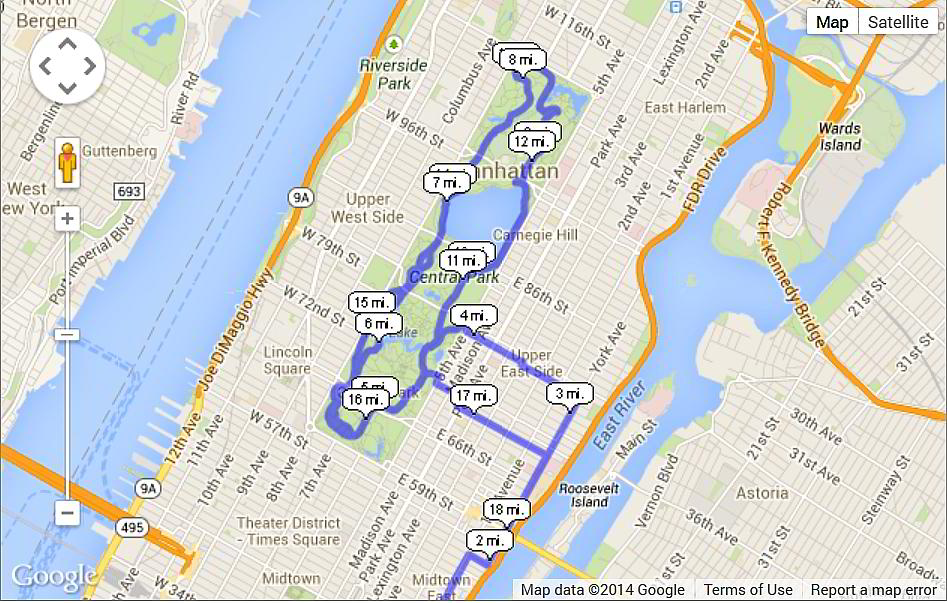 |
| Central Park 20 Miler Route Click for on-line map |
From my Training Log:
Numbness overall some better
Moved back to heel striking and used altered arch supports from Dr. L.
Went longer and numbness was more tingling that hurt.
Home to Boathouse via Melissa's: very slight tingle. Massaged foot briefly
1st loop: Some numbness last few miles, no pain. More delayed than previous week. Massaged foot for a while.
2nd loop: some numbness from about 13. Pain at 14.6. Stopped and massaged foot and took out heel lift. Felt the difference - more impact on rt. heel. At end of loop (72 & Fifth) some tingling, massaged some more.
Home: some tingling. Massaged briefly at 34th Street (19.5). OK to home.
Overall fitness good. Rt. hamstring no problem.
Not as sore as previous week after the run.
I considered this a good run with the hamstring problem largely absent, and the numbness diminished. The following elevation profile is interesting in the number of ups and down you get in going around Central Park, but I guess everyone knows that already.
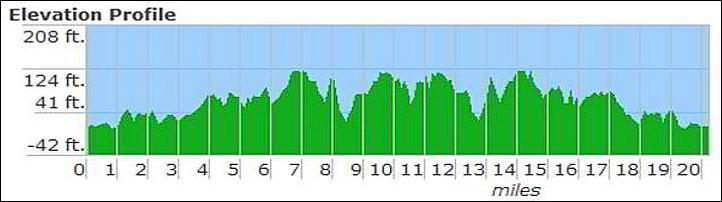 |
| Central Park 20 Miler Elevation Profile |
Two weeks later found me in Thornton, Colorado, where we were visiting my son and his family who moved there about 6 months before. It was our first visit and we knew little about the area (a suburb of Denver) except what we could get from a Google Map. We did know it was a dry flat area just east of the Rockies. Dry and flat sounded good for a long run (in spite of the 5000+ foot elevation), but where to run? Roads were not pedestrian friendly and I couldn't very well run across farm fields.
It turns out that this particular town, Thornton, (largely developed over the last 30 years) had solved the problem. When the residential subdivisions were developed, a series of drainage ditches were preserved (for mitigation in time of flooding) and around most of them a right-of-way was established — sometimes narrow and sometimes quite wide — and a series of bike paths were constructed on these right-of-ways. (see this: Thornton Colorado Bike Path Map.)
In fact, they were perfect, flat running territory. So I explored the maps and planned out a 6 mile loop which started about a mile from my son's house. Voila! a 20 mile route (1 + 3 x 6 + 1 = 20). The map shows the details and the slide show shows the terrain. My impression was that is was dryer than I expected. A desert, really.
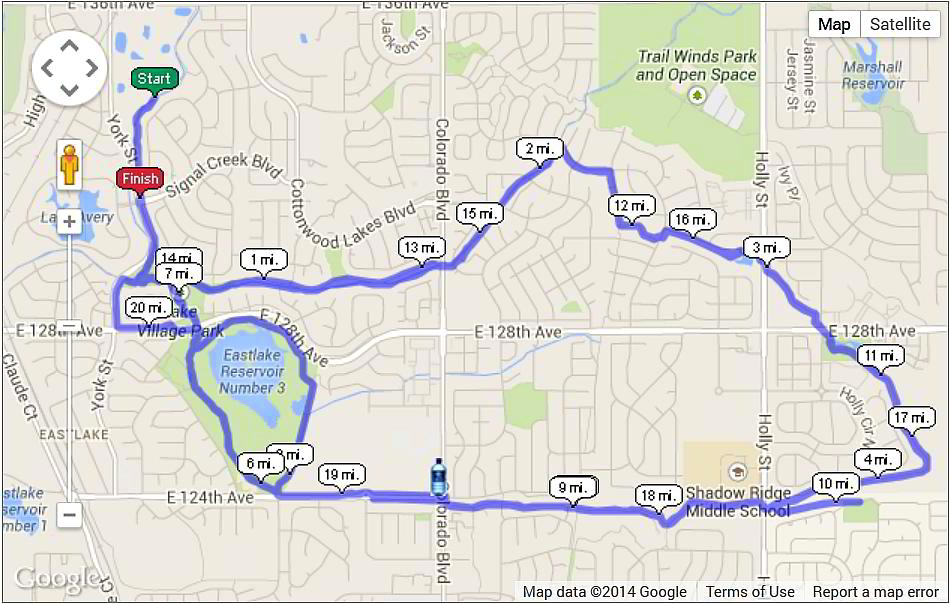 |
| Thornton Colorado 20 Miler Route Click for on-line map |
From my Training Log:
20 miler good — but not great
hamstring OK, numbness better but still needed stops for massage
start at Peter's house
Loop 1 (CW 6.27 miles) start AT Gazebo / port-o-san, (York Ave at park)
loop 2 (CCW 7.02 miles) at 12.48 (a little before Summit Cove Rd) stopped, rubbed foot to relieve numbness
loop 3 (CW 6.45 miles) at 15.20 (same place) stopped, rubbed foot to relieve numbness (same) / at 18.71 (Colorado and 124th) stopped, rubbed foot etc.
Finish (York and Signal Creek) total 20.60 miles
The elevation profile below is more for comparison to the Central Park one than for it's intrinsic interest. Surprisingly, the total elevation difference between the high and low points for each loop, was about the same as in Central Park, however the hills were 2 - 3 miles down and 2 - 3 miles up, which, to tell the truth, I hardly noticed during my run. To me the whole thing was flat. No one would ever say that about Central Park.
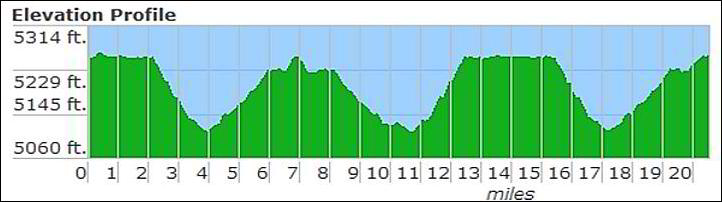 |
| Thornton Colorado 20 Miler Elevation Profile |
The following slideshow does not show the picturesque Colorado mountain terrain we've come to expect — sorry. But what you see is what I got, and it was pretty easy running.
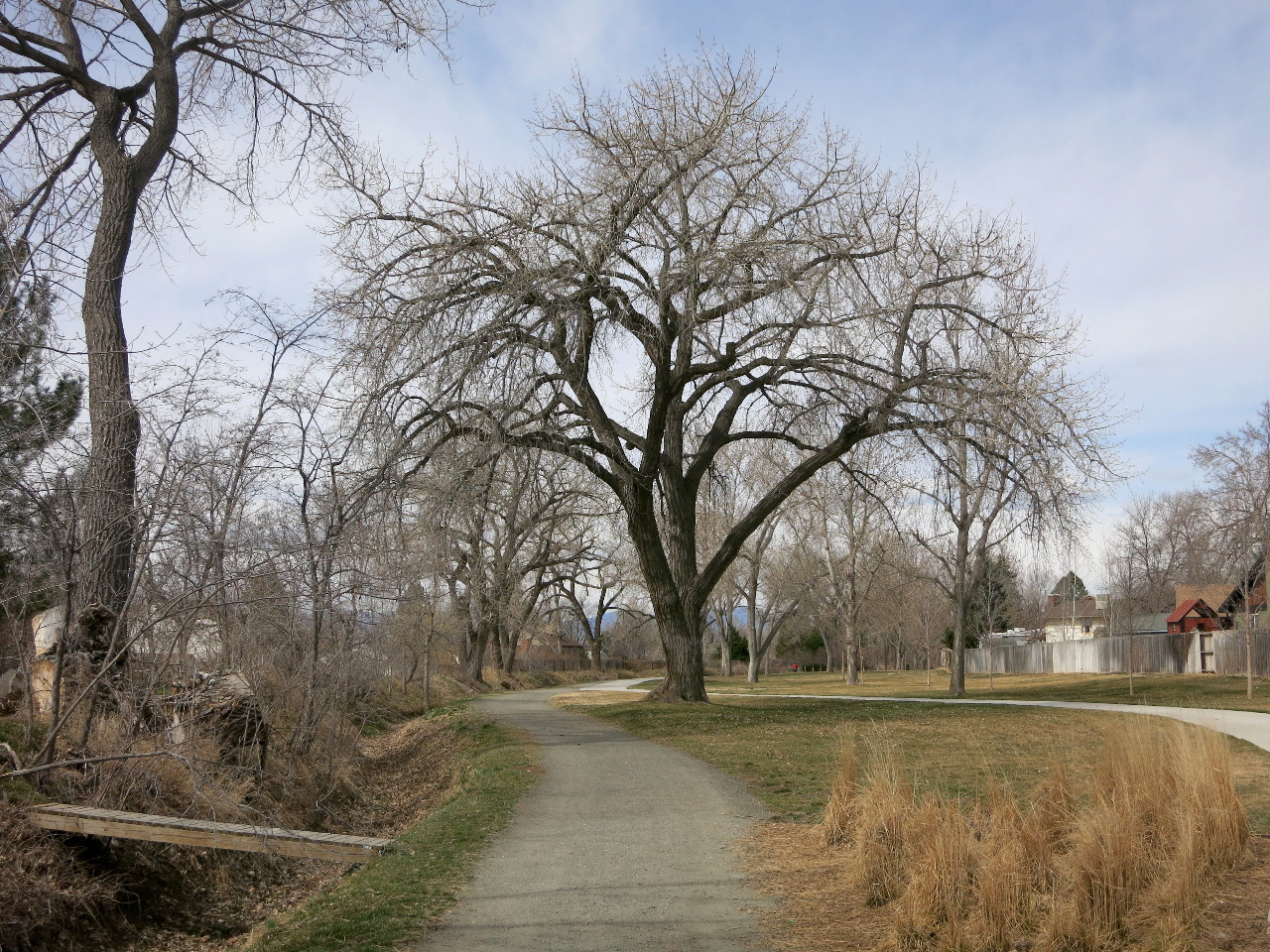 |
| A Magnificent Cottonwood Tree on the Bike Path |
BTW: the trees that you see in most of these photos (including the one above) are Cottonwoods. They're quite impressive and I can't wait till we visit again and they are all in full leaf.
April 13th: One Last Fling —
The Van Cortlandt Track Club
Urban Environmental Challenge 10K Trail Race
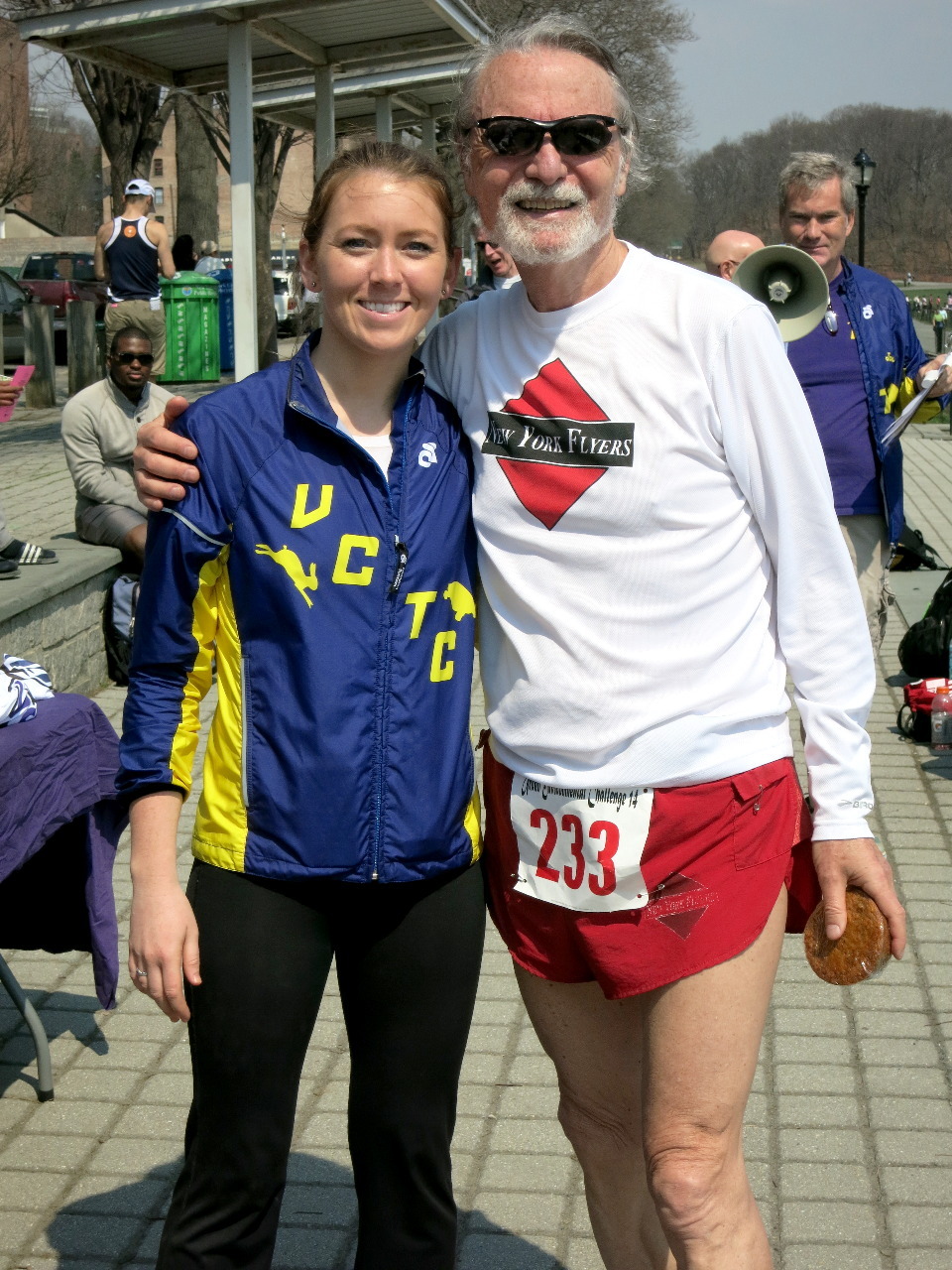 |
| Papa Bear receives a coveted carrot muffin from the race director |
"Running a 5K a week before a marathon can be not only OK, but
beneficial. I would say that it
would only be appropriate for an experienced runner who knows how to
stay within themselves and not overdo things. You definitely fall into
that
category, so give it a go!"
I figure, if a 5K is OK, a 10K must be OK, OK
 !
! The Park was beautiful and the weather was perfect (high 50°s to low 60°s) and this really helped me chase away the pre-marathon jitters and do some very enjoyable running in a place I love.
And although I was cautious (I slowed to a walk on the many rocky ups and downs) I did push hard. I saw one other gentleman who looked to be in my age group (= gray hair) and moved ahead and stayed ahead of him in the second half of the course and yes, I beat him by a good minute or two. Unfortunately some other old guy managed to sneak ahead of us and beat me out for the 1st place in the 70+ group.
But 2nd place isn't too bad (as my daughter would say, it was a "podium finish") and I walked away with one of the coveted carrot muffins that we strive for when we go up to "Vanny" to race on the trails. My wife (with whom I will share the prize at breakfast tomorrow) was equally pleased.
 |
| The VCTC Urban Environmental Challenge 10K Trail Race |
So, I "blew out the cylinders," so to speak, in this race. Now with a few days of rest, and maybe an easy 3 or 4 miler or two later in the week, I AM READY!
For those who like to know these things, here's a link for the race: VCTC UEC 10K Trail Race
Papa Bear
This post is adapted from several posts on Papa Bear's Training Blog: Beyond Central Park: Training for the 2014 Boston Marathon – a "Do-Over" .


1 comments:
Congratulations on the podium finish today, Richard!!!
Best of luck in Boston!
Post a Comment