Friday, September 23, 2016

Looking Back At the Long Hot Summer

by 
Papa Bear 

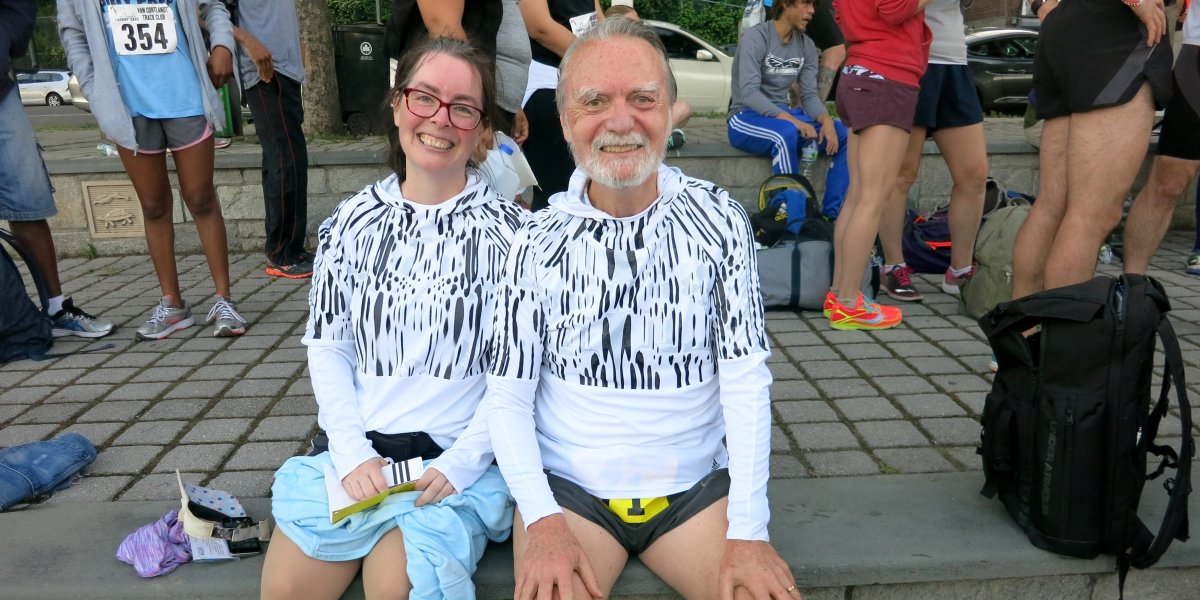
If you take a look at the title picture of this post (above) you'll see two happy runners at a race in Van Cortlandt Park. It's me and my daughter Susan after both of us won raffle prizes (those hoodies) after the race. I had never before won a raffle prize although I have run every one of these races for the last 4 or 5 years. And my daughter Susan on the other hand, has only run in one VCTC summer 5K before — after all she lives in Portland Oregon. So it was a pleasant and unexpected happening that we would both win one of these prizes and the picture shows our delight. It was also my fastest race in the Van Cortlandt Park series this summer.

So why a title like "Long Hot Summer"? Well I didn't mean to imply it was not a fun summer or a summer when I didn't enjoy the races. It was and I did. But the problem, if you want to call it that, is that although I revamped my training in the hopes of improving my race times, I had very little success in doing that. And I think a major reason was the hot and humid weather that persisted across June and July and into August.

But it wasn't just the heat and humidity — it was an overloaded schedule of races that pushed my speed work efforts into the background. But first a word about that training schedule: in late May, when the summer series of cross country 5Ks was getting underway, I asked coach Joe, my massage guy, if I could fit two training workouts into the two week period between successive 5Ks (which are held on alternate Thursday evenings), perhaps at 1/3 and 2/3 of the way through the two week period.

Double Workouts

He said try something different: the recovery from a tough workout starts primarily on the 2nd day after the workout, not the next day. So do two workouts on two successive days focusing on different types of workout (say hill repeats, and intervals) and then take the next 4 days for recovery. So the double workout should be at least 4 days before the next Thursday 5K, e.g. Thursday/Friday or Friday/Saturday of the week before the race. The table below illustrates how this schedule would look.

Date Note
VCTC 5K #1 May 26st
Speed workout June 2nd Day 1: hills, Day 2: intervals
VCTC 5K #2 June 9th
Speed workout June 16th Day 1: hills, Day 2: intervals
VCTC 5K #3 June 23rd
Speed workout June 30th Day 1: hills, Day 2: intervals
VCTC 2x2 Relay July 7th
Speed workout July 14th Day 1: hills, Day 2: intervals
VCTC 5K #5 July 21st
Speed workout July 28th Day 1: hills, Day 2: intervals
VCTC 5K #6 Aug. 4th
Speed workout Aug. 11th Day 1: hills, Day 2: intervals
VCTC 5K #7 Aug. 18th

So I started out doing just that: I would do hill repeats on Cat Hill (at first just 6 but building up by adding 1 or 2 repeats each time) and the next day intervals at the East 6th Street track (at first 200s with the same number of intervals as I did hills).

I was very tired after the 2nd day but I felt it was the "good" tired you get after you do a tough workout.

Oops! more races

But by the 2nd cycle of this routine, I realized that I had registered for a number of NYCRuns 5Ks, which happen usually on one of the weekends between the Van Cortland park 5Ks. See the next table. So some weeks I had to squeeze my double workouts in between the races, losing the valuable recovery time, and sometimes I had to do just a single workout, or none at all.

Date Note
VCTC 5K #1 May 26st
NYCRuns 5K May 30th Race: Roosevelt Island
VCTC 5K #2 June 9th
Speed workout June 16th Day 1: hills, Day 2: intervals
VCTC 5K #3 June 23rd
Speed workout June 26st Day 1: hills, Day 2: intervals
VCTC 2x2 Relay July 7th
NYCRuns 5K July 17th Race: Roosevelt Island
VCTC 5K #5 July 21st
Club Team Race July 30th Race Central Park
VCTC 5K #6 Aug. 4th
Brooklyn Mile Aug. 14th Race: Brooklyn
VCTC 5K #7 Aug. 18th
NYCRuns 5K Aug. 20th Race: Governors Island


It's clear from the table that I was mostly going from race to hot and humid race without much in the way of training workouts between.

Just go with the flow

By the end of June I realized that I was trying to do too many things at once. And since I had no control over the heat or humidity, I just settled on doing whatever training workouts I could fit in without compromising the needed recovery period, and just wait for Fall to arrive with cooler weather and a much more reasonable race schedule. And that's where we are now, September 22, the first day of Fall.

Summer summary

The table below shows the results of the summer giving finishing times and age group awards. Although the times did not improve over the summer there was lots of fun races and good times.

Date Finish
VCTC 5K #1
Van Cortland Park
May 26st 32:22 2nd 70+
NYCRuns 5K
Roosevelt Island
May 30th 28:42 2nd 70+
VCTC 5K #2
Van Cortland Park
June 9th 30:59 2nd 70+
VCTC 5K #3
Van Cortland Park
June 23rd 32:02 3rd 70+
VCTC 2x2 Relay
Van Cortland Park
July 7th Best costume award
NYCRuns 5K
Shore Road, Brooklyn
July 17th 28:49 1st 70+
VCTC 5K #5
Van Cortland Park
July 21st missed start
35:36 2nd 70+
Club Team Race
Central Park
July 30th 51:19
VCTC 5K #6
Van Cortland Park
Aug. 4th 31:57 3rd 70+
Summer Streets Run
Central Park to Brooklyn
Aug. 6th Ice Cream
Brooklyn Mile
Williamsburg, Brooklyn
Aug. 14th 8:37 2nd 70+
VCTC 5K #7
Van Cortland Park
Aug. 18th 32:36 3rd 70+
NYCRuns 5K
Governors Island
Aug. 20th 29:56 1st 70+
NYCRuns 5K
Roosevelt Island
Sept. 5th 28:40 2nd 70+
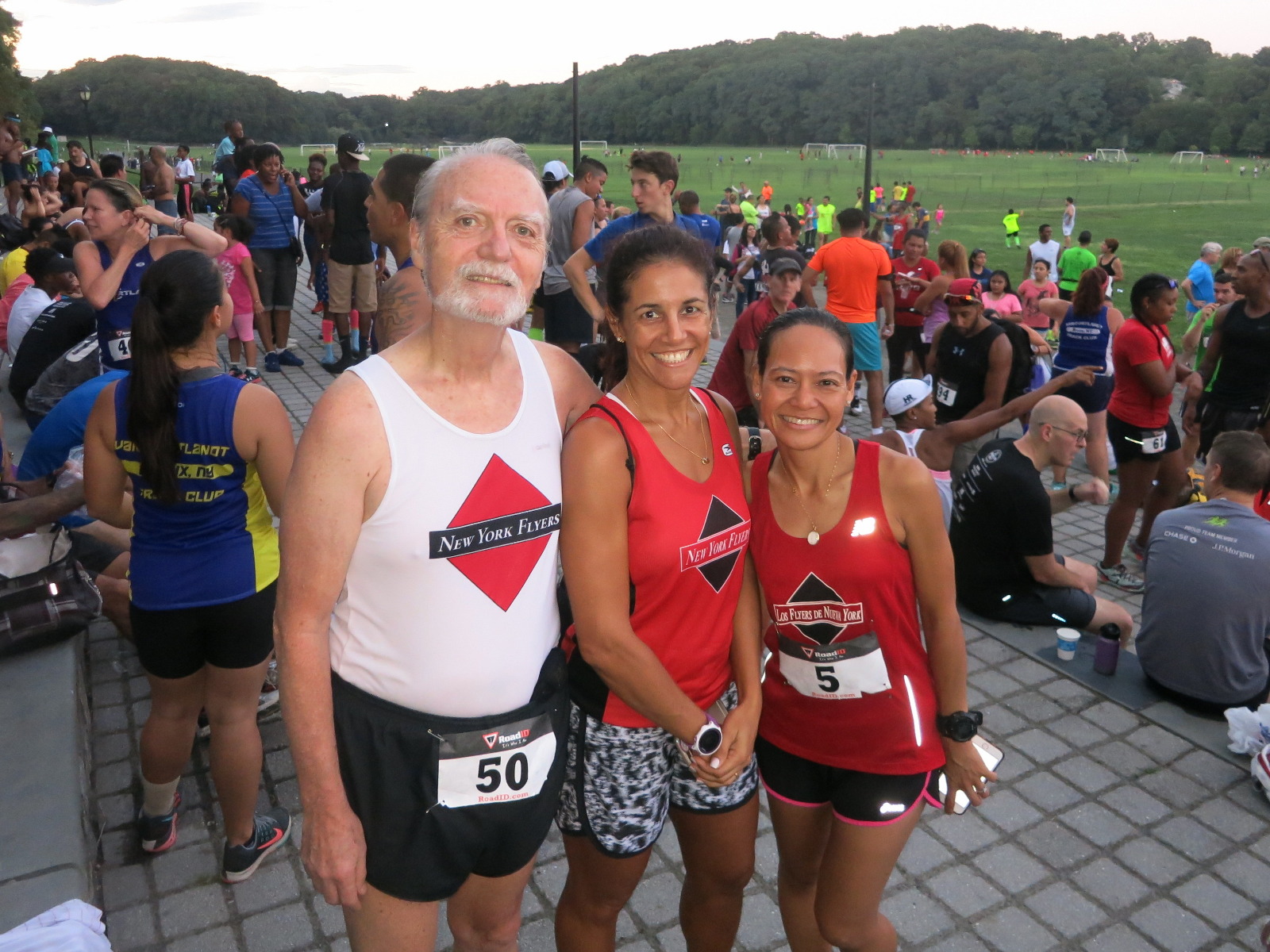
Susan and Susan with Me

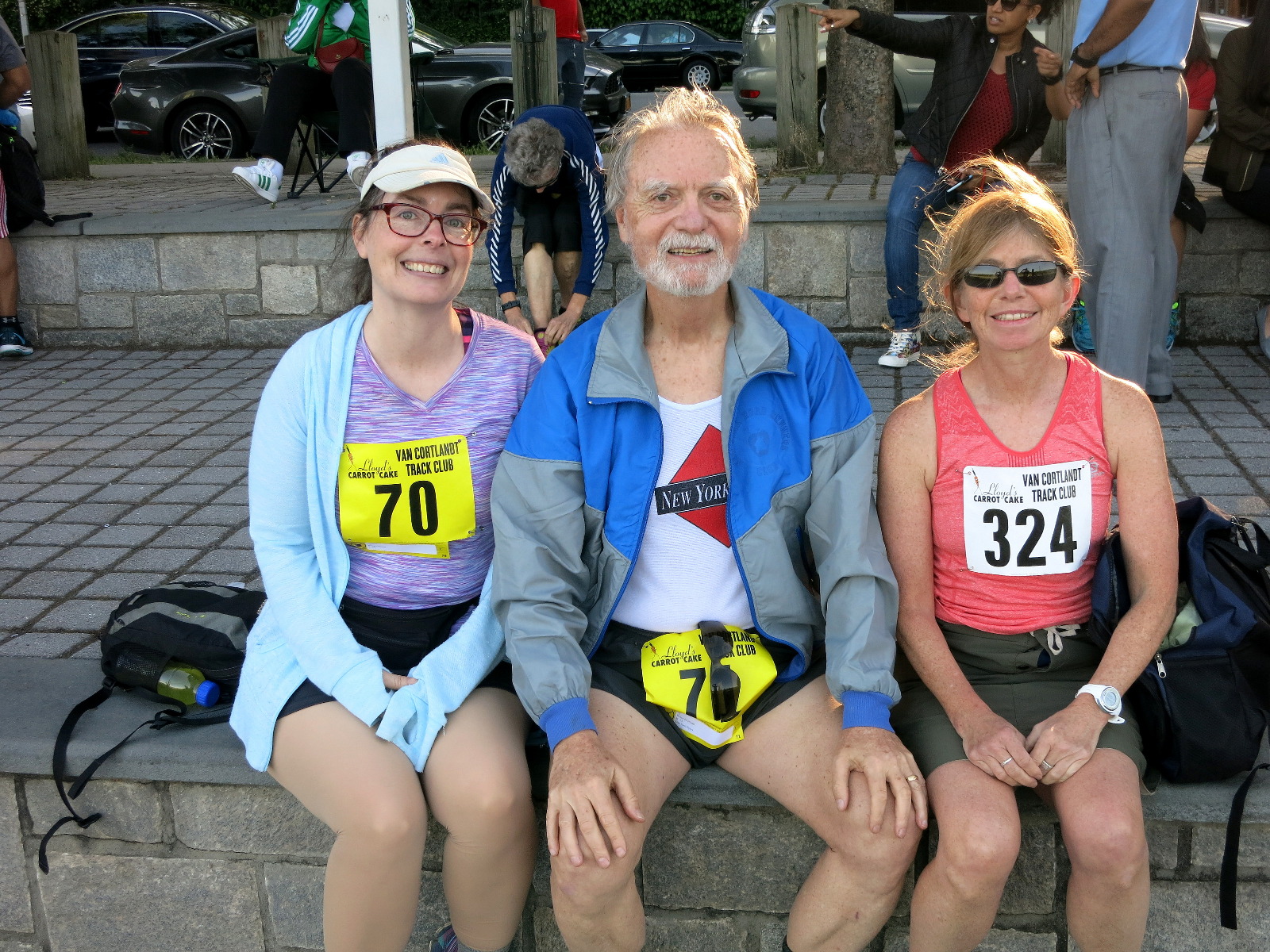
The first photo shows me with my daughter Susan and my friend Susan at the VCTC 5K #2. This was actually my best finishing time at Van Cortland for the whole summer season and it was certainly a delight to have my daughter run one of these races during her visit to New York. Click for Slideshow.
Dorothy and the Scarecrow
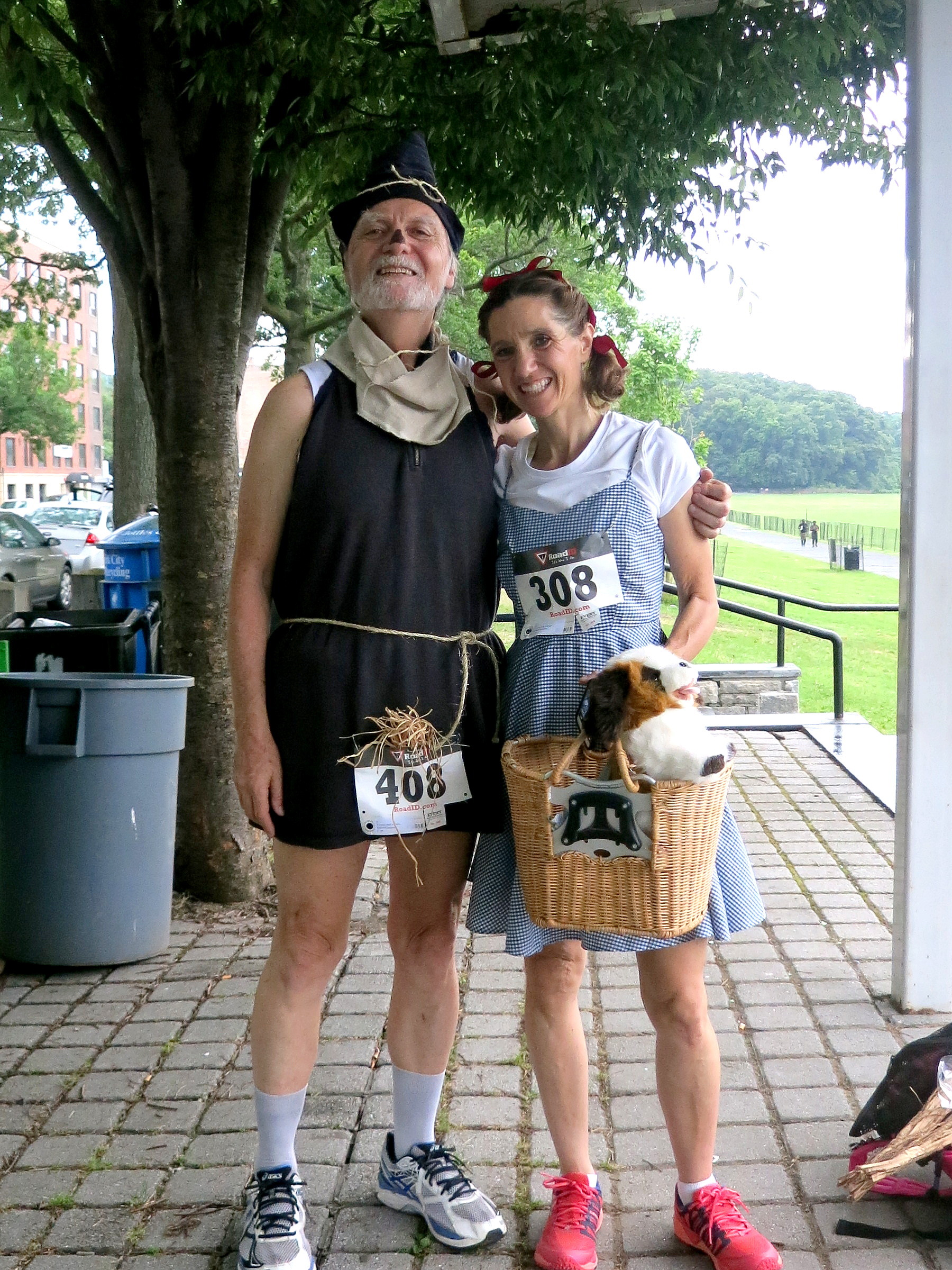
The next photo shows Heidi and me at the 2x2 mile cross country relay. We won the best costume award, and as far as our race time is concerned, you don't want to know. It was lots of fun throwing those costumes together from odds and ends and thanks to Heidi, we looked pretty darn good. We won the costume contest (based on audience applause) in a landslide.

1st 70+ at the Shore Road 5K
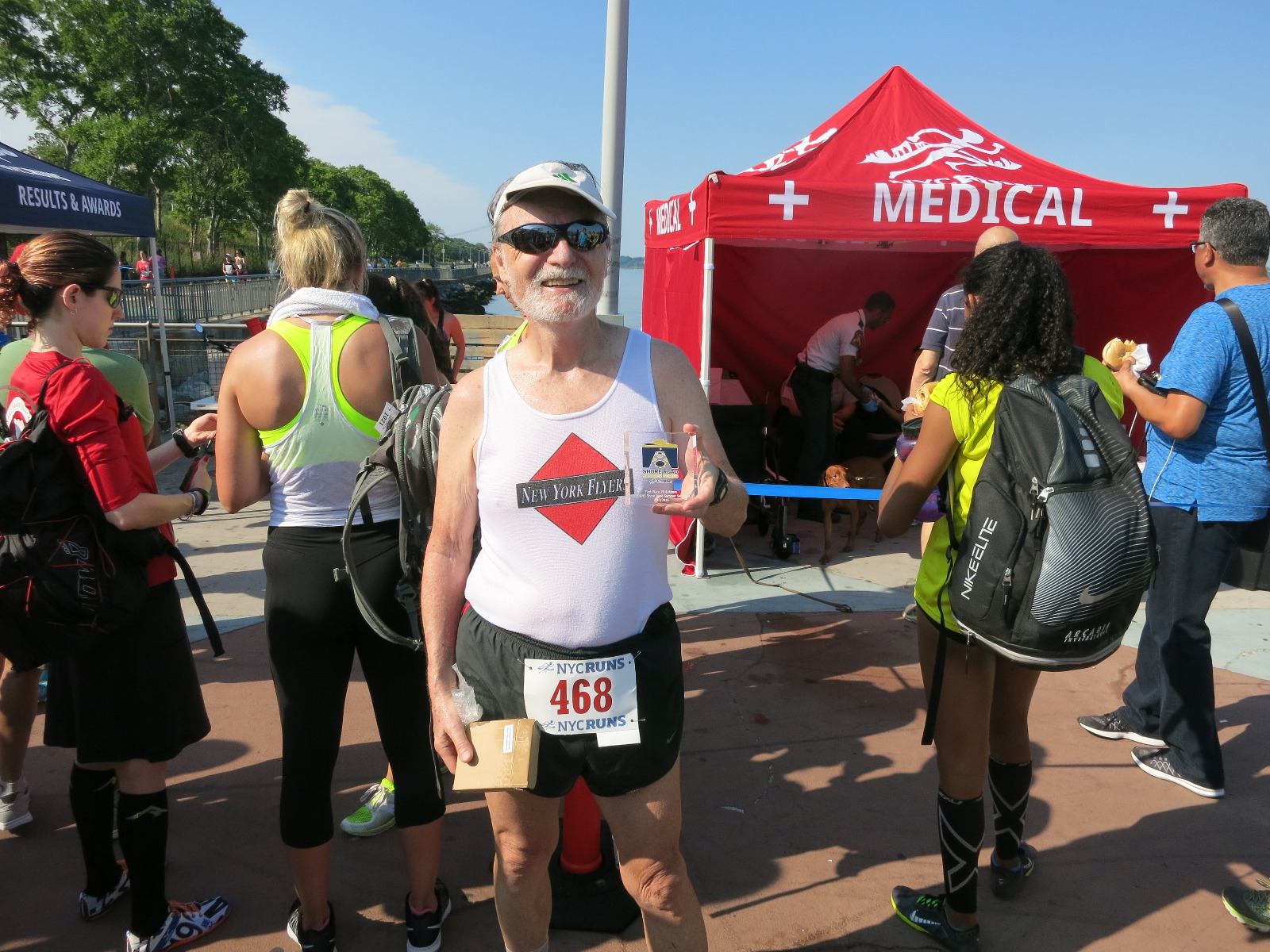
On July 17th I took the subway out to Bay Ridge Brooklyn for the Shore Road 5K. Unfortunately I got off at the wrong stop and had to walk about ¾ mile to get to the start. Luckily I was in time to get my bib and warm up a little. But cooling off would have been better than warming up – It was bright sunshine, temperatures in the high 80°s and no shade. The 5K and 10K started together but the 10Kers had to do two out-and-backs vs. one for us. I managed a reasonably good race and went home with a 1st in the 70+ age group award. Click for Slideshow.

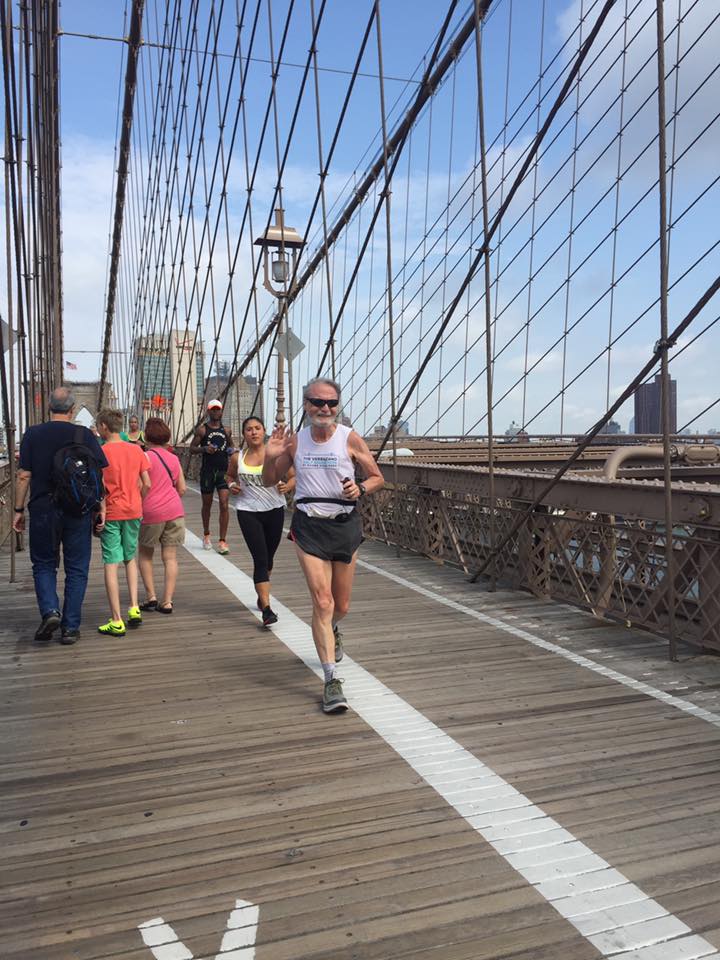
Crossing Brooklyn Bridge
Late July was miserable – I missed the start due to slow subways in VCTC 5K #5 and lost about 2 or 3 minutes as I spent the race trying to catch up with the back of the pack and the July 30th Club Team 5 miler in Central Park was a death march in extreme heat and humidity. VCTC 5K #6 was not much better but then came the August 14th Summer Streets Run. This is when they shut down Park Avenue and walkers, runners and bikers go down to the Brooklyn Bridge (or up the other way). I met the Flyers at 23rd Street and when we got to the bridge, we crossed over and ran through the recently built Brooklyn Bridge Park to the Ample Hills ice cream shop. Ice cream is the 2nd best thing (after beer) to enjoy after a long hot run. Click for Slideshow.

The Brooklyn Mile
Then came the August 14th Inaugural Brooklyn Mile sponsored by the Brooklyn Running Shop in Williamsburg. I had never run a 1 mile race in all my many, many miles of running so this would be a first. Coach Joe gave me some hints on this kind of race and it amounted to turnover and pacing. We calculated a target pace based on recent race (it was 8:36), and he laid out how to train with some intervals, how to warm up, etc. Well, the horn went off and I went out too fast by about 10 seconds for the 1st quarter. I slowed down down a bit but it was difficult since I had already "shot my wad" so-to-speak. Luckily the last quarter was slightly down hill so I came in at 8:37 and I was 2nd in the 70+ age group. Click for Slideshow.

But it was almost an embarrassment to recall that in my 1992 Grandma's Marathon (see this and this) where I first qualified for Boston, I RAN THE WHOLE DAMN 26.2 MILES OF THE MARATHON AT UNDER AN 8 MINUTE PACE! I know, I know, that was 24 years ago and age takes it's toll, but, but still ...

With Luiza and Pei at the VCTC 5K #7
Moving right along, the last VCTC 5K of the summer was rather more fun than usual, if not faster. Pei and Luiza from the Thursday night Flyers Group Run came up and ran the 5K. It's always nicer when there are friends and teammates there at a race. They give you encouragement and can join you at a post race get-together and of course join you on the long subway ride back to the city. Click for Slideshow.

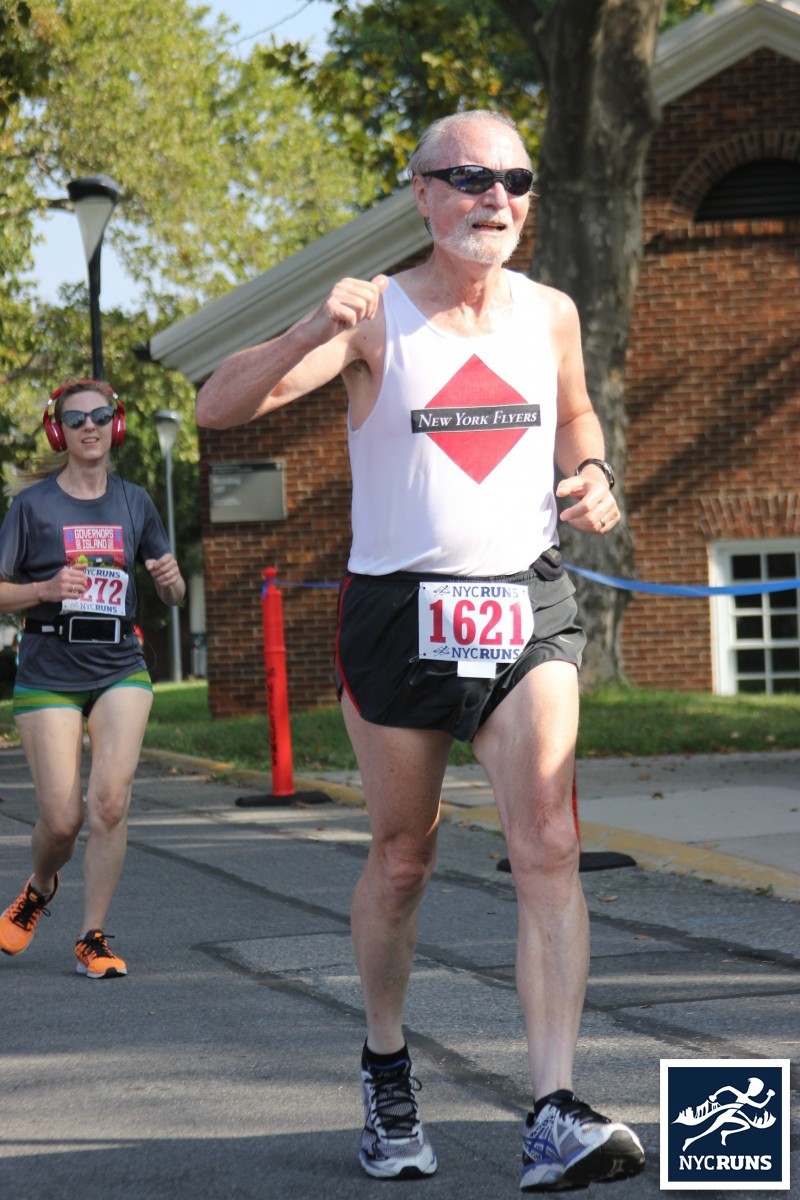
Governors Island 5K
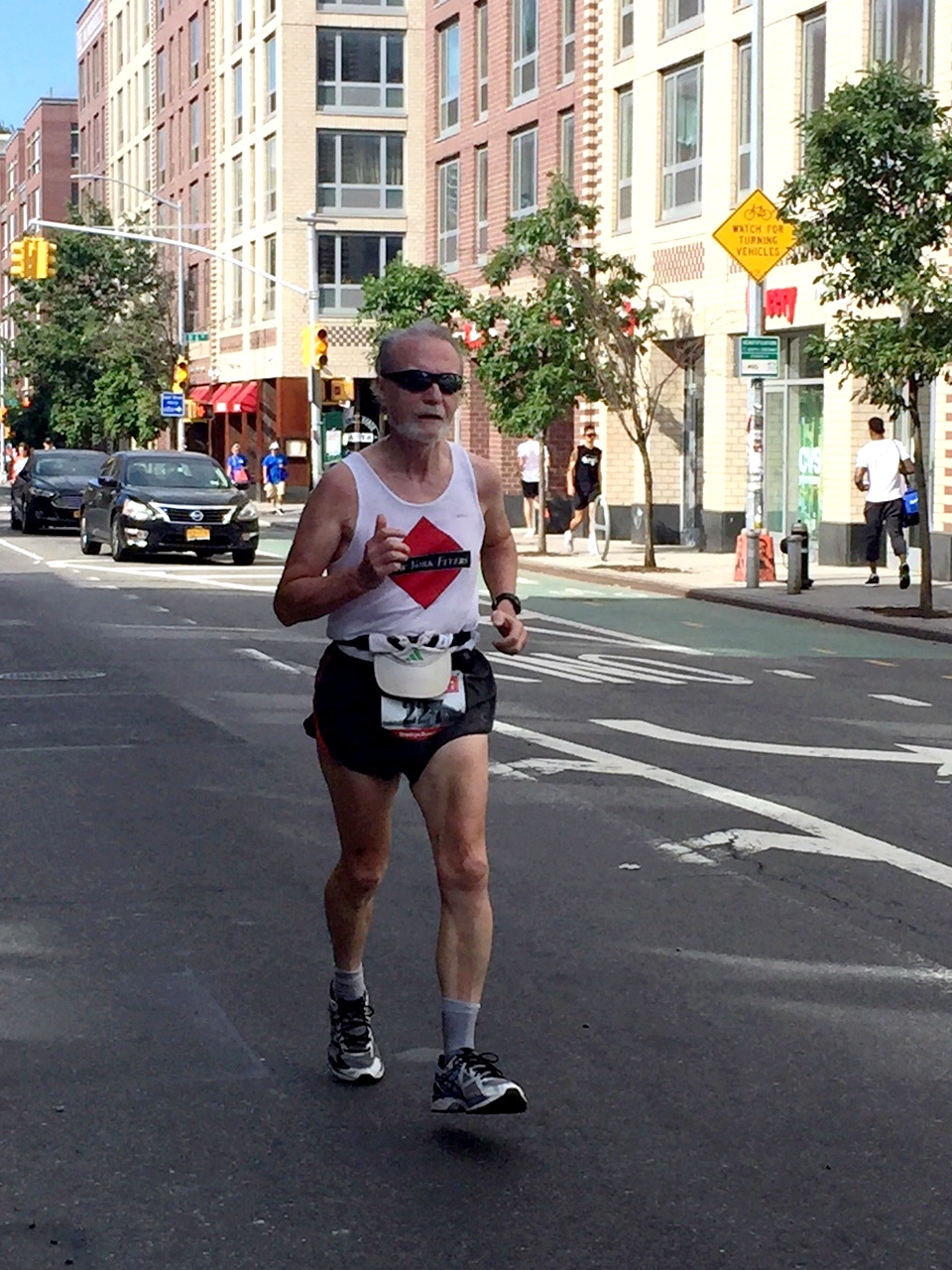
On the other hand, the last two races of the summer, the August 20th "Governors Island 5K" and the September 5th "Labor Day 5K" did get faster, if only slightly. I took the 7:30 ferry to Governor's Island with an absolute horde of runners. Due to some strategic planning, I was the first to get to the port-o-sans and had a chance to scout out the area. I had been to the island about 6 or 7 years ago when the Coast Guard gave it to the City but a lot had been done since. The race was well organized, as usual, by NYCRuns and went off as planned, if a few minutes late starting. It turns out they had only an hour to set up before the runners arrived.

The route was basically a clockwise circuit of the Island. Views were great in all directions although there was not much shade. But the weather was better than it had been for weeks and I had a credible race, just breaking 30 minutes, and 1st in the 70+ age group. I should note that this race was only 2 days after the last VCTC 5K and just under week after the Brooklyn Mile. Click for Slideshow.

Finishing the Labor Day 5K
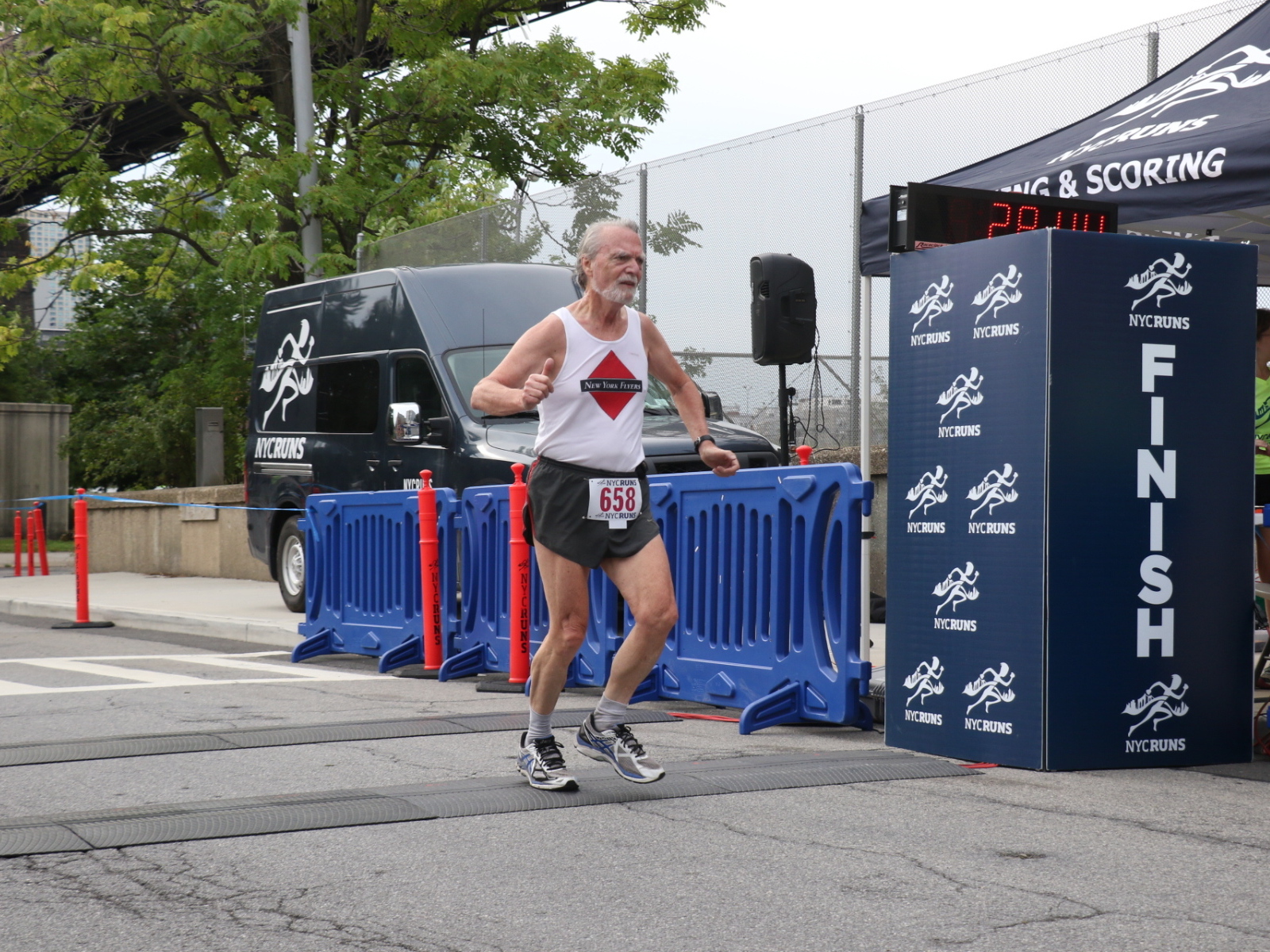
The September 5th Labor Day 5K on Roosevelt Island had even better weather and I achieved, if ever so slightly, my best time this year on the Roosevelt Island course, a 28:40. As usual I took a cab at 7:00 to the Roosevelt Island Tramway stop at 59th and Second Avenue and I was at the race site on Roosevelt Island by around 7:40. I felt good in the race but in retrospect I should have pushed the 2nd mile harder. My 28:40 was satisfying, but remembering the 28:42 in late May before the summer weather kicked in, I knew I was back to just about where I started. Of course placing 2nd in the 70+ age group (out of 6) felt good. Click for Slideshow.

After the race, I took the tram back to Manhattan and the bus uptown to meet up with my friend Susan who had just gotten back from a 6 week visit to Switzerland and France where she did some alpine races in one of the most beautiful spots in the world.

We had a nice walk around Randall's Island and ended at Earl's Beer and Cheese for a couple of cold ones. And what better way to end a long hot summer than that!

Fall Arrives

Fall arrived yesterday and on Sunday I'll be back to Roosevelt Island with hopefully some new faster results. I did a solid interval workout this week and a tempo run last week so it's time to move into a productive Fall season.

This post is adapted from Papa Bear's recent post on his blog:
Running and Stuff for 2016


Read more...

Tuesday, June 28, 2016

The Ultimate Human Race

Jo R.
South Africa’s Comrades Marathon described as “The Ultimate Human Race” is the world’s oldest ultra-marathon and is famous for its relentless, punishing terrain. Named by founder Vic Clapham in 1921, the course honors soldiers who fought in the First World War and celebrates the comradery runners share when completing the distance. The course alternates each year between the cities of Durban to Pietermaritzburg. On even years the “down” course is 89km beginning in Pietermaritzburg and on odd years the “up” course is 85km starting in Durban. Last fall I signed up for the Comrades down run seeking adventure. Feeling intimidated by the distance, I did not study the course or train much beyond the New York Flyer’s Marathon Training Program (MTP), coached by Brain Rossetti.


Comrades down run elevation profile. Many smaller hills the size of Central Park’s Harlem Hill or more are not represented. The last 10K is brutal and hard to run as the legs are in pain from hours of down-hill running.

            The morning of the race we boarded a bus at 3:30am in Durban and drove to the start in Pietermaritzburg. During the hour long drive I was amazed at the distance and steep rolling elevation that covers 1,800 feet during the event. The race began in front of City Hall in Pietermaritzburg at 5:30am and we were off. The course was slow and congested during the first few miles. Comrades is the largest running event in South Africa and over 20,000 runners participated. As the sun rose over Umlaas, the first of “The Big Five” Comrades hills I caught up with the sub-10-hour bus pace group and decided to run with them for as long as I could. The day before I spoke with Comrades Head Coach Lindsey Parry at the race expo who predicts your Comrades time to be two and a half times your marathon finishing time. Parry said I was capable of running a 9:30 Comrades off my 3:44 Chicago Marathon finishing time. However, as this was my first Comrades expectations weren’t high. The only goal was to finish.

Descending Umlass Road the first of “The Big Five” Comrades hills as the sun rises early in the race.      

Running with the sub-10-hour bus paced by Coach Linda, the group ran briskly maintaining an even 10:28 pace and stopping to walk for one minute every 10K. During the first part of the race the pace was easy and I felt strong. However, after running 50K my energy began to slow and I became scared of losing pace with the group and not being able to make the 12-hour timing cut-off. We ran through aid stations which was stressful as I struggled to grab water, salted oranges, or backed potatoes to eat and maintain pace with the group. I was so afraid of losing the group that I did not make a rest stop for 35 miles. There was an unspoken comradery with our group as we passed satchels of water to each other. I handed Linda cookies and asked if he needed food. One woman who wore a Comrades green number for having run over 10 races provided never-ending encouragement. She explained we were all Comrades helping each other through this race, Coach Linda was our leader, and that he needed us to run behind him and we needed his guidance. We ran together over the hills and helped each other through adversity as the miles went on. As the race progressed I felt more comfortable running a few paces in front of Linda, which mentally provided a bit of a cushion, being a few steps ahead. With 19 km to go Linda said we would “go at our own pace” after the 14k mark and the group began to slow down. At that point running was all mental and we were very fatigued from the constant hills and strong sun. At one point we ran for kilometers down a curved section of the highway at a 45-degree angle.


Running with the Sub 10:00 bus pace group and Coach Linda. Linda is wearing a Comrades green number race bib that indicates he’s successfully completed ten races and the number 50 to signal his age. My race bib is blue, the color for international runners.

            During this part of the race I dug deep and remembered the two NYRR NYC 60K ultra-marathons I’d completed. The first 60K, which I’d run without proper fueling and struggled to finish, you can read about on the Flyers Blog by clicking HERE.  From this experience I knew that once I started walking the race was over, as my body would feel pain and I would move very slowly. Finishing miles 42-50 was a struggle and I kept trying to calculate how long I would have until I was “safe” and could complete Comrades by walking if needed. Finally, during the last 10k we encountered Cowie’s Hill, the last of “The Big Five” set of Comrades hills. The group continued running but I had to stop and walk losing pace with Linda. My quads were on fire from the downhills and it hurt to run. I was in such pain that when I finally stopped to heed nature’s call after running 35 miles without a rest stop I could not squat down. At that point finishing was the only option. I walked/ran the remaining steep hills- that felt never-ending as there were 4 or 5 during the final 10k. As I ran towards the 4km maker I asked a passer-by what time it was. He replied 3:06 and at last I felt relief knowing I would finish. As it was too painful to run I did my best to power-walk, running once inside Sahara Stadium and finished in 10:06:20.


At the finish in Sahara Stadium with my Bronze Medal after finishing Comrades in 10:06:20

            Comrades was one of the toughest experiences of my life. It was terrifying. The course is brutal. But the race is an amazing transformative experience. I’m so impressed by the brave, kind sprit of the people of South Africa. The scope and power of Comrades dwarfs any other running event. There really is nothing else like it. After the race I ran into Comrades legend and 9-time winner Bruce Fordyce at The Big Easy restaurant in the Hilton Hotel. He grinned and said “10:06 for your first Comrades! We’ll you have to come back next year and get your double medal.”

Comrades Bronze Medal awarded to 9:00-10:59 hour finishers.

Some tips on training for Comrades:

Train for a marathon but then add two long runs together to mimic the distance of Comrades. For example, run 13 miles on one day and then 26 the next. For my training I completed MTP and then added an additional brunched run of 10 one day and 20 the next, three weeks before the race. In January I completed the Walt Disney World Marathon Dopey Challenge: a 5K, 10K, half marathon, and full marathon over four days- great Comrades training. To read about my adventures as posted in the Flyers Blog, please click HERE.

Run an ultra-marathon the season before running Comrades as the longer distance will help with endurance. Last November I ran the NYRR NYC 60k in 5:50:58, a great experience to practice fueling, test stamina, and develop mental toughness.

Be fresh for Comrades. Comrades Head Coach Lindsey Parry has stated you can’t run a marathon hard before Comrades and that’s true. The body has to be completely fresh to complete the 56-mile distance. At the end of April, I switched from running the Illinois Marathon in heavy rain and decided to complete the half instead. Good decision. You can’t have a cold or any muscle strains or injuries going into Comrades. If you do run a marathon before Comrades, it should be done at an easy pace. Researching Comrades I read a blog post by someone who said they ran a 50 miler leading up to the race and that ended up hurting them as their body was not rested.

Consider the training differences for the “up” or “down” runs. While this was not something I’d considered before the race, “down” training should have addition strength training to help combat leg muscle fatigue from down-hill running and “up” runs need extensive hill training. Parry has a great post about training for Comrades.  To view it, please click HERE. 


Be aware that finishing Comrades is 90% mental toughness. With 89K, the punishing terrain, timing cut-off, and hot South African conditions you are going to push your body beyond its limits. When you converse with someone after the race and ask “How was your Comrades?” they will usually respond with when they felt physically and mentally tested. Be prepared for this. This is why running a 60k helps. Not just with training but with mental confidence. After running Comrades, I had a conversation with a runner who ran with a marine who told him that Comrades was the hardest experience of his life. American Olympian and Ironman masters champion Collen De Reuck stated 2016 Comrades “was the most challenging event I have ever done.” You can read more about her experience running Comrades by clicking HERE.   Again, be prepared for this. This is a race that brings grown men to tears. But it is also an amazing human experience that I can’t wait to run again. 

-Jo R.

Read more...

Tuesday, June 7, 2016

My Redemption Marathon

Lindi B
This spring, I surprised myself with a personal best in a redemption marathon.  After DNF'ing in the heat at mile 17.5 of the Boston Marathon, my soul needed another chance to finish a marathon with a positive experience.  Initially, I thought I would wait until August or September (just prior to the 2017 Boston Marathon application deadline); I knew from my own experience at Rehoboth five weeks after the NYC Marathon last year that it was something of a long shot for a revenge marathon to turn out as well as I hoped.  But by the weekend after Boston, I was not sore, appeared to have most of the fitness from my training build up and was itching to give it another try.
A few hours of online searches yielded the May 1, New Jersey Marathon as a good choice. The race had scenic stretches along the ocean, was a few hours from home and still had available entries and places to stay. I was moved by my husband Michael’s willingness to go with me and cheer me on, and his encouragement that I try again. We discussed doing it in low key way, not broadly announcing my plans in advance so that my disappointment would not have to be too public if it didn’t work out.
We settled on race goals together. My primary goal was to finish the marathon feeling strong, with a smile on my face. My second goal was to run a few minutes faster than the 3:45, Boston Marathon qualifying time. I would only try to run a personal best, faster than 3:38, if I was confident that I was accomplishing the first two and not risking melting down or an unhappy ending.
In the time between marathons, I tried to correct the fueling problems that plagued me in Boston. During Boston, my water canteen had blown up from the Nuun tablets I needed for electrolytes on a hot day. I learned that I could solve that problem by filling my water carrier less full. During Boston, I was nauseous for 10 miles. I decided to try to solve it by modestly increasing my gel intake, from four to five gels, after listening to a Runners Connect podcast by a fueling expert who said that nausea was caused by the stomach emptying and blood flow then needing to be rediverted from the muscles to the stomach. I planned and memorized the mile markers where I would refill water, take gels and see my husband. I visualized staying calm through anything that could go wrong, and the last miles being very windy and hard, yet pushing through.
Our trip to the Jersey shore was easy and uneventful. It took only a few minutes to pick up my number at the expo, take a cheesy photo with my remarkably tolerant teenaged daughter Kira, and head for a pre-race dinner. We were pleasantly surprised to be able to get a same day reservation at Piccola Italia, a restaurant with good, homemade pasta and swift service. I was unfortunately too nervous to be able to eat very much. We stayed at Cedars & Beeches, a lovely, Victorian bed and breakfast located a few miles from the finish line and near where the marathon route would pass twice.
Lindi Kira expo number
Cheesy Expo Photo with My Daughter
The night before the race, I was worried. Not only was I going into the race with a poor track record, but I was worried that I had not been able to adequately rebuild my carb stores after getting food poisoning on the Tuesday night before the marathon. It didn’t help that I had felt too nervous to eat much at dinner time. I did my best to fuel on juice, bananas and whatever my body would accept. When pre-race nerves woke me at 3 am, I downed a sesame bagel with almond butter and a banana. At 4:30 am, I managed another banana and the overnight oatmeal I had brought. I started to relax.
My pre-race experience was almost perfect.  After imprinting the image of my sleeping daughter curled up like a cat in her bed in my mind, I arrived an hour before the 7:30 am start. I managed a wobbly smile to Michael when he dropped me off and wished me luck.  got a little thrill that my predicted finishing time got me a number near the front and elite baggage check. Mercifully, we were allowed to stay warm and use the restrooms inside the Monmouth Track/expo building. I ventured into the cold rain 9 minutes before the start and jogged five minutes to my corral. I stepped across the starting line three and a half minutes after the leaders. I’ve got this, I thought. Cold rain, can do.
The first five miles were hard. My Garmin shut down and refused to give any reading for almost the first mile. I wanted to run conservatively, but the large, 3:40 pace group ahead of me was slower than I wanted to start, so I weaved around them. My body was in flex between feeling too hot in the rain coat I was wearing and feeling grateful for when the wind gusted. I felt some relief after unbuttoning it. I struggled with a sinking feeling of defeat in the fourth mile when I started to feel nauseous. Here it is again. How would I be able to manage it for 21 miles? I took a gel, thinking that trying the frequent fueling strategy advocated by the podcast couldn’t hurt. 7:45, 7:55, 7:58, 8:06.
Almost immediately after taking the gel, I felt better. I settled in with the 3:30 pace group and my music. I decided that I would not look at my watch. I would run however felt comfortable, take a gel every four miles, stop for water as I had planned and enjoy my music. So long as I did not let the 3:40 group pass me and get out of sight, I would accomplish my pre-race goals.  I appreciated the spectators who had come out in the cold rain and smiled at their signs:  “Gu now, brews later.”  “You’re running better than the government” and “Touch here for power.” As planned, I stopped for water at mile 9.8 and got a huge lift from seeing Michael and Kira in the 13th mile.  7:56, 7:51, 7:54, 7:56, 8:10, 7:56, 7:57, 7:48
At around that time, we split from the half marathon runners, who turned in to finish. It was a bit hard to see them go, knowing we were really only getting started. When the pace started to feel hard in the 15th mile, I remembered my goal of finishing with a smile on my face, and let the 3:30 pace group go. I coasted along comfortably and happily until my next planned water stop at mile 17, where I tried to make a brief bathroom stop to relieve my full bladder. Ugggh!  Both portapotties were full and did not vacate.  I soldiered on. 7:55, 8:11, 8:14, 8:15, 8:37
Despite some physical discomfort, I started to feel much better when I got to mile 18, past the point where I had dropped out of the Boston Marathon and Rehoboth the prior December. I felt strong. “Nine more miles,” I told myself. “Let’s do it.” Miles 19-21 were mostly along the boardwalk. The winds were gusty, and the surface harder to run on than the road, but I kept thinking that running through it was an amazing, spiritual experience.  This is why I run! I decided that small, scenic marathons were the best for me. My body greedily and gratefully accepted my fifth gel. 8:35, 8:28, 8:25
When the course turned inland, I felt my form starting to degrade, but decisively put one foot in front of the other. I thought of the water stop planned at mile 23 and seeing my husband and daughter again just before mile 25. The 3:35 pace group caught up with me at the mile 23 water stop. A peek at my watch showed my heart rate plodding along at 166. My muscles were getting tired, but I had no excuse not to stay with them and dog it too much. I took a final, sixth gel and felt better. My heart soared when I saw my husband and daughter, telling me that I looked strong and cheering me on. I turned onto the final leg of the race along the ocean. 8:27, 8:14, 8:13
On the homestretch, I realized that I would meet my goals: finish with a smile on my face, BQ, plus get a healthy PR to boot. I choked back tears of joy and gratitude. My music play list cycled to a spiritual song, “Here I am to Worship,” and a flock of geese flew overhead in a perfect “V.”  8:11, 8:13
Ocean Place
A few moments later, I saw the finish line ahead. I picked up the pace and couldn’t stop smiling.
I crossed the finish line in 3:34:33. A healthy PR, and 11th in my age group.
I was redeemed.
A few minutes later, I was thrilled to see fellow NY Flyers Nick B, Denise I, and Dana M at the finish line. These connections with wonderful people are also why I run. 
-Lindi B

Read more...

Friday, May 13, 2016

Jerusalem Marathon: One that Needed to Be Done

Amanda  B
Like many of my marathons, the Jerusalem Marathon was planned at short notice only 3 weeks out from the event after a friend sent me a message saying: “Do the Jerusalem Marathon with me!” This was the same friend who had also talked me into flying to California from my home on the Gold Coast in Australia with only two days notice of the Huntington Beach Surf City Marathon less than 6 weeks before. She knows how weak I am at passing up the opportunity, when asked, to run a marathon in a new city somewhere around the world.

 After messaging her back with the usual initial response of: “No, I can’t afford it and I don’t know if I’ll be working that week,” I soon received a reply saying she had booked a hotel room for both of us so the accommodation was sorted and I didn’t have to worry about that. Damn, she knows how to tempt me into submission lol! It only took me a couple of hours to show signs of caving and start Googling for airfares. I had soon convinced myself I needed to do just this one more marathon…and booked the flights.

My friend Gloria had started doing some research and found that many travel blogs mentioned about avoiding getting your passport stamped in Israel because it can be a problem if you go into Arab countries. As I was transiting through Dubai both ways I was hoping this wasn’t going to be an issue. Further blog research revealed that Israeli immigration no longer stamps people’s passports and instead issues you with a ticket and places a removable barcode sticker on the back of your passport so there is no record of your entry into Israel in your passport. That was a relief. A visa wasn’t required to enter the country so I didn’t have to worry about that either.

A couple of days out from travelling I went to the website of the Australian Department of Foreign Affairs and Trade (DFAT) to register my travel plans and also check out what warnings they were issuing for people travelling to Israel. The warnings weren’t very sobering but I figured terrorists can strike anywhere these days so I wasn’t going to let that spoil my marathon plans.

As the departure day drew closer I was beginning to dread the long trip of an expected 36 hours each way with only three nights and two days spent in Jerusalem. As I never know when I’m going to be needed at work I always book the minimum stay when I travel. Needless to say I was very glad to finally get to the hotel in Jerusalem at 2am on Thursday morning, the day before the marathon. Gloria had already arrived in the early afternoon the day before so had picked up our race bibs at the Expo so that freed up our time to spend all day Thursday doing some sightseeing around the Holy City.

We were staying at the Crowne Plaza Jerusalem Hotel, which was a very convenient short walk of about 1.6 km (1 mile) to the start line and an even shorter walk from the finish line. Avoiding race day logistics of how to get to and from the start and finish lines in a city you’re unfamiliar with is always a huge bonus.

After getting to bed around 2:30am I fell straight to sleep with earplugs and an eye mask in place to make sure I slept well. At 8:30am I was woken by the phone ringing with Gloria urging me to get down to the dining room so I didn’t miss out on breakfast. While I’d been sleeping she had organized with the help of the hotel concierge, Benny, for a local taxi driver to give us a tour of Jerusalem and Bethlehem. Benny proved to be a wonderful help during our short visit in organizing all our travel needs.

Our guide picked us up at the pre-arranged time of 11:30am and drove us around the city of Jerusalem, showing us as much as he could in the short amount of time we had. We had requested to go to Bethlehem and as this is situated in Palestine it was necessary to change drivers before passing from the Jewish state of Israel to the Arab state of Palestine. Although the neighboring citizens seem to live in harmony with each other there is the problem that the Israelis are not covered by insurance while they’re in Palestine so the taxi drivers are reluctant to drive over the boarder. This is why we had to change drivers and cars.

Once we were in Bethlehem with the Palestinian guide, we were met by a third guide who would show us through the Church of Nativity which lays on the site where baby Jesus was supposedly born. It was starting to feel like a covert mission with all the car changes and different tour guides synchronizing their appearance at designated meeting points as we arrived. This third guide appeared out of a souvenir shop across the road from where we were parked and dressed in a very smart suit and his eyes concealed behind mirrored Ray Ban sunglasses perched on his bald head he looked extremely out of place amongst the predominantly Muslim village folk. With all the heavily armed military personnel at checkpoint locations throughout our afternoon drive, and now being met by this bald well-suited man, I was starting to feel like we were extras in a Jason Bourne movie!

Our tour guide, Adel, explained how the basilica was originally commissioned in 327 by Constantine the Great and his mother Helena, over the site that’s still traditionally considered to be located over the cave that marks the birthplace of Jesus of Nazareth. The original basilica was competed in 339 and destroyed by fire during the Samaritan Revolts of the 6th century. A new basilica was built in 565 by Justinian, the Byzantine Emperor, with the original architectural tone of the original church restored. Numerous additions have been constructed since then with the site holding prominent religious significance to both Christian and Muslim faiths. We visited the underground cave located beneath the basilica, which enshrines the site where Jesus is said to have been born. Next to this “Grotto of the Nativity” is the “Grotto of the Manger” which marks the site where Mary supposedly laid the newborn baby Jesus in the manger.

With the church visit completed we walked back down the basilica steps to the road where our tour guide #2 was waiting and we all jumped in his vehicle and drove around to the souvenir shop where we had picked up Adel. After having a wander through the shop it was time for tour guide #2 to take us back into the Jewish side of Jerusalem. As we drove around the hilly streets of Bethlehem I noticed a very high limestone wall with rolls of barbed wire on top of it and asked the tour guide if that was a prison. He replied “That’s the wall.” Oh, “The Wall,” how could I have forgotten The Wall! I felt like an idiot as I ignorantly ask about the wall that literally imprisons the people of Palestine from the rest of the world. The wall is known as the Israeli West Bank barrier (amongst other names) and once completed it will be about 700 kilometres (430 miles) long. It was built by the Israeli government in the West Bank and acts as a separation barrier that separates about 9.4% of the West Bank and prevents 23,000 Palestinians from accessing the bulk of that territory. Even after visiting the country I still have problems understanding the politics of the troubled states and was surprised to see everyone living harmoniously, despite the abundance of heavily armed soldiers everywhere. It seemed like a ticking time bomb, never really knowing when it was going to go off.

Source:
http://www.redstate.com/uploads/2015/10/
Dome_of_the_Rock_and_Wailing_wall_by_Peter_Mulligan.jpg
We had an early night so we could make an early start the next day. Friday and Saturday are the weekend in Middle Eastern countries, which is why the marathon was held on a Friday, with Friday being their equivalent of our Sunday.

The marathon was to start at 7am with the half marathon starting at 6:30am in the grounds of the Sacher Gardens. The hotel accommodated the many guests who were staying there for the events with an early opening of the dining room for breakfast at 4:30am. By 6am we were dressed and fed and ready to leave for the start line. We enjoyed a leisurely stroll to the southern end of Sacher Garden in the brisk morning air, chatting to other race participants along the way. The weather forecast for the day was a range of 7 - 16°C (45 - 61°F) but despite being fairly cool it was to be fine and sunny. I was rugged up for a cold start but fortunately it wasn’t too chilly while standing around waiting for the race to start.

While lining up to use the port-a-loo it was difficult to ignore the security presence in the area. Unfortunately, since the Boston bombings in 2013 these heightened security measures are becoming increasingly more commonplace in many big city marathons, although there was definitely a larger amount of heavily armed police and military personnel at this marathon than what I’d seen at any other I’ve done.

With the marathon start time getting closer we herded into the start line corral with the rest of the marathoners and half marathoners. The half marathon seemed to be starting late so we had to wait off to the side until they all got started and left the marathoners to start our race. There were a total of 1,264 participants for the 42.2 km marathon and 4,076 participants in the 21.1 km half marathon. Later in the morning there would also be 7,364 people run a 10 km event and 2,629 people participate in the 5 km event. With a total of over 15,000 runners between all four events there was no shortage of atmosphere at the start line.

The weather started to give us a scare as low cloud cover began drizzling light rain down on us but fortunately it was only short-lived and the clouds dissipated and the threat of a wet start to the race eased. It was still cold enough as the starters siren sounded for me to keep my wooly jumper and scarf on for a while but after 10 minutes I’d warmed up enough to be able to shed the layers of disposable clothing. When I’m expecting a cold start to a race I always buy some cheap layers at a thrift store that I can discard once I start running. At most big city marathons now they have people collect any discarded clothing at the start of the course and distribute them to needy people in their community.

With the expected daily high temperature not being too high for my liking I chose to wear a long sleeved running shirt under my race singlet and I also still had a pair of gloves on my hands, which
stayed there for another 15 minutes. I was glad I wore long sleeves as the sun kept hiding behind the clouds for a lot of the morning and while we were on top of the hills it was quite windy and chilly. I spent the whole race adjusting my sleeves up and down as I ran from sun into shade.

The course was very hilly and for the first half of it we wound our way up Mt Scopus, which was the highest point on the course. The views were amazing looking back through the valley as the marathon course meandered it’s way around the high ground of the mountain that stood guard above the Holy City.

The limestone buildings of Jerusalem stretched out for miles beneath us with barely a change in color between the buildings and the barren limestone outcropping on the surrounding hills. The landscape was void of any trees for as far as the eye could see, except for the few in the landscaped grounds of the university that sat atop the mountain. The only rare trees that could be seen in some areas on the hilly slopes of the city were olive trees, some of them straight out of the history books. Olive trees in Jerusalem’s Garden of Gethsemane, revered by Christians as the place where Jesus Christ prayed before he was crucified, have been dated to at least 900 years old. These olive trees are among the oldest broad-leaved trees in the world.

As we wound our way around the ancient streets of Jerusalem it was impossible not to notice the strong security presence, with groups of soldiers and police positioned along the course with machine guns slung over their shoulders as they watched the passing parade of runners. Their presence seemed more of a supportive role than a menacing one and they cheered the runners as we ran past, certainly not concerned about us taking photos of them.

In the second half of the race we wound around the ancient walled confines of the Old City of Jerusalem. The Old City is a 0.9 square kilometres (0.35 sq mi) walled area within the modern city of Jerusalem. Until 1860 this area constituted the entire city of Jerusalem and is home to several sites of key religious importance for Muslims, Jews and Christians. We only skirted around the outer perimeter walls as it seems strangers are not advised, or welcomed, within its inner sanctum.

The last few kilometres of the course were very steep hills and it was a great relief to come out of a tunnel and emerge on the carpeted path to the finish line. It had taken me 4 hours and 37 minutes to get there but I had a memorable tour of the city of Jerusalem over that time. The course had been well stocked with water bottles, energy gels and energy drinks, as well as the occasional aid station with orange and banana pieces and also yummy fresh dates.

There were thousands of people congregated in Sacher Garden at the finish line and the mood was very festive. I kept my legs moving by walking the short distance back to the hotel and enjoyed a nice long hot recovery shower once I got there. Gloria and I both flew out of Tel Aviv the next morning, heading to Istanbul, although on different flights. I was only transiting through the airport on the way to Dubai but Gloria decided to spend a couple of days in Istanbul but was shocked to hear there had been a suicide bomber in the city soon after she arrived and everyone was advised to remain indoors. Fortunately the remainder of my trip home was incident free but hearing of the bombing in Istanbul reminded me again of not taking my safety for granted. In a way though I think it has probably added to the excitement of running my way around the world and exploring places that I might not otherwise have visited. The Jerusalem marathon was very well organized and the route was amazing. I highly recommend it to anyone interested in visiting the Holy City and getting a lot of sightseeing done on foot while you’re there!

-Amanda B

Blogmaster's Note: Amanda Barlow lives in Australia is an accomplished runner and adventurer, besides being a member of the NY Flyers.  To order her book about her exploits running an ultramarathon in the Amazon jungle, please click HERE.

Read more...

  © Blogger templates The Professional Template by Ourblogtemplates.com 2008

Back to TOP