Saturday, April 20, 2013

THE 2013 BOSTON MARATHON


To the reader — I wrote this almost entirely on the day after the race when I got home.  Before leaving Boston I had in mind several versions of my marathon day report depending on how things worked out. Well, as everyone knows, things worked out in a tragedy that was beyond anyone's wildest imagination.

Informed by this reality, my race report became a very personal narrative of my inner thoughts. Like many runners, I had no inkling of what happened till I reached the Mass. Avenue underpass around mile 25½, so I can add little about the finish line tragedy. But hopefully writing this will give me some catharsis and hopefully you can find some truth and hope for yourself. Thank you for reading this, one of the hardest things I've had to write.

Training

I

 wanted this marathon to be a good performance, perhaps like my qualifying race. But I was smart enough to know this was not a race for risk taking. The ultimate goal was to cross the finish line on my own two feet. All else was negotiable. With this in mind I undertook a conservative but very thorough training plan. Here's what my long run schedule from my training blog looked like: Long Run Schedule. You'll note it's fairly heavy on long runs but I gave myself plenty of time (20 weeks). The week-day runs would evolve to include tempo runs and hill repeats, and I would add in some cross training, primarily Deep Water Running.


Well, I never got to that point. At week 11, we had the one snow storm of the season and I must have strained my right hamstring. The following week I had to limp through the Cherry Tree 10 Miler. At that point I put myself on the disabled list and started serious rehab. I was happy that this was two months before the marathon, not two weeks. By weeks 18 or 19 I was doing reasonable runs again — although the so-called long run schedule was long since abandoned. Feel free to read through the whole blog (here) to get the big picture.

I ran the Cherry Blossom 10 Mile Run in Washington DC on April 7th and it went rather well. By relaxing and taking it easy, I had a pain-free steady run at a reasonable pace. I would hope to do as well in Boston. My plan when I get to Hopkinton is to take it easy and have some fun. I got myself here, and that was a huge accomplishment. Now it's time for a "Victory Lap" so-to-speak. I'm writing this on Thursday. In 4 days I'll just go with the flow and hope for the best. Wish me luck!

The Pre-Race Dinner

I

  spent Sunday evening with a group of Flyers and members of my family at Al Dente in the North End having a scrumptious meal. It started out with some stress while we waited for our table in the chill, and even when we got seated it seemed crowded and noisy. But we (or maybe the venue) soon got mellow and we were in for a great dining experience. Yes, of course I had some wine (actually 2 glasses). This is about relaxing and having fun, remember? I took the orange "T" line back to where I was staying the night at the Hostelling International Boston hostel on Stewart Street, just two blocks from the Boston Common. I got to bed early after hanging out in the common room for a while to relax and gather my thoughts.


Dinner at Al Dente
The Boston Marathon
As we run any race, or even a long run, there is always an inner dialog with yourself. Yesterday was no different. Particular spots along the Boston course evoked thoughts, sometimes about historic Boston events, sometimes about my own recollections. Some thoughts were about good, inspirational things and some were not so good. But these thoughts helped keep me going.

The First Few Miles — Katherine Switzer (1967)
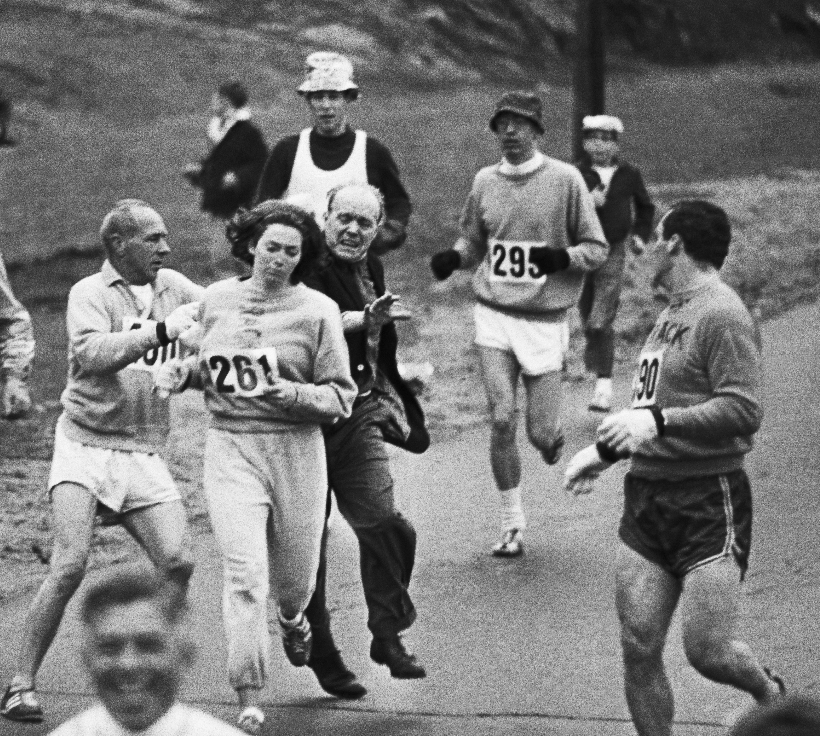


Semple goes for Switzer's number
I told myself at the start to take it easy and hold back. Don't go with the flow on these easy downhill miles. But I can not run the first few miles at Boston with out thinking of Katherine Switzer, the first woman to get an official entry (in 1967) and whom the race director Jock Semple tried to forcibly evict from the course. Look at the photo (click on it for a larger version) — Semple is apoplectic and Katherine is scared for her life. Her boyfriend runs interference and eventually pushed Semple out of the way. Even now 45 years later, when I think of this scene (which made the front page of the NY Times) I never fail to conjure that image shown in the photo.

But I told myself to take it easy, so I put Katherine out of my mind and concentrated on my pace. BUT I'M STILLED PISSED OFF!

Thanks a lot Jock you jerk! Once again you messed up my pace.

Natick — My Family
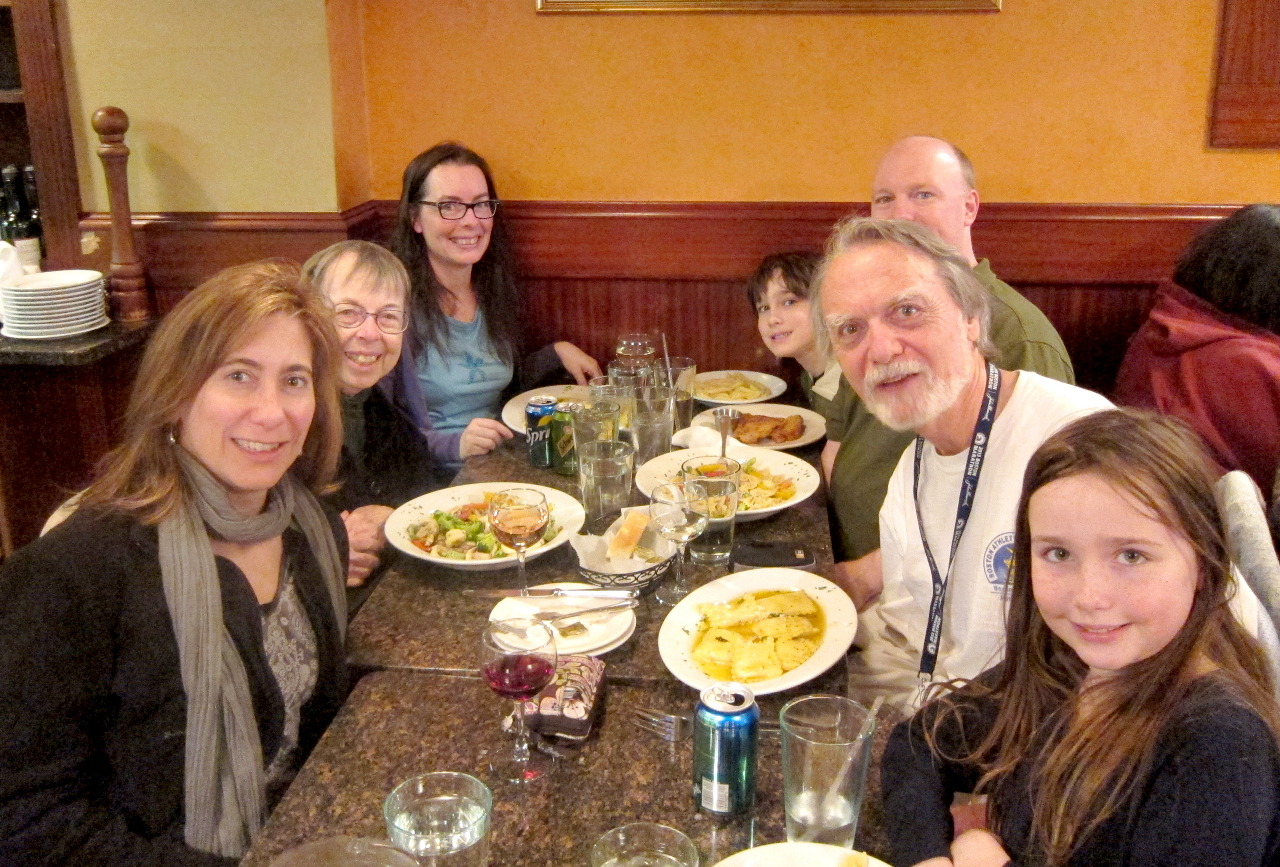


Dinner the night before
My right foot was hurting starting aound mile 7, so I stopped and gave it a little massage. It felt better and I got back into my pace. But at Natick I got an even bigger lift. My entire family was there. My daughter Susan, my son Peter and his wife Nancy, their children and of course my wife Joy. Peter took a video of my meeting and it looks lile a bunch of chaotic hugs and kisses, "Good Luck"s, "See You Later"s, and the rest, It was one of the high points of the race for me. I took off with renewed energy and headed for Natick center and thence on to Wellesley. Since there was no photo taken of them at the spot, I put in the photo taken at the dinner the night before (click on it for a larger version) with the exact same cast of charaters.

Thank you one and all for the support you have always given me!

Wellesley — Bobbi Gibb (1966)


When you get to mile 12 in Wellesley, runners start to glance at one another expectantly. When they get to Wellseley College, they encounter a screaming phalanx of "Wellesley Girls" (and now some Wellesley Boys) lining the course with all manor of signs and suggestions. You have to be there to appreciate this tradition which goes back to he earliest days of Boston.


Bobi Gibbs c. 1966
But in 1966, something very special happened at Wellesley. In the year before Katherine Switzer's "push seen round the world", Roberta "Bobbi" Gibb, who just loved to run long distances and did it well, applied for entrance to Boston but was rejected because she was a woman. She ran anyway as a "bandit" and was ignored by the race officials, but the other runners and the crowds adored her. She made headlines throughout the region, easlily finishing in the 3:20s, ahead of about two-thirds of the field.

At Wellesley College, women crowded the course. They saw one of their own and cheered wildly. Word spread among the crowd that a woman was actually running the Boston Marathon. At every intersection Gibb got more and more encouragement. For this attention she was not prepared. 
(From Tom Derderian's article Bobbi.)

When I get to Wellesley, I always remember Bobbi, who one year when I was just 23, brought the screams of the Wellesley girls to a higher level, and unknown to many of today's Wellesley Girls, opened the door a little bit wider for them.

Thanks Bobbi for just doing your thing.

The Firehouse — The NY Flyers
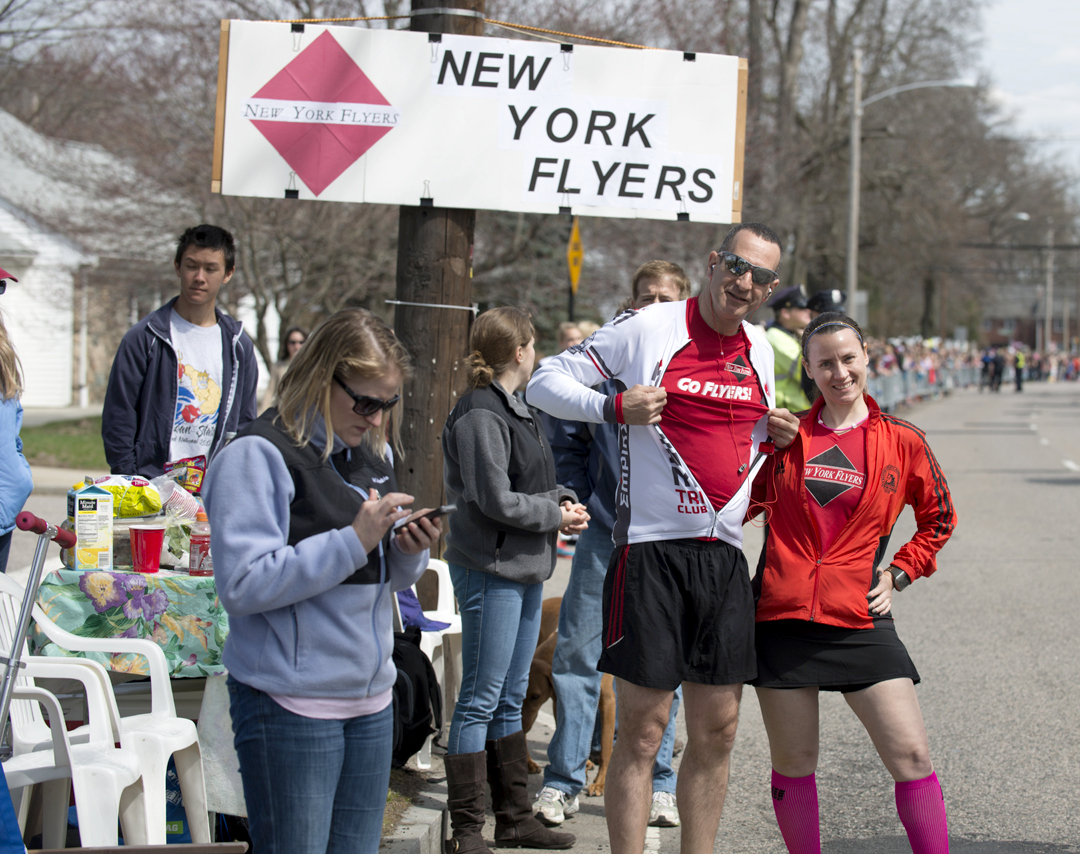

After passing the wall of screams at Wellesley College, you pass through the town of Wellesley, plus a golf course or two and then you cross the upper reaches of the Charles River at Newton Lower Falls and enter the town of Newton. This point is the low point on the course, so it's all up from here. Then you quickly

The Flyers
go over Route 128 aka I-95. I think of this little overpass as the first Newton Hill, although it wasn't there in the day of Johnny Kelley or Tarzan Brown so technically it "doesn't count." But don't tell that to your legs. Although there's a relatively flat portion prior to the real hills where you travel over miles 15 and 16.

Then having just passed the low point, you reach the high point — especially if you're a Flyer. Here you will find on the left side of the course an aid station that has been here since 1996. Principally the "baby" of Ed A. with the generous help of his Newton friends Martha and Jay H. and staffed by Flyers too numerous to name. They will give you everything you need provided it's legal, plus a very large supply of encouragement. Here's me coming in: Arriving at the Aid Station. I stayed there almost two minutes massaging my right foot (again!) and imbibing in some `dihydrogin monoxide as a chaser to some vitamin I. I told Ed I had been stopping every 4 miles or so to give my foot a little massage and we both hoped it would last till after the hills this time. Thanks Ed for doing this for us for so many years.

Heartbreak Hill — Ellison "Tarzan" Brown (1936)

Well, not only did my foot pain abate for the notorious hills, but I charged up and over the same at a strong pace. I decided the hills are all in your head and just a little foot pain is all you need as a distraction. Well, maybe. In any case, they start as you turn onto Commonwealth Avenue at the Newton firehouse and last for about two miles till you reach the last and most famous hill, Heartbreak Hill. Why do that call it Heartbreak Hill you ask? Ah, therein lies a story.
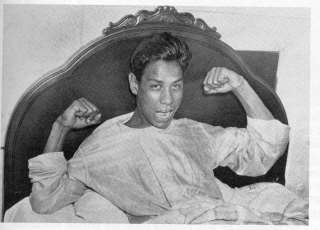

Ellison "Tarzan" Brown
It seems that Johnny Kelley (the elder) won the race in 1935 and was a favorite to win again in 1936. Then out of nowhere came an unknown Naragansett Indian named Ellison "Tarzan" Brown who took off and broke all the check point records up to Newton. Then when he got to the hills he slowed down. Kelley, seeing an opening, surged past Brown and patted him on the back as he went by. Soon after the gentle pat, Brown passed him back and after some give and take, surged and never looked back. Kelley could not respond. Kelley fell apart on Beacon Street and was relegated to walking 6 times. Will Cloney, a reporter for the Boston Herald noted "Kelley was walking like an intoxicated man". Brown won handily and Kelley ended up 5th. Jerry Nason of the Boston Globe coined the name "Heartbreak Hill" for the 3rd Newton Hill where Kelley met his demise, because Tarzan "broke Kelley's heart". And for all the years since 1935, that's what they have called it

Today I had a picture of Brown and Kelley in my head as I ran these hills. But I played the part of Brown, not Kelley — my heart was unbroken, hah! So there. So I'll give ½ credit to Tarzan and ½ credit to Ed's aid station.

The Reservoir — I Meet my Dad (1993)


After the last of the Hills, you pass by Boston College. It offers a distinctly different culture than Wellesley. Instead of the screams of young women you might be offered beer by some guys. It's all good and enjoy it while you recover from the hills. Soon you will take a giant step downhill when you get to the Chestnut Hill Reservoir. Boston College, unsurprisingly is in Boston as is the Reservoir. But when you get to the bottom of the road running along the side of the reservoir and get to Cleveland Circle, you will enter Brookline.
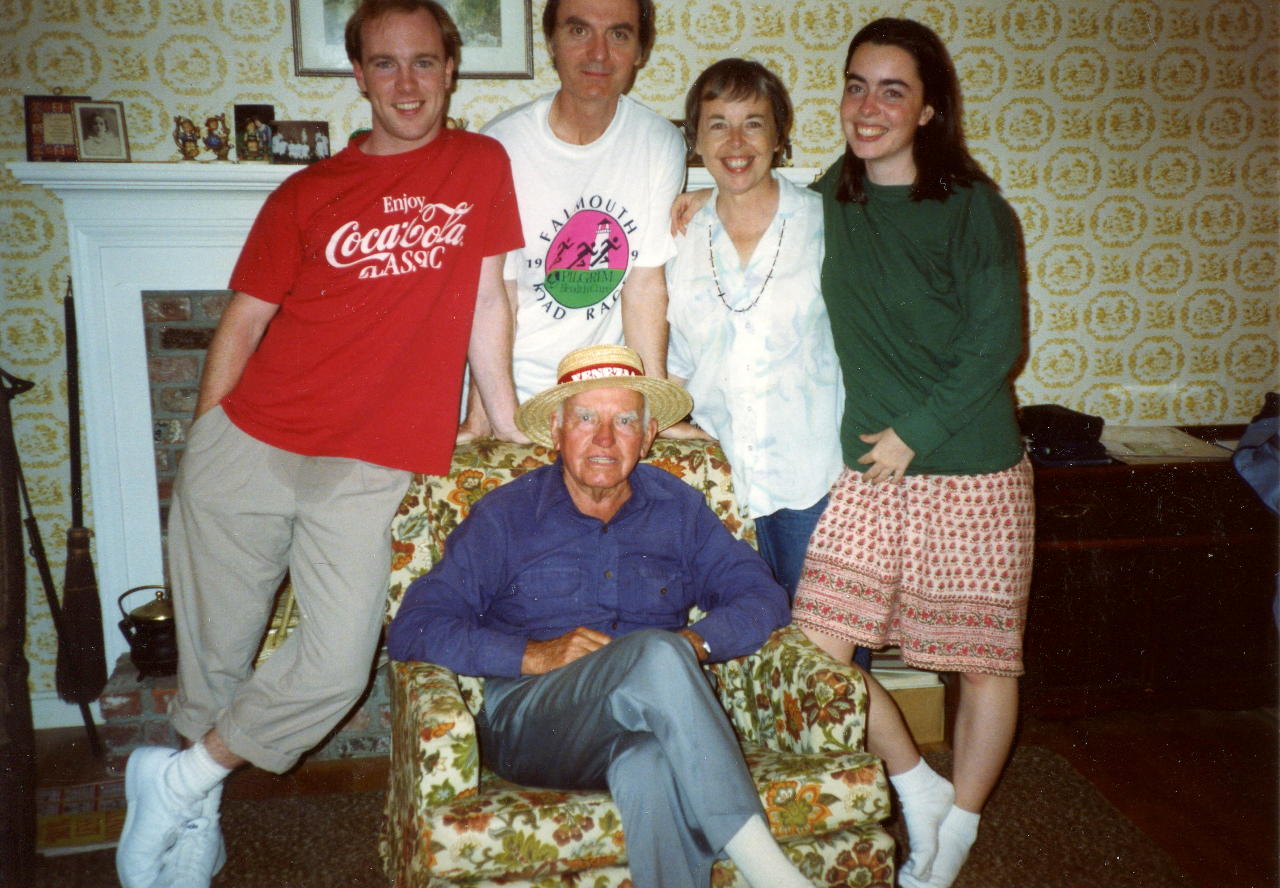
My Family c. 1993
Along that short stretch of downhill known as Chestnut Hill Avenue a wonderful thing happened in 1993. It was my first Boston Marathon and I was supposed to meet my family along that stretch. I spotted my son about halfway down on the right and stopped. "Where's Da?" I asked. "Across the road with Mommy." So I cut across the road – thronged with runners – annoying a few of them with my sudden retrograde course change. I found them and got a big hug from my dad. It was probably the first time he had been to the Boston Marathon since the 1950s when he took us to watch. The proud look in his eyes was all it took for me to finish strong. A circle of some 40 years had been closed.
I thought of "Da" when I ran down this stretch yesterday. He died in 1998 at age 93 and this brief "encounter" with his memory is always uplifting. I don't have any photos of him at the 1993 Boston, but the picture shows my whole family at Da's house on Cape Cod after the '93 Falmouth Road race (click on it for a larger version). It's fun to compare this photo with the one above taken Sunday night at the dinner. What a difference 20 years can make.

Thanks Da for introducing me to the Boston Marathon. And thanks for everything.

Beacon Street — Bill Rogers Ties his Shoes (1975)
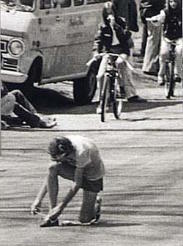

Rogers ties his shoe
When you get to Cleveland Circle at the bottom of the hill, you get onto Beacon Street. Beacon Street takes you all the way to Kenmore Square, just past mile 25. Almost the whole of this stretch is in the city of Brookline, which is almost entirely surrounded by Boston. It's also in Norfolk County although it is completely separate from the rest of that county. I'll bet there were interesting politics going on when Brookline was founded. From the looks of it along Beacon Street, you would never guess Brookline is not part of Boston.
I've always felt kind of lonely on Beacon Street. It's straight with a few rolling "bumps" but I usually have little steam left when I reach this part. You would think a flat section after the hills would be welcome, but I never find it so. I just never can wait to finally see the Citgo sign and know I'm finally getting to Kenmore Square.

Perhas to give myself a lift, I usually think of Bill Rogers who, in 1975, on his way to a course record, and running in a hand lettered T-shirt, stopped to tie his shoe somewhere along this section. Yes, he really did. Look at the photo if you don't believe it. I think I get my lift from the sheer craziness of it.

Thanks Bill, you helped get me through another year of the Beacon Street Doldrums.

The Last Mile — My Cheering Section
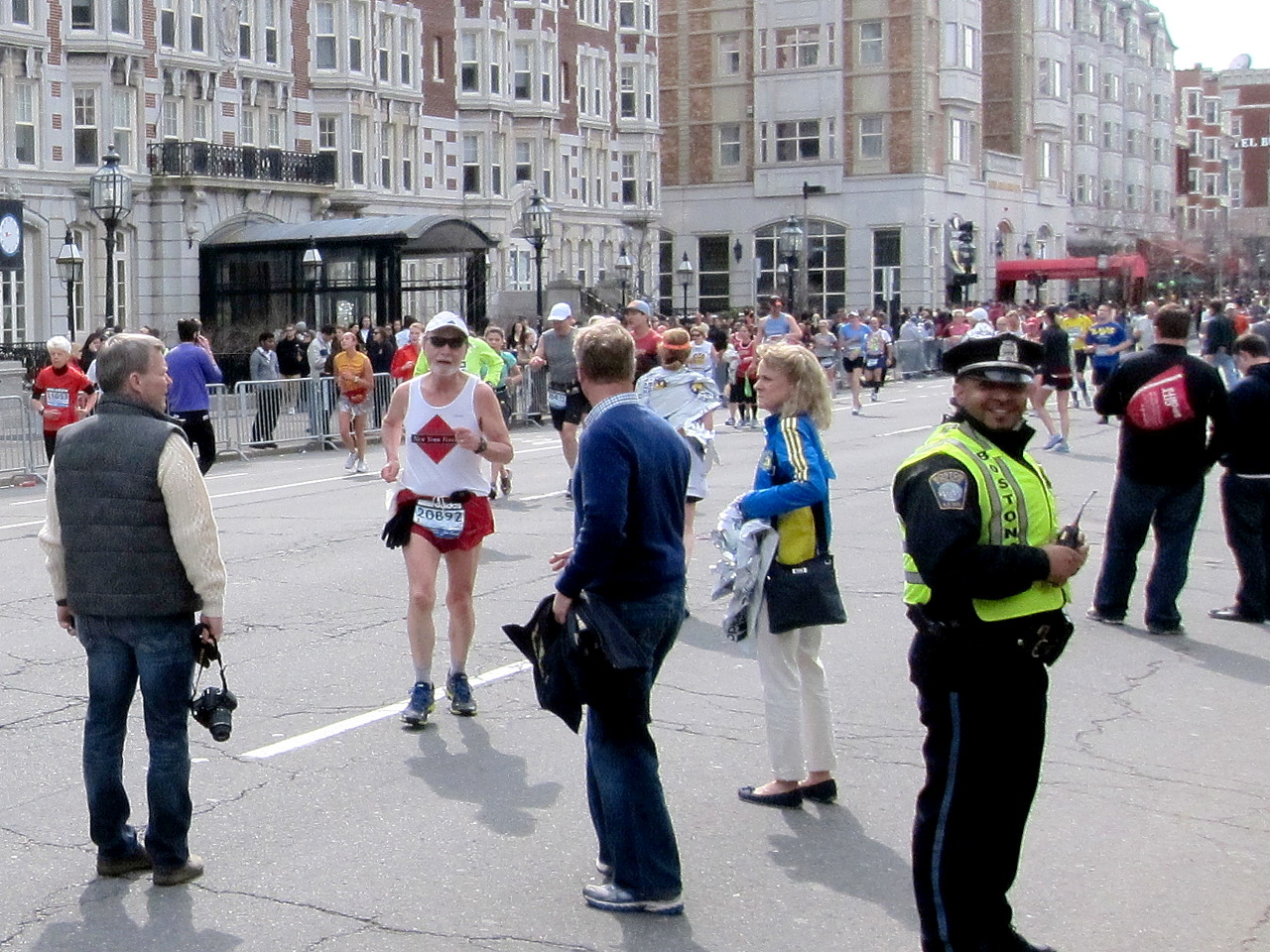


Approaching Charlesgate
My son and daughter had taken the train from Natick to Boston and we had agreed to meet at a spot underneath the Charlesgate overpass, about ¼ mile before where Mass. Avenue crosses the course. This is roughly a half mile from the finish. Later we would realize this was a very lucky plan. As I passed the 25 mile mark just before Kenmore Square, I saw that the race clock showed a time of 5:19:xx. (xx = don't remember). Subtracting 40 minutes for the wave 3 start meant that I had 21 minutes to break 5 hours. Since I was running between a 10 and 11 minute pace, this was reassuring, since at least I would break 5 hours.

Just before the Charlesgate overpass, I spotted my kids and went over. They said how strong I looked (but of course) but also said that they had heard that "something happened" and it might be a problem meeting at the Arlington Street Church we had agreed on after the race. So I said I would just call them on my cell phone and we would arrange another spot to meet.

A few blocks later things came to a halt. There was just a huge mass of runners waiting but not moving. Many were on their phones trying to figure out what was happening. I would guess that it was about 3:20 to 3:25 PM. The police were stopping runners at the Mass. Avenue underpass and said that the finish line was closed and the race had been stopped. At first I thought that they might start ut up again but I soon learned that things were much more serious than I imagined. At this point, perhaps at 3:30, I knew my race was over. Only later did I learn that this was about 45 minutes after the explosions at the finish line. I was probably a little past Mile 23 when it happened.

The Race is Over


I was standing on Commonwealth Avenue near Mass. Avenue. People around me were crying, trying to call friends, trying to find out details. Only now did I learn that some explosions had gone off and that some people may have been killed. After finding out what I could, I realized I had to do something for myself. I had on only shorts and a singlet — AND I had my cell phone — and I was beginning to get cold. I had to go back and find my kids. They had some clothes for me and we needed our own strategy to get through this.

I walked back to Charlesgate and looked around where we had met (about 100 yards west of Charlesgate). Cell phone coverage was non-existent to very spotty, but finally I got a text through to my daughter Susan asking where they were. She texted back but I did not understand her directions. At least we were talking. I texted again and said I would go to where we met and stay put. In the mean time I went to the first aid station near Charlesgate and got a plastic bag to put on. I got another text from Susan saying she was at the spot and Peter was circling. A few minutes later he found me and we were reunited. I would guess it was around 4:00 PM.

Making our Way Home


Meanwhile, back in Natick at Peter's house, everyone was frantic, not knowing our whereabouts or if we were OK. Peter's daughter, age 8 was hysterical. We soon realized we had an advantage in that we knew we were safe and we knew we would get home. They could do nothing but try to call us, and watch TV, which had a constant flow of very disturbing scenes and commentary. Finally, a text from Susan to Nancy (Peter's wife) got through and things settled down a little, but they still wanted to hear Peter's voice. A text was not quite enough for the reassurance they needed.

My kids and I were standing around at our meeting spot. Someone was cooking some stuff on the green in the middle of Commonwealth Avenue and I accepted a leg of chicken and something to drink. Thanks guy.
We heard rumors that the T was shut down and commuter trains were not running (this was a false rumor). So we decided to walk up on Beacon Street to get away from the Back Bay, find a place to eat and drink and call Nancy to come pick us up.

About then Susan realized that in spite of the tragedy, we needed the finish line photo I never had a chance to get. The following photo is my "Finish Line" photo. We look happy because we are safe and we are together. But beneath the smiles we were pretty freaked out. But given the situation, I love this photo, taken by an unknown teen somewhere on Beacon Street. Thanks kid.
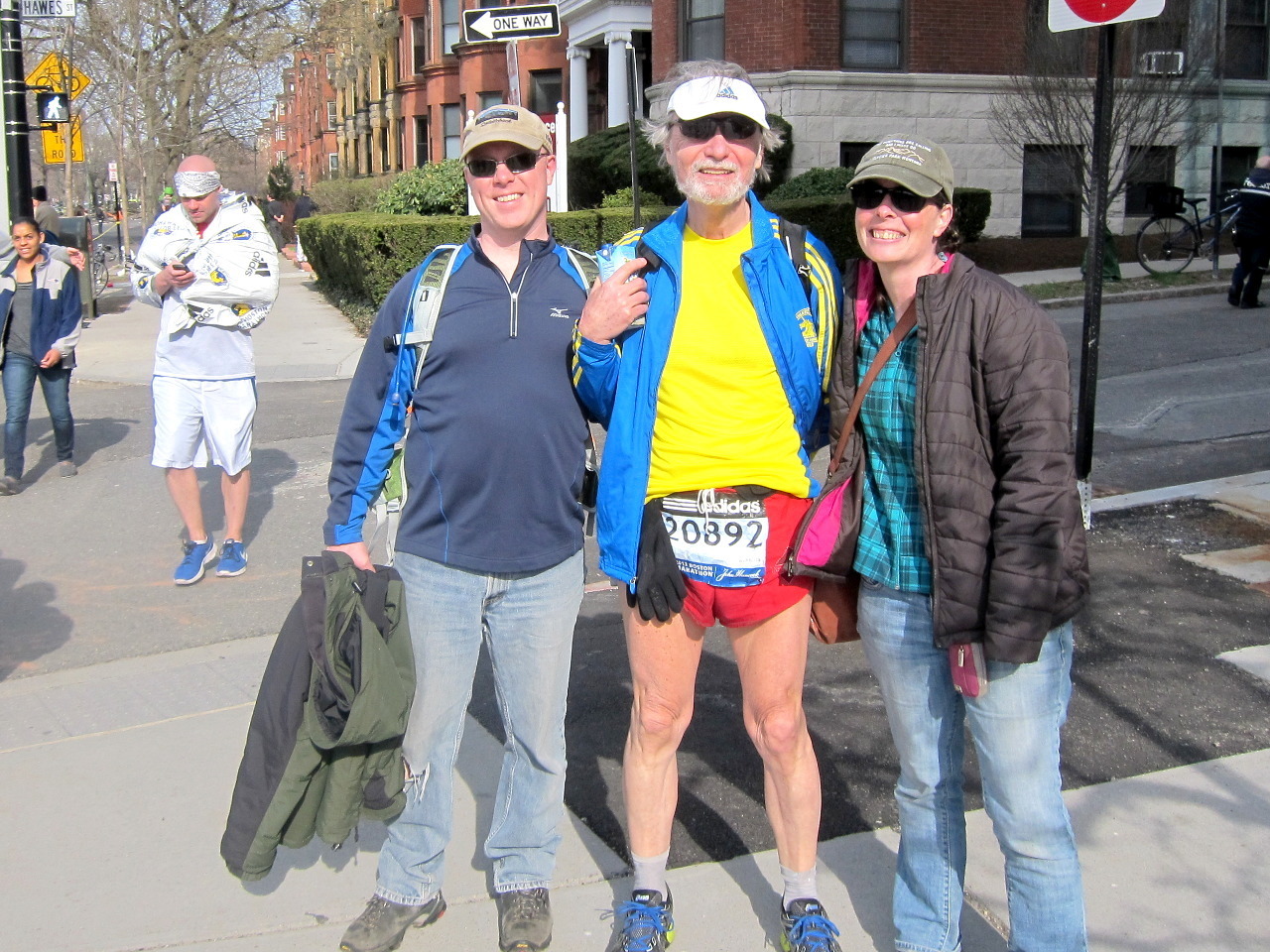
My "Finish Line" Photo, with my best supporters,
my son Peter and my daughter Susan
We decided to walk up to Coolidge Corner (a bit over another mile) since there would be a few good places to eat there and it would give Nancy a place to pick us far enough away from the Back Bay. We first looked into a bar, but it was packed and the TVs were blaring out the gruesome news and it was just too much for us. We then found the perfect spot on Harvard Street a block from Beacon. It was Otto's Pizza and they had really good Pizza and a variety of beers, both of which we all needed. After further conversations with Nancy, it was decided we would walk down Harvard Street to Commonwealth Avenue (about a half mile) and meet there so she could get off and then back on the Mass. Pike.

Meanwhile we couldn't help but talk about what had happened. Contrasting our own lucky situation with that of the wounded and families of the dead was difficult. There were very bad things out of our control, and a few good things we could control. We had, you might say, survivor's guilt. It won't go away, so we each tried to cope with it and we will continue to do so for a long time. Thoughts of 9/11 came to mind — a much larger tragedy but much less personal. My wife just walked in as I was writing this and said she was in a state of shock on Monday and she realizes now that she could have lost her husband and two children just like that. How lucky we are!

At about 5:45 we walked down the hill and met up with Nancy. She got us back to Natick in about 20 minutes and soon we were back with the very grateful members of my family.

Ruminations


I

t's now the second day after the race and my thoughts are still in flux. Being home in New York City reading the New York Times makes the whole thing worse, the more I read. A front page article about the bombs, another article about the victims flooding the ERs. It's very, very hard to take.

Given the tragedy we experienced, plus my own experiences, past and present, what do I think about running future marathons and in particular future Bostons? Will I ever go back? In 2003 I said "This was my last Boston. It's not fun any more. I'm getting too old for this sort of thing!". Well, that was about fatigue and burnout and those things don't bother me now.

After the race, someone emailed and suggested "I know in the scheme of things it's not your focus, yet I'd think not being able to cross the finish line is still disappointing on some level. So I hope you may run it again next year if it's something you want to do." Honestly, to me not crossing the finish line is no issue at all.

I thought a bit about some of my mental scenes from my run. There is an interesting comparison bnetween Katherine Switzer and Bobbi Gibb. Katherine became an outspoken activist for women's sports equality. I'm guessing she ran the race in 1967 because it was right and fair. Bobbi, on the other hand, ran because she just loved to run. Her agenda was personal, not political. I strongly respect both points of view. But thinking through my experiences yesterday, and my personal feelings developed over my 70 years, I think I will lean towards Bobbi:

"I will run Boston again, not because I must, but because I can! I'm old enough to know there's lots of other great things out there besides Boston that I can do, but still young enough to want to do them all!"


- Papa Bear (Richard G.)

Read more...

Wednesday, April 17, 2013

Support For Boston -- We Wear Race Shirts

Kathy K
Rather than using words, Flyer Kathy K took it upon herself to create a pictorial tribute to the Boston Marathon.  

And rather than using more words in this Flyers Blog post, instead I'll provide you the link to view what she's posted on her own blog.

Please click here.

Blogmaster's Note: Flyers please feel free to share your own Boston thoughts and/or experiences within the comments section, below.  Whether you ran Boston, spectated, or otherwise have something you'd like to say.  To comment, if you don't have a gmail account you can just sign in as annonymous and if you want us to know who you are make sure to note your name at the end of your comment.  -Dave K

Read more...

Wednesday, April 10, 2013

The Tobacco Road Marathon and other Rail-to-Trail Marathons

Kathy K
On Saturday, March 17th, I ran the Tobacco Road Marathon -- a beautiful, tranquil rail-to-trail course in the Raleigh-Durham area of North Carolina. 

The race features both a marathon and a half-marathon.  What makes the event special is that more than 20 miles of the marathon are run on the American Tobacco Trail. 


Photo: traillink.com
(Erie Canalway Trail: Little Falls to Albany - Mohawk Hudson Bikeway, New York State)
Rails-to-trails is a nationwide network of recreational multi-purpose public trails and paths created from former railroad corridors. The trails can be unpaved or paved. They are most often flat or follow a gentle grade, they traverse urban, suburban and rural America. They are ideal for many uses, such as bicycling, running, walking, cross-country skiing and equestrian use.  The Rails-to-Trails Conservancy reports that there are 20,000-plus miles of rail-trail throughout the country, and more than 9,000 miles of potential rail-trails waiting to be built.

I have now run the Tobacco Road Marathon twice.  Raleigh-Durham is an easy city to get to from New York.  There are frequent non-stop flights, and the price is usually reasonable.  The weather is comfortable, and it is  easy to get around.  The host hotel, Embassy Suites, Raleigh-Durham Research Triangle, is a very nice hotel with an airport shuttle.  The expo, held at the Embassy Suites, is good for a small race.

The race organizers and volunteers do a good job at setting up the races, and of providing support (water, Gatorade, GU, medical and enthusiastic cheers) along the course.  I like running on the flat, packed unpaved course. To me, the scenery is lovely.  I don't find it repetitive or boring.  I think its cool to follow historical paths. Most days of the week, I'll gladly trade the hoopla of the big city marathons for the serenity of a peaceful trail marathon.


WOW!!!
I've run two other marathons that took place largely on Rails-to-trails: The Mohawk Hudson River Marathon, in upstate New York, and the Deadwood Mickelson Marathon in South Dakota.  Both were beautiful and memorable.  I think that I would like to run some more rail-to-trail marathons.  Below are some links for websites for Marathons that are run on rails-to-trails.  It is only a beginner list - feel free to comment below with more links. 

Please click HERE if you'd like to read my full report posted on my blog.

-Kathy K.

Blogmaster's Note: Kathy, as a travel and running blogger, is competing in a KLM contest so please check out her entry and "like" it if you like it so that she may win -- you can click here for the link to her contest entry. -Dave K

Read more...

Thursday, April 4, 2013

Vive la Revolution


Scott C
Many of us in the running and multi sport community have long utilized indoor cycling, which for this piece we will refer to as spinning.

We spin for a variety of reasons ranging from the obvious––that it’s a fun intense activity–– to the perhaps not so obvious as it can:
  • Torch 500-700 calories an hour
  • Compete with a speed work session in terms of maximum heart rate, sweat factor and a great group dynamic, and
  • As a non-impact, or more accurately a non-weight bearing activity, be done by many on a daily basis year round.

I want to go deeper here, I want to try and bring the uninitiated into the world of spinning both from a class participant's perspective and from the perspective of a teacher, a class leader whose bike sits on a platform and who can address, motivate or sometimes even alienate a room full of 20-40 eager cyclists ready to rip up their bodies, drench their clothes, and exit that spin room feeling totally spent.  

As a running and multi-sport coach, I integrate specificity into each athletes scheduling model.  Specificity often takes on various components such as implementing a pattern of intervals segments that differ based on distance goals. The training approach will include a progression in tempo and hill repeats using pacing ranges that allow an athlete to explore a greater depth or be more “in touch” with their leg turnover and pacing range.  Focus also is placed on developing and enhancing their conditioning to enable each athlete to achieve a better overall understanding of their mechanics.

As a “middle aged” athlete who some may have accused of being reckless with my body in the past as an arrogant Type A overachiever, I have had to learn that as my body ages I need to work smarter. I now need to be open minded and patient.  I need to work in greater specifics on how I utilize my volume and where I want to maximize my energy in selected work outs. And, I need to try and look at the bigger picture.

I’ve discussed the above context with my athletes, and considered it for myself, as it can and does relate to the activity known as spinning.

Spinning History

To offer a brief history, spinning was created by a man known as Johnny G more than two decades ago, and the first indoor “spin” class premiered in Venice, California in 1992. Johnny created the weighted “flywheel” you see on all spin bikes as well as the ability to allow a cyclist to add or to minimize their resistance levels. Both the flywheel and the ability to progress, adapt to resistance levels using cadence or RPM variations, which I will offer more explanation on, give each rider the feel of being on bicycle and simulating that sensation within a class dynamic.

Add a strong motivating instructor and some great loud music and you just might be hooked on this awesome work out!

How Can Spinning Help a Runner?

Spinning can help runners gain greater range of motion, enhanced functional strength, improved heart rate, and the ability to add at least one cross-training activity to increase not just training volume and variations but also our athletic “shelf lives.”  In addition, spinning can help develop perhaps the most integral and important aspect that any runner needs to take that next step in achieving more PR’s…..confidence!

From a class participant's perspective and from an individual who teaches a 45-60 minute spin class, spinning should offer diversity, and that diversity needs to begin with and include a 7-10 minute warm up period where your objective is to relax your shoulders, put some flexion through your elbows and begin developing a fairly high cadence by working with a resistance level that should simulate riding a bicycle outside on a flat smooth road. Moving past the warm-up and looking to increase our work load we will put ourselves through segmental training that will involve high RPM intervals, tempo riding and hills, hills, hills! 

Cadence and RPM

The terms cadence and RPM (revolutions per minute) are interchangeable to both an indoor spinning participant and to an outdoor cyclist. Both relate to the number of times our legs are turning the crank on either a spin bike or a road, mountain, hybrid or triathlon bike.

To the recreational cyclist cadence might be 70 RPM on a flat road. To a more aggressive cyclist or “freaks of spin” it might mean 90-110 RPM, again on a flat road within a very manageable resistance spin range or rear gear range on an outdoor bicycle. Conversely when utilizing hills, either outdoors or on a spin bike, our cadence range will decrease in reflecting the difficulty or rate of perceived exertion.  When spinning indoors, we use resistance to simulate a challenging gradient, or outside riders can find challenging gradients on paths such as Central Park's winding Northern Hill.

While there are certain spin bikes that can measure our cadence anyone can do this by counting within a 15 second range the number of times your left or right knee or foot turns over, multiplying it by four to calculate the RPM whether on a flat road (high cadence) or on a fairly challenging hill (lower cadence).

The relevance and subsequent benefit to both the cyclist and the runner behind our change up in cadence directly relates to developing and utilizing our range of motion and leg turn over thus increasing our leg strength, utilizing changes in heart rate for interval, tempo and hill segments.    

Structure and Stimuli

The relevance and benefit to not just an older athlete but any athlete steeped in one dimensional training is that it allows your body to develop, progress and adapt to different stimuli and overload while gaining not just physically but psychologically as well in getting enjoyment from a new found activity and quenching the urge to explore your own limits from within.  The physical “push me hard” and the psychological “I feel drained” are two components that spinners seek and leave them wanting to keep coming back for more.


However, the two components have limited success unless the spin instructor leading his or her charges can provide the spinners with a structure, a menu based on working past the warm up and getting everyone to be on the same page and to take them into the next stage.  The structure might include, for example, working through higher RPMs, using limited time-based interval drills, or maybe a blend of both endurance and functional strength using an extended hill set that features both vertical and seated climbing over a length of time––all based on changing gradients and resistance levels or categories.

A Spinner's Perspective

No matter what type of structure an instructor might bring, for many spinners often what's as or more important to the spinner might be how that instructor “bonds” with the class, how personal he or she is, how well he or she takes command of the room, what type of music is played.  Sometimes it’s just a matter of  an instructors style, your personal taste or more precisely what works for me just may not work for you.

I genuinely love spinning and the rewards I get from it and because of this I’ve been an instructor for 10 years now, I’ve taught at Crunch Fitness, Reebok/Sports Club LA, the 92nd Street Y, and some other smaller private clubs.  During this time I’ve learned a lot about people, about venues I’ve worked at and while some might seem peculiar some have also been valuable (but I think that might be left to perhaps a follow up piece I can call…..Confessions of a Spin Instructor!).

Some Qualities of a Good Spin Instructor

I will say though that one of the more important things any instructor needs to do is ask and  identify anyone in the class who is either new to spinning or isn’t seated correctly on their spin bike. I make sure to do both as I think it’s important that someone new to spinning understand the intensity behind it and use those first few classes to ride properly and more conservatively and within an easy resistance range vs. too aggressively so that they aren’t turned off by the experience.  This helps a new spinner to give spinning the chance it deserves, and if they aren't fit on their bikes correctly they do not allow their knees to have a fair range of motion, and they may also risk injury.

A good instructor will explain both proper form and why and how he or she wants you to work through a ten minute blended interval segment. A good instructor will encourage, never disparage and never put someone on the spot or isolate them for doing something wrong. A good instructor will be firm but fun. A good instructor will never go to anybody’s bike and turn up their resistance but will rather explain that their cadence is too fast and resistance is required to make the most out of their time.

Finally a good instructor will understand that everyone is different and while one person might be there to leave a puddle of salty water under their bike, someone else may be there for a different reason that the instructor may or may not agree with or relate with, but should respect, too.

Spinning is hot and I know some people who ride and take as many as 10 classes per week shuttling between Equinox, Flywheel or Soul Cycle where some instructors are rock stars, have intense followings and are sometimes more important to the spinner than their therapist, hairdresser, or maybe even their boyfriend or girlfriend!

Spinning certainly has been a welcome cross training activity for me as it’s allowed me to develop my leg turnover, increase my strength, work hard during a triathlon off-season to prep for a new season, and to burn calories dressed in a triathlon kit sweating profusely indoors while it’s freezing outdoors.  And it's great to get paid to be the instructor to make my spinners work hard while I get my work out in as well.

Scott C Leading His Spinning Class
If you’ve been curious then try it!  And if you're interested in trying out a spinning class at the 92nd Street Y, please don't hesitate to contact me and I’ll arrange to give you a guest pass so you can try one of the classes I either teach regularly or for when I sub for others when they need the help.

Spinning Play List

This is the play list and structure for one of my recent classes

The warm up

Beautiful Day/ U2
Speed of Sound/ Coldplay

First blended hill interval segments

Sweet Nothing/ Florence Welch
Ooh La La/ Goldfrapp
White Flag/ Dido (Rich Radio Remix)

Hill Work combined vertical/seated climbing based on categories

Sprawl Arcade/ Fire
Anything Can Happen/ Ellie Goulding
Brain Damage/Eclipse/ Pink Floyd
A Loop in Time/ Wally Brill
        .      
Final interval work

On the run/ Pink Floyd
Anthem/ Moby

Cool down
Novio/Moby

-Scott C 

Blogmaster's Note: I happen to love spinning and have taken lots of classes at lots of places.  Recently I took Scott's spinning class at the 92nd Street Y and it was great!  I especially liked doing "hill #4" when he had us visualize riding six repeats of the northern hills of Central Park (hill #4 was conquered while Scott had us working hard to the beat of Pink Floyd's Comfortably Numb) -Dave K.

Read more...

  © Blogger templates The Professional Template by Ourblogtemplates.com 2008

Back to TOP