
THE 2013 BOSTON MARATHON

To the reader — I wrote this almost entirely on the day after the race when I got home. Before leaving Boston I had in mind several versions of my marathon day report depending on how things worked out. Well, as everyone
knows, things worked out in a tragedy that was beyond anyone's wildest
imagination.
Informed by this reality, my race report became a very
personal narrative of my inner thoughts. Like many runners, I had no
inkling of what happened till I reached the Mass. Avenue underpass around mile 25½,
so I can add little about the finish line tragedy. But hopefully writing this
will give me some catharsis and hopefully you can find some truth and hope for
yourself. Thank you for reading this, one of the hardest things I've had to
write.
Training
| I |
wanted this marathon to be a good performance, perhaps like my qualifying race. But I was smart enough to know this was not a race for risk taking. The ultimate goal was to cross the finish line on my own two feet. All else was negotiable. With this in mind I undertook a conservative but very thorough training plan. Here's what my long run schedule from my training blog looked like: Long Run Schedule. You'll note it's fairly heavy on long runs but I gave myself plenty of time (20 weeks). The week-day runs would evolve to include tempo runs and hill repeats, and I would add in some cross training, primarily Deep Water Running.
Well, I never got to that point. At week 11, we had the one snow storm of the season and I must have strained my right hamstring. The following week I had to limp through the Cherry Tree 10 Miler. At that point I put myself on the disabled list and started serious rehab. I was happy that this was two months before the marathon, not two weeks. By weeks 18 or 19 I was doing reasonable runs again — although the so-called long run schedule was long since abandoned. Feel free to read through the whole blog (here) to get the big picture.
I ran the Cherry Blossom 10 Mile Run in Washington DC on April 7th and it went rather well. By relaxing and taking it easy, I had a pain-free steady run at a reasonable pace. I would hope to do as well in Boston. My plan when I get to Hopkinton is to take it easy and have some fun. I got myself here, and that was a huge accomplishment. Now it's time for a "Victory Lap" so-to-speak. I'm writing this on Thursday. In 4 days I'll just go with the flow and hope for the best. Wish me luck!
The Pre-Race Dinner
| I |
spent Sunday evening with a group of Flyers and members of my family at Al Dente in the North End having a scrumptious meal. It started out with some stress while we waited for our table in the chill, and even when we got seated it seemed crowded and noisy. But we (or maybe the venue) soon got mellow and we were in for a great dining experience. Yes, of course I had some wine (actually 2 glasses). This is about relaxing and having fun, remember? I took the orange "T" line back to where I was staying the night at the Hostelling International Boston hostel on Stewart Street, just two blocks from the Boston Common. I got to bed early after hanging out in the common room for a while to relax and gather my thoughts.
 |
| Dinner at Al Dente |
As we run any race, or even a long run, there is always an inner dialog with yourself. Yesterday was no different. Particular spots along the Boston course evoked thoughts, sometimes about historic Boston events, sometimes about my own recollections. Some thoughts were about good, inspirational things and some were not so good. But these thoughts helped keep me going.
The First Few Miles — Katherine Switzer (1967)
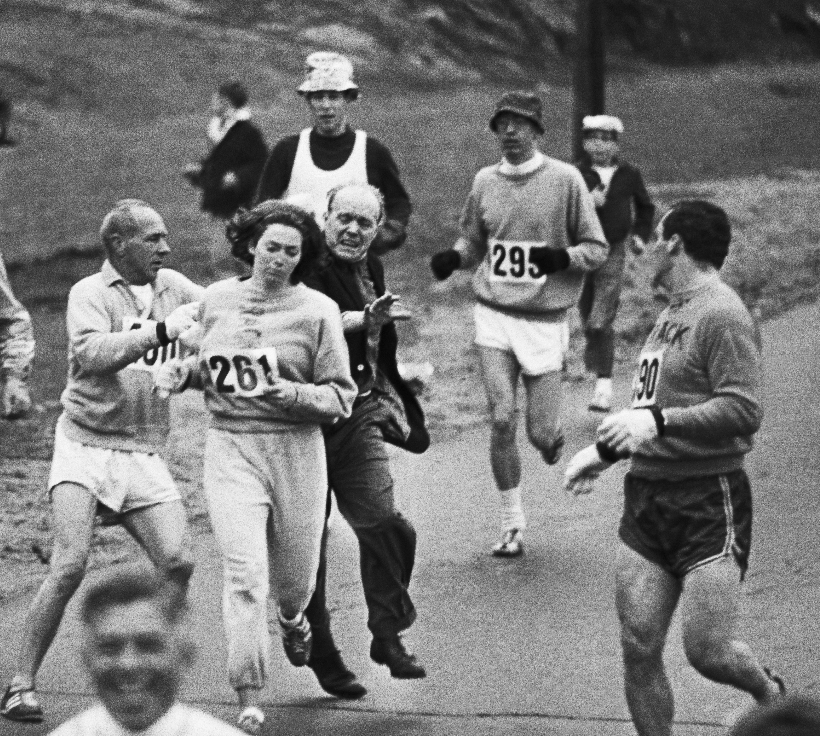
Semple goes for Switzer's number
|
Thanks a lot Jock you jerk! Once again you messed up my pace.
Natick — My Family
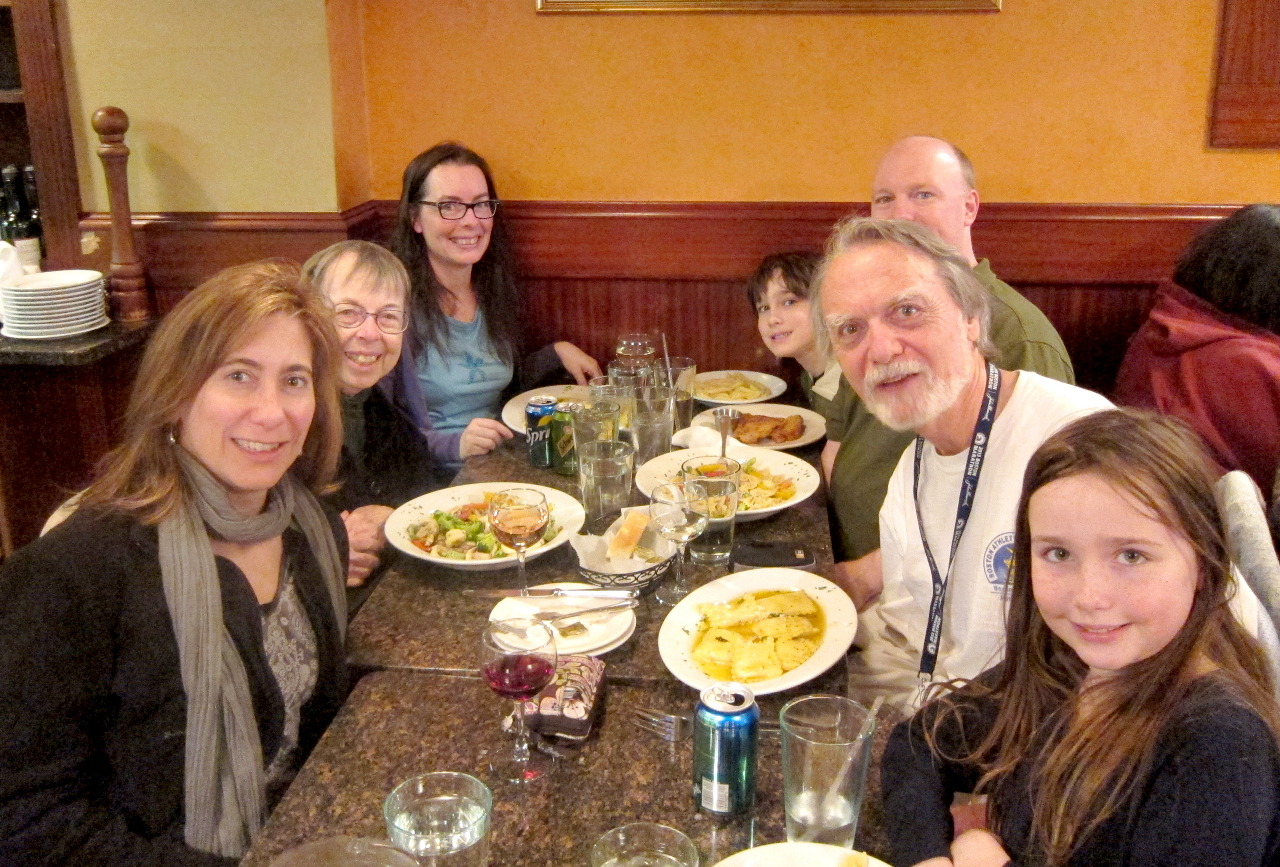
Dinner the night before
|
Thank you one and all for the support you have always given me!
Wellesley — Bobbi Gibb (1966)

Bobi Gibbs c. 1966
|
At Wellesley College, women crowded the course. They saw one of their own and cheered wildly. Word spread among the crowd that a woman was actually running the Boston Marathon. At every intersection Gibb got more and more encouragement. For this attention she was not prepared.
(From Tom Derderian's article Bobbi.)
(From Tom Derderian's article Bobbi.)
Thanks Bobbi for just doing your thing.
The Firehouse — The NY Flyers
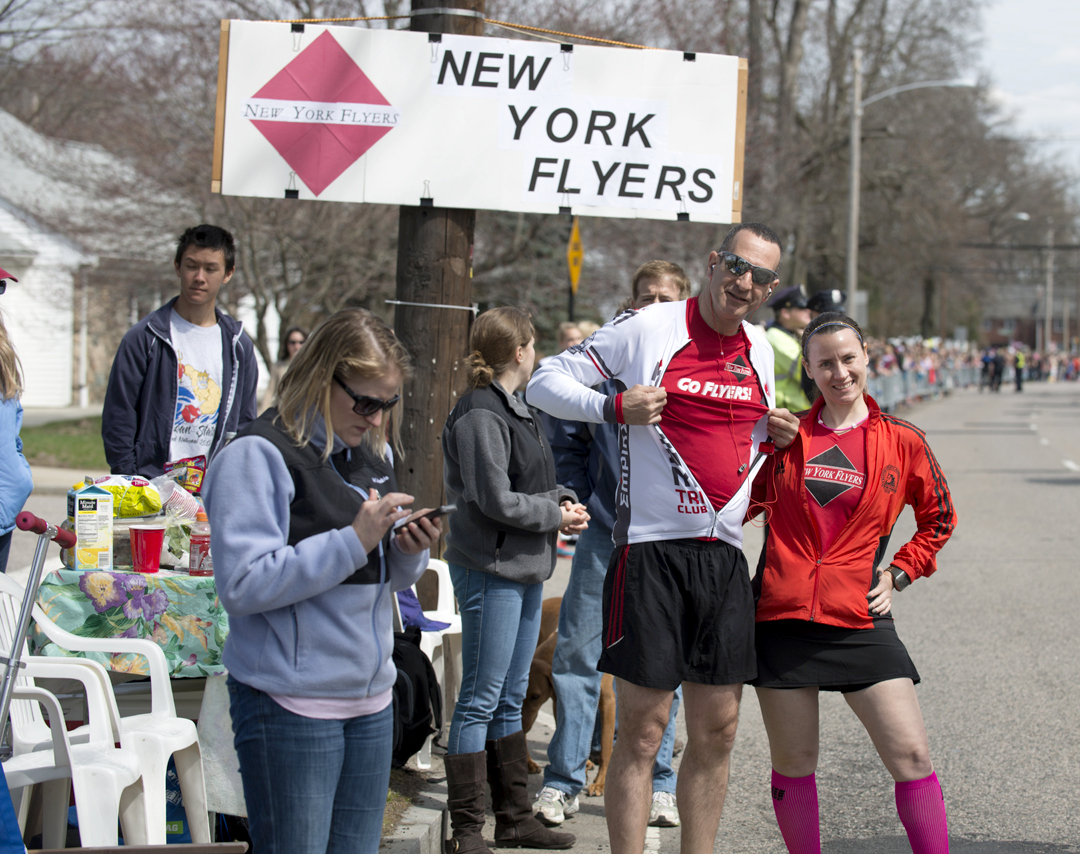
The Flyers
|
Then having just passed the low point, you reach the high point — especially if you're a Flyer. Here you will find on the left side of the course an aid station that has been here since 1996. Principally the "baby" of Ed A. with the generous help of his Newton friends Martha and Jay H. and staffed by Flyers too numerous to name. They will give you everything you need provided it's legal, plus a very large supply of encouragement. Here's me coming in: Arriving at the Aid Station. I stayed there almost two minutes massaging my right foot (again!) and imbibing in some `dihydrogin monoxide as a chaser to some vitamin I. I told Ed I had been stopping every 4 miles or so to give my foot a little massage and we both hoped it would last till after the hills this time. Thanks Ed for doing this for us for so many years.
Heartbreak Hill — Ellison "Tarzan" Brown (1936)
Well, not only did my foot pain abate for the notorious hills, but I charged up and over the same at a strong pace. I decided the hills are all in your head and just a little foot pain is all you need as a distraction. Well, maybe. In any case, they start as you turn onto Commonwealth Avenue at the Newton firehouse and last for about two miles till you reach the last and most famous hill, Heartbreak Hill. Why do that call it Heartbreak Hill you ask? Ah, therein lies a story.
Ellison "Tarzan" Brown
|
Today I had a picture of Brown and Kelley in my head as I ran these hills. But I played the part of Brown, not Kelley — my heart was unbroken, hah! So there. So I'll give ½ credit to Tarzan and ½ credit to Ed's aid station.
The Reservoir — I Meet my Dad (1993)
After the last of the Hills, you pass by Boston College. It offers a distinctly different culture than Wellesley. Instead of the screams of young women you might be offered beer by some guys. It's all good and enjoy it while you recover from the hills. Soon you will take a giant step downhill when you get to the Chestnut Hill Reservoir. Boston College, unsurprisingly is in Boston as is the Reservoir. But when you get to the bottom of the road running along the side of the reservoir and get to Cleveland Circle, you will enter Brookline.
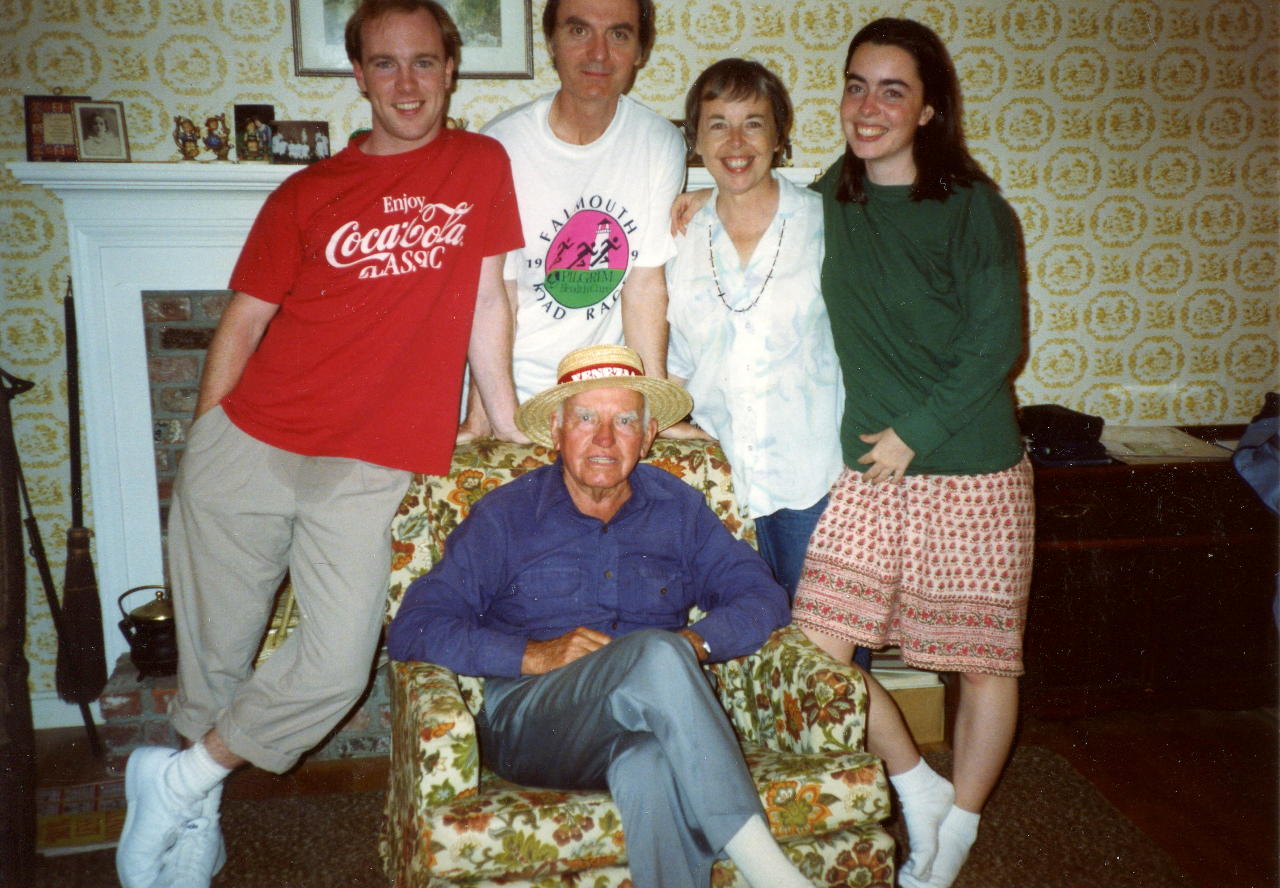
My Family c. 1993
|
I thought of "Da" when I ran down this stretch yesterday. He died in 1998 at age 93 and this brief "encounter" with his memory is always uplifting. I don't have any photos of him at the 1993 Boston, but the picture shows my whole family at Da's house on Cape Cod after the '93 Falmouth Road race (click on it for a larger version). It's fun to compare this photo with the one above taken Sunday night at the dinner. What a difference 20 years can make.
Thanks Da for introducing me to the Boston Marathon. And thanks for everything.
Beacon Street — Bill Rogers Ties his Shoes (1975)
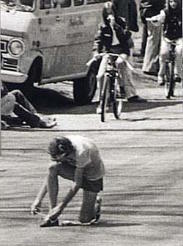
Rogers ties his shoe
|
I've always felt kind of lonely on Beacon Street. It's straight with a few rolling "bumps" but I usually have little steam left when I reach this part. You would think a flat section after the hills would be welcome, but I never find it so. I just never can wait to finally see the Citgo sign and know I'm finally getting to Kenmore Square.
Perhas to give myself a lift, I usually think of Bill Rogers who, in 1975, on his way to a course record, and running in a hand lettered T-shirt, stopped to tie his shoe somewhere along this section. Yes, he really did. Look at the photo if you don't believe it. I think I get my lift from the sheer craziness of it.
Thanks Bill, you helped get me through another year of the Beacon Street Doldrums.
The Last Mile — My Cheering Section
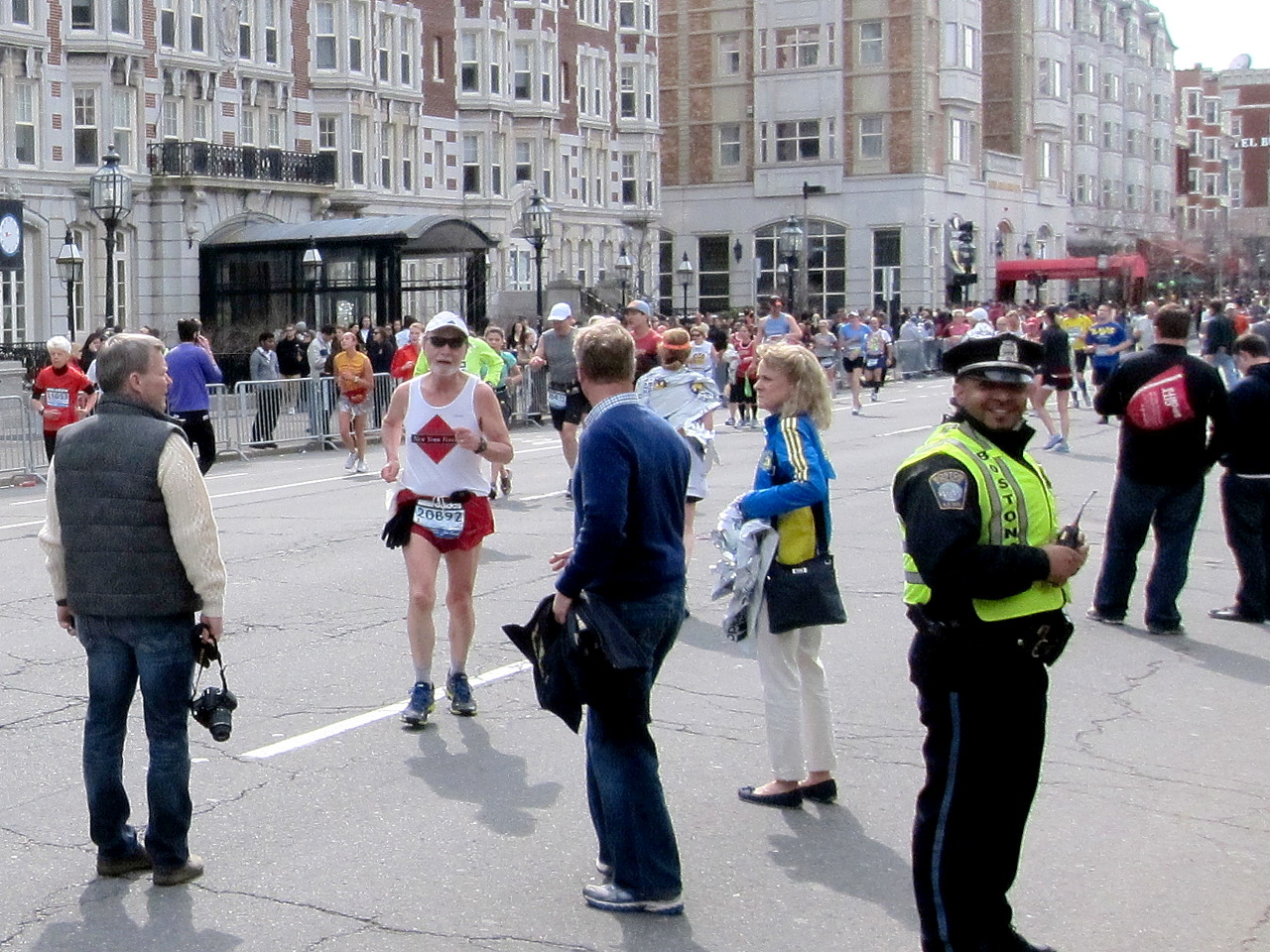
Approaching Charlesgate
|
Just before the Charlesgate overpass, I spotted my kids and went over. They said how strong I looked (but of course) but also said that they had heard that "something happened" and it might be a problem meeting at the Arlington Street Church we had agreed on after the race. So I said I would just call them on my cell phone and we would arrange another spot to meet.
A few blocks later things came to a halt. There was just a huge mass of runners waiting but not moving. Many were on their phones trying to figure out what was happening. I would guess that it was about 3:20 to 3:25 PM. The police were stopping runners at the Mass. Avenue underpass and said that the finish line was closed and the race had been stopped. At first I thought that they might start ut up again but I soon learned that things were much more serious than I imagined. At this point, perhaps at 3:30, I knew my race was over. Only later did I learn that this was about 45 minutes after the explosions at the finish line. I was probably a little past Mile 23 when it happened.
The Race is Over
I was standing on Commonwealth Avenue near Mass. Avenue. People around me were crying, trying to call friends, trying to find out details. Only now did I learn that some explosions had gone off and that some people may have been killed. After finding out what I could, I realized I had to do something for myself. I had on only shorts and a singlet — AND I had my cell phone — and I was beginning to get cold. I had to go back and find my kids. They had some clothes for me and we needed our own strategy to get through this.
I walked back to Charlesgate and looked around where we had met (about 100 yards west of Charlesgate). Cell phone coverage was non-existent to very spotty, but finally I got a text through to my daughter Susan asking where they were. She texted back but I did not understand her directions. At least we were talking. I texted again and said I would go to where we met and stay put. In the mean time I went to the first aid station near Charlesgate and got a plastic bag to put on. I got another text from Susan saying she was at the spot and Peter was circling. A few minutes later he found me and we were reunited. I would guess it was around 4:00 PM.
Making our Way Home
My kids and I were standing around at our meeting spot. Someone was cooking some stuff on the green in the middle of Commonwealth Avenue and I accepted a leg of chicken and something to drink. Thanks guy.
We heard rumors that the T was shut down and commuter trains were not running (this was a false rumor). So we decided to walk up on Beacon Street to get away from the Back Bay, find a place to eat and drink and call Nancy to come pick us up.
About then Susan realized that in spite of the tragedy, we needed the finish line photo I never had a chance to get. The following photo is my "Finish Line" photo. We look happy because we are safe and we are together. But beneath the smiles we were pretty freaked out. But given the situation, I love this photo, taken by an unknown teen somewhere on Beacon Street. Thanks kid.
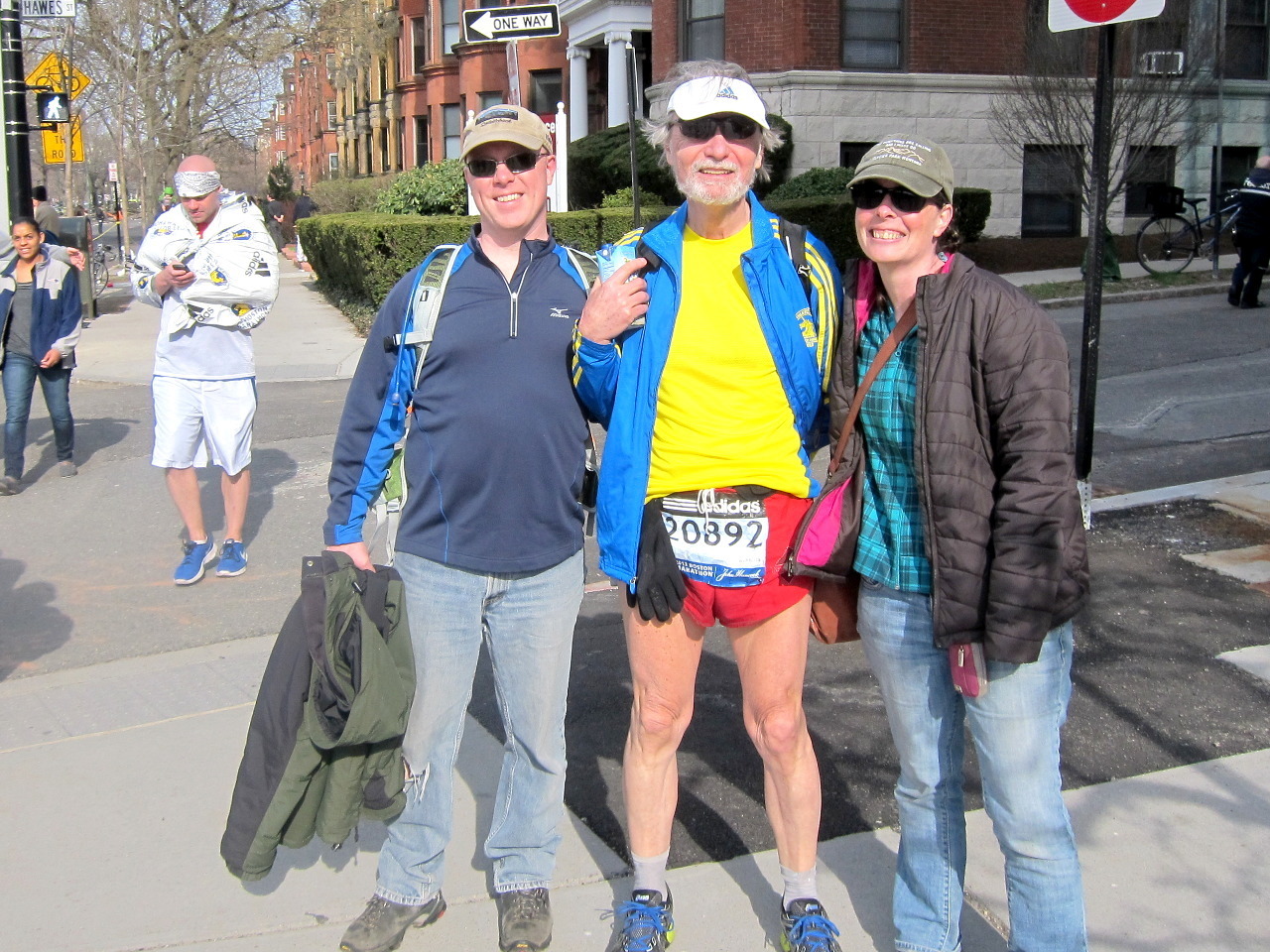
My "Finish Line" Photo, with my best supporters,
my son Peter and my daughter Susan |
Meanwhile we couldn't help but talk about what had happened. Contrasting our own lucky situation with that of the wounded and families of the dead was difficult. There were very bad things out of our control, and a few good things we could control. We had, you might say, survivor's guilt. It won't go away, so we each tried to cope with it and we will continue to do so for a long time. Thoughts of 9/11 came to mind — a much larger tragedy but much less personal. My wife just walked in as I was writing this and said she was in a state of shock on Monday and she realizes now that she could have lost her husband and two children just like that. How lucky we are!
At about 5:45 we walked down the hill and met up with Nancy. She got us back to Natick in about 20 minutes and soon we were back with the very grateful members of my family.
Ruminations
| I |
t's now the second day after the race and my thoughts are still in flux. Being home in New York City reading the New York Times makes the whole thing worse, the more I read. A front page article about the bombs, another article about the victims flooding the ERs. It's very, very hard to take.
Given the tragedy we experienced, plus my own experiences, past and present, what do I think about running future marathons and in particular future Bostons? Will I ever go back? In 2003 I said "This was my last Boston. It's not fun any more. I'm getting too old for this sort of thing!". Well, that was about fatigue and burnout and those things don't bother me now.
After the race, someone emailed and suggested "I know in the scheme of things it's not your focus, yet I'd think not being able to cross the finish line is still disappointing on some level. So I hope you may run it again next year if it's something you want to do." Honestly, to me not crossing the finish line is no issue at all.
I thought a bit about some of my mental scenes from my run. There is an interesting comparison bnetween Katherine Switzer and Bobbi Gibb. Katherine became an outspoken activist for women's sports equality. I'm guessing she ran the race in 1967 because it was right and fair. Bobbi, on the other hand, ran because she just loved to run. Her agenda was personal, not political. I strongly respect both points of view. But thinking through my experiences yesterday, and my personal feelings developed over my 70 years, I think I will lean towards Bobbi:
"I will run Boston again, not because I must, but because I can! I'm old enough to know there's lots of other great things out there besides Boston that I can do, but still young enough to want to do them all!"

- Papa Bear (Richard G.)


1 comments:
Congratulations Richard! You are a winner of Boston as all the others who got to the starting line and experienced the ups and downs along the way. Its the run and not the finish line that matters. Enjoy your victory! Lene
Post a Comment